The Beginner’s Guide to Cellular IoT: Choosing the Right Connection
1. Introduction: The “Three Bears” of Connectivity
In the architecture of the Internet of Things (IoT), there is no “one size fits all” radio interface. For a Senior IoT Architect, selecting a wireless standard is a rigorous optimization problem involving three primary constraints: Range (Link Budget), Throughput (Spectral Efficiency), and Battery Life (Power Consumption).
Just like the “Three Bears,” some standards offer massive bandwidth that exhausts small batteries, while others offer extreme range at the cost of data speed. Finding the connection that is “just right” requires an understanding of the three pillars of modern cellular IoT: NB-IoT, LTE-M, and the newly emerged 5G RedCap.
As we transition from legacy 2G/3G systems toward a 5G Standalone (5G SA) future, these standards represent the tools we use to navigate the physical limitations of radio frequency (RF) propagation and the requirements of decentralized, “sovereign” infrastructure.
Link to the Technical White Paper https://dereticular.com/technical-white-paper-securing-the-kinetic-edge-a-sovereign-stack-evaluation-of-nb-iot-lte-m-and-5g-redcap/
——————————————————————————–
2. NB-IoT: The “Deep Diver” for Hard-to-Reach Places
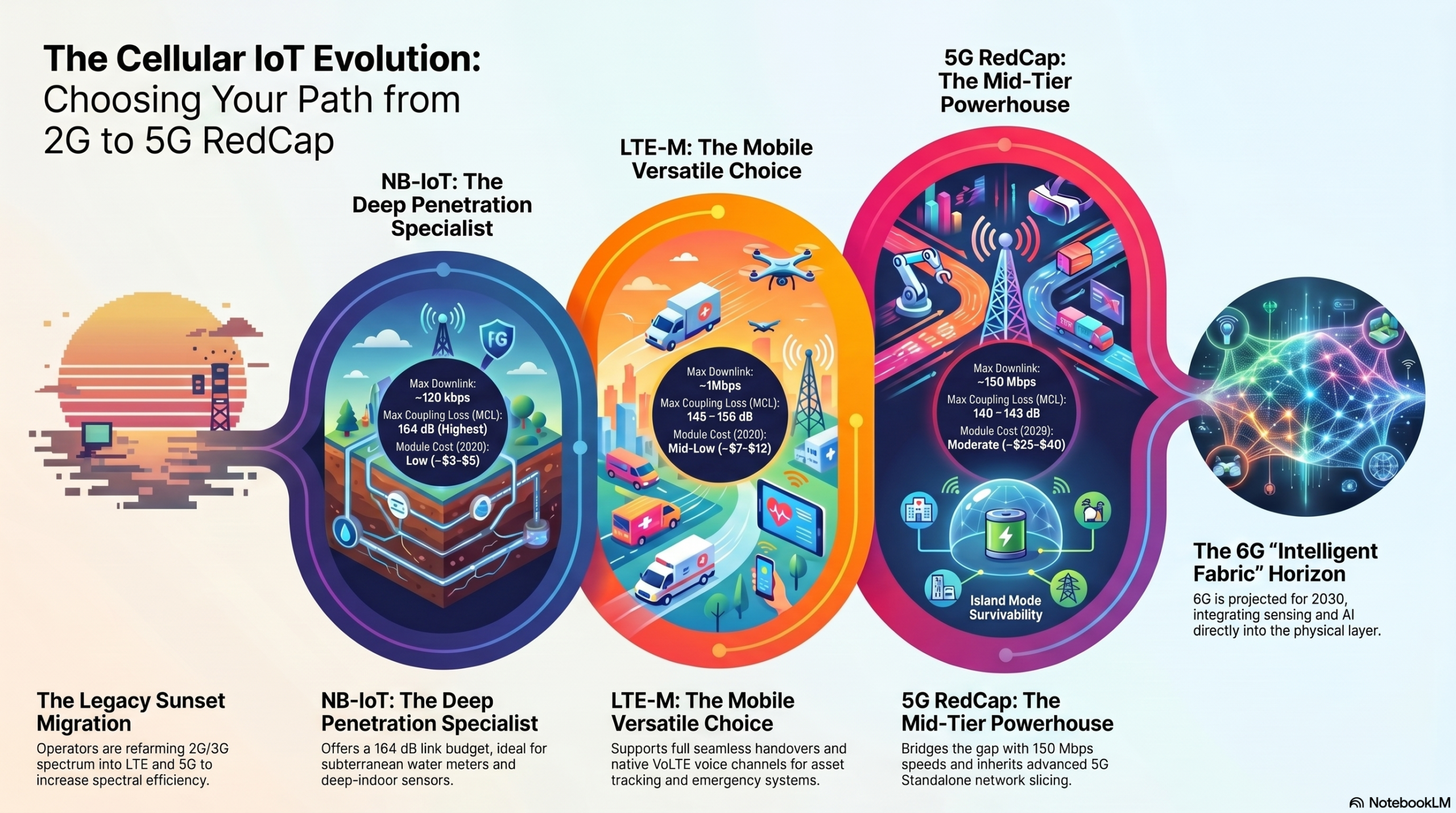
NB-IoT (Narrowband IoT) is the specialist for extreme signal penetration. When a sensor is buried under layers of soil or hidden behind the reinforced concrete of a utility vault, the signal faces massive attenuation. NB-IoT overcomes this with a 164 dB Maximum Coupling Loss (MCL)—the highest in the industry.
The technical secret behind this depth is Power Spectral Density (PSD). By concentrating the device’s transmit power into an ultra-narrow bandwidth, we can “punch through” barriers that would block a wider signal.
The Physics of Penetration
Technical Note: Power Spectral Density (PSD)
The relationship between power and bandwidth is defined by the formula:
PSD \propto \frac{P}{B}
- P = Transmit Power
- B = Bandwidth
Architect’s Perspective: Imagine a 10W lightbulb. If you use it to light a whole warehouse (Wide Bandwidth), the light is dim everywhere. If you focus that same 10W into a laser beam (Narrow Bandwidth), it can burn through steel. NB-IoT focuses its energy into a mere 180 kHz, creating a high-density “beam” of data that survives subterranean environments.
Link to the Podcast https://academy.dereticular.com/podcast/evolution-of-cellular-iot-from-5g-redcap-to-6g-foundations/
Ideal Use Cases (Stationary Only):
- Sub-surface Utility Assets: As illustrated in Figure 3, NB-IoT is the only choice for monitoring valves buried deep underground where standard signals fail.
- Agricultural Soil Probes: Used for sensors buried in high-density soil.
- Remote Rural Sensing: Under 3GPP Release 15 (NPRACH), NB-IoT can achieve a staggering 120 km theoretical cell radius, making it the king of long-range, low-data telemetry.
Transition: While NB-IoT is the champion of depth, its lack of “handover” support means it is functionally “tethered” to the spot. If your asset moves, you need a standard designed for mobility.
——————————————————————————–
3. LTE-M: The “Versatile Traveler” for Assets on the Go
LTE-M (Long-Term Evolution for Machines) is the most practical layer for the “Sovereign Edge.” It strikes a balance between efficiency and capability, offering two features NB-IoT lacks: Full Mobility and Voice Support (VoLTE).
LTE-M supports seamless “handovers,” meaning a device on a moving truck (see Figure 4) can transition between cell towers without dropping its session. It also utilizes Coverage Enhancement (CE) Modes to bridge the gap with NB-IoT:
- CE Mode A: Standard coverage (~145 dB MCL).
- CE Mode B: Uses up to 2,048 repetitions to reach an effective 155.7 dB MCL, though at a significant cost to battery and latency.
Metric Comparison: NB-IoT vs. LTE-M
| Metric | NB-IoT | LTE-M |
| Mobility | Limited (Re-selection only) | Full (Seamless Handovers) |
| Voice Support | No | Yes (VoLTE) |
| Link Budget (MCL) | 164 dB | 145 dB – 155.7 dB |
| Bandwidth | 180 kHz | 1.4 MHz |
| Sovereign Readiness | Low (Carrier-Tethered) | High (Open-Source Friendly) |
The “So What?”: For any “Kinetic” application—wearables with emergency buttons, moving logistics, or private networks using open-source tools like srsRAN—LTE-M is the architectural gold standard.
——————————————————————————–
4. 5G RedCap: The “Future-Proof” High-Performer
RedCap (Reduced Capability), introduced in 3GPP Release 17, is the “NR-Light” version of 5G. It is designed to replace aging mid-tier standards (LTE Cat-1 and Cat-4) by scaling down 5G’s complexity while keeping its most powerful features.
The Evolution: RedCap (Rel-17) vs. eRedCap (Rel-18)
Looking toward 2026 and beyond, we see the emergence of eRedCap:
- RedCap (Rel-17): 20 MHz bandwidth, ~150 Mbps peak speed. Ideal for video surveillance.
- eRedCap (Rel-18): 5 MHz bandwidth, ~10 Mbps peak speed. Designed as the direct successor to LTE Cat-1, prioritizing power efficiency over raw speed.
Why Choose RedCap?
- Network Slicing: Reserve a dedicated “lane” for critical infrastructure (e.g., a smart grid) so your data isn’t competing with public mobile traffic.
- High-Precision Positioning: Centimeter-level accuracy without the power drain of GPS.
- Time-Sensitive Networking (TSN): Essential for microsecond-level synchronization in factory automation.
The “Cost-vs-Longevity Paradox”: Today, a 5G RedCap module costs 25–40, whereas an LTE Cat-1bis module is only 4–6. However, for industrial assets with a 15-year lifecycle, RedCap is the only way to ensure your hardware survives the 4G sunsets of the 2030s.
——————————————————————————–
5. The Security Evolution: Why “Old” is “Dangerous”
In the era of “Kinetic AI,” your network is only as strong as its weakest link. Legacy 2G/3G networks suffer from Unidirectional Authentication—the device trusts the tower, but the tower never has to prove its identity. This allows hackers to use IMSI Catchers (Stingrays) to intercept data and track locations.
The 5G Security Standard
Modern standards like LTE-M and RedCap enforce Mutual Authentication. 5G RedCap goes further by introducing SUCI (Subscription Concealed Identifier). Unlike LTE-M, which transmits the device ID (IMSI) in cleartext, 5G RedCap encrypts the ID before it even hits the airwaves, making location tracking significantly harder.
[!IMPORTANT] The Sovereign Stack & “Island Mode” Resilient infrastructure must be capable of Island Mode—localized, off-grid autonomy where the system continues to coordinate energy or water flow even if the central cloud link is severed. LTE-M and 5G RedCap are “Sovereign-ready” because they can be easily deployed on private base stations using software-defined cores (Open5GS).
——————————————————————————–
6. The Master Selection Matrix
Use this matrix to align your project’s physical environment with the correct standard.
| Standard | Best For… | Latency | Sovereign Readiness | The Trade-off |
| NB-IoT | Static / Underground | Very High (Secs) | Low | No Voice; Carrier-Locked |
| LTE-M | Mobile / Interactive | Moderate (ms) | High | Higher Power than NB-IoT |
| 5G RedCap | Future-Proof / Industrial | Low (<10ms) | High | High Initial Module Cost |
Rule of Thumb for the Architect:
- Choose NB-IoT for reach: Deep penetration (164 dB MCL) for stationary sensors that must last 10+ years.
- Choose LTE-M for movement and resilience: The practical choice for private networks, voice needs, and mobile assets.
- Choose RedCap for longevity and performance: The mid-tier 5G bridge for industrial automation and high-security utility grids.