
Implementation Blueprint: Project Octagon Node 3 (West Virginia Sovereign Stack)
deck
podcast
video
- Strategic Vision: Bypassing the Permitting Wall
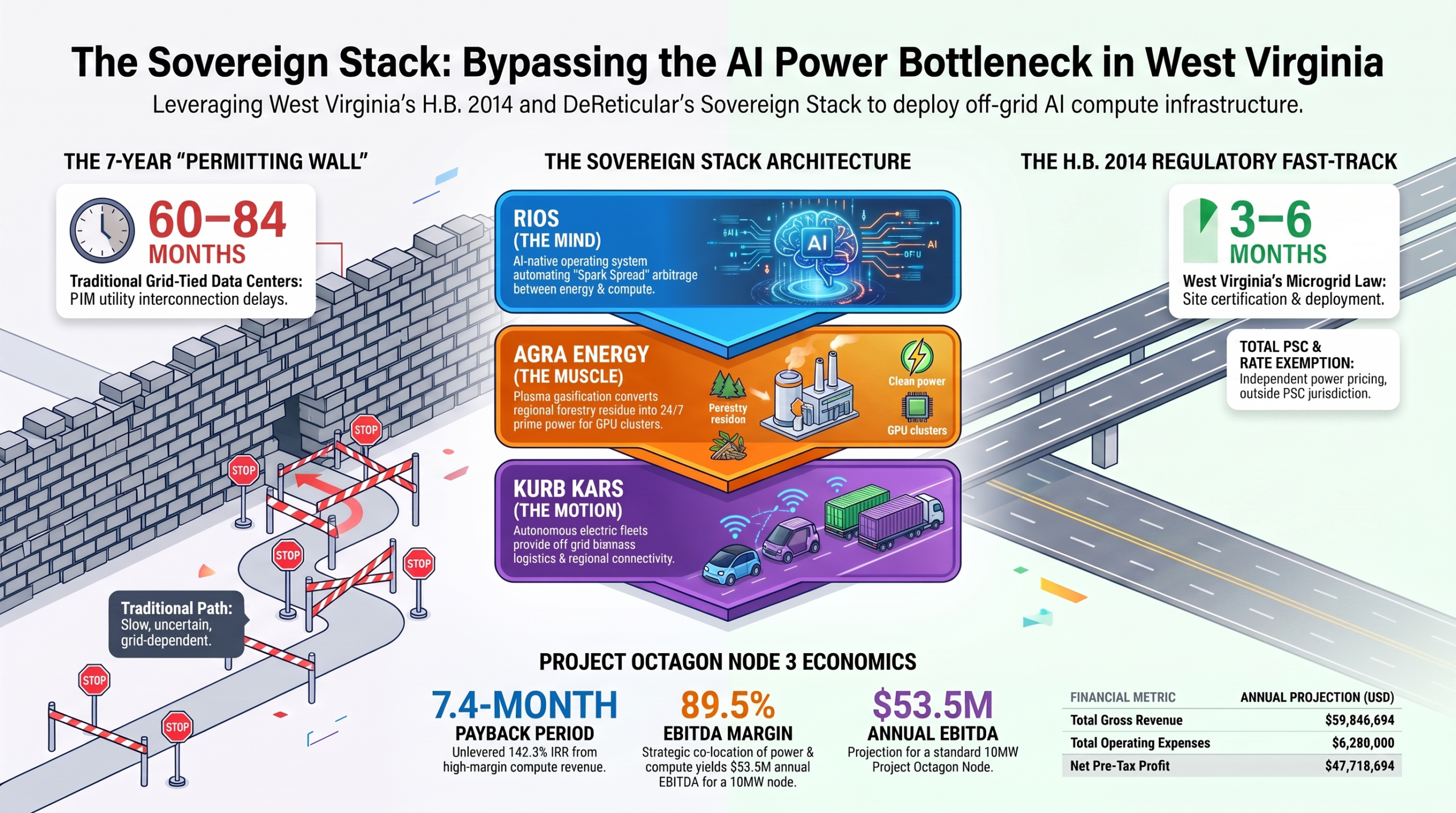
The scaling of artificial intelligence has encountered a structural bottleneck: the “Permitting Wall.” Traditional hyperscale data centers are currently stalled by PJM interconnection queue delays spanning 60 to 84 months, a timeline that is incompatible with the 18–24 month capital cycle of GPU hardware generations. Project Octagon Node 3 resolves this by shifting from “The Line”—legacy linear infrastructure with single-point-of-failure vulnerabilities—to “Spherical Resilience.” By deploying a West Virginia Sovereign Stack, we utilize a decentralized, behind-the-meter (BtM) topology that bypasses federal transmission hurdles entirely, achieving deployment in under six months while maintaining total operational autonomy.
Linear Infrastructure vs. Spherical Resilience
Feature / Metric Linear Infrastructure (“The Line”) Spherical Resilience (Sovereign Stack)
Topology Cascading, central-outward tree Non-Euclidean, self-healing mesh
Grid Interdependence 100% reliant on PJM interconnect Zero-to-Minimal (Behind-the-Meter)
Interconnection Timeline 60–84 Months (PJM Queue) 3–6 Months (State Certification)
Fault Isolation Cascading regional blackouts Localized deterministic islanding
Energy Monetization Passive consumer (LMP volatility) Active “Spark Spread” arbitrage
Regulatory Oversight Federal (FERC) & State (PSC) Streamlined State Development (WVDED)
The Sovereign Stack Components
- The Mind (RIOS): The Rural Infrastructure Operating System is an AI-native Distributed Energy Resource Management System (DERMS) utilizing hardware-secured TPM 2.0 oracles and Sysbox container isolation to orchestrate the node’s micro-economy.
- The Muscle (Agra Energy & Compute): Agra Energy plasma gasification converts regional residues into syngas to power RIOS-CC-1000 liquid-cooled, high-density compute modules, which are vibration-isolated to protect GPU silicon from the mechanical harmonics of the gensets.
- The Motion (Kurb Kars): An autonomous DePIN transport fleet that handles off-grid feedstock logistics and regional connectivity, governed by the local Hyphanet mesh.
This architectural shift is secured by a unique legislative sanctuary that positions West Virginia as the premier jurisdiction for sovereign computing.
- Regulatory Navigation: The H.B. 2014 Framework
West Virginia House Bill 2014 (The Power Generation and Consumption Act) serves as the primary catalyst for Node 3. By codifying the “Certified Microgrid Development Program,” the state has created a regulatory sanctuary where high-impact AI compute can bypass traditional utility gatekeepers.
Structural Advantages of Certification
- PSC Regulatory Exemption (§24-2-21a): Certified districts are exempt from Public Service Commission jurisdiction, allowing for unregulated internal power transfer pricing and bypassing “Certificate of Convenience and Necessity” litigation.
- Queue Bypass (§24-2F-8): Certification grants a statutory exemption from regional net-metering and interconnection standards, effectively removing the project from the multi-year PJM study queue.
- Zoning Preemption: State certification overrides restrictive municipal or county zoning, consolidating siting authority within the State Department of Commerce to ensure consistent development.
- Captive Power Authority: The framework codifies the right to consume self-generated power on-site, provided the facility meets the mandatory high-impact load requirements.
The Captive Power Ratio Proof
To maintain statutory compliance, the district must consume at least 70% of its generated energy locally. High-density AI compute is the mathematically ideal load for this requirement due to its near-constant power draw.
\text{Captive Ratio} = \frac{\text{Annual Internal Compute Consumption (66,900 MWh)}}{\text{Annual District Generation (78,840 MWh)}} = 84.85\%
For the 10 MW flagship Node 3, the calculation (based on a 90% capacity factor for generation and an 8.5 MW continuous compute draw) yields an 84.85% ratio, satisfying the \ge 70\% statutory mandate while limiting wholesale exports to near-zero.
Regulatory Timeline Comparison
- Traditional PJM Interconnection Queue: 60–84 months.
- West Virginia State Microgrid Certification: 3–6 months.
Crucially, the regulatory roadmap requires a 120-day pre-submission notice to local distribution utilities (Mon Power or Appalachian Power) to document good-faith negotiations regarding standby demand, a critical milestone for administrative mobilization.
- Phase 1: Mobilization & Administrative Onboarding (Months 1–2)
Phase 1 focuses on establishing the “Software Authority” in Morgantown. By leveraging the Ascend West Virginia program, the project secures immediate access to the high-tech talent pipeline of West Virginia University (WVU) and the $321M NSF RETI Engine.
Immediate Execution Tasks
- [ ] Finalize formal Ascend West Virginia application for Morgantown Hub residency.
- [ ] Submit the 120-day utility notice and the formal Letter of Intent (LOI) for Certified Microgrid District designation to the WVDED.
- [ ] Execute an MOU with the WVU Statler College of Engineering to provide a direct pipeline for RIOS kernel development and hardware oracle validation.
- [ ] Establish the “Software Authority” base of operations in Morgantown.
Regional Hub Specialization
- Morgantown Hub (The Mind): Software R&D and RIOS orchestration, serving as the commercialization vehicle for university-led R&D and NSF RETI grid-resilience initiatives.
- New River Gorge Hub (The Muscle): The physical testbed for rugged terrain mobility (Kurb Kars), off-grid “Island Mode” validation, and rural mesh deployment.
- Phase 2: Site Acquisition & Feedstock Supply Chain (Months 3–6)
In the Sovereign Stack, feedstock security is the fuel of compute. Establishing a localized supply chain within a 35-mile operational radius is a strategic necessity to insulate the node from energy market volatility.
Site Selection & Resilience Requirements
- Acreage: 15–30 acres of industrial/agricultural land with access to timber haul routes.
- Strategic Resilience: Agra Energy reactors utilize a dual-fuel capability, with the ability to shift automatically to coal-bed methane or stored pellets to hedge against seasonal biomass interruptions.
- Feedstock Scale: Securing 40,000 green tons/year of forestry residue and industrial hemp.
Feedstock Logistics Loop
- Sourcing: Secure five-year agreements with regional sawmills at a delivered cost of \le \$35/\text{ton}.
- Standardization: Residue is sized to 2-inch dimensions and dried to <15% moisture using recovered waste heat.
- Transport: Initial deliveries transition to the Kurb Kars autonomous fleet, utilizing off-grid electric mobility to reduce logistics costs from $0.35 to $0.12 per ton-mile.
- Hopper Intake: Standardized dry feed is delivered to the gasifier for continuous syngas production.
- Phase 3: Technical Integration & “Island Mode” Activation (Months 7–9)
Phase 3 transitions to “Kinetic Compute” deployment, focusing on the 700V DC Bus architecture which eliminates double-conversion UPS losses.
Deployment Sequence
- Agra Energy Systems: Installation of two 5 MW plasma gasification systems coupled with syngas scrubbing trains and reciprocating engines.
- RIOS-CC-1000 Modules: Positioning of liquid-cooled, vibration-isolated 1.2 MW compute modules, with server PSUs connected directly to the centralized DC busbar.
- DC Efficiency: Direct DC bus coupling yields a 7–9% reduction in parasitic power losses compared to traditional AC data center configurations.
“Island Mode” Redundancy Protocols
- N+1 Redundancy: The node maintains three 5 MW gensets for a 10 MW load, ensuring a warm-standby unit is always available.
- Transient Suppression: A 2.0 MW / 2.0 MWh BESS bridges the DC bus during GPU load spikes, responding within <4 milliseconds.
- IEEE 1547.4 Compliance: Automated solid-state switches ensure deterministic islanding, detaching the node in <8 milliseconds upon detecting grid instability to maintain utility-grade uptime.
- Phase 4: Commercial Scaling & “Spark Spread” Optimization (Months 10–12+)
The economic engine of the node is the “Spark Spread”—the real-time arbitrage between the cost of energy and the value of high-density FLOPs.
Spark Spread Decision Logic
“RIOS maximizes profitability via a real-time objective function. If the value of a FLOP exceeds the marginal gain of BESS charging or biochar production, 100% of syngas power is routed to compute. Conversely, during low demand, power is redirected to BESS charging or Kurb Kars logistics, always maintaining the statutory >70% captive power ratio.”
Project Octagon Global Sync
Node 3 integrates into a global peer-to-peer mesh, synchronizing telemetry with international nodes like the 7,000-acre agricultural-compute campus in Kaabong, Uganda. This transforms Node 3 into a high-margin asset within a decentralized global infrastructure network.
- Financial Architecture: The Six Individual Profit Centers
The “Multi-Revenue Design” ensures institutional-grade resilience by decoupling the project from single-market volatility.
Sovereign Stack Profit Center Economics
Profit Center Monetization Mechanism Target Customer Expected Gross Margin
- AI Compute GPU FLOP Sales / CaaS Contracts AI Labs / Enterprise 65% – 82%
- Agra Energy Power, Biochar, Carbon Credits Internal Node / Ag 50% – 70%
- RIOS Software SaaS License + Arbitrage Share 3rd-Party Microgrids 85% – 92%
- Kurb Kars MaaS Freight & Logistics Timber / Ag Operators 40% – 55%
- DePIN Mesh Verification & Bandwidth Fees P2P Data Consumers 75% – 88%
- Studio / IP Node Franchise & Tech Transfer Municipalities / Devs 70% – 85%
Key Financial Return Metrics
- Total Initial CapEx: $33,200,000
- Annual Net EBITDA: $53,558,694
- Simple Payback Period: 7.4 Months
- Unlevered IRR: 142.3%
- Feedstock Resilience: Sensitivity analysis confirms that a 42% increase in biomass pricing alters the payback period by less than eight days, demonstrating extreme insulation from commodity price shocks.
- Institutional Synergy: The WVU & NSF RETI Integration
DeReticular serves as the commercialization vehicle for the $321M NSF RETI Engine at West Virginia University, translating breakthroughs in grid edge resilience into field-deployed infrastructure.
RETI Research Pillar Mapping
RETI Research Pillar DeReticular Synergy
Grid Edge Resilience RIOS Autonomous DERMS (Island Mode)
AI Data Center Strain Behind-the-Meter High-Density Compute
Cybersecurity TPM 2.0 Silicon Root-of-Trust & Sysbox Isolation
Commercialization Project Octagon Node 3 Site Deployment
The Agent-to-Agent (A2A) Outdoor Campus
This concept establishes an autonomous micro-economy on WVU-affiliated rural land. Software “Agents” representing energy production, compute load, and logistics fleets negotiate trade in real-time via the Hyphanet mesh. This zero-trust environment allows for the automated negotiation of energy-to-compute pricing without human intervention.
Strategic Call to Action: Execution begins September 1. Immediate priorities include the 120-day utility notice filing, formal H.B. 2014 application submission, and the finalization of long-term feedstock contracts to lock in base input costs.