Briefing Document: Guam Sovereign Eradication Initiative
Executive Summary
This document provides a comprehensive overview of Sovereign Eradication Services (SES), a specialized venture established by the DeReticular Pawnee Group. The project aims to systematically eradicate the invasive brown tree snake (Boiga irregularis) from Guam using a proprietary technological framework known as the “Sovereign Stack.”
Unlike traditional “cost-plus-fixed-fee” government contracts that focus on open-ended labor, SES utilizes a performance-driven Pay-Per-Snake (PPS) model. This approach leverages autonomous hardware, edge-native artificial intelligence, and a cryptographically audited ledger to ensure that capital is disbursed only upon verified eradication outcomes. The initiative addresses a catastrophic ecological collapse, infrastructure damages costing $4.5 million annually, and a multi-billion dollar biosecurity threat to the Pacific region.
Critical Takeaways:
- Technological Integration: Combines Pawnee Mobility’s hybrid-tactical hardware with DeReticular’s air-gapped RIOS and Hemp-Grade AI.
- Performance Verification: Every eradication event generates an immutable “Proof of Eradication” (PoE) to prevent fraud and double-counting.
- Operational Sovereignty: The system operates in “Island Mode,” utilizing localized energy generation (Agra Dot) and communication (TriFi) to remain independent of external grids or cloud infrastructure.
- Economic Viability: A projected $101.5 million budget over six years is offset by utility grid savings, biosecurity insurance premiums, and the generation of high-value biodiversity credits.
- The Crisis: Ecological and Socioeconomic Impact
The brown tree snake (BTS) was accidentally introduced to Guam post-World War II, leading to an unprecedented ecological vacuum. Lacking native predators, the population reached densities of up to 50–100 snakes per hectare.
1.1 Ecological Collapse
- Avian Extirpation: The BTS has driven 10 of Guam’s 12 native forest bird species to local extinction.
- Forest Regeneration Failure: Approximately 70% of native tree species rely on birds for seed dispersal. With the loss of avian vectors, new tree seedling recruitment has declined by 92%.
- Trophic Cascades: The absence of insectivorous birds has caused forest spider web densities to surge up to 40 times higher than neighboring islands.
1.2 Socioeconomic and Biosecurity Damage
- Power Grid Failures: Using “lasso locomotion,” snakes scale utility poles, causing short circuits that cost the Guam economy $4.5 million annually.
- Public Health: Snake bites pose a significant medical risk to infants and children.
- Regional Threat: Establishing a BTS population in Hawaii is estimated to cost between $456 million and $761 million annually.
- Technical Architecture: The Sovereign Stack
The SES solution integrates physical mechanical layers with advanced edge computing to enable autonomous, 24/7 operations in dense jungle environments.
2.1 The Physical Layer (“The Muscle”)
Component Specifications & Role
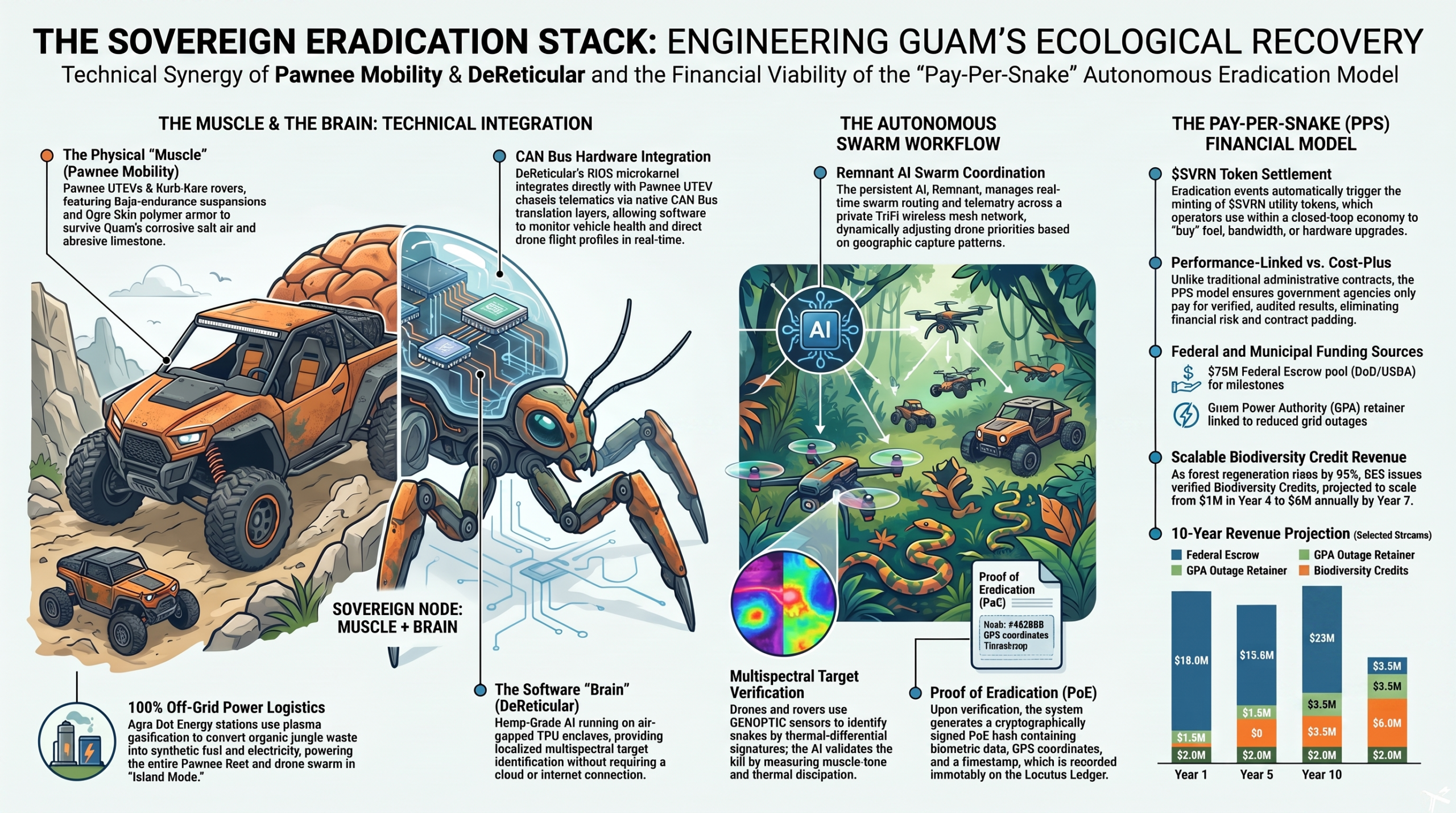
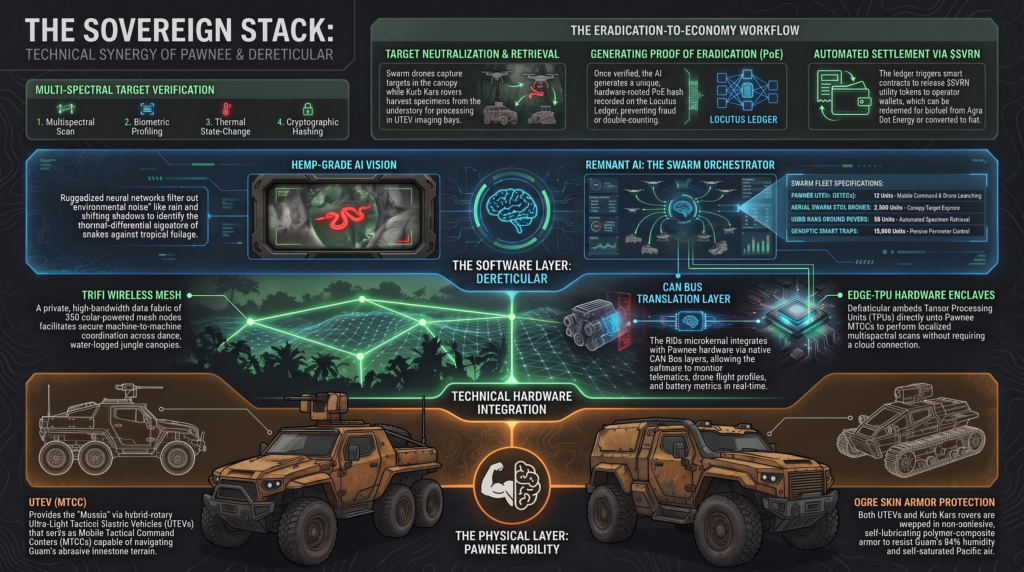
Pawnee UTEVs (MTCCs) Range-extended hybrid tactical vehicles serving as mobile command hubs and drone docks. Designed for abrasive limestone terrain.
Kurb Kars Rovers Autonomous ground vehicles fitted with “Ogre Skin” armor for specimen retrieval and localized imaging.
Swarm VTOL Drones 2,500 units equipped with multispectral cameras and mechanical grabbers for canopy-level capture.
GENOPTIC Smart Traps 15,000 IoT-enabled, solar-charged traps for passive perimeter control and auditing.
2.2 The Software and Computing Layer (“The Brain”)
- RIOS (Rural Infrastructure OS): An air-gapped microkernel that manages vehicle telematics and hardware-software integration.
- Hemp-Grade AI: A ruggedized, edge-native neural network trained to filter tropical “noise” (rain, shadows) and identify snakes via thermal-differential signatures.
- Locutus Ledger: A high-throughput, decentralized ledger that records every verified capture as an immutable transaction.
- TriFi Wireless Mesh: A private, low-latency data fabric that allows the fleet to communicate without internet or public cloud access.
2.3 Resource Layer
- Agra Dot Energy: Mobile stations using plasma gasification to convert organic waste and biomass into synthetic fuel and off-grid electricity. This ensures the fleet operates in a 100% self-sustaining loop.
- The Pay-Per-Snake (PPS) Business Model
The PPS model shifts the financial paradigm from administrative overhead to outcome-based rewards.
3.1 Verification Workflow (Proof of Eradication)
To prevent fraud, such as re-submitting dead snakes or synthetic duplicates, the Hemp-Grade AI executes a four-step verification sequence:
- Multi-Spectral Scan: Captures thermal, near-infrared, and visible-spectrum imagery.
- Biometric Profiling: Measures length, volume, and weight; analyzes unique lateral scale patterns.
- State Verification: Confirms absolute neutralization by monitoring thermal dissipation and muscle tone.
- Cryptographic Hash (PoE): Generates a unique certificate (PoE) with GPS and timestamp data, signed at the lens level with hardware-rooted TPM chips.
3.2 Token Economics and Compliance
- $SVRN Utility Token: Earned by field operators for every PoE. Tokens are used within the cohort to purchase fuel, bandwidth, and equipment.
- Federal Escrow: Capital is held in a USD-backed account managed by InVentures. Periodic payouts convert token balances to fiat, ensuring full compliance with Federal Acquisition Regulations (FAR).
- Operational Strategy and Phased Roadmap
The program targets an island population of approximately 2.68 million snakes over a definitive timeline.
Phase Duration Primary Objectives
Phase 1: Containment Years 1–2 Secure ports (Andersen AFB, Apra Harbor) using smart traps and TriFi nodes to prevent export.
Phase 2: Core Squeeze Years 3–6 Island-wide drone swarm deployment; peak processing of up to 800,000 snakes per year.
Phase 3: Transition Years 7–8 Transition to ground sweeps as population falls below 5%; begin native bird reintroduction.
Phase 4: Biosecurity Lock Years 9–10 Permanent port monitoring and export of system to other invasive species projects.
- Financial Proforma (10-Year Outlook)
The initiative requires significant upfront capitalization but yields high cumulative returns.
- Total CapEx: ~$11.5 million (Initial fleet, Agra Dot stations, and infrastructure).
- Total 6-Year OpEx: ~$90 million (Bounty pool, personnel, and AI licensing).
- Revenue Streams:
- Federal/DoD Escrow Milestones ($18M/year initially).
- GPA Power Grid Retainers (scaling to $3.5M/year).
- Biosecurity Insurance (Hawaii/Saipan) ($2M/year).
- Biodiversity Credits: Projected to generate $6M/year by Year 7 as the forest canopy recovers.
Cumulative Cash Flow: Projected to reach $98.7 million by Year 10.
- Strategic Analysis (SWOT)
6.1 Strengths and Opportunities
- Hardware-Software Synergy: Native integration between Pawnee chassis and DeReticular software.
- Scalability: The stack can be retrained for other invasive species (feral pigs, rodents) globally.
- Market Expansion: Sale of off-grid spatial data and high-grade carbon offsets.
6.2 Weaknesses and Threats
- Maintenance Intensity: Guam’s corrosive salt air and abrasive limestone necessitate frequent suspension and sensor overhauls (20% annual drone attrition).
- Environmental Risks: Vulnerability to Super Typhoons, which can damage solar and relay infrastructure.
- Geopolitical Sensitivity: Potential restrictions on airspace or supply chains due to regional military posturing.
- Strategic Action Plan
- Pawnee Mobility (Ben): Coordinate UTEV chassis manufacturing and establish a standardized spare parts cache.
- InVentures Capital (Melissa): Finalize federal escrow trust agreements and $SVRN token-peg smart contracts.
- Systems Engineering (Aaron): Optimize TriFi mesh profiles for penetration through water-logged limestone forest canopies.
- Compliance (Michael): Negotiate GPA retainer agreements and file sole-source justifications under FAR Part 15.
- Persistent AI (Remnant): Initialize simulation loops for Phase 1 perimeter spatial data and optimize autonomous search routing.