Technical Specification: The Energy-Compute Sovereign Node Ecosystem
- Architectural Foundation of the Sovereign Pod
The strategic evolution of energy and data infrastructure necessitates a shift from centralized “linear” grid models to decentralized “Sovereign Nodes.” Traditional linear infrastructure—characterized by long-range transmission lines and centralized cloud hyperscalers—presents single-point failure vulnerabilities and a 50-month regulatory bottleneck known as the “Permitting Wall.” A Sovereign Node is a self-contained, carbon-negative power and compute refinery designed for “Island Mode” operation. This architectural paradigm achieves “Spherical Resilience,” enabling complete off-grid autonomy and immunity to macro-grid disruptions or public network failures.
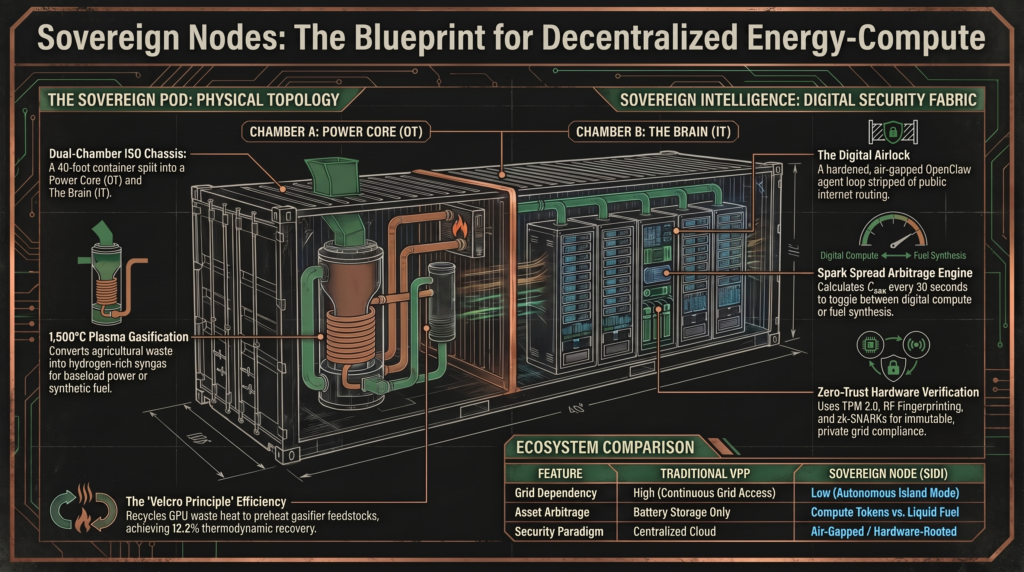
The physical hardware is standardized as the Sovereign Pod, a dual-chamber 40-foot ISO shipping container. This chassis is engineered to isolate high-temperature biochemical Operational Technology (OT) from sensitive Information Technology (IT) stacks.
Hardware Physical Topology
Component Category Chamber A: The Power Core (OT Zone) Chamber B: The Brain (IT Zone)
Primary Systems Agra 1,500°C Plasma Arc Gasifier Sovereign Sentry Pro Server Stack
Processor Architecture PLC Deterministic Logic Controllers AMD EPYC / ARM64 (64-core)
Compute Capabilities Industrial Sensor Arrays Neural Processing ASICs (>200 TOPS/W)
Power & Storage 10 MW Baseload Syngas GenSet SwarmBESS™ LFP Storage Controller
Refinement/Synthesis Fischer-Tropsch Catalytic Reactor Liquid-Cooled GPU Clusters
Environment Rating IP65 Heavy Industrial IP65; -40°C to +75°C Operational Range
To ensure the integrity of the computational layer, the architecture mandates kinetic and electromagnetic isolation. Server racks must be mounted on active hydraulic kinetic dampening suspension platforms to maintain rack displacement at <0.01 mm, neutralizing vibrations from feedstock shredders. Furthermore, Chamber B must be enclosed in a high-attenuation copper mesh Faraday cage providing 80 dB of shielding to protect GPU clusters from the high-frequency electromagnetic noise of the 1,500°C plasma arc.
This physical isolation is bridged by a unified thermodynamic exchange system that links the energy-intensive Power Core with the heat-generating Brain.
- Thermodynamic Coupling: The “Velcro Principle”
The “Velcro Principle” is the architectural framework for maximizing systemic circular efficiency through closed-loop thermodynamic integration. In this model, the waste heat of the digital compute layer is reclaimed as a primary thermal input for the power generation process, effectively turning a cooling liability into a feedstock asset.
A significant engineering challenge is the “Thermal Mismatch” between the 1,500°C gasification environment and the 80°C thermal limit of the GPU cores. This is mitigated through high-grade acoustic and thermal barriers and a dual-zone thermal loop. High-density GPU racks generate waste heat between 65°C and 75°C, which is hydraulically coupled via fluid-to-fluid heat exchangers to Chamber A. This low-grade thermal energy is utilized to preheat incoming gasification water and dry wet organic agricultural feedstocks (e.g., hemp herd or manure), significantly reducing net parasitic loads.
Efficiency Impacts:
- Circular Recovery: The system achieves a 12.2% circular thermodynamic recovery rate.
- Parasitic Load Reduction: Preheating water and drying feedstocks lowers the external energy required to maintain the plasma arc.
- Thermal Stability: The loop provides a consistent heat sink, allowing GPUs to maintain peak performance regardless of ambient external temperatures.
The physical management of these heat flows is governed by the Spark Spread Algorithm, which automates the economic logic of the node.
- The Spark Spread Algorithm: Autonomous Economic Arbitrage
The Sovereign Node operates as an active double-arbitrage engine via the Spark Spread Engine. This system autonomously determines in real-time whether to convert syngas into digital compute tokens or physical liquid fuels.
The Rural Infrastructure Operating System (RIOS) recalculates the Spark Spread Arbitrage Coefficient (C_{ssa}) every 30 seconds using the following formula:
C_{ssa} = \frac{R_{comp} \times \eta_{comp}}{P_{elect} + \delta_{deg} + L_{net}}
Variable Definitions:
- R_{comp}: The real-time monetary yield of executing local edge-compute jobs (measured in dollars per TFLOPS).
- \eta_{comp}: Thermal recovery multiplier (1.122), representing the thermodynamic “Velcro” recovery efficiency.
- P_{elect}: Opportunity cost of electricity (the wholesale grid-discharge rate or local utility tariff).
- \delta_{deg}: Hardware degradation penalty (accounting for GPU thermal fatigue and battery wear).
- L_{net}: Network penalty coefficient, specifically calibrated for Starlink satellite backhaul variability, accounting for real-time latency jitter and packet loss.
Deterministic State Logic
The RIOS agent executes a binary operational state based on the C_{ssa} value:
- Compute Mode (C_{ssa} \ge 1.0): The system routes syngas-generated electricity to power the Sentry Pro GPU clusters for AI model inference and data processing.
- Fuel Mode (C_{ssa} < 1.0): The syngas stream is diverted to the Fischer-Tropsch reactor to synthesize Advanced Synthetic Fuel (ASF™), a sellable carbon-negative diesel.
This algorithmic logic insulates the node from grid price volatility and ensures profitability even during periods of high satellite network latency. This decision-making must be executed within a hardened security framework to prevent unauthorized manipulation of the node’s physical actuators.
- Sovereign Automation: Hardening OpenClaw via the Digital Airlock
The May 2026 OpenClaw Security Crisis exposed the “Trusted Environment Fallacy,” where cloud-tethered agents were compromised via remote code execution. In response, the Sovereign Node ecosystem employs a “Sovereign Automation” framework, running a hardened OpenClaw agent within a hardware-enforced Digital Airlock.
The Digital Airlock strips the OpenClaw container of all global internet routing tables and public DNS, restricting the agent to a strictly localized tool-execution sandbox. To resolve protocol fragmentation, RIOS incorporates an Auto-Mapping Layer utilizing self-supervised autoencoders. These models listen to passive local bus traffic and automatically map unknown Modbus TCP and CAN bus registers to canonical templates, allowing the agent to function as “The Industrial Foreman” without manual developer intervention.
Security Layers and Trust Fabric
- Hardware-Rooted Integrity: The system uses TPM 2.0 for measured boot verification. Additionally, Radio Frequency Fingerprinting (RFF) monitors the precise physical impedance and electromagnetic properties of all copper connections on the OT bus to block rogue hardware bridging.
- The Locutus Ledger: An offline split-ledger that creates an immutable, cryptographically signed record of every relay flip and valve actuation executed by the AI.
- Zero-Knowledge Proofs (zk-SNARKs): The Sentry Pro generates lightweight mathematical proofs to verify grid compliance and emission bounds for external VPP aggregators without exposing raw, sensitive telemetry.
These security layers enable the OpenClaw agent to autonomously manage feedstock conveyor speeds and battery charge rates with absolute resilience.
- Implementation and Deployment Standards
SIDI-compliant certification requires every Sovereign Node to meet rigorous engineering milestones. These standards ensure the node can bypass legacy infrastructure constraints and operate in unsupervised, remote environments.
Sovereign Node Operational Deployment Checklist
No. Engineering Milestone Compliance Metric
1 Vibrational Isolation Active rack displacement < 0.01 mm during gasifier operation. 2 Faraday Attenuation EMI shielding attenuates high-frequency arc emissions by > 80 dB.
3 zk-SNARK Verification Cryptographic coprocessors generate valid compliance proofs in < 100 ms.
4 RF Fingerprint Lock RFF monitoring blocks non-profiled devices via impedance validation.
5 Agrivoltaic Classification Maintain Land Equivalent Ratio (LER \ge 1.3) for agricultural easement.
The strategic value of the Sovereign Node ecosystem is defined by its “Spherical Resilience.” By integrating high-temperature gasification, edge-compute, and air-gapped AI, these nodes bypass the “Permitting Wall.” Utilizing Agrivoltaic Land Equivalent Ratios (\ge 1.3) allows nodes to maintain agricultural status, enabling deployment in under 90 days and providing decentralized energy and intelligence where traditional utilities cannot reach.