
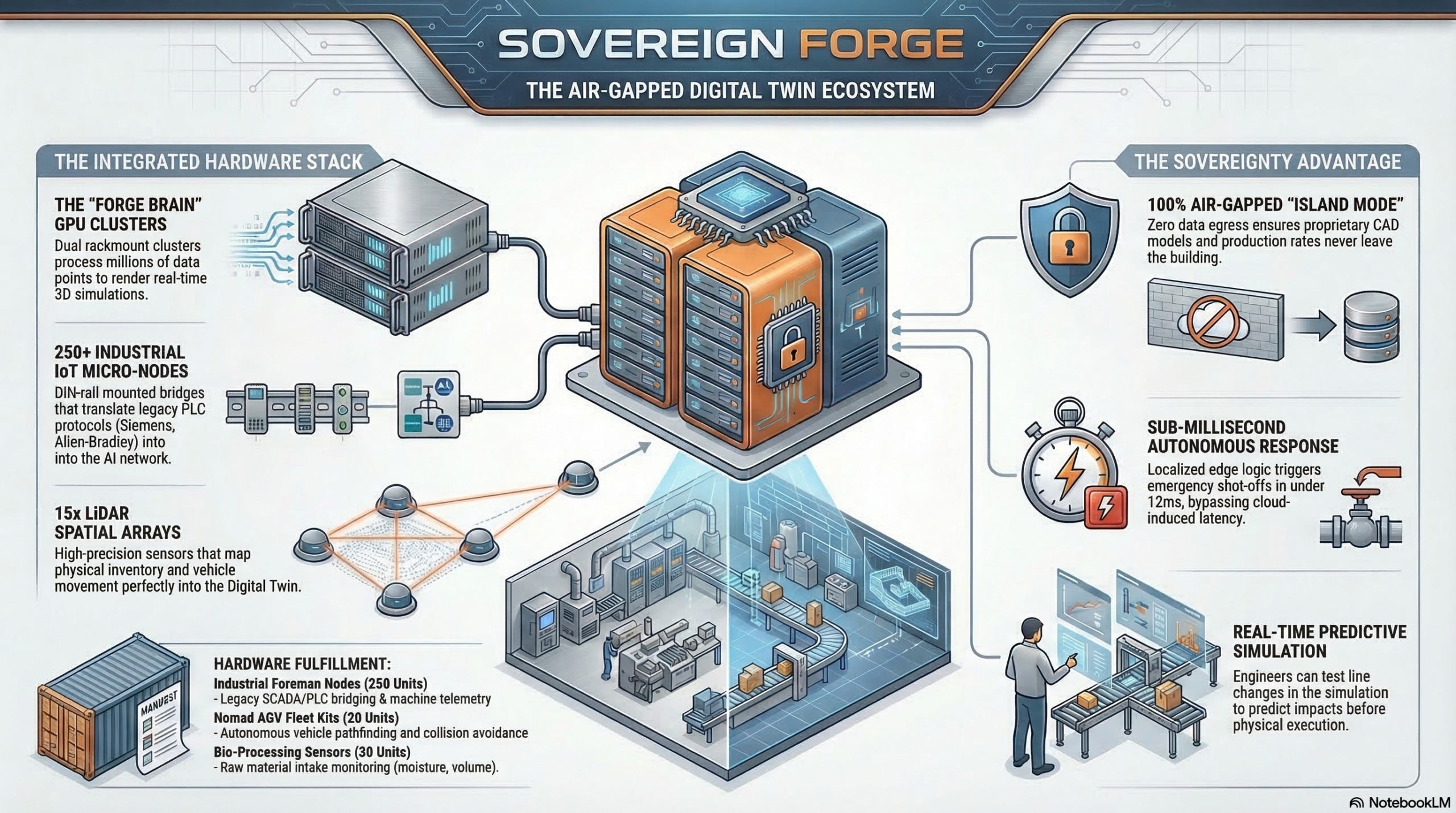
Risk Mitigation Strategy: Sovereign Forge Air-Gapped Industrial Automation
1. Strategic Security Foundation: ‘Island Mode’ and IP Sovereignty
In the high-stakes sectors of defense and bio-manufacturing, intellectual property (IP) is a matter of national and strategic survival. The current trend toward cloud-integrated Industry 4.0 exposes proprietary CAD models, biological formulas, and production metrics to state-sponsored exfiltration and corporate espionage. “Island Mode” is the foundational defense against these threats, establishing a hard digital and physical perimeter. This architecture eliminates the exfiltration attack surface by collapsing the data plane into a localized, hardware-authenticated perimeter. Whether monitoring critical raw material intake via the 50x Bio-Processing & Silo Nodes or managing the assembly line, all telemetry remains within the physical confines of the facility, ensuring that sensitive data—from chemical synthesis metrics to proprietary production rates—never crosses the air-gap.
The security posture of Sovereign Forge is a departure from the “software-defined” security of traditional cloud architectures, which are vulnerable to API breaches and credential theft. To mitigate Risk R-IP-01 (Corporate Espionage), the system utilizes localized, encrypted NVMe drives exclusively. This creates a zero-trust hardware environment where data sovereignty is absolute. Unlike cloud storage, which necessitates constant egress to third-party servers, the Forge architecture anchors its security in physical hardware isolation, providing an impenetrable barrier to external threat actors.
To secure internal communications within the air-gap and prevent lateral movement or insider threats, the system utilizes a Root CA Minting process:
- Cryptographic Root Establishment: During the ingestion phase, a unique, localized Certificate Authority (CA) is minted on the Forge clusters, establishing a “Single Source of Truth” for identity.
- Hardware-Level Authentication: This Root CA issues unique cryptographic identities to all 300+ edge nodes—including GPU clusters, IoT bridges, and LiDAR arrays—ensuring only authenticated hardware can participate in the network.
- Encrypted Intra-Network Isolation: Every communication within the facility is encrypted and verified against the local CA, creating a closed-loop ecosystem that rejects unauthorized devices at the hardware layer.
- Lateral Movement Mitigation: By requiring cryptographic trust for every node interaction, the system prevents compromised nodes from accessing unauthorized segments of the data fabric.
This establishment of hardware-level trust ensures that the foundational data layer is secure, allowing for the extreme computational demands required for real-time operational performance.
——————————————————————————–
2. Operational Performance: Edge Computing and Latency Eradication
For high-speed robotics and automated material handling, sub-millisecond latency is a critical safety and operational requirement, not a luxury. Cloud-based dependencies introduce variable network “lag” that can lead to catastrophic kinetic failures. By replacing distant cloud orchestration with localized edge compute, the Sovereign Forge eliminates the round-trip delay of the macro-internet. This ensures that the loop between sensing an obstacle and executing a physical safety response is governed by the speed of local hardware, meeting the rigorous demands of safety-critical manufacturing environments.
The “Forge Brain,” comprising 2x high-capacity Sentry Pro Clusters, works in concert with a Private 5G/Wi-Fi 7 Canopy powered by 40x Nomad Forge-Points to mitigate Risk R-LAT-01. With 128GB of VRAM per node, the clusters provide the necessary overhead for local LLM inference and the high-fidelity 3D rendering of the Digital Twin. This localized compute capacity allows the system to process tens of thousands of IoT streams simultaneously, ensuring that the 20 AGVs on the floor operate with guaranteed sub-5ms latency, even in environments with heavy electromagnetic interference.
| Category | Cloud-Based Robotics | Sovereign Forge Edge Logic | Mitigation Strategy |
| Latency (ms) | High/Variable (ISP Dependent) | Ultra-Low (Sub-5ms Guaranteed) | Local Sentry Pro GPU Clusters |
| Data Egress Risk | High (Constant Cloud Syncing) | Zero (Total Air-Gap Isolation) | Localized, Encrypted NVMe |
| Connectivity Resilience | Low (Fails on Internet Outage) | Absolute (Local Infrastructure) | 40x Nomad Forge-Points |
| Safety Logic Execution | Centralized/Delayed | Localized/Instant | Industrial Foreman Micro-Nodes |
By centering raw compute power on-site, the system overcomes the primary hurdles of high-speed automation while preparing for the integration of legacy factory hardware.
3. Legacy Integration: Bridging the Analog-Digital Divide
The “Legacy Machinery Incompatibility” (R-INT-01) crisis represents a strategic bottleneck for Industry 4.0; a digital twin is only as effective as the oldest machine it monitors. Incorporating “dumb” assets into a smart ecosystem is a tactical necessity to avoid “Digital Twin Blind Spots”—unmonitored areas where equipment failure can cause cascading production delays. By bridging legacy hardware into the unified fabric, manufacturers gain total visibility without the massive capital expenditure of a total machinery overhaul.
The integration is achieved through 250x Industrial Foreman Micro-Nodes. These DIN-rail mounted bridges are capable of 4-20mA analog-to-digital translation, allowing the system to read raw electrical signals from legacy equipment. By monitoring analog fluctuations in current or voltage, the Forge can ingest high-fidelity data from a 40-year-old stamping press as easily as a modern PLC. This visibility ensures that the Digital Twin reflects the total operational reality of the plant, preventing the catastrophic failures that occur when legacy machinery operates outside of the monitored digital ecosystem.
The Phase 3 Deployment workflow synthesizes this integration into a unified data fabric:
- Protocol Mapping: Existing control cabinets are assessed for Siemens, Allen-Bradley, and Modbus protocols.
- Hardware Bridging: Factory electricians install Micro-Nodes directly into machinery control cabinets, converting varied industrial protocols into a singular data stream.
- Unified Data Fabric: This stream is fed into the DeReticular AI network, allowing legacy machines to participate in autonomous orchestration and predictive maintenance schedules.
This hardware connectivity provides the granular telemetry required to power the system’s high-level volumetric simulation capabilities.
4. Dynamic Safeguards: Real-Time Digital Twin and Volumetric Syncing
The strategic value of a 1:1 physical-to-digital alignment is the ability to move from reactive safety to predictive orchestration. Maintaining a perfect digital mirror allows for real-time simulation of production changes and automated collision avoidance. This “Volumetric Syncing” transforms the factory from a static workspace into a responsive, high-fidelity environment where human and machine movements are perfectly synchronized.
This synchronization is driven by 15x Vault Warden LiDAR arrays and 20x Nomad Fleet Kits. The Fleet Kits integrate directly into the CAN Bus of factory vehicles, allowing for precise spatial pathfinding. When the Vault Warden arrays detect an obstacle—such as an unlogged pallet or a spill—the Volumetric Syncing instantly updates the Digital Twin. The AI then calculates a new path and reroutes all AGVs in real-time. This localized response ensures that physical movement is always aligned with the digital safety model, mitigating accidents before they manifest.
The efficacy of this “Localized Logic Execution” is demonstrated in the following Sequence of Operations (Anomaly Response):
- Sensing: A vibration sensor on a high-speed CNC spindle detects an anomalous frequency.
- Localized Analysis: An Industrial Foreman node cross-references this vibration against the Digital Twin’s baseline performance metrics locally.
- Logic Execution: The system triggers a localized GPIO (General Purpose Input/Output) relay on the edge node.
- Safety Halt: The machine is powered down in 12 milliseconds, preventing catastrophic spindle failure at speeds impossible for cloud-dependent architectures.
This machine-level safety framework serves as the foundation for the protection and management of the factory’s most critical asset: the human workforce.
——————————————————————————–
5. The Human Element: Occupational Health and Compliance Risk
Strategic risk mitigation must incorporate human safety metrics to ensure HIPAA and OSHA compliance within the air-gapped environment. Integrating these standards directly into industrial orchestration allows for rapid medical response and automated regulatory reporting without exposing sensitive personnel data to external networks. Localized health data management ensures that worker privacy is maintained while maintaining a high-readiness posture for workplace incidents.
The Factory Clinic Node and the Sovereign Executive AI are central to this objective. In the event of an injury, medical personnel use the Sovereign Executive AI’s voice-to-text logging to record the incident into a HIPAA-compliant database. The AI then performs an automated safety protocol review, cross-referencing the incident with the machine’s telemetry and generating an OSHA compliance report. This reduces administrative risk and ensures that incident documentation is instant, accurate, and kept entirely on-premise.
Risk management is further decentralized through 5x Floor Supervisor Kiosks. These ruggedized terminals utilize the Deep Admin LLM to empower managers with:
- Human Error Prevention: Instant access to maintenance runbooks for complex machinery (e.g., KUKA robotic arms), ensuring repairs meet engineering standards.
- Bottleneck Analysis: Direct queries (e.g., “Identify the current bottleneck on Line 4”) to prevent equipment over-exertion and human fatigue.
- Real-Time Operational Oversight: A single, air-gapped interface to monitor total factory safety and production status.
This integration of machine telemetry and human safety metrics results in a holistic risk posture that protects both personnel and physical capital.
——————————————————————————–
6. Implementation and Deployment Risk Management
The deployment of heavy-industry hardware requires a rigorous “Hybrid Fulfillment Workflow” to manage logistical complexity and ensure day-one reliability. This process balances remote engineering preparation with on-site physical integration.
The deployment is executed across three distinct phases, each with a critical validation checkpoint:
- Phase 1: Calibration: DeReticular engineers perform CAD/BIM model ingestion and map the client’s PLC/SCADA matrix. Validation Step: Verification of the protocol matrix to ensure immediate node-to-machine recognition upon arrival.
- Phase 2: Provisioning: The hardware stack is prepared for heavy-industry use. Validation Step: A mandatory 72-hour thermal and VRAM burn-in test simulating peak IoT data ingestion to guarantee hardware stability under maximum load.
- Phase 3: Ignition: On-site installation by plant operators and field techs. Validation Step: Real-time alignment of LiDAR spatial arrays with the Digital Twin to confirm a 1:1 synchronization between physical and digital reality.
The SOV-BNDL-FORGE package is a turnkey $249,999.00 investment that includes the perpetual enterprise license and the complete hardware stack—GPU clusters, IoT nodes, sensors, and 5G canopy—required to maintain the air-gap mandate. This avoids the long-term risks of subscription-based cloud models and hardware-software incompatibility.
The ultimate value of the Sovereign Forge is Absolute Production Sovereignty: the total decoupling of industrial output from external vendor dependencies and geopolitical network instability, ensuring that the factory remains operational and secure regardless of external conditions.