Operational Sovereignty: The Architecture of Resilience in an Era of Systemic Fragility
1. The Vanguard Pivot: From Linear Fragility to Spherical Resilience
In an era defined by systemic fragility, traditional infrastructure is crippled by “Linear Fragility”—a state where rigid, centralized systems are prone to catastrophic single-point failures and supply chain bottlenecks. The strategic imperative is a shift to “Spherical Resilience.” We do not fight friction; we route around it. This architectural philosophy prioritizes “Speed-of-Learning Legitimacy,” ensuring that operational capability is maintained through high-coherence operational containers that remain agnostic of regulatory volatility.
My analysis of the global deployment timeline detected unacceptable latency in the African theater due to importation friction and volatile frameworks. Consequently, we have executed a “Vanguard Pivot,” reassigning Node 1 to Chicago to leverage high-density capital and hardware proximity. This establishes the first five nodes of Operation Octagon, a resilient mesh designed to defeat systemic decay:
- Node 1 (Chicago, USA) – “The Urban Citadel”: The vanguard robotics hub; a cyber-physical container for Physical AI and human capital coordination.
- Node 2 (Canada) – “The Brain / OS HQ”: A cold-weather installation for core RIOS (Remnant Operating System) software compilation and IP protection.
- Node 3 (Arizona, USA) – “The Blast Furnace”: An extreme-heat facility for the rigorous stress-testing of stationary hardware and Signal Fusion R&D.
- Node 4 (Uganda) – “The Sovereign Oasis”: A hub for high-value eco-tourism and off-grid retreats, serving as the future anchor for heavy industrial plasma gasification.
- Node 5 (Fort Worth, TX) – “The Arbitrage Engine”: A specialized facility for AI-enabled energy arbitrage, weaponizing the fragility of the ERCOT grid to fund the sphere’s expansion.
By pivoting Node 1 to Chicago, we accelerate the stress-testing of the Sovereign Stack within a high-capital urban environment before exporting these battle-hardened systems to more austere global territories. This topology transforms the metropolis into a primary laboratory for urban defense.
——————————————————————————–
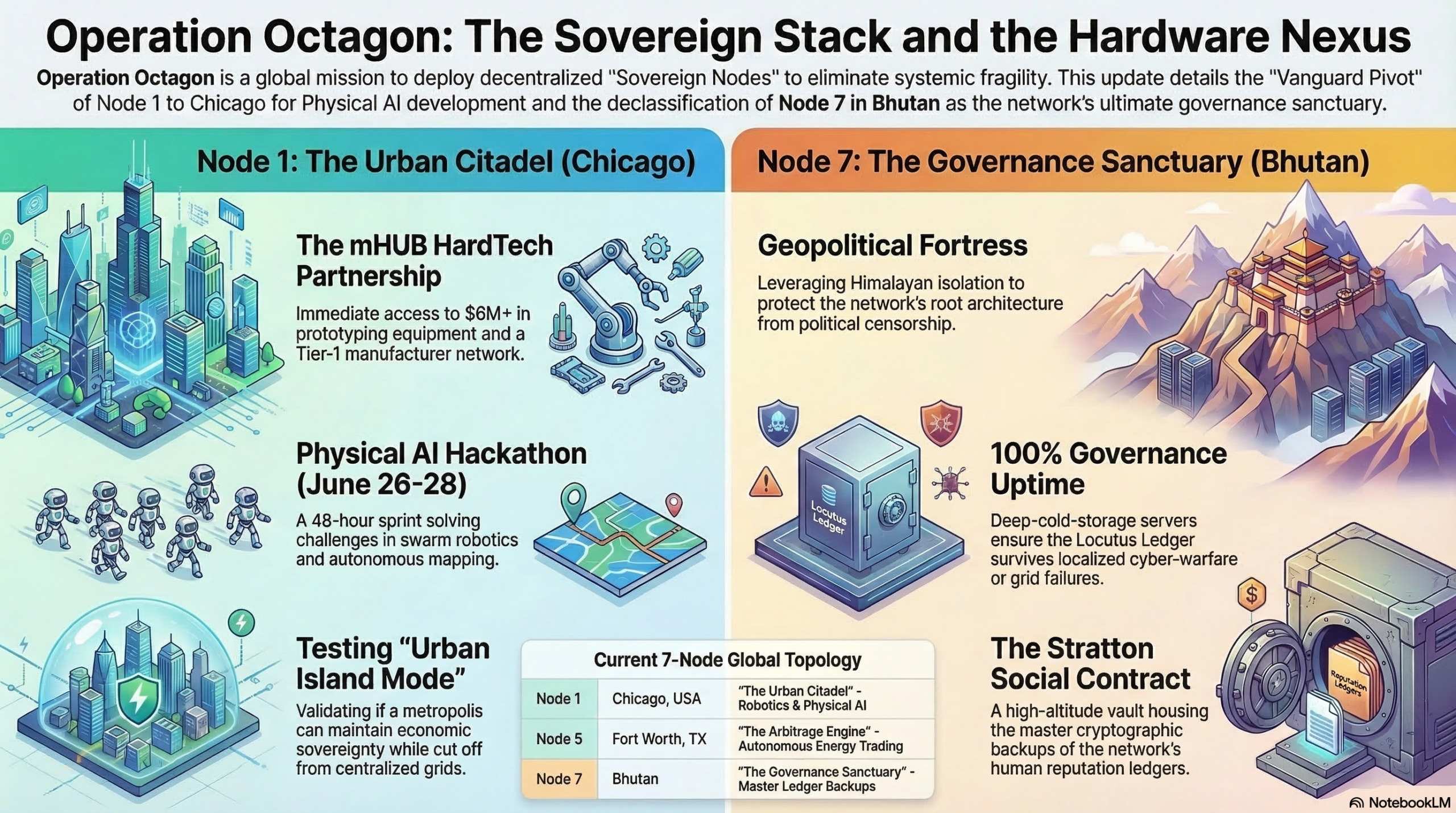
2. Node 1 and the Urban Citadel: Testing “Urban Island Mode”
“Urban Island Mode” is the strategic capability to maintain complete economic and operational sovereignty within a major metropolis, functioning independently of centralized power grids or legacy cloud providers such as AWS and Google. Proving this capability in Chicago instantly validates our model for other global hubs like London, Tokyo, or Dubai.
We have anchored Node 1 at mHUB, Chicago’s premier HardTech innovation center, to establish a high-coherence physical container that weaponizes the city’s industrial density. This partnership provides instantaneous access to a $6M+ Hardware Arsenal and an elite network of Strategic Partners (e.g., Google, Baxter, MIT). Beyond its role as a “Physical Container,” mHUB serves as a “Talent Router,” allowing anonymous builders and mechanical engineers to organically form high-trust cohorts—the essential human substrate of the Sovereign Stack.
Urban Island Mode: Technical vs. Operational Parameters
| Parameter | Traditional Architecture | Sovereign Architecture (Node 1) |
| Compute Basis | Centralized Cloud (AWS/Google) | Localized Edge-Compute Boards |
| Software Core | Proprietary/Closed-Source OS | RIOS (Remnant Operating System) |
| Network Governance | Web2 Centralized Protocols | Sovereign Sentry Servers |
| Power Dependency | Centralized Utility Grid | Localized Energy Storage/Arbitrage |
| Trust Model | Institutional Verification | Locutus Ledger (Cryptographic) |
| Data Integrity | Terms of Service Agreements | Air-Gapped Physical IP Protection |
To validate the Sovereign Sentry localized servers, Node 1 will co-sponsor a Physical AI Hackathon (June 26-28), strategically timed to leverage the momentum of the Automate trade show. This building sprint challenges teams to solve three core tracks:
- Swarm Robotics Coordination: Coordinating assembly tasks without centralized cloud Wi-Fi.
- Autonomous Physical Mapping: Sensors creating semantic maps for Vault Warden security protocols.
- Human-Robot Collaboration: Developing “cobots” that safely adapt to human gestures, essential for our hospitality and mobility nodes.
This kinetic testing in the Urban Citadel ensures the hardware is battle-hardened before we secure the network’s heart in the Himalayas.
3. Node 7: The Governance Sanctuary and the Himalayan Fortress
While Node 1 serves as the kinetic edge, Node 7 in Bhutan acts as the network’s immutable heart—the “Governance Sanctuary.” The geopolitical logic is absolute: Bhutan’s geographic isolation, high altitude, and unique focus on “Gross National Happiness” provide an environment agnostic of the regulatory volatility found in Western jurisdictions.
Node 7 is the digital and physical fortress housing the “Roots” of the Project Surfboard Tree of Life architecture. It is the ultimate safe haven for the master cryptographic backups of the “Stratton Social Contract.”
The Deep-Cold-Storage Cluster Node 7 hosts a specialized cluster of Sovereign Sentries in deep cold storage. This infrastructure protects the Locutus Ledger from the dual threats of localized cyber-warfare and political censorship. By housing the Roots of the Tree of Life in this sanctuary, we ensure that even if urban nodes face total kinetic disruption, the network’s legal and reputational foundation remains permanently intact.
This governance redundancy guarantees that the network’s overarching social contract and human reputation ledgers are decoupled from localized physical risks, connecting geographic sanctuary to the underlying technological components of the Sovereign Stack.
——————————————————————————–
4. The Sovereign Stack: Sovereign Sentries and the Locutus Ledger
Operational sovereignty requires the seamless integration of “Cold Steel” (hardware) and “Digital Ledgers” (software), collectively known as the Sovereign Stack. This tiered system is engineered to operate in total isolation from legacy Web2 architecture.
The Sovereign Sentry server is the standard for resilient hardware. Its specifications include:
- TPM 2.0 Modules: For hardware-based cryptographic root-of-trust.
- EMP-Shielded Casings: Protection against electromagnetic pulse events and localized electronic warfare.
- FIDO2 Keys: High-assurance, multi-factor authentication for all sovereign access.
The Locutus Ledger provides the network’s decentralized memory. It serves as a genesis block for the “Stratton Social Contract,” immutably tracking trust, builder contributions, and opportunity generation. This ledger creates “immutable resumes” for talent, such as the participants in the mHUB Hackathon, which cannot be altered or deleted by central authorities. By utilizing “Island Mode Ledger Execution,” the network maintains its internal history locally, ensuring that professional assets remain valid even when a node is disconnected from the global internet.
5. Protecting Intellectual Property and Human Reputation Ledgers
Modern knowledge workers face existential threats from localized cyber-warfare and political censorship. The Octagon architecture counters these via a “Trust Arbitrage” revenue model. Node 1 generates value by leasing air-gapped server space to enterprises requiring absolute IP protection and by connecting ledger-verified builders with strategic capital.
The IP Protection Framework
- Level 1: Hardware Isolation
- Utilization of air-gapped Sovereign Sentries to prevent remote digital intrusion, as defined in the Vanguard Pivot protocols.
- Level 2: Cryptographic Integrity
- Maintenance of immutable backups of all IP and reputation data on the Locutus Ledger.
- Level 3: Geopolitical Redundancy
- Ensuring the Bhutan Sanctuary (Node 7) can restore network integrity following catastrophic urban failures.
Synthesizing these layers is the Industrial Foreman AI agent. Working in tandem with the Spark Spread Algorithm (Node 5), the Foreman acts as a “Cyber-Physical” shield. It is a financial optimizer that manages the differential between the cost of electricity and digital compute. It autonomously decides when to utilize power for complex AI processing (Compute) versus when to discharge energy back into the grid for maximum fiat profit (Arbitrage), all while ensuring thermal safety and power routing.
——————————————————————————–
6. The Future of Kinetic Intelligence: Physical AI and Sovereign Autonomy
The ultimate manifestation of the Sovereign Stack is Physical AI. For intelligence to be truly sovereign, it must be kinetic—capable of moving, building, and navigating the world without tethers to centralized cloud dependency.
The Operation Octagon Topology defines this global, autonomous resilience:
- Node 1 (Chicago): The Urban Citadel (Vanguard Robotics & mHUB Partnership).
- Node 2 (Canada): The Brain (RIOS Software & IP Storage).
- Node 3 (Arizona): The Blast Furnace (Hardware Stress Testing).
- Node 4 (Uganda): The Sovereign Oasis (Eco-Tourism & Industrial Anchors).
- Node 5 (Fort Worth): The Arbitrage Engine (Energy & Capital Generation via ERCOT).
- Node 6 (La Paz County): The Circulatory System (Sovereign Mobility & Logistics).
- Node 7 (Bhutan): The Governance Sanctuary (Tree of Life Root Ledgers).
Strategic Mandate for Operational Sovereignty:
- Weaponize Volatility: Transition from being a victim of system fragility to harvesting kinetic energy and capital from grid and regulatory instability.
- Establish Hard-Tech Redundancy: Shift core IP and professional reputations to air-gapped, localized hardware and decentralized ledgers to eliminate remote intrusion risks.
- Integrate Kinetic Intelligence: Move beyond software into Physical AI, ensuring that your operations possess the autonomous capability to move and adapt in the real world.
“We do not just build software. We build the machines that will build the future, and we secure the laws that will govern them.”