Sovereign Mobility: Integrating Autonomous Transportation into Western Arizona
Executive Summary
This briefing document details the strategic realignment and operational framework of Node 6, the Autonomous Transportation Division of the DeReticular industrial infrastructure conglomerate. Situated in La Paz County, Arizona, Node 6 is the “circulatory system” of a global network known as Project Octagon. Its primary mission is the establishment of “Sovereign Mobility”—on-demand, autonomous transportation independent of fragile energy, data, and labor supply chains.
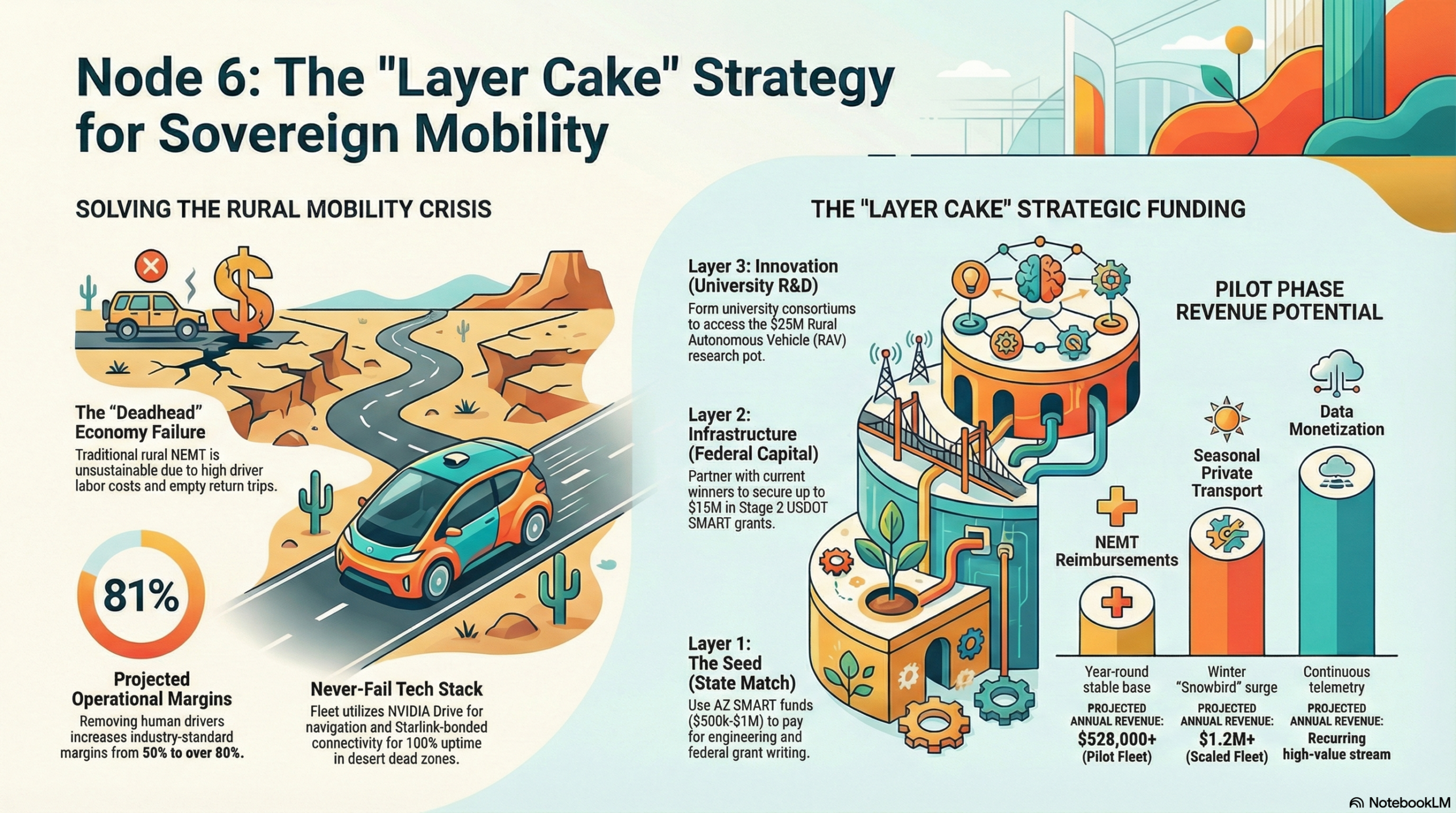
The project addresses a systemic failure in rural Non-Emergency Medical Transportation (NEMT), particularly in regions with aging demographics and seasonal population surges. By deploying a fleet of Kurb Kars—ruggedized, autonomous electric pods—Node 6 aims to eliminate the “deadhead” economy and driver labor costs, increasing operational margins from the industry standard of 50% to approximately 81%.
Strategic success is predicated on a “Layer Cake” funding model that leverages state-level seed capital (AZ SMART Fund) to capture multi-million dollar federal grants (USDOT SMART, CFI, RAV). Key integration opportunities include the 2026 Route 66 Centennial, seasonal transit grids for the Quartzsite “Snowbird” migration, and “Blue Mobility” safety initiatives for the Colorado River Indian Tribes (CRIT).
——————————————————————————–
1. The DeReticular Ecosystem and the Sovereign Stack
DeReticular operates as a venture studio and industrial conglomerate, functioning as a central financing arm that develops independent operating divisions. The organization is guided by the Sovereign Stack thesis, designed to enable communities to operate in “Island Mode”—fully self-sufficient and resilient against national grid failures.
The Three Pillars of the Sovereign Stack
- The Muscle (Agra Dot Energy): Power generation via plasma gasification.
- The Motion (Kurb Kars): Autonomous logistics and robotics.
- The Mind (Biz Builder Mike/RIOS): Network intelligence and business architecture.
The Rural Infrastructure Operating System (RIOS)
RIOS is the proprietary “Global Operating System” that links the physical components of the ecosystem.
- Federated Learning Mesh: Insights gained in one geographic location (e.g., navigating Arizona dust storms) are pushed via network updates to others (e.g., agricultural tractors in Uganda).
- Agentic Workflow: AI agents replace human dispatchers, negotiating routes, charging schedules, and pickups directly with the vehicles.
- Signal Fusion: Bonding high-performance Starlink satellite internet with cellular data to ensure 100% uptime in remote “cellular dead zones.”
2. Node 6: The Autonomous Transportation Division
Formerly designated for “Governance & Education,” Node 6 has been repurposed as the operational hub for healthcare logistics and mobility in La Paz County, Arizona.
Leadership: Brion Crum (“The Human Link”)
Node 6 is led by Champion Brion Crum, a veteran of private equity and real estate. His mandate is to manage the “nexus of technology, capital, and real estate,” ensuring that autonomous infrastructure—such as depots and charging hubs—is physically and economically integrated into the community.
The Regional Challenge: La Paz County
The region serves as an ideal testbed for sovereign mobility due to extreme demographic and geographic pressures:
- Demographic Strain: A permanent population of ~1,805 with a median age of 71.2 years, requiring frequent medical access.
- The Accessibility Gap: Major hospital care is located 32 miles away in Parker, AZ, while existing transit (“Camel Express”) operates only once per week.
- The Seasonal Surge: The winter migration of “Snowbirds” brings over 750,000 to 1,000,000 visitors to Quartzsite, overwhelming local infrastructure and road capacity.
- NEMT Failure: Traditional providers suffer from the “deadhead” economy—the high cost of driving empty vehicles to remote pickups—leading to chronic reliability gaps and missed medical appointments.
——————————————————————————–
3. Technology and Operational Framework
Node 6 utilizes the Kurb Kar fleet to provide 24/7 on-demand NEMT and logistics.
Core Technological Pillars
| Component | Technology | Function |
| The Vehicle | Kurb Kars | Autonomous electric pods that eliminate driver labor costs. |
| The Brain | NVIDIA Drive | AZDOT-approved platform capable of navigating unmapped or poorly marked rural roads. |
| The Nervous System | Global Mesh Protocol | Bonding Starlink and CAT4 vSIMs for unbreakable connectivity. |
| The Power Source | Vehicle-to-Grid (V2G) | Vehicles act as mobile batteries, stabilizing the microgrid and generating revenue via energy trading. |
Healthcare Integration: “Clinic-in-a-Box”
In partnership with Node 2 (Canada), vehicles are equipped with diagnostic sensors. Patient vitals are collected during the 45-minute commute to the hospital and uploaded via Starlink, effectively turning the transport vehicle into a preliminary medical check-up site.
——————————————————————————–
4. Economic Model and Revenue Streams
The Node 6 model transforms transportation from a depreciating asset into a high-margin utility.
- NEMT Reimbursements: Billed to Arizona Medicaid (AHCCCS) and private insurance. Estimated at a $12.21 base rate plus 1.53 per mile. A standard 64-mile round trip yields ~110 in revenue.
- Seasonal B2C Transport: Private ride-hailing services for “Snowbird” visitors in Quartzsite during Q1, utilizing surge pricing to subsidize year-round local healthcare transit.
- Data Monetization: High-value “edge case” driving data (e.g., extreme heat, unpaved roads) is verified via zkVerify and sold to global autonomous algorithm developers.
- Operational Efficiency: Removing the human driver is projected to increase industry-standard margins from 50% to 81%, allowing for a capital expenditure (CapEx) recoup period of approximately six months per vehicle.
——————————————————————————–
5. The “Layer Cake” Funding Strategy
Node 6 employs a multi-tiered, non-dilutive funding strategy to secure capital for the 2026 fiscal year.
Funding Layers
- The Seed Layer (State): Targeted at the AZ SMART Fund to secure $500,000 to $1,000,000 for feasibility studies, engineering, and professional grant-writing services.
- The Infrastructure Layer (Federal):
- USDOT SMART Grants (Stage 2): Up to $15 million, pursued by partnering with Stage 1 winners like the Arizona Commerce Authority.
- Charging and Fueling Infrastructure (CFI) Grant: Leveraging the 50% set-aside for rural areas by framing depots as “Public Community Charging Hubs.”
- The Innovation Layer (Research & Operations):
- Rural Autonomous Vehicle (RAV) Research Program: A $25 million pool requiring a university partner (e.g., ASU or U of A) to study AV deployment in rural/tribal settings.
- FTA Section 5311: Annual formula grants for operational assistance, designating the Kurb Kar fleet as a rural public transit operator.
——————————————————————————–
6. Strategic Regional Integration
Node 6 aims to embed its technology into the regional fabric through three high-visibility initiatives:
Route 66 Centennial (2026)
Positioned as a “High-Tech Heritage” initiative, the project seeks “Official Centennial Project” status. Plans include a “Route 66 Green Corridor” pilot with autonomous shuttles and the conversion of historic motels into “Autonomous Depots.”
Quartzsite Seasonal Transit Grid
Deploying an on-demand micro-transit service during the January-February RV influx. This solves “last mile” mobility for visitors and aligns with the Town of Quartzsite General Plan 2024 for economic diversification.
Colorado River “Blue Mobility”
Establishing the “Parker to Pad” connection in partnership with the Colorado River Indian Tribes (CRIT). This autonomous route links the Blue Water Casino to medical centers, reducing drunk driving and improving healthcare access for tribal elders. It aims to overlay autonomous safety sensors onto the ongoing $25 Million Mohave Road Reconstruction Project.
——————————————————————————–
7. Implementation Roadmap (2026)
| Timeline | Action Item | Target Partner |
| Immediate | Formalize Partnership Vision and TIP alignment. | WACOG |
| Q1 2026 | Apply for AZ SMART Fund and RAV Research Program. | La Paz County, ASU/U of A |
| Q2 2026 | Incorporate V2I sensors into Quartzsite Blvd widening. | WACOG / Town of Quartzsite |
| Q3 2026 | Secure USDOT SMART Stage 2 funding. | AZ Commerce Authority |
| Q4 2026 | Secure operational status and FTA formula funds. | ADOT Transit Division |