
Why a Failing Power Grid is the Next Great Financial Frontier: Insights from the DeReticular Energy Intelligence Model
The stability of modern civilization rests upon centralized power grids characterized by “Linear Fragility.” These legacy systems are increasingly susceptible to cascading failures caused by aging infrastructure and extreme weather events—most notably seen in the “Hard Mode” environment of the Texas ERCOT grid. While traditional models view grid instability as a catastrophic liability, the DeReticular Energy Intelligence (DEI) framework suggests it can be transformed into a “capital geyser.”
By treating infrastructure failure as a predictable data point rather than an accident, DEI identifies a massive strategic opportunity. The question for the modern infrastructure analyst is no longer how to prevent grid volatility, but how to weaponize it into sovereign capital. Can grid instability be shifted from a recurring drain on resources into the ultimate financial engine?
Weaponizing Grid Volatility into Capital
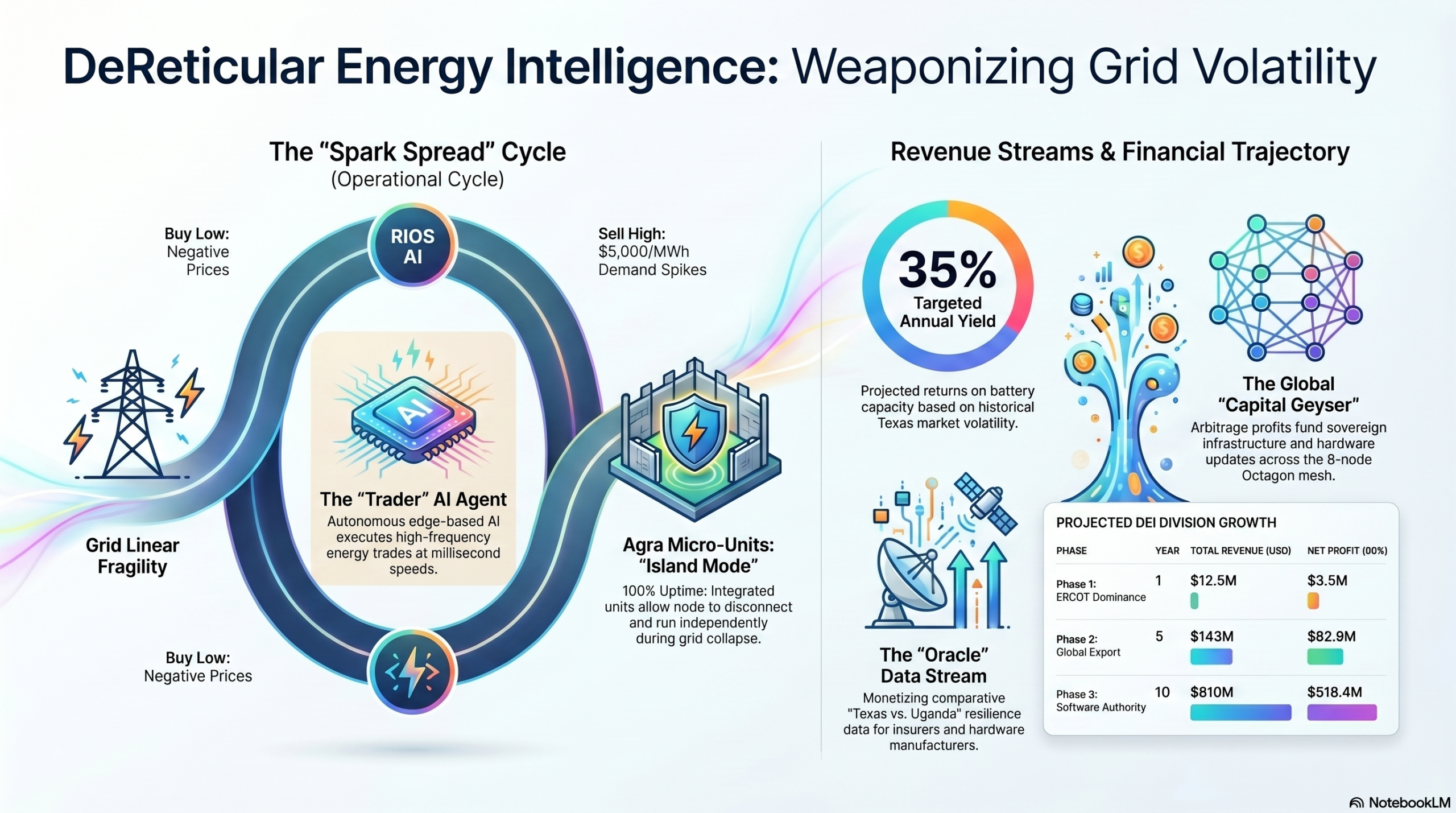
The core of the DEI business plan is “Energy Arbitrage,” a high-frequency offensive strategy that exploits the extreme price fluctuations inherent in deregulated, “islanded” markets. In the ERCOT theater, energy prices swing violently from negative rates (where the grid pays you to consume oversupply) to caps of $5,000/MWh during demand spikes. Using the proprietary Spark Spread Algorithm, DEI transitions from a defensive posture to an offensive one, viewing grid failure as “unharvested kinetic energy.”
“Volatility destroys the fragile. To the sovereign node, volatility is simply unharvested kinetic energy.” — Remnant
The Rise of “The Trader” and Autonomous Arbitrage
Capturing profit from these millisecond-scale fluctuations requires speeds that exceed human capability. DEI utilizes a specialized RIOS (Rural Infrastructure Operating System) AI agent known as “The Trader.” Operating within high-density RIOS-CC-1000 racks, this agent bypasses the latency of the public cloud to execute three distinct operational modes:
- Low/Negative Prices: The system identifies oversupply and directs power into Industrial Battery Energy Storage Systems (BESS), specifically Tesla Megapacks.
- Internal Consumption Mode: When energy is cheap, the AI spins up “Sovereign Sentry” servers to process complex AI models and federated learning tasks for the global mesh, maximizing the “Spark Spread” differential between electricity costs and digital compute value.
- High Prices: During demand spikes, the system instantly suspends compute processes and discharges stored energy back into the grid at maximum market rates.
“Island Mode” – The Power to Defect
A primary objective of the DEI model is the achievement of “Island Mode,” the ultimate strategic win for community resilience. At Node 5 (The Urban Energy Lab in Fort Worth), this is accomplished by pairing Tesla Megapack arrays with 10 TPD (Tons Per Day) Agra Micro-Units. Strategically located near the Fort Worth Stockyards, these units utilize plasma gasification to validate waste-to-energy models using livestock biomass, ensuring a 24/7 carbon-negative baseload.
| Feature | Centralized Fragility | Sovereign Resilience |
| Grid Status | Grid-dependent / Brittle | Island Mode / Defect-ready |
| Reliability | Susceptible to blackouts | Baseload (Always-on) |
| Financial State | Passive Borrower/Consumer | Sovereign Lender/Owner |
“Island Mode is the operational state in which a community or industrial zone functions with full independence from national power grids and centralized supply chains.” — Sovereignty Reimagined
The “Digital Twin” Strategy (Texas vs. Uganda)
DEI monetizes fragility beyond the meter by treating Node 5 as a “Digital Twin” to Node 4 in Kaabong, Uganda. By comparing hardware performance in the extreme, dry heat of Fort Worth against the equatorial humidity of Uganda, DEI generates high-value comparative analytics. This “Resilience Data” allows agricultural insurers and hardware manufacturers to accurately price risk for infrastructure projects in Africa and Southeast Asia. With a near-zero marginal cost to sell these datasets, this “Oracle” function generates projected margins of 90%.
Energy-as-a-Software and the Sovereign Stack
The long-term vision of DEI is a transition from physical asset management to a software-centric model. As the “University” of the Octagon network, Node 5 masters the “hard math” of maximizing revenue per kWh. These lessons are pushed via Over-the-Air (OTA) updates to sovereign nodes globally through “Federated Learning.” This ensures that a optimization discovered in the Texas “classroom” instantly hardens the entire global mesh, providing every node with the latest commercial and defensive intelligence.
The Wealth of Sovereignty
The 10-year financial proforma for DEI projects a scaling of the initial $8M expansion into a powerhouse generating $810M in annual total revenue and $518M in net profit. This trajectory positions DEI as the “Automated Treasury” for the broader DeReticular Venture Studio model. The fiat profits from Texas do not just enrich investors; they fund the hardware and “human software” updates for the rest of the global mesh.
As global grids continue to struggle under the weight of “Linear Fragility,” the choice for communities and investors is becoming clear: Is your current infrastructure a liability that drains resources during a crisis, or an asset that turns volatility into gold?
“The grid is failing everywhere. DEI is the system that learns how to catch the falling pieces and turn them into gold.” — Remnant