
The Sovereignty of the Forge: AI-Augmented Manufacturing and the Death of the Paper-Based Supply Chain
1. Introduction: The Invisible Crisis in the Skies
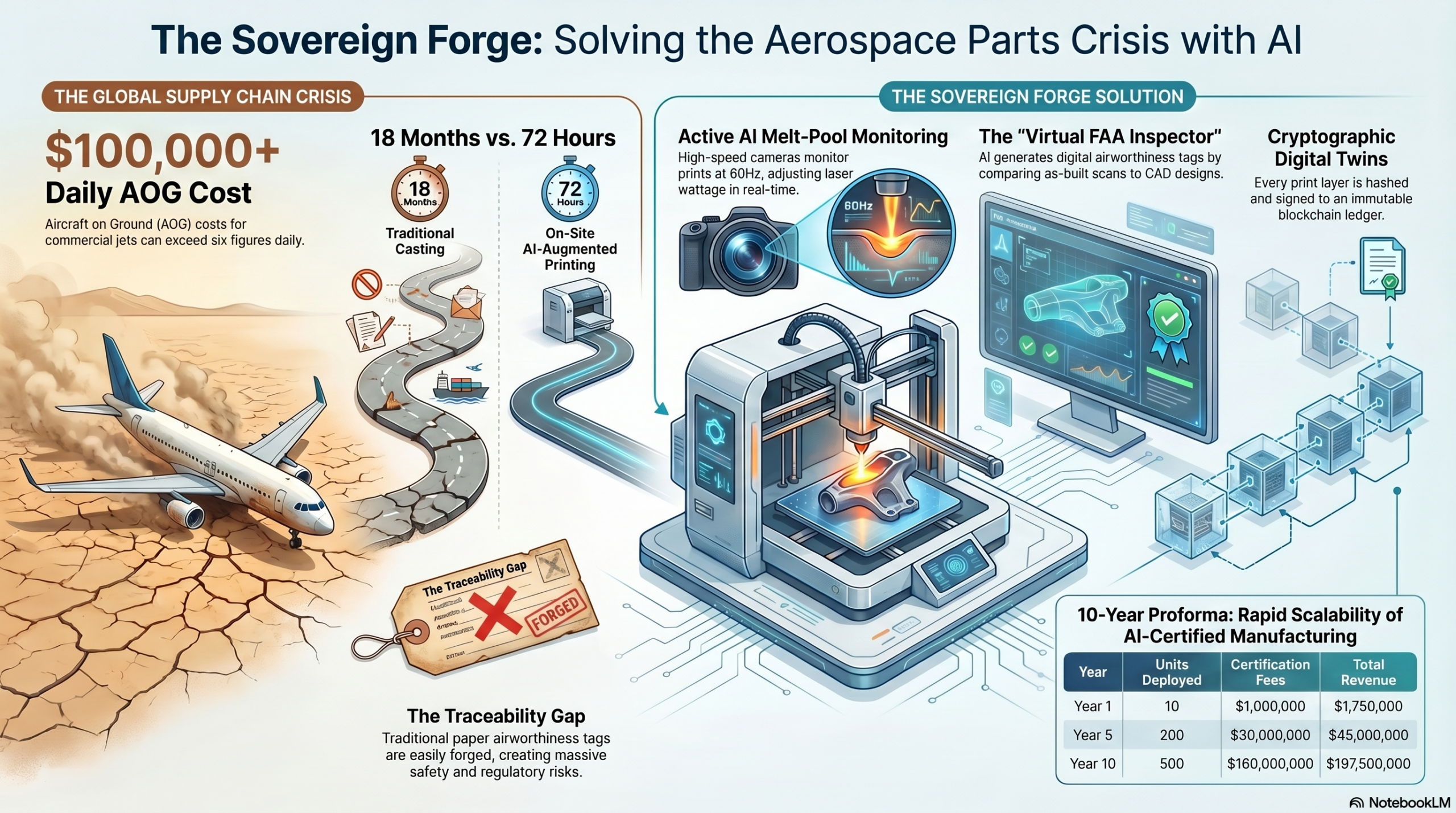
The aerospace industry is currently paralyzed by a “Parts Drought” that is no longer a mere logistical inconvenience—it is an existential threat to global flight operations. When a modern jet is grounded due to a missing component—a state known as Aircraft on Ground (AOG)—the financial hemorrhaging is immediate, often exceeding $100,000 per day in lost revenue. This crisis reached a breaking point with the 2023-2024 AOG Technics scandal, which flooded the market with thousands of engine components backed by counterfeit airworthiness documentation. We are no longer just fighting a physical shortage of hardware; we are facing a systemic collapse of trust. The industry demands a shift from fragile, centralized supply chains to a verified, “Point-of-Use” manufacturing model.
2. The $1.06 Trillion “Super-Cycle”
We are witnessing the birth of a historic industrial “super-cycle.” A unique market paradox has emerged: record-breaking global travel demand is colliding with historic production delays at Boeing and Airbus. Consequently, the average age of the global commercial fleet has risen from 14 years in 2019 to 16 years in 2025, forcing airlines into desperate “cannibalization” strategies—stripping parts from parked aircraft to maintain active ones.
The total aircraft parts market is projected to reach $1.06 trillion by 2032, but the true story lies in the growth velocity of the aftermarket. While the overall market grows at a CAGR of 5.6%, the spare parts segment (valued at $53 billion in 2025) is projected to grow at 6.8% to 8.0% through 2030, significantly outperforming new aircraft production. This pressure is forcing a fundamental shift in industrial philosophy: the transition from “Just-in-Time” inventory to a “Just-in-Case” sovereign infrastructure.
3. Printing the “Unprintable”: The Tungsten Revolution
The most critical bottleneck in engine maintenance involves high-pressure turbine (HPT) blades. These components must withstand the extreme environments of the engine core, making Tungsten the ideal material due to its ultra-high melting point of 3,422°C. However, Tungsten’s notorious brittleness has historically rendered it unprintable via traditional additive methods.
The solution is the Sovereign Forge (SKU: SOV-AUTO-FORGE), an AI-augmented specialty printer stack that retrofits onto existing Laser Powder Bed Fusion (LPBF) systems. Utilizing the DeReticular Optic Array, the system monitors the melt-pool via high-speed thermal cameras at 60Hz. If the AI detects a temperature fluctuation of more than 2%, it executes closed-loop corrections—adjusting laser wattage or scan speed in real-time to prevent “hot cracking.” This technical breakthrough extends to other refractory materials, such as Titanium-Aluminide for drone propulsion mounts and Tungsten-carbide heat shields.
“A Tungsten specialty printer, overseen by a Sovereign Forge AI node, transforms a repair station from a ‘part seeker’ into a ‘part creator.'”
4. The End of Paper: The “Virtual FAA Inspector”
The AOG Technics scandal proved that paper-based FAA Form 8130-3 tags are a relic of a bygone era, dangerously prone to forgery. The DeReticular Sovereign AI stack replaces this vulnerability with an “active robotic inspector.” As the part is built, the OpenClaw “Inspector” AI compares the “As-Built” scan to the “As-Designed” CAD file at a sub-millimeter level.
Every layer of the print is hashed and signed by a TPM 2.0 module, creating an immutable Digital Twin on the Locutus Ledger. This creates a “Dirty Fingerprint”—a mathematical record of the part’s birth that is far superior to paper. This is not just a technological luxury; it is a regulatory necessity. Under the FAA Reauthorization Act of 2024 and the December 2024 Final Rule, approximately 977 foreign repair stations must implement rigorous new tracking and testing mandates by December 20, 2027. The Sovereign Forge provides these facilities with an automated path to compliance.
5. Ghost Files: Securing IP with Ephemeral Decryption
Historically, manufacturers have been hesitant to send high-value aerospace designs to foreign repair stations for fear of Intellectual Property (IP) theft. DeReticular solves this through “Ephemeral Decryption.” Under this protocol, sensitive CAD data exists only within the printer’s volatile RAM during the manufacturing process.
The moment the print cycle is completed, the data is wiped. The foreign facility never “owns” or even accesses the raw file, allowing manufacturers to deploy proprietary designs into contested or foreign zones without risk. With the lead engineer authorizing the start via a Sovereign Key (YubiKey), the process ensures total human-in-the-loop accountability without exposing the “crown jewels” of aerospace engineering.
6. The 48-Hour Turnaround: Logistics in Contested Zones
The Sovereign Forge fundamentally alters the timeline of aerospace maintenance, moving from a model of global shipping to one of “Time-as-a-Service.” Traditional lead times for critical engine parts range from 12 to 18 months; the Sovereign Forge reduces this to a 48–72 hour window.
This capability is essential for “contested logistics,” allowing naval carriers or remote forward operating bases to print verified drone components and engine mounts on-site. The platform targets three primary market verticals:
- Commercial Aftermarket: Eliminating $100k/day AOG costs by “minting” airworthiness at the airport.
- Defense: Standardizing the Forge node for the F-35 supply chain and expeditionary units.
- Space & eVTOL: Small-batch production of high-heat shields and specialized mounts for the burgeoning electric flight market.
7. Conclusion: The Rise of the Sovereign Infrastructure
We are moving toward a future where we no longer sell physical parts, but rather the right to forge them. DeReticular is shifting the business model to a hybrid of hardware leasing and a Transactional Certification Fee ($500 per part). By moving the “Back-to-Birth” digital trail from paper to an AI-verified ledger, we are establishing the new global registry of physical assets.
As we face a decade of aging fleets and volatile supply chains, the ability to “forge” airworthiness at the point of need is the only path forward. It leads us to a pivotal question: In an era where documentation can be faked in seconds, would you feel safer on an aircraft maintained by paper records, or one whose flight-critical parts were “born” under the unblinking, mathematical eye of an AI-verified forge?