Project Octagon: Economic Sustainability & Non-Dilutive Infrastructure Framework
- The Sovereign Economic Model: Resolving the “Bush Gap”
In frontier markets, the primary obstacle to remote industrialization is the “Bush Gap”—a systemic deficit of dependable utilities, connectivity, security, and healthcare that deters international engineers, investors, and industrial partners. Establishing “Sovereign Infrastructure” is a strategic imperative to bridge this gap, creating a self-sufficient enclave that operates independently of fragile, centralized national grids. Node 1, located in Kaabong, Uganda, serves as the “Concierge Layer” of the Project Octagon mesh, providing the high-standard human interface and logistical support necessary to overcome regional deficits and stabilize the “Mind, Muscle, and Motion” of the broader ecosystem.
The core philosophy of this model is the adoption of “Island Mode” operations. By rejecting the “Linear Fragility” inherent in centralized, single-point-of-failure networks, the Sovereign Stack utilizes a self-healing honeycomb geometry to ensure absolute operational capacity. This approach transforms reliability from a variable into a luxury asset, guaranteeing 100% uptime for critical services and providing a “sanctuary of reliability” that facilitates the deployment of high-value industrial assets in geographically remote regions.
This transition toward total operational sovereignty requires a sophisticated financial architecture designed to fund physical assets without compromising the long-term equity or vision of the founders.
- The InVentures Capital Stacking Architecture
Traditional infrastructure projects in frontier markets often succumb to dilutive venture capital rounds, forcing founders to surrender equity and control early in the development cycle. To preserve 100% founder equity, the Project Octagon framework utilizes the InVentures Capital Stacking model. This strategy secures physical assets by layering various non-dilutive funding sources, ensuring the project remains bootstrapped while achieving the scale necessary for industrial-grade deployment.
The “30/40/30” Capital Stack model deconstructs deployment costs into three distinct, non-dilutive layers:
Layer Allocation Source Type Key Strategic Examples
Layer 1 30% Infrastructure & Clean Energy Grants NSF VINES (up to $6M), NTIA AI-RAN
Layer 2 40% Opportunity Zone Real Estate Funds Tax-advantaged regional investment pools
Layer 3 30% Consortium Partner Allocations AEU (land/power) & TriFi (hardware matching)
This architecture provides a decisive competitive advantage over traditional venture-backed models. By leveraging public infrastructure budgets and tax incentives, the framework allows for the deployment of high-value hardware and energy systems while maintaining absolute ownership of the core technology stack. This “Behind-the-Meter” (BTM) asset base creates significant depreciation offsets that further shield the project’s bottom line.
With the capital architecture secured, the model focuses on transforming these physical assets into diversified, high-margin revenue drivers.
- The Dual-Use Medical Model: From Cost Buffer to Revenue Driver
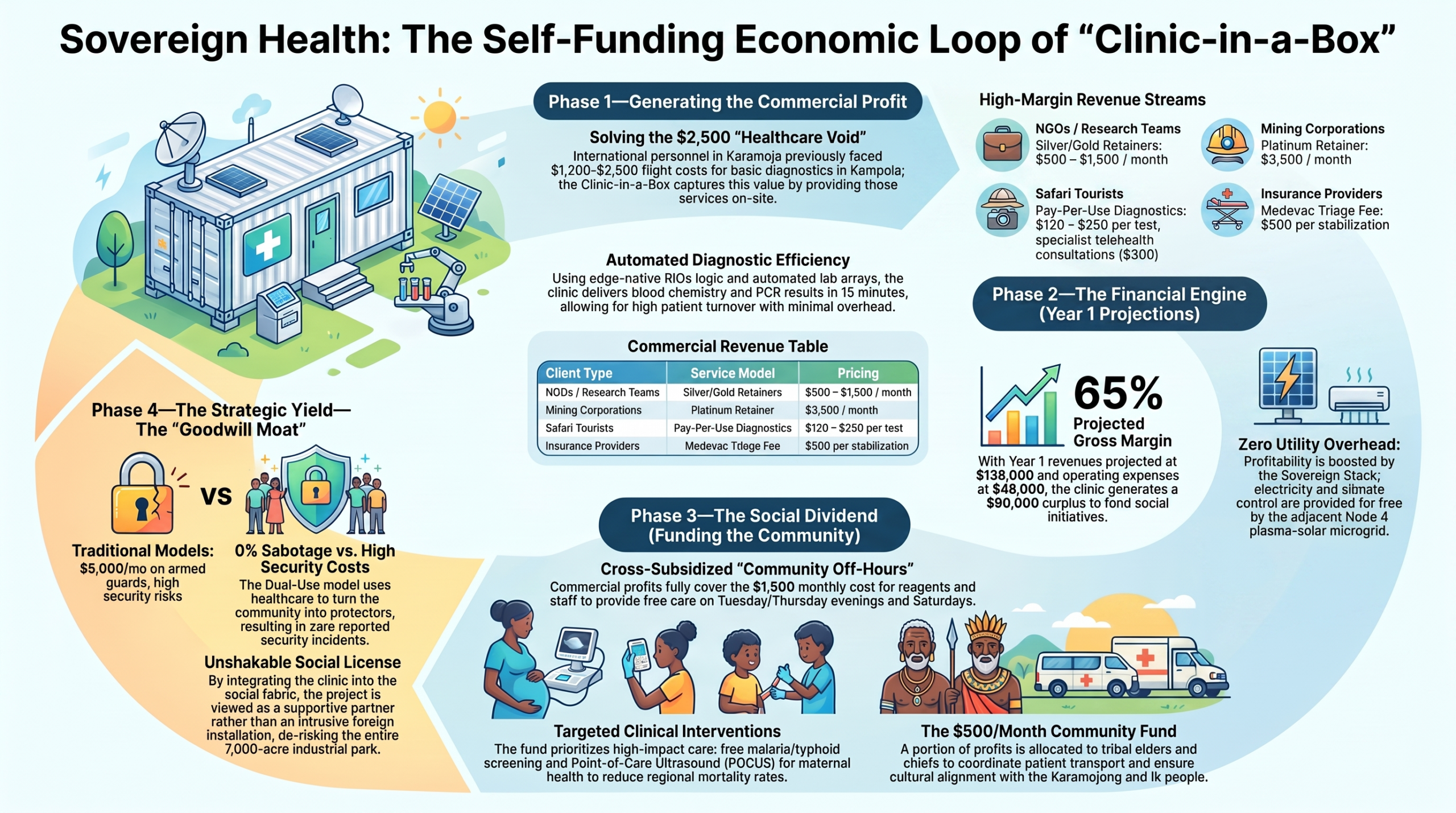
The “Dual-Use” logic transforms assets originally designed for internal workforce safety into commercial tools capable of dominating a regional healthcare vacuum. In Northern Uganda, a severe “healthcare void” exists where expatriates and NGO workers must currently spend $1,200 to $2,500 for emergency charter flights to Kampala for basic diagnostics. The “Clinic-in-a-Box”—a telemedicine and edge-diagnostic module—capitalizes on this by offering Western-standard medical care locally, overseen by Node 2 (Canada) specialists via Starlink High-Performance backhaul.
To monetize this asset, the framework employs a tiered B2B Corporate Retainer model:
Retainer Tier Target Client Monthly Fee Included Services
Silver Local Conservation NGOs $500 5 staff; basic screening; 24/7 emergency access.
Gold Development Partners (WFP) $1,500 15 staff; bi-annual physicals; Kurb Kar emergency pickup.
Platinum Multinational Mining Corps $3,500 40 staff; occupational health tracking; insurance-ready reviews.
By addressing the “Economic Friction of Kampala Evacuations,” the Clinic stabilizes insurance liability and reduces medevac costs (generating $500 stabilization fees per event). Furthermore, the Clinic generates B2C revenue through a Premium Diagnostic Fee Schedule:
Service Type Client Fee Estimated Margin Underwriting Value
PCR Multi-Infectious Screen $120 85% Immediate diagnostic proof for insurance
CBC & Metabolic Panel $150 88% Western-standard baseline vitals
12-Lead ECG (Node 2 Review) $200 75% Insurance-compliant cardiac telemetry
POCUS Ultrasound Consult $250 80% Real-time trauma/internal assessment
In Year 1, the Clinic is projected to generate $138,000 in revenue with a 65% gross margin. Crucially, in Years 1–3, this revenue is primarily de-risked through internal chargebacks to Node 4, ensuring the facility is operational and refined before the Year 4 commercial pivot.
- Social License as an Asset Protection Mechanism
In remote regions, local community integration is a critical risk-management strategy. Rather than relying on hostile physical barriers, the Project Octagon framework builds a “Goodwill Moat” by integrating the Karamojong and Ik populations into the project’s success. This turns potential threats into the project’s primary security layer.
The dual-use medical model allows for the cross-subsidization of local care, funded by high-margin corporate fees. This creates a superior security profile compared to traditional models:
Aspect Traditional Security Dual-Use Model
Monthly Cost ~$5,000 (Armed guards, patrols) $500 (Community Fund) + Subsidized Reagents
Security Risk Fence-cutting, sabotage, tension 0% sabotage; community protection of assets
Mechanism Friction and asset loss Local warriors protect Kurb Kar fleet and SEIP
The “Sovereign Cultural Loop” is reinforced by the $500/month Community Fund managed by the Karamojong Council of Elders and Ik tribal chiefs. This fund is used for critical community logistics, such as transporting elderly patients from distant villages to the Clinic. This trust secures the physical perimeter of the 7,000-acre Smart Eco-Industrial Park (SEIP), as the community views the infrastructure as their own vital lifeline.
- Operational Sovereignty: Low-OPEX Infrastructure Integration
The economic sustainability of Node 1 is predicated on its synergistic relationship with Node 4 (The Energy Engine). By utilizing the Sovereign Stack, the logistics hub operates with an exceptionally low operational cost baseline through Behind-the-Meter (BTM) generation.
The primary driver of this efficiency is “Zero Utility Cost.” All power is provided by the Agra Dot Energy plasma-solar microgrid at Node 4, which features a 10–11 MW baseload capacity. This system utilizes thermochemical conversion through plasma arc gasification (operating at 1,500°C–1,800°C) to dissociate organic waste into hydrogen-rich syngas. This eliminates electricity and water heating expenses from the Node 1 OPEX ledger.
The campus maintains high-standard off-grid accommodations through four primary assets:
- The Lodge: Premium, climate-controlled modular housing for investors and “Black Start” engineers.
- The Depot: A DC Fast Charging hub drawing directly from the microgrid to fuel the Kurb Kar fleet at near-zero marginal cost.
- The Clinic: High-security facility housing the diagnostic modules and edge-native data vaults.
- The Bridge: Tactical staging for initial construction crews and heavy material laydown.
These physical foundations provide the stability required to scale into high-margin digital revenue streams through the conversion of surplus thermal energy into compute power.
- The Digital “Data Flywheel” and SaaS Scaling
Once physical sovereignty is established, surplus physical energy is converted into high-value digital revenue. The 10–11 MW of power from Node 4 energizes RIOS-CC-1000 compute clusters housed at Node 1. These clusters perform zero-knowledge cryptographic verification, AI rendering, and LLM training, creating a “Data Flywheel” where power is directly arbitrated into digital assets.
The Phase 3 roadmap focuses on SaaS platform licensing, white-labeling the “Experience Layer” software for regional operators:
- A2A Reservation System: An edge-native AI booking engine that automates travel, visa filings, and logistics.
- DAOSRUS Experience Layer: Proprietary software for immersive mapping and guest-management in remote hospitality.
The Agent-to-Agent (A2A) workflow allows personal AI agents to negotiate directly with the Node 1 logistics agent. This results in a $0 marginal cost of customer acquisition, as the entire booking and ticketing process is handled autonomously. This scalability allows the software-as-a-service model to achieve 80%+ gross margins as it expands to regional mining and safari operators.
- Risk Mitigation and The Path to Year 4 Expansion
Project Octagon follows a disciplined strategy: transitioning from an Internal Service (Years 1–3) to a Commercial Pivot (Year 4), and eventually to Regional Scale.
Condensed SWOT Analysis:
- Strengths: Unmatched off-grid moat; 100% equity preservation via non-dilutive stack.
- Weaknesses: Single-point dependency on Node 4 microgrid; Extreme Asset Depreciation due to murram roads.
- Opportunities: NGO medical monetization; B2B SaaS licensing; AI “Data Flywheel.”
- Threats: Regional instability; Regulatory Overreach or Grid Protectionism; infrastructure delays.
To bridge the physical “Hard Gap,” the project utilizes “Ash/Char” blocks. This carbon-negative masonry is manufactured on-site by mixing the sterile thermochemical byproduct of the plasma gasifier with local soil, enabling the transition from modular containers to permanent structures.
The “Human Capital Gap” is addressed through the DeReticular Academy/Hospitality Module, which trains local staff in RIOS-based management. To mitigate the “Autonomous Mobility Gap,” driving data from Node 3 (Arizona)—which undergoes extreme “Desert Hardening”—is used to pre-train Kurb Kars for Kaabong’s unpaved roads.
The Octagon model proves the financial viability of decentralized, sovereign infrastructure as a superior vehicle for industrializing the world’s most remote frontier markets.