
Infrastructure Development Roadmap: Achieving Operational Sovereignty through the Localized Energy Loop (LEL)
1. The Strategic Pivot: Navigating the Global Entropy Trap
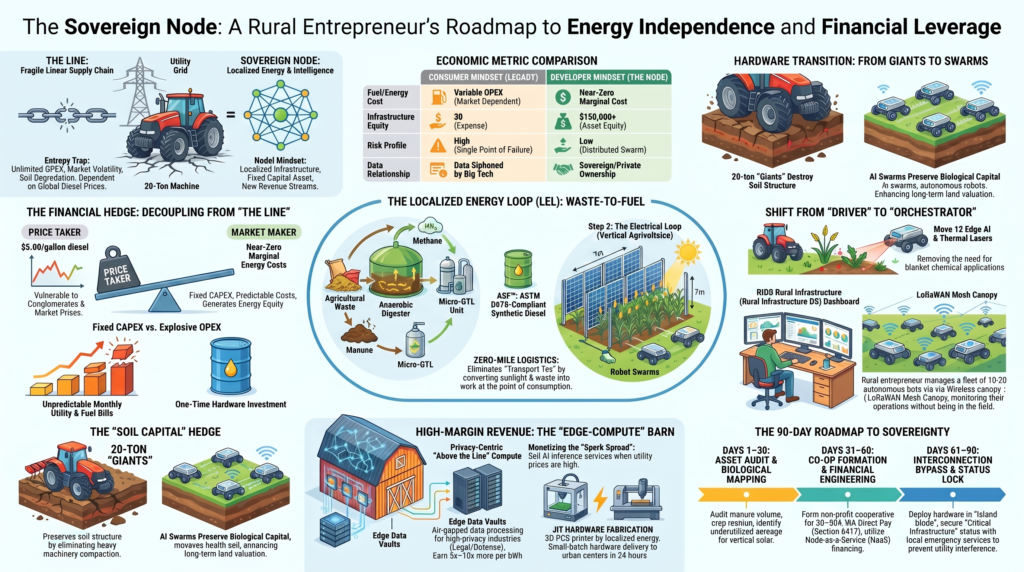
Modern industry is currently ensnared in an “Entropy Trap”—a terminal state where the escalating costs of maintaining centralized, linear systems begin to cannibalize the profits they generate. Legacy operations are tethered to “The Line,” a fragile, global logistics chain where every disruption in diesel refining or transcontinental shipping acts as a tax on the operator. To ensure long-term survival, we must execute a strategic decoupling from “The Line” and transition to “The Node.” This is not merely an efficiency gain; it is a structural pivot toward a circular, nodal production model where energy and resources are regenerated, stored, and deployed within the same square mile.
The fundamental axiom of this AI-driven industrial shift is the distinction between “Below the Line” commodity tools and “Above the Line” sovereign assets. We must cease acting as Price Takers who utilize generic, siphoned LLMs that offer no competitive moat. Instead, we must build Sovereign Infrastructure—proprietary workflows integrated with localized physical execution. By owning the energy loop and the data vault, the nodal entrepreneur converts vulnerable operational expenses (OPEX) into defensible hardware equity (CAPEX).
| Dimension | The Line (Centralized Legacy) | The Node (Sovereign Future) |
| Logic | Linear Logistics (Grid/Oil Dependency) | Nodal Resilience (Island-Mode) |
| Energy | Variable OPEX (Diesel/Utility Bills) | Fixed CAPEX (Micro-GTL/Agrivoltaics) |
| Intelligence | Cloud-Dependent (Latency/Data Mining) | Edge-Sovereign (Local Inference/RIOS) |
| Hardware | “Giants” (20-ton Single-Point-Failure) | “Swarms” (Distributed Resilient Bots) |
| Economic Status | Price Taker (Market Victim) | Market Maker (Sovereign Producer) |
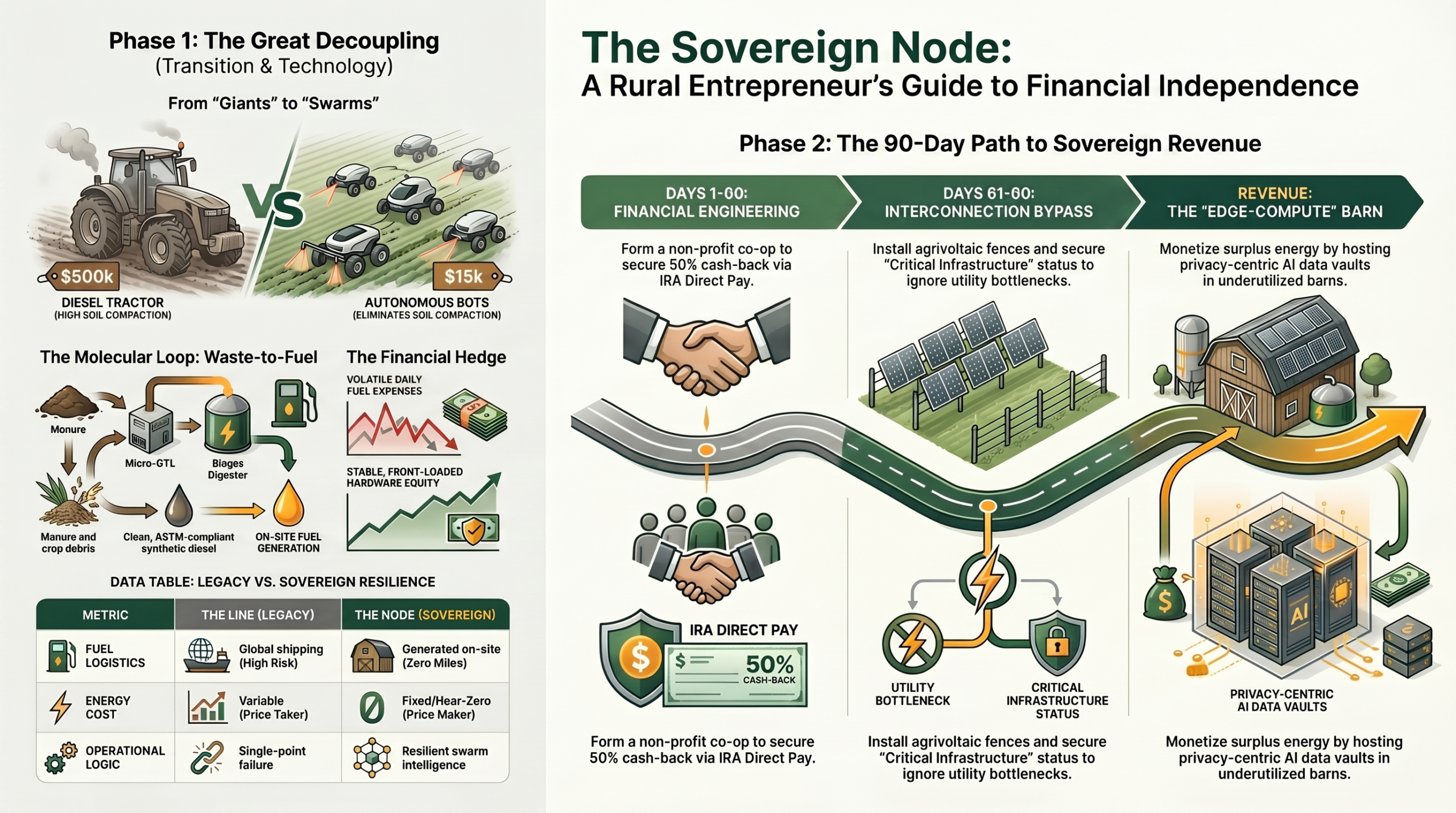
This structural decoupling begins with the stabilization of molecular energy—internalizing the fuel supply chain to neutralize market volatility.
——————————————————————————–
video
2. Pillar I: The Molecular Loop and Biological Syngas Production
Establishing on-site liquid fuel production is our primary defense against the escalating entropy of petroleum markets. Traditional operations remain slaves to “The Line,” where legacy diesel giants achieve a dismal 25–30% real-world thermal efficiency, losing the remainder to heat and noise. By internalizing the supply chain, the Node eliminates the “Transport Tax” (the 3–5% energy loss inherent in delivery) and transforms fuel into a stable, hardware-based asset.
The “Molecular Loop” is powered by the Agra-Dot Micro-GTL (Gas-to-Liquid) process, utilizing Fischer-Tropsch technology to convert organic liabilities into high-density energy. One Agra GTL unit can convert regional waste into 45+ barrels of synthetic diesel per day, effectively turning the farm into its own fuel station.
The Four-Step Molecular Lifecycle:
- Conversion: Anaerobic digesters break down local biological waste (manure or crop debris) into methane-rich biogas.
- Plasma Refinement: GTL units convert gas into syngas, synthesized into stable, high-grade liquid fuel.
- Utilization (ASF™): Agra Synthetic Fuel (ASF™) powers heavy autonomous machinery and backup generators.
- Thermal Recycling: Waste heat from synthesis is recaptured to maintain digester temperatures in winter, ensuring a self-sustaining inner loop.
Agra Synthetic Fuel (ASF™) meets ASTM D975 standards, allowing for immediate implementation in existing diesel engines without modification. While the Molecular Loop handles heavy-duty cycles, the high-frequency electrons required for daily autonomous workflows are managed by the Electrical Loop.
——————————————————————————–
3. Pillar II: Vertical Agrivoltaics and the Electrical Loop
The Electrical Loop provides the “daily bread” for autonomous workflows, delivering high-frequency DC electrons directly to electric swarm units. To maximize land-use efficiency, we deploy vertical bifacial solar fences. These structures utilize a negligible 2% land footprint, allowing for the simultaneous cultivation of crops and energy. This integration increases the Land Equivalent Ratio (LER) by 1.2x to 1.6x, out-producing traditional single-use land models.
Managing these inputs requires RIOS (Rural Infrastructure OS), which facilitates “Solar-Work Sync.” RIOS orchestrates swarm tasks in 15-minute shifts based on real-time output, bypassing the 70% thermal losses common in combustion-only systems through a “Zero-Loss Charge” model.
- High-Energy Mode: During peak output (11 AM – 2 PM), bots are scheduled for intensive tasks like thermal laser weeding.
- Low-Energy Mode: During cloud cover, RIOS shifts the swarm to low-power monitoring or environmental scanning.
This orchestration optimizes the “Spark Spread”—the strategic logic of deciding whether to store energy, execute physical work, or convert electrons into high-margin digital assets.
——————————————————————————–
podcast
4. The Intelligence Layer: Swarm Logic vs. Legacy Giants
The metric of productivity has shifted: we are moving from the “Driver-to-Horsepower Ratio” to “Compute-per-Plant.” As the Director, your role transitions from “Field Hand” to “Fleet Commander” (or Rural Telemetry Commander). Using Move 9 (Voice-in, Structure-out) logic, the Commander gives high-level verbal directives (“Clear the North 40 by Tuesday”), which RIOS parses into coordinate-specific schedules for the swarm.
| Category | Giants (Macro-Scale) | Swarms (Micro-Scale) |
| Vision | GPS Guidance (Field-level) | Computer Vision (Plant-level) |
| Action | Blanket Application (Imprecise) | Point Application (Micro-targeted) |
| Data | Average Yield per Field | Specific Health Profile per Plant |
| Adjustment | Pre-set Mechanical Cycles | Real-time Edge-Inference (Move 12) |
The advantage of “Compute-at-the-Edge” is the “certainty of action.” By utilizing Visual Odometry and Convolutional Neural Networks (CNNs), swarm bots execute millisecond-precision tasks, such as firing thermal lasers at weeds, which eliminates chemical reliance and captures the profit margin previously lost to herbicide inputs.
Swarms are structurally anti-fragile:
- Redundancy: If one bot in a 20-unit fleet fails, 95% of operational capacity remains.
- Modular Repair: Bots utilize generic brushless motors, reducing repair complexity.
- Ground Pressure: Weighing only 150–800 lbs (versus the 40,000–50,000 lbs of “Giants”), swarms allow for operation on saturated ground and eliminate the “Soil Compaction Tax.”
——————————————————————————–
5. The Financial Hedge: Sovereign Data Vaults and Capital Preservation
The Sovereign Node is a financial instrument designed to decouple the entrepreneur from the “Unlimited OPEX” model of legacy industry. By front-loading the cost of energy and automation, we preserve Biological Capital. Legacy “Giants” crush soil structure, necessitating expensive fertilizers—a secondary OPEX that the lightweight swarm avoids entirely.
A primary arbitrage opportunity lies in the Sovereign Data Vault (Edge-Compute Barn). Rather than selling surplus solar/syngas back to the grid at low-margin wholesale rates, the Node routes power to on-site AI compute racks. This converts raw energy into high-margin “Privacy Compute” for the Healthcare, Legal, and Defense sectors—industries that demand the air-gapped data sovereignty that only a local Node can provide.
“Above the Line” Sovereign Revenue Streams:
- Chemical Displacement: Capturing 100% of the margin previously spent on herbicides.
- Green Data Premiums: Selling high-resolution soil-carbon/nitrogen data via the Locutus Ledger.
- P2P Energy/Fuel Sales: Utilizing the Locutus Ledger for peer-to-peer sales of ASF™ or electricity to neighboring nodes, bypassing utility fees.
——————————————————————————–
6. Tactical 90-Day Execution Roadmap
We must operate in “Island Mode,” bypassing the 4-to-7-year utility interconnection queues by deploying “behind-the-meter.”
Phase I (Days 1-30): Asset Audit & Identity Shift
Identify primary feedstocks (manure, crop residue, or solar mapping). Transition from the “Consumer Mindset” (viewing bills as overhead) to the “Developer Mindset” (viewing land as an energy-dense asset).
Phase II (Days 31-60): Financial Engineering
Utilize the “Bypass Formula” to maximize cash flow. Form a non-profit cooperative to access the IRA Direct Pay (Section 6417) stack:
- 30% Base Credit
- 10% Domestic Content Bonus
- 10% Energy Community Bonus Totaling a 50% direct cash reimbursement for hardware. Remaining costs are covered via Node-as-a-Service (NaaS), paying for the balance through the generated Spark Spread.
Phase III (Days 61-90): Interconnection Bypass & Status Lock
Deploy hardware for internal use. Secure Critical Infrastructure (CI) Status by linking the Node to essential services: powering a Sovereign Medic Agent, fire-break fuel production, or emergency mesh communications. This creates a legal “lockdown” against utility lobbyists, as blocking the node would compromise emergency response.
Executive Financial Breakdown | Item | Consumer Mindset (Monthly) | Developer Mindset (Infrastructure) | | :— | :— | :— | | Energy Cost | $4,500 (Outgoing Bill) | $0 (Internal Generation) | | Equipment CAPEX | N/A | $100,000 (Hub Unit) | | IRA Cash-Back | 0 | **-50,000 (50% Stack)** | | Asset Value | $0 (Expense) | $150,000+ (Infrastructure Equity) | | Status | Continuous Dependency | Bypassed via CI Designation |
The transition to the Nodal model is the only strategy that ensures survival in an era of escalating entropy. By building sovereign infrastructure that “lives off the land,” the localized Fleet Commander out-executes centralized conglomerates who remain shackled to the rising costs and inherent fragility of “The Line.”