The Permitting Wall: Why the Future of AI is Moving Off-Grid
Introduction: The Five-Year Waiting Room
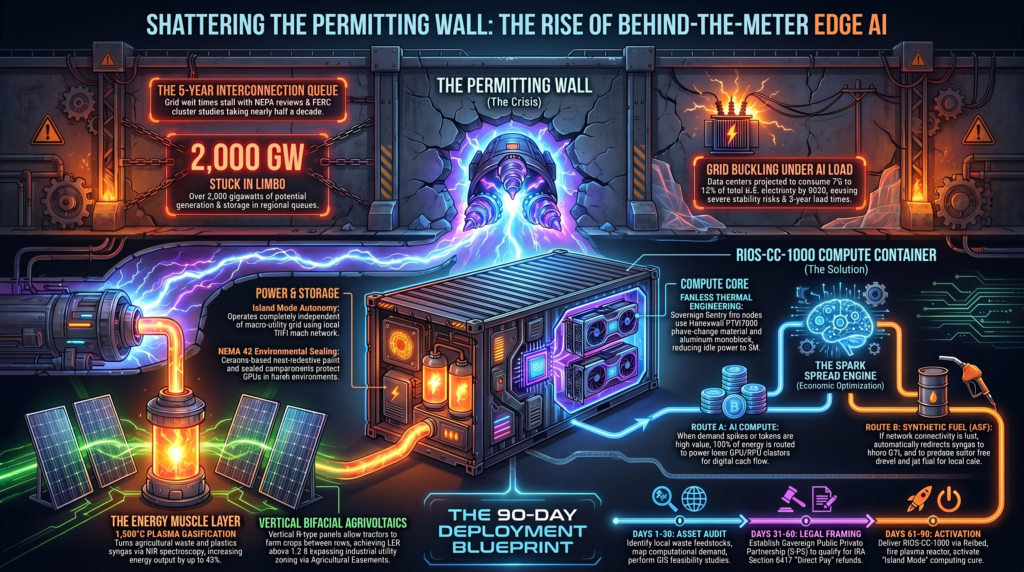
The rapid acceleration of agentic artificial intelligence has reached a critical collision point with the physical limitations of the U.S. electric grid. As hyperscale data center operations expand, they have encountered what infrastructure experts call the “Permitting Wall.” This barrier is defined by grid interconnection queues that now regularly exceed five years and a National Environmental Policy Act (NEPA) review process that slows physical buildouts to a crawl.
For the modern hyperscaler, centralized infrastructure is no longer an asset; it is a national security risk and an operational impossibility. To survive the coming “DeReticular” shift, the industry is moving toward the Sovereign Stack—a suite of distributed, off-grid technologies that allow for “Island Mode” operations, bypassing the decaying utility pipeline entirely.
Takeaway 1: The Grid is a Five-Year Bottleneck
The “Transmission Logjam” is not merely an administrative delay; it is a fundamental failure of physical supply chains. Currently, over 2,000 gigawatts of generation and storage capacity are trapped in regional interconnection queues. While FERC Order 2023 attempted to move from a “first-come, first-served” to a “first-ready” approach, it cannot legislate the existence of physical hardware.
The reality is a 4.5-year average for an Environmental Impact Statement (EIS) and a staggering 3 to 4-year lead time for high-voltage step-up transformers. In the time it takes to secure a single transformer, multiple generations of AI chips will have reached obsolescence.
Data center operations are projected to consume between 7% and 12% of total U.S. electricity generation by 2028, creating single-point-of-failure vulnerabilities that the legacy grid is physically incapable of supporting.
Takeaway 2: Turning Tires and Manure into AI Inference
To achieve energetic self-determination, the Sovereign Stack utilizes advanced thermal conversion via Agra Dot Energy’s plasma gasification. Operating at temperatures exceeding 1,500°C, these nodes use an ionized gas arc to perform molecular cracking, reducing negative-cost feedstocks—such as municipal solid waste, manure, and rubber tires—into their basic elemental constituents.
Molecular Cracking and Byproduct Economics By integrating Near-Infrared (NIR) Spectroscopy, the system analyzes feedstock composition in real-time to optimize high-purity syngas production. Beyond energy, the process creates a “circular economy” through its byproducts: porous biochar for carbon sequestration and soil enhancement, and vitrified slag—an inert, glass-like aggregate—for high-tensile road construction. This allows the node to serve as a local infrastructure hub while powering high-density compute.
podcast
Takeaway 3: The Regulatory Loophole of Vertical Agrivoltaics
Bypassing the Permitting Wall requires a radical rethink of land use. The Sovereign Stack employs “Vertical Bifacial Agrivoltaic” arrays, featuring N-type solar panels installed vertically with strict 7-meter row spacing. This specific geometry allows standard tractors and combines to continue cultivating crops like hemp or soy directly between the solar rows.
The strategic brilliance lies in the Land Equivalent Ratio (LER) of 1.2. Because this configuration makes the land 20% more productive than if it were used solely for farming or solar, the property maintains its “active agricultural classification.” This allows developers to bypass industrial utility zoning and years of permitting, operating instead under protected local agricultural easements.
Takeaway 4: Compute That Doesn’t Breathe
Standard data center hardware is designed for sterile, air-conditioned rooms. In contrast, the RIOS-CC-1000 and Sovereign Sentry Pro are engineered for the “non-breathing” requirements of ruggedized environments. Housed in a 10-foot ISO High-Cube shell with NEMA 4X environmental sealing and multi-layered, ceramic-based heat-reflective paint, these nodes are built to withstand harsh external conditions without traditional air intake.
To manage the heat of dense GPU operations without fans, the units utilize a fanless anodized aluminum monoblock chassis paired with Honeywell PTM7950 Phase Change Material (PCM).
This material provides a thermal conductivity rate of 8.5 W/mK and transitions from a solid to a liquid at 45°C. By eliminating mechanical fans and dust risk, the design reduces idle power draw to just 5W and removes the primary mechanical points of failure common in edge hardware.
Takeaway 5: The “Spark Spread” – When a Computer Becomes a Fuel Plant
Financial survival in a decentralized model depends on the “Spark Spread” algorithm—a mathematical optimization layer managed by the Sovereign Sentry Pro. This engine dynamically arbitrates local energy allocation between two primary routes: digital cash or liquid fuel.
Digital Cash vs. Liquid Fuel The algorithm optimizes the yield (\Pi) by adjusting the allocation factor a(t):
- Route 1 (Digital Cash): Directing power to high-margin Edge AI inference or DePIN utility token mining (V_{compute}).
- Route 2 (Liquid Fuel): Directing syngas to a Micro-GTL unit to refine it into sulfur-free Advanced Synthetic Fuel (ASF™) for regional logistics (V_{ASF}).
This creates a “self-healing” financial model: if external connectivity is lost, the value of compute (V_{compute}) drops, and the Spark Spread engine automatically shifts the allocation to fuel production, ensuring the node remains profitable even in isolation.
Takeaway 6: Bypassing the Capital Freeze with “Direct Pay”
Traditional rural energy financing has stalled, highlighted by the 2026 USDA REAP grant freeze. To move forward, the Sovereign Stack leverages Section 6417 (Direct Pay) of the Inflation Reduction Act. This provision allows non-profit cooperatives and local municipalities to receive direct cash refunds of 30-50% for clean energy deployments, turning tax credits into immediate liquidity.
Under the Node-as-a-Service (NaaS) model, this hardware is deployed with zero upfront cost. The hardware essentially “pays for its own lease” through the automated revenue generated by the Spark Spread algorithm, creating a self-financing loop that avoids the volatility of traditional venture capital or predatory lending.
Conclusion: The End of the Transmission Era
The Permitting Wall is not a temporary delay; it is the terminal point for centralized utility thinking. We are entering an era of Energetic Self-Determination, where the most influential “tech” companies will be decentralized energy cooperatives operating in “Island Mode.”
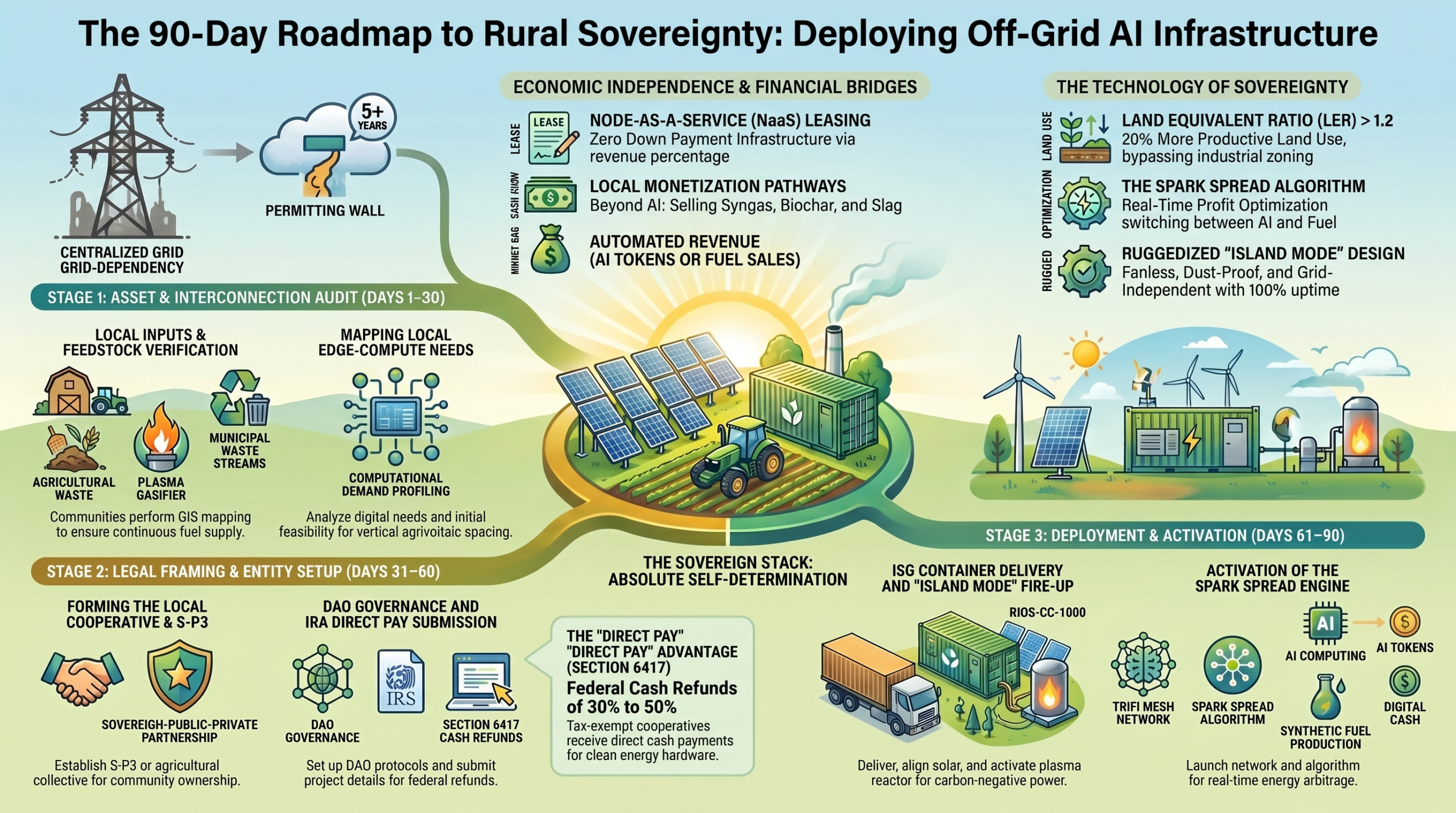
For those ready to exit the five-year waiting room, the 90-day deployment blueprint provides a concrete path to computational sovereignty:
- Days 1–30 (Asset Audit): Identify local agricultural/municipal waste streams and map edge-compute demand.
- Days 31–60 (Entity Design): Form the local S-P3 cooperative and establish the legal framework for Section 6417 Direct Pay.
- Days 61–90 (Deploy & Scale): Deliver the RIOS-CC-1000 container, fire the plasma reactor, and activate the real-time Spark Spread engine.
The question for the next decade is no longer how to connect to the grid, but how quickly you can walk away from it.