
The Rural Platform Playbook: Transitioning from Extractive Pipelines to Sovereign Economies (2026 Edition)
1. The Macroeconomic Shift: Rural Renaissance vs. Federal Bottlenecks
As of mid-2026, rural America is no longer defined by decline, but by a profound demographic reversal. Tech-literate professionals and young families are migrating to non-urban counties in record numbers, bringing a hybrid talent pool that fuses “blue-collar” operational expertise with high-level digital strategy. This influx is the foundational asset for the 2026 Rural Renaissance, yet it faces immediate friction from traditional federal funding structures. The $42.5 billion Broadband Equity, Access, and Deployment (BEAD) program is currently mired in administrative paralysis and cost inflation, forcing a federal pivot toward “tech-neutrality” that favors localized wireless mesh and satellite architectures over delayed fiber deployments. Simultaneously, the USDA’s March 31, 2026, freeze on Rural Energy for America Program (REAP) grants—intended to purge foreign-controlled components from the supply chain—has halted traditional solar projects. This necessitates an immediate shift toward “bankable” continuous baseload energy, specifically biomass gasification, which remains eligible for REAP Guaranteed Loans. Consequently, the convergence of this demographic influx and federal friction demands that local leaders abandon the role of passive consumer and embrace the role of “Platform Orchestrator.”
video
2. Theoretical Framework: From Pipelines to Platform Orchestration
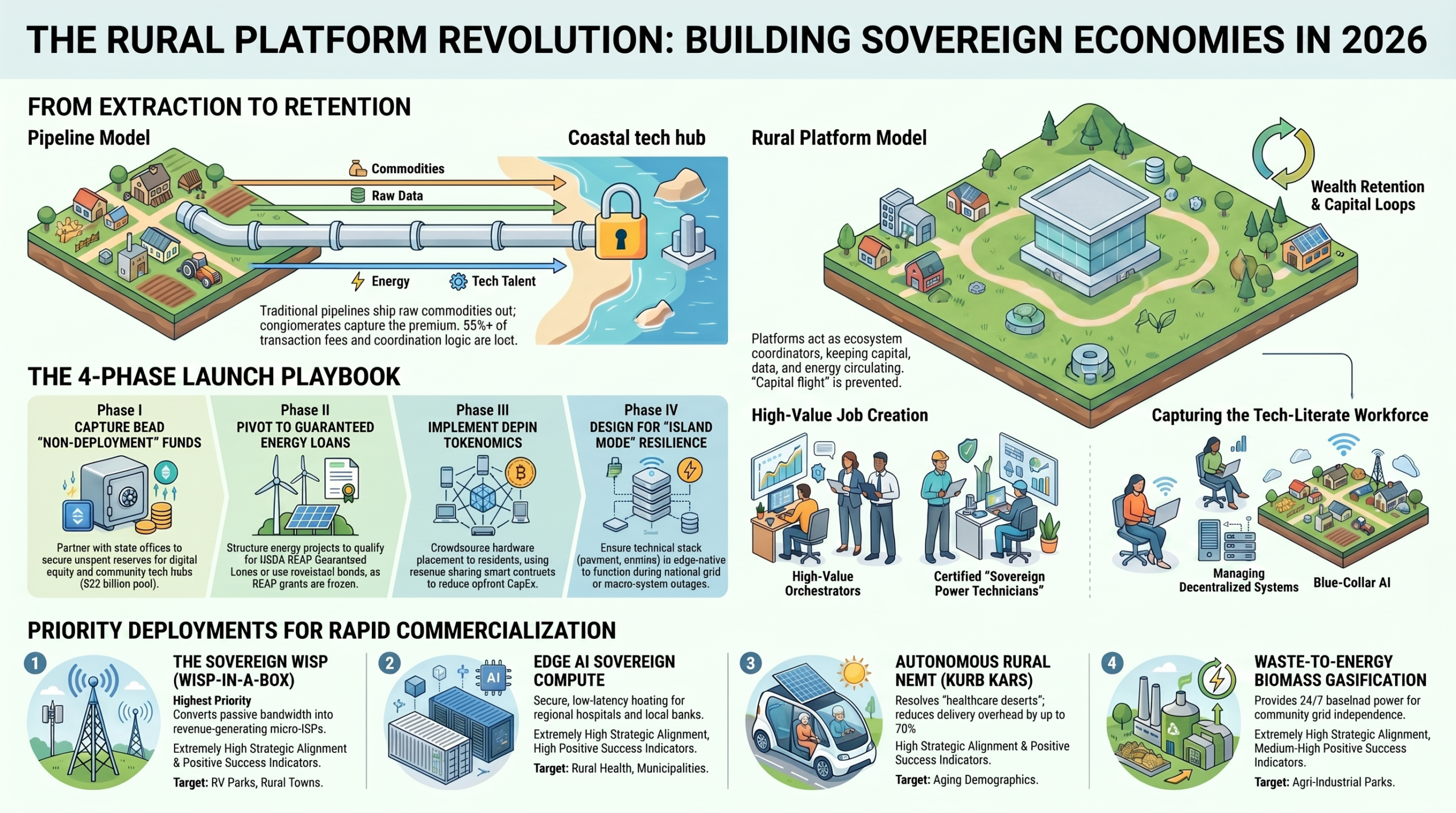
For a century, rural economies have been structured as “Pipelines”: linear extraction models that ship raw commodities (timber, grain, labor) down a supply chain, capturing minimal value while exporting wealth to coastal hubs. To achieve systemic resilience, municipalities must adopt the Sangeet Paul Choudary framework of “Platform Orchestration.” In this model, the municipality acts as an ecosystem coordinator, providing the digital infrastructure and governance logic that allows local producers and consumers to interact directly.
This represents a strategic “Inversion of the Firm.” Rather than the municipality serving as an internal consumer of external assets, it orchestrates an external ecosystem of productive nodes. By controlling the coordination logic and the transaction interface, the community captures the “Interaction Tax” and prevents the capital flight inherent in centralized cloud models.
podcast
Comparison: Traditional Pipeline vs. Rural Platform Model
| Dimension | Traditional Pipeline Model | Rural Platform Model |
| Value Creation | Linear extraction; value is pushed to consumers at the end of the pipe. | Ecosystem orchestration; value is co-created by a network of local nodes. |
| Asset Ownership | External conglomerates own the means of production (Fiber, Grid, Fleet). | Community-owned S-P3s or cooperatives own the “Sovereign Stack.” |
| Wealth Retention | 90%+ of transaction fees and data profits flow out to centralized tech hubs. | 95%+ of transactional logic and capital stay within the local circular economy. |
This theoretical inversion is only possible when supported by a hardened, self-contained architecture known as the Sovereign Stack.
3. The Sovereign Stack: The Mind, Muscle, and Motion of Local Infrastructure
The Sovereign Stack is a unified architecture designed for absolute operational continuity. Its defining feature is “Island Mode”—the capacity for municipal infrastructure to autonomously disconnect from national grids or public clouds during macro-system failures without losing essential local functionality.
The Three Pillars of the Stack
- The Mind (Connectivity & Compute): This pillar is embodied by the Sovereign WISP model. Utilizing the Sovereign Sentry hardware line—Standard (Intel N100), Pro (Intel i3-N305), or Enterprise Epyc Edition—municipalities hyperconverge edge-compute with Starlink Business satellite backhaul via enterprise APIs. This converts passive bandwidth costs into community-owned assets distributed through TriFi mesh networks. To ensure supply chain resilience, the stack utilizes NVIDIA Jetson or Rockchip RK3588 processors, bypassing closed silicon ecosystems.
- The Muscle (Energy): This utilizes the Agra Dot Energy model of 1,500°C plasma gasification. Unlike intermittent solar, plasma gasification generates carbon-negative, 24/7 baseload power from agricultural waste. At Project Umoja (Node 4) in Uganda, this model uses a 7,000-acre hemp estate to generate 10MW of power, proving its viability for industrial-scale applications.
- The Motion (Logistics): This is managed by Kurb Kars, an autonomous Non-Emergency Medical Transportation (NEMT) model. In La Paz County, Arizona (Node 6), where the median age is 71.2, Kurb Kars uses NVIDIA Drive-powered pods to navigate dirt roads. By eliminating driver labor and charging from local microgrids, the model achieves an 81% operating margin, solving the “Deadhead Economy” (empty return trips) that bankrupts traditional rural transit.
Strategic Synergies: The Reinforcing Data Flywheel
The stack operates as a closed-loop system. Muscle (Energy) provides the 24/7 power required for Mind (Compute) nodes. Motion (Logistics) pods autonomously gather biomass feedstock for the gasifier, while the Mind coordinates the routing. Furthermore, the RIOS Roaming & Passport protocol lowers operational cellular costs by automatically shifting data traffic to the local TriFi mesh as vehicles enter the campus zone.
4. Financial Engineering: The “Layer Cake” and Non-Extractive Funding
Traditional commercial debt in the 2026 landscape is predatory. Local leaders must utilize a “Layer Cake” strategy to stack non-dilutive capital.
- Layer 1: The BEAD Windfall: Municipalities must lobby for a portion of the $22 billion in BEAD “non-deployment” reserves. These funds are earmarked for localized digital equity and community tech hubs rather than legacy fiber.
- Layer 2: Federal Incentives (IRA Section 6417): The “Direct Pay” provision allows 501(c)(3) cooperatives or municipal entities to receive 30-50% cash refunds from the U.S. Treasury for clean energy assets. This allows non-profits to bypass extractive tax-equity middlemen.
- Layer 3: Node-as-a-Service (NaaS): Hardware is deployed with zero down, amortized through the Spark Spread Algorithm. The system automatically arbitrates between “Liquid Refining Mode” (converting biogas into Advanced Synthetic Fuel (ASF™)) and “Digital Alchemy Mode” (mining DePIN compute tokens), depending on which yield is higher.
The Sovereign-Public-Private Partnership (S-P3) To shield local assets from external creditors, municipalities should form an S-P3 where a local non-profit co-op owns the physical assets (land, gasifiers) while a private firm manages the network. This entity utilizes Intercompany Sovereign Debt—low-interest, long-term credit kept within the private legal stack—to insulate the community from global forex shocks and predatory seizures.
5. The 90-Day Action Plan for Local Leaders
Speed of execution is critical to capture 2026 federal windows before policy shifts in 2027.
- Phase I (Days 1–30): The Asset & Infrastructure Audit. Execute a comprehensive audit of local biomass feedstock—specifically hemp hurd and municipal solid waste—to determine total baseload BTU potential. Map regional connectivity gaps and talent pool depth.
- Phase II (Days 31–60): Governance & Entity Design. Form a local cooperative and implement the DAOSRUS governance layer. This utilizes Radio Frequency Fingerprinting (RFF)—verifying hardware identity based on the physical electromagnetic transient of the antenna—to replace vulnerable passwords with physics-based security.
- Phase III (Days 61–90): Provisioning & Deployment. Secure NaaS leasebacks and deploy a RIOS Pilot Command Center (a 10-ft NEMA 4X ISO container). Activate the local sovereign cloud and launch a pilot Sovereign WISP or Kurb Kars route.
6. Safeguarding the Ecosystem: Security, Curation, and Judgment
The May 15, 2026, Agentic Crisis—where four chainable CVEs allowed hackers to exploit cloud-connected AI for “god mode” system access—demonstrated that cloud-tethered AI is a liability. The Sovereign Stack prevents data exfiltration by running specialized OpenClaw agents air-gapped on Sovereign Sentry hardware:
- The Field Medic: Provides off-grid equipment diagnostics and step-by-step repair guidance.
- The Industrial Foreman: Automates physical machinery (valves, agrivoltaic tilts) via local CAN Bus protocols.
- The Sovereign Elector: Manages tamper-proof municipal voting via TPM 2.0 hardware.
The Communication Fail-Safe: Hyphanet vs. New Freenet
The stack utilizes a dual-stack communication protocol to ensure continuity. Hyphanet (the Java-based legacy stack) is used for “Deep Archiving”—preserving un-censorable, static community records. The New Freenet (the Rust-based stack) is used for “Real-time DApps,” such as the River chat client, allowing sub-second messaging over local mesh networks even if global DNS is poisoned.
The Locutus Ledger and the Human Luxury Goods
All “Proof of Labor” and civic decisions are recorded on the Locutus Ledger, an offline state database immune to global shutdowns. As AI commoditizes “Knowledge,” the municipal workforce must pivot to the human “Luxury Goods”: Curiosity (framing the right problems), Curation (validating AI outputs), and Judgment (making high-stakes decisions with moral conviction).
Conclusion Owning the coordination logic of the local economy is a democratic imperative. By deploying the Sovereign Stack, rural municipalities transition from fragile endpoints of a global pipeline to resilient, sovereign nodes in a new planetary geometry.