
The Mathematics and Physics of Edge AI: A Guide to Localized Intelligence
1. The Paradigm Shift: From Cloud-Tethered to Sovereign Automation
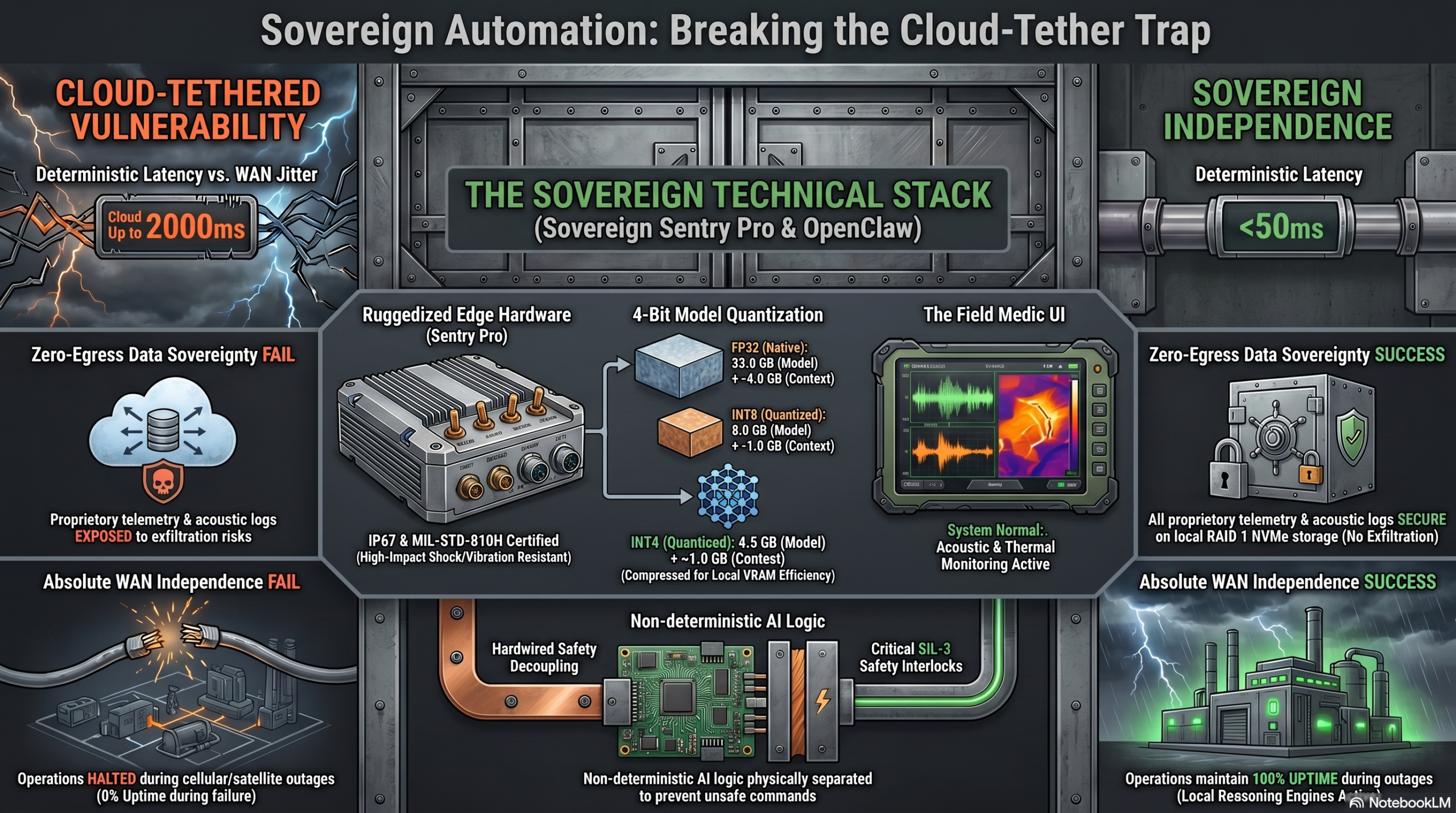
The industrial landscape is currently entangled in the “Cloud-Tether Trap”—a design paradigm where intelligence is centralized in remote data centers, forcing local hardware to act as mere telemetry conduits. This architecture introduces four critical operational risks:
- Deterministic Network Deficits: Wide-area networks (WAN) suffer from non-deterministic latency spikes. A high-speed sorting conveyor or thermal adjustment loop cannot operate reliably when round-trip times fluctuate between 30ms and 1200ms.
- Backhaul Fragility: In remote extraction sites or offshore platforms, continuous connectivity is a luxury, not a guarantee. When the cloud connection drops, the machine’s “brain” is severed, halting predictive maintenance and autonomous guidance.
- Data Exfiltration: Streaming proprietary acoustic logs, high-resolution optical feeds, and sensitive telemetry exposes intellectual property to corporate espionage and changing privacy compliance frameworks.
- Software Lock-in: Cloud-dependent systems often utilize software locks to prevent local modifications, forcing operators to wait for a cloud-based “handshake” to authorize simple mechanical overrides—a critical failure during time-sensitive harvesting or production windows.
The architectural alternative is Sovereign Automation, where intelligence resides directly at the point of physical work. This shift provides four fundamental solutions to cloud-based failure modes:
- Zero-Latency Control: Localized intelligence eliminates network jitter, allowing decision loops to occur within the LAN or physical boundary, solving the Network Deficit failure mode.
- Absolute Uptime: Systems remain 100% functional regardless of external communications stability, directly mitigating Backhaul Fragility.
- Physical Data Custody: Sensitive operational metrics never leave the facility, providing a hardware-level solution to Data Exfiltration risks.
- Operational Sovereignty: Local processing empowers the “Right to Repair,” solving Software Lock-in by allowing diagnostic overrides and maintenance without external authorization.
These mathematical and operational requirements find their physical manifestation in specialized, ruggedized silicon. However, moving massive neural architectures from data centers to the field dictates a strict VRAM ceiling that renders standard model deployments non-viable.
——————————————————————————–
2. The Weight of Intelligence: Understanding Model Quantization
The physical barrier to Edge AI is not raw processor speed (FLOPS), but the constraints of Memory (VRAM) capacity and bandwidth. Standard foundation models utilize FP32 (32-bit floating-point) precision. Each model parameter requires 4 bytes of memory. For an 8-billion (8B) parameter model, the memory budget is prohibitive:
Weight Memory (FP32) = 8 \times 10^9 \text{ parameters} \times 4 \text{ bytes/parameter} = 32 \text{ GB}
Most edge environments cannot dedicate 32 GB of high-speed memory solely to model weights. We overcome this through Quantization, a mathematical process that maps continuous 32-bit weights to lower-precision 4-bit integer (INT4) representations. While raw 4-bit math suggests a 4.0 GB footprint, the industry-standard GGUF format (specifically the Q4_K_M method used in OpenClaw) requires 4.5 GB to account for quantization metadata and grouping overhead.
Critically, a Curriculum Architect must understand the Memory Budget. Memory is a finite resource split between the model’s “brain” (Weights) and its “short-term memory,” known as Context Overhead or the KV-cache. As the conversation or data stream grows, the KV-cache consumes more VRAM, leaving less room for the model weights.
Model Weight Compression Comparison (8B Parameter Model)
| Precision | Weight Memory (GB) | Context Overhead (8k Context) |
| FP32 | 32.0 GB | ~4.0 GB |
| FP16 | 16.0 GB | ~2.0 GB |
| INT8 (Q8_0) | 8.0 GB | ~1.0 GB |
| INT4 (Q4_K_M) | 4.5 GB | ~1.0 GB |
While quantization successfully addresses the physical footprint of the model, we must evaluate the resulting trade-off in “reasoning cohesion.”
——————————————————————————–
3. The Precision Trade-off: Perplexity and Performance
Quantization is not lossless; it introduces “quantization noise.” We measure this impact using Perplexity, a statistical metric defined in the technical glossary as the model’s ability to predict a sample. Lower perplexity indicates higher reasoning coherence.
Empirical testing on 8B parameter models reveals that the mathematical degradation is minimal compared to the memory savings:
- FP16 (Baseline): 5.72 Perplexity
- INT8 (Quantized): 5.74 Perplexity (+0.35% degradation)
- INT4 (Quantized): 5.89 Perplexity (+2.97% degradation)
The Engineering Trade-off: Accepting a marginal 2.97% increase in perplexity facilitates a massive 71.8% reduction in memory overhead. This compromise is the mathematical bridge that allows “cloud-class” intelligence to function within the physical confines of edge hardware. However, quantization only solves the problem of size; it does not address the physics of execution speed.
——————————————————————————–
4. The Physics of Speed: Memory Bandwidth and Token Generation
Edge AI computation is defined by two distinct physical phases, each with a different bottleneck:
- The Prefill Phase (Prompt Processing): The model ingests the initial telemetry or text. This is compute-bound, meaning performance is limited by the raw number of matrix multiplications (TOPS/FLOPS) the chip can perform.
- The Decoding Phase (Token Generation): The model generates an answer or command one token at a time. This is memory-bandwidth bound.
The Decoding Phase is the critical limit for token generation. Because the process is autoregressive, the processor must sweep the entire 4.5 GB of model weights from the VRAM into the registers for every single token generated. The “speed limit” of the AI is therefore defined by the width and speed of the memory highway.
We calculate the Maximum Theoretical Token Generation Speed (T_{max}) using the memory bandwidth (B) of the processor:
T_{max} = \frac{\text{Memory Bandwidth (B)}}{\text{Model Size (GB)}}
For an INT4 8B model (4.5 GB) running on a processor with 200 GB/s bandwidth:
T_{max} = \frac{200 \text{ GB/s}}{4.5 \text{ GB}} \approx 44.4 \text{ tokens/second}
The Engineering Safety Margin
In real-world applications, theoretical speeds drop to 30–35 tokens per second. This “Real-World Gap” is a necessary engineering buffer caused by:
- KV-Cache Overhead: The memory bandwidth consumed by managing the context window.
- Compute Latency: The temporal cost of the processor performing the actual math once the data arrives.
These mathematical abstractions find their physical manifestation in specialized, ruggedized silicon designed to survive the environments where this speed is most needed.
——————————————————————————–
5. The Hardware/Software Manifestation: Sovereign Sentry Pro & OpenClaw
To transform these formulas into operational reality, we deploy a tightly integrated hardware-software stack.
The Sovereign Sentry Pro (Hardware)
The Sentry Pro is a ruggedized compute cluster designed for the field, featuring:
- Unified Memory Architecture: 64GB LPDDR5 delivering 204.8 GB/s bandwidth, ensuring the memory highway can support the bandwidth-heavy decoding phase.
- High-Density Accelerators: Integrated Tensor cores delivering 275 Sparse TOPS for high-speed prefill and vision processing.
- IP67-rated & MIL-STD-810H Certified: A fanless CNC-milled aluminum chassis providing passive cooling and shock resistance up to 60°C ambient temperatures.
- TPM 2.0 Module: A cryptographic anchor for secure boot and signed local updates, ensuring the air-gap remains uncompromised.
The OpenClaw Framework (Software)
The OpenClaw framework is a modular orchestration layer designed to maximize hardware efficiency. It replaces heavy, high-latency Python environments with C++ optimized runtimes using GGUF formatted models.
OpenClaw includes a Deterministic Parsing Layer—a critical safety feature that acts as a schema validator. Because AI models are non-deterministic, any command the model suggests (e.g., changing a pressure valve) must pass through this hardcoded validator to ensure it falls within predefined physical safety boundaries before being written to the machinery.
The Technical Bridge
| Category | Current State (Cloud-Tethered) | Desired Future State (Sovereign Edge) |
| Data Architecture | Continuous streaming; high jitter. | Air-gapped star topology; <50ms latency. |
| Hardware | Low-power gateways; thin clients. | Sovereign Sentry Pro; Unified Memory. |
| Software | Heavy Python-based SDKs. | OpenClaw; C++ GGUF runtimes. |
——————————————————————————–
6. Learning Synthesis: The Edge AI Essentials
The journey from bits to behavior on the edge is governed by three architectural pillars:
- Quantization as the Enabler: Local execution is non-viable without mathematically shrinking the model. Reducing an 8B model to 4.5 GB (INT4) is the prerequisite for edge deployment.
- Bandwidth as the Speed Limit: Speed is not a factor of “brain power” (TOPS), but of the memory highway. The model must be fully swept through the registers for every token generated.
- Sovereignty through Safety: True local intelligence requires an “air-gap” protected by TPM 2.0 and a Deterministic Parsing Layer to ensure that non-deterministic AI reasoning never overrides physical safety limits.
By mastering the interplay between memory bandwidth, quantization noise, and deterministic safety, the curriculum architect builds systems that are not just “smart,” but autonomous and sovereign.