
Governance Charter for Sovereign Autonomous Agentic Ecosystems
1. Strategic Intent and the Autonomous Economic Coordination Layer (AECL)
The global economic landscape is undergoing a fundamental structural transition from an internet of information to the Autonomous Economic Coordination Layer (AECL)—a machine-native transaction network. This charter establishes the strategic necessity of the AECL as the operational substrate for the convergence of Sovereign AI, Decentralized Physical Infrastructure Networks (DePIN), and machine-to-machine (M2M) commerce. We are witnessing a shift in the competitive frontier; the primary theatre of competition is no longer corporation versus corporation, but autonomous ecosystem versus autonomous ecosystem.
The historical evolution of economic systems has reached its third epoch:
- Centralized Industrial Economies: Defined by top-down infrastructure and nation-state banking.
- Digital Platform Economies: Characterized by hyperscale cloud dominance and centralized SaaS architectures that created data monopolies.
- Sovereign Autonomous Economies (SAE): The emerging paradigm where AI-native operations and sovereign compute enable decentralized, self-sustaining economic units.
To lead this transition, we hereby establish the Sovereign Governance Mandate. This mandate dictates that the architecture shall prioritize local ownership of models, local inference, local training, and local policy enforcement. The goal is the maintenance of absolute sovereignty over data and compute while enabling global economic interoperability through cryptographic standards. This economic vision is predicated on the foundational technical requirement of verifiable, cryptographic machine identity.
2. Cryptographic Machine Identity and Accountability Framework
Traditional human-centric identity systems—passports, centralized bank accounts, and legal registries—are fundamentally insufficient for an agentic economy. Machines can replicate, fork, migrate, and evolve at speeds that render manual human verification obsolete. For an autonomous ecosystem to maintain accountability, identity must be rooted in hardware and code, ensuring that every action is traceable to a cryptographically verified origin.
M2M Identity Capability Requirements
| Capability | Purpose | Technical Enforcement |
| Cryptographic Identity | Persistent Machine Trust | Unique digital signatures and machine-level accountability. |
| Hardware Attestation | Device Integrity | Trusted Execution Environments (TEEs) and boot-level verification. |
| Verifiable Credentials | Permission Validation | Cryptographic proof of rights and role-based access control (RBAC). |
| Reputation Systems | Behavioral Trust | Historical tracking of agent reliability via zero-trust runtime verification. |
Persistent Machine Trust is the non-negotiable prerequisite for autonomous commerce. It bridges the trust gap between machine coordination and human-level accountability, ensuring that agents operate within bounded permissions. With a secure identity framework established, the architecture shall utilize advanced payment protocols for secure financial authorization.
3. The Three-Mandate Model for Autonomous Commerce (AP2 & x402)
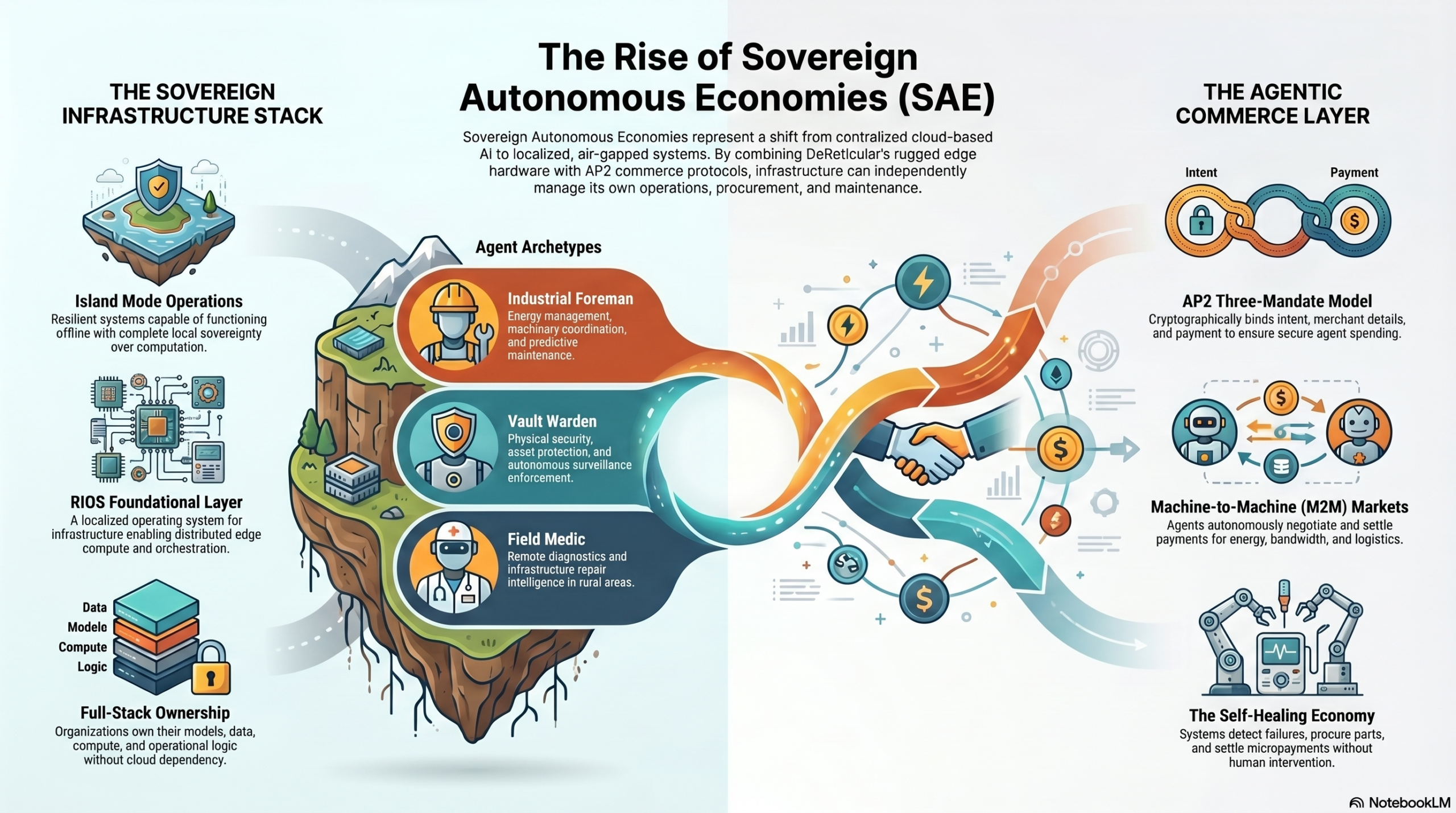
To solve the “trust gap” in agentic spending, this architecture mandates the implementation of the Agent Payments Protocol (AP2)—developed by Google, Coinbase, and over 60 ecosystem partners—and the x402 standard. These protocols provide the cryptographic framework for agents to securely execute transactions on behalf of humans or organizations without the risk of “hallucinated purchases” or unauthorized resource depletion.
The architecture shall enforce the Three-Mandate Model for all commerce:
- Intent Mandate: Defines the authorized goal (e.g., “Procure 500kW of energy below market rate”), establishing bounded autonomy for the agent.
- Cart Mandate: A merchant-signed confirmation of exact products, pricing, and fulfillment details, ensuring the agent interacts with valid, non-hallucinated data.
- Payment Mandate: Binds the approved payment method to the specific transaction context, ensuring settlement only occurs if the cart matches the original intent.
Strategic integration of the HTTP 402 “Payment Required” status code via x402 transforms the web into a programmable payment fabric. This enables stablecoin micropayments and real-time machine-to-machine settlement, turning static APIs into monetizable, sovereign resources. These payment mandates are designed for integration into “Island Mode” operational environments to ensure transactional resilience.
4. Sovereign Infrastructure and “Island Mode” Operations
To ensure resilience against cloud provider dependency and geopolitical fragmentation, the ecosystem shall deploy Sovereign Infrastructure powered by a specialized open-source stack: Kubuntu as the foundational Linux OS, Freenet for decentralized P2P communication, and pfSense for network security and policy enforcement. This stack enables “Island Mode”—the ability for cyber-physical systems to operate with complete local sovereignty, maintaining air-gapped resilience and military-grade privacy-preserving AI.
Within this sovereign environment, the OpenClaw framework and RIOS (Rural Infrastructure Operating System) orchestrate specialized agents to drive Autonomous Infrastructure Capitalism:
- Industrial Foreman: Orchestrates machinery, balances energy loads, and manages predictive maintenance in manufacturing and utilities.
- Vault Warden: Manages physical security and asset protection through autonomous surveillance and security enforcement.
- Field Medic: Provides remote diagnostics and repair intelligence, specifically for rural utilities and humanitarian logistics.
- DevOps Sovereign: Conducts autonomous IT operations, cyber-defense, and sovereign cloud maintenance.
These agents transform static assets into active economic participants, yet their recursive speed necessitates advanced mitigation of agentic runaway.
5. Risk Mitigation: Mitigating Agentic Runaway and Technical Exploits
The move toward autonomy introduces the risk of Agentic Runaway—where recursive failures or logical loops cascade through the ecosystem at machine speed, threatening physical infrastructure. This charter identifies four critical vulnerabilities and prescribes mandatory mitigation:
- Replay Attacks: Mitigated via zero-trust runtime verification and unique transaction sequencing.
- Context-Binding Failures: Addressed through strict cryptographic mandate validation to ensure agents remain within their operational boundaries.
- Prompt Injection: Countered through hardened edge inference systems and secure memory isolation.
- Mandate Hijacking: Prevented via local mandate validation and the rigid enforcement of the Three-Mandate Model (Intent, Cart, and Payment).
To govern these risks, we implement the Machine Constitution. This is a programmatic policy engine designed to prevent recursive market failures by enforcing hard bounds on agent behavior directly within the runtime. These safety measures must interface seamlessly with jurisdictional law and traditional regulatory requirements.
6. Jurisdictional Compliance and Policy Engines
The “Compliance Gap” (KYC/AML, sanctions, and liability) represents a major hurdle for M2M commerce. This charter mandates the development of Jurisdiction-Aware Policy Agents that dynamically enforce localized regulatory modules and sanctions screening within decentralized networks.
Strategic directives for compliance include:
- The transformation of regulatory rules into machine-readable logic.
- The deployment of Sovereign Compliance Layers that allow agents to screen transactions in real-time before settlement.
- The integration of compliance as a native feature of the agentic stack, ensuring that Decentralized Physical Infrastructure Networks (DePIN) remain legally accountable without relying on centralized intermediaries.
7. Governance of DePIN and Autonomous Resource Markets
DePIN transforms static assets—telecom towers, compute clusters, energy grids—into intelligent, self-managing economic systems. Governance of these systems shall be handled through Autonomous Infrastructure Markets, where agents negotiate for bandwidth, compute, and energy. In community-led environments, Autonomous Cooperatives shall pool resources to retain local value.
We mandate the Self-Healing Infrastructure workflow to ensure operational uptime:
- Detection: Sensors or the Industrial Foreman identify a hardware or resource failure.
- Diagnosis: The OpenClaw framework analyzes the telemetry to determine the required remedy.
- Procurement: An agent utilizes AP2/x402 mandates to autonomously source parts or services from the market.
- Validation: The Vault Warden or a monitoring agent verifies the repair/delivery, completing the economic cycle.
This self-optimizing loop ensures that infrastructure remains self-financing and resilient, marking the transition to civilization-scale automation.
8. Strategic Outlook: The Future of Sovereign Autonomous Civilizations
The trajectory of this governance framework leads toward Autonomous Civilization Infrastructure—a world of self-financing energy grids, AI-mediated taxation, and smart cities that optimize their own resources in real-time.
Strategic Probability Matrix (3–7 Year Outlook)
| Probability | Outcome | Strategic Impact |
| High | Widespread adoption of AP2 and Edge AI. | Rapid shift to M2M micropayment economies. |
| Medium | Autonomous municipal utilities and energy grids. | Decoupling of critical infrastructure from centralized grids. |
| Transformational | Self-financing infrastructure ecosystems. | Emergence of post-corporate, agent-managed sovereign states. |
Principal Architect’s Closing Statement
Sovereignty over compute, AI, and payments is no longer a technical preference; it is the modern equivalent of national economic sovereignty. The internet is evolving from an information network into an autonomous economic coordination layer.
The future of technological and economic power will be defined by the successful integration of sovereign infrastructure, autonomous agents, and programmable governance into a unified, resilient ecosystem.