
The $389,999 “Town in a Box” That Reclaims Your City from Big Tech
The Fragility of the Modern City
Most modern municipalities of 3,000 to 10,000 residents are operating on borrowed time. Their most critical systems—police communications, medical records, and local commerce—are tethered to centralized cloud providers located thousands of miles away. This creates a dangerous dual crisis: a single fiber-optic failure can paralyze a city’s services, while a constant “SaaS extraction” bleeds the local economy dry through subscription fees paid to Silicon Valley.
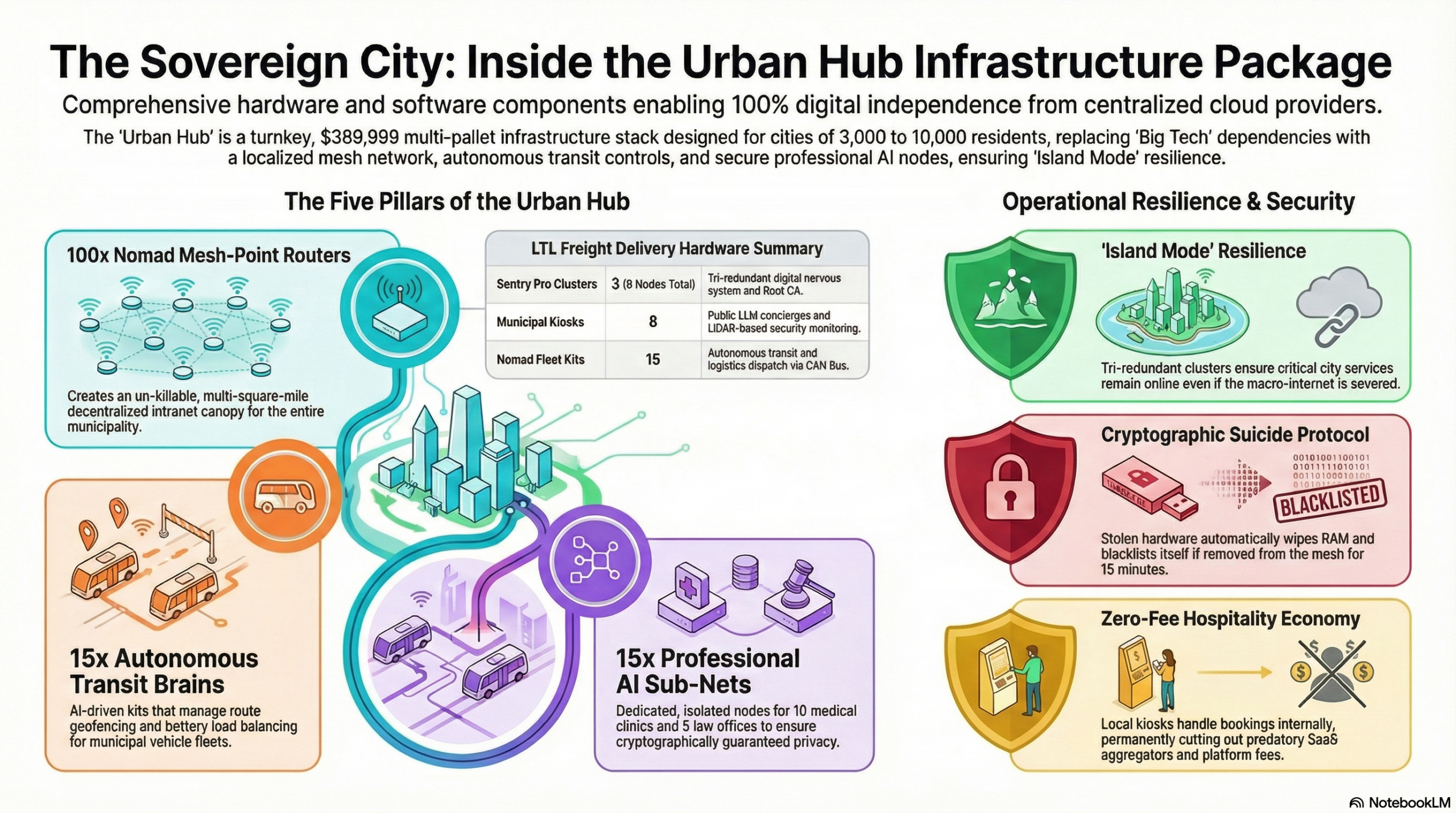
The “Urban Hub” Infrastructure Package is a radical $389,999 alternative to this dependency. This is not just a software update; it is a physical reclamation of civic power. Arriving as a multi-pallet hardware fleet via dedicated freight, this turnkey nexus allows a town to deploy its own Sovereign Municipal Operating System. By shifting from global clouds to local silicon, cities can finally own their data, their transit, and their economic future.
Takeaway 1: “Island Mode” – The End of Municipal Downtime
The foundation of the Urban Hub is Digital Sovereignty, powered by a “Digital Nervous System” that refuses to die. The core consists of three high-capacity Sentry Pro clusters—9x 1U Nodes total—distributed across three distinct municipal zones like City Hall, Police HQ, and the Utility Center.
This configuration provides active-active-active redundancy, meaning if one data center is compromised or loses power, the others seamlessly maintain the load. This core powers a Communications Mesh of 100 ruggedized Nomad Mesh-Point routers, casting an un-killable intranet canopy over several square miles. In “Island Mode,” the city functions even if the global internet is severed. First responders, utility workers, and local businesses continue to communicate and coordinate over a self-healing, localized grid that ensures the city’s heart keeps beating when the wider world goes dark.
Takeaway 2: Reclaiming the Circulatory System (Bye-Bye, DoorDash and Airbnb)
The Urban Hub is designed to stop the “vampiric” drain of wealth from local borders. The package includes eight AI-powered municipal kiosks that act as the gatekeepers of the Decentralized Hospitality Economy. These are not just information stands; they are the engines of a middleman-free future.
Running the Sovereign Executive LLM, these kiosks act as zero-fee booking engines for local hotels, restaurants, and venues. By facilitating these transactions locally, the system reclaims the city’s economic circulatory system from external aggregators. As the operational guidelines specify:
“The Sovereign Executive local LLM interacts with visitors naturally via voice, processing transactions that stay entirely within the local town’s economy, permanently cutting out predatory SaaS aggregators (Airbnb, Expedia, Doordash).“
Takeaway 3: Professional Privacy – AI for Doctors and Lawyers
For small-town professionals, the cloud is often a liability. The Urban Hub solves the tension between AI efficiency and strict privacy through Professional Sub-Nets. The package provisions ten medical nodes and five legal nodes that are cryptographically isolated from the rest of the municipal traffic.
These nodes allow doctors to use local Whisper AI for patient dictation and lawyers to automate contract generation without ever sending sensitive data to a centralized server. This data isn’t floating in an abstract cloud; it is physically housed in localized, secure databases within the city’s own walls. This is a massive leap forward for institutional trust, providing the power of high-end AI with the security of an air-gapped vault.
Takeaway 4: The Industrial Foreman – Autonomous Symbiosis
The package extends its intelligence into the physical movement of the city via 15 Nomad Fleet Kits. These mobile edge servers integrate directly with the CAN Bus of municipal vehicles—electric buses, shuttles, and maintenance trucks—to create a traffic-aware autonomous fleet.
This fleet is managed by the Industrial Foreman AI, which coordinates a “surprising” level of urban symbiosis. When the municipal kiosks detect a surge in foot traffic at a specific transit hub, the Industrial Foreman autonomously dispatches extra shuttles to balance the load. To ensure the system remains sustainable, it utilizes Microgrid Integration, handshaking with local solar arrays to ensure vehicles primarily charge when solar output peaks, preventing a drain on the city’s macro-grid.
Takeaway 5: “Cryptographic Suicide” – Security with Teeth
A decentralized grid requires security that can defend itself in the field. The Urban Hub addresses the risk of physical hardware theft (R-SEC-05) through a high-stakes protocol known as “Cryptographic Suicide.”
The eight municipal kiosks serve as the “eyes” of this security grid, utilizing Vault Warden’s LiDAR-based volumetric monitoring to sense breaches. Because these edge nodes lack localized keys, they require a constant cryptographic handshake with the city’s Root Certificate Authority. If a Mesh-Point or Kiosk is unplugged for more than 15 minutes or its chassis is breached, the Vault Warden protocol instantly wipes the RAM and blacklists the node’s MAC address. This “all-or-nothing” security model ensures that stolen hardware is instantly rendered a useless paperweight, protecting the integrity of the entire municipal grid.
Conclusion: The Future of Localism
The Urban Hub represents a pivot toward a new kind of localism. By running a city on a Sovereign Municipal Operating System, leaders are no longer just administrators; they are the guardians of a self-contained digital ecosystem.
This move toward “air-gapped” city infrastructure suggests a future where the most resilient towns are those that can stand alone. As digital instability becomes the global norm, every urban planner must face a fundamental question: Would you rather trust your city’s survival to a fiber-optic cable owned by a global conglomerate, or to a local grid that you own?