Technical Operations Guide: The Village Infrastructure Genesis Package (SOV-BNDL-VILLAGE)
1. Architectural Foundation: The Digital Nervous System
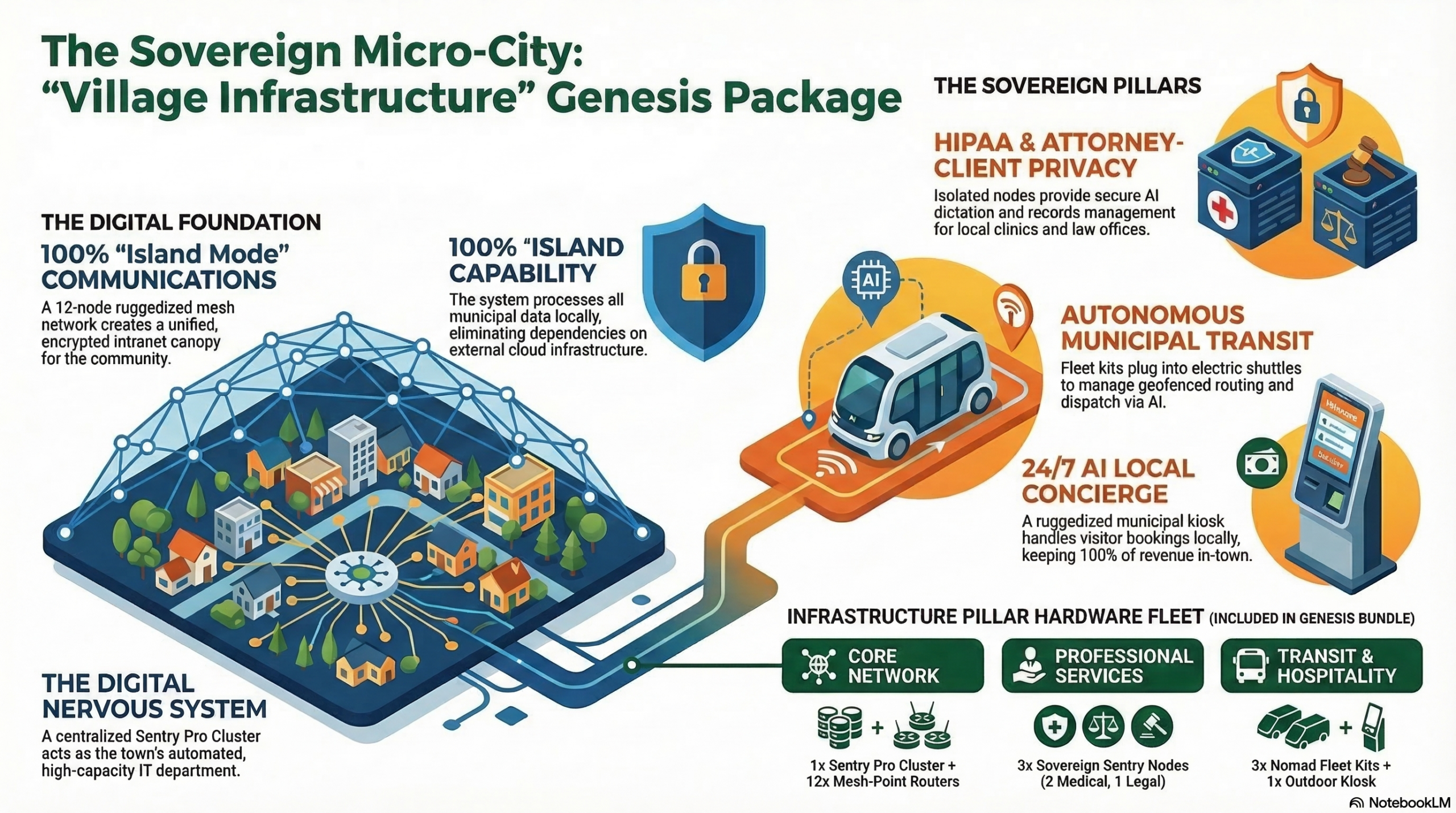
The strategic imperative of the Village Infrastructure Genesis Package is the establishment of a decentralized “Digital Nervous System” via the DeReticular Sovereign Automation ecosystem. This architecture is designed to restore municipal autonomy by systematically eliminating “Big Tech” cloud dependencies. By localizing compute and logic, the system enables a permanent “Island Mode” for town operations. In this state, critical municipal functions—including healthcare, legal services, and emergency transit—remain fully operational even during total macro-internet fiber-line failures. This shift transforms the municipality from a vulnerable consumer of external services into a resilient, self-sovereign digital entity.
The Sentry Pro Cluster acts as the centralized administrative brain of the village. This high-capacity core orchestrates the environment, hosts the town’s Root Certificate Authority (CA), and executes the DevOps Sovereign (Deep Admin) protocols required for system-wide health and security.
Foundation Layer: Bill of Materials
| Component | Quantity | Specifications / Software Role |
| Sentry Pro Cluster | 1 (3x 1U Nodes) | Core Compute; 64GB RAM per node; Proxmox/RIOS environment; hosts Root CA. |
| DevOps Sovereign | Included | Deep Admin software for high-level orchestration, self-healing, and security. |
| Genesis Fleet License | 1 | Master SHA-256 key unlocking OpenClaw agents: DevOps, Executive, Foreman, and Vault Warden. |
| RIOS Core | Included | Foundational Operating System providing the environment for elastic clustering. |
The strategic impact of “Island Mode” on municipal resilience is absolute. By localizing VoIP routing, internal scheduling, and transit logistics, the town ensures community continuity during external infrastructure collapses. This robust core provides the compute-redundancy necessary to support the village-wide communication canopy.
2. Mesh Network Deployment and Connectivity (Nomad Mesh-Point)
A unified, “un-killable” intranet canopy is the strategic prerequisite for a sovereign municipality. The Genesis Package achieves this through a dual-spectrum mesh that integrates Wi-Fi 6E for high-bandwidth professional applications and LoRaWAN for wide-area, low-power IoT telemetry. This ensures total coverage across the village footprint, maintaining connectivity for both high-density data and thousands of municipal sensors.
The deployment of 12 Nomad Mesh-Point Routers follows a rigorous “Pre-Configured” protocol to minimize field errors:
- Topology Mapping: DeReticular engineers map the village’s GPS coordinates during the consultation phase to pre-set LoRaWAN frequencies and geofences.
- Staging & Flashing: Units are staged simultaneously in the warehouse where the DeReticular Controller establishes the mesh topology and verifies handshakes before shipment.
- Physical Installation: Ruggedized routers are mounted on municipal light poles or rooftops, instantly auto-discovering the central Sentry Pro Cluster upon power-up.
The self-healing DeReticular mesh topology ensures that if a single node is compromised or loses power, the network dynamically reroutes traffic to maintain low-latency telemetry. This allows the internal economy and emergency services to function without interruption during macro-internet outages.
Mesh Communication Protocols
| Protocol | Usage Case | Primary Advantage |
| Wi-Fi 6E | High-speed data, video conferencing, Medical OCR for records processing. | Ultra-high bandwidth and low latency for professional pillars. |
| LoRaWAN | IoT sensor monitoring, transit geofencing, low-power utility telemetry. | Wide-area coverage and extreme penetration (GPS-mapped). |
While the mesh provides the physical connectivity, the cryptographic layers provide the mathematical gating required to secure municipal operations.
3. Cryptographic Sub-netting and Professional Pillar Isolation
In a sovereign municipal setting, zero-trust architecture is a tactical necessity. Physical shared infrastructure—the mesh—requires absolute mathematical isolation to protect sensitive legal and medical data. The system utilizes “Segmented CA Certificates” to ensure that a security breach in a public-facing area cannot pivot into the core professional pillars of the community.
The security of the ecosystem is established during the Root CA minting process. The Deep Admin core generates SHA-256 keys to create segmented sub-nets, cryptographically gating data at the source.
Professional Pillars: Configuration Standards
- Medical Nodes: Two dedicated Sovereign Sentry nodes are deployed for healthcare. These nodes use zero-cloud egress for all OCR medical record processing and local Whisper AI patient dictation, ensuring strict HIPAA compliance.
- Legal Node: A single Sovereign Sentry node is dedicated to the town attorney. It is pre-configured for automated contract generation and localized VoIP routing to protect attorney-client privilege.
Architecturally, the risk of “Inter-Clinic Contamination” (R-COMP-02) is mitigated through logical and physical distinction. Doctor A and Doctor B do not share a database or software instance; each practitioner operates on a physically distinct Sovereign Sentry node within their own cryptographically segmented sub-net. This ensures patient data remains siloed despite sharing the same physical mesh. This high-security internal environment seamlessly interfaces with external visitor and transit logistics.
——————————————————————————–
4. Public Interface and Autonomous Logistics Integration
The “Gatekeeper” (Municipal Kiosk) and the “Fleet” (Nomad Kits) act as the primary interfaces between the digital nervous system and the local economy, creating a frictionless visitor experience and a high-yield local economy.
The Municipal Kiosk serves as the public concierge. It runs a hybrid container of the Sovereign Executive, utilizing a local LLM to handle hospitality bookings entirely over the local mesh. Simultaneously, it runs Vault Warden software for secure, LiDAR-based volumetric monitoring of the town square.
For autonomous logistics, Nomad Fleet Kits function as mobile edge servers. These kits integrate directly with municipal electric shuttles via CAN Bus/OBD-II ports to enable:
- Supply Chain Diplomat/Logistics Mode: The Industrial Foreman agent manages autonomous routing and local logistics dispatch.
- Route Geofencing: Precise GPS-based boundaries ensure vehicles remain within the village footprint.
- Battery Load Balancing: Automated power-cycle management for the municipal fleet.
The Sovereign Concierge ensures 100% revenue retention for the community. By bypassing third-party booking platforms like Expedia or Airbnb, the town retains all hospitality fees within the local ecosystem. This autonomous infrastructure requires proactive oversight to scale as the village expands.
——————————————————————————–
5. Operational Maintenance, Risk Mitigation, and Scaling
Proactive system health monitoring is essential for maintaining an elastic, sovereign infrastructure. The Town IT Director manages the system not as a static network, but as a growing foundation capable of scaling from 100 to 1,000 residents through dynamic resource management.
The RIOS Core, built on Proxmox, enables “Elastic Clustering.” This allows the IT Director to dynamically reassign RAM and CPU resources across the Sentry Pro Cluster in real-time. As the population grows, resources are shifted to network routing daemons to prevent bottlenecks without requiring a system-wide shutdown.
Technical Risk Register
| Risk ID | Description | Technical Mitigation |
| R-SCALE-01 | Node Saturation: Bottlenecked mesh routing as population scales. | Elastic Clustering: Dynamic RAM/CPU assignment via Proxmox/RIOS. |
| R-SEC-03 | Kiosk Vandalism/Theft: Physical breach of the kiosk chassis. | Vault Warden Lockdown: Instant key-wiping and mesh-wide police alerts. |
| R-COMP-02 | Inter-Clinic Contamination: Data leakage between separate practices. | Cryptographic Sub-Netting: Physically distinct nodes and Segmented CA Certificates. |
The “Vault Warden Lockdown” protocol is the final safeguard for public-facing hardware. If the physical chassis of a kiosk is breached, the system instantly wipes all local decryption keys and broadcasts an emergency alert to the local police node.
The Village Infrastructure Genesis Package is an “un-killable” turnkey foundation for autonomous community growth. It is the architectural starting point for a municipality that values data sovereignty, economic independence, and structural resilience.