

Preparing for the Agentic Web: AI Integration in WordPress 7.0
Executive Summary
The release of WordPress 7.0 marks a strategic shift toward an AI-driven “agentic web.” By introducing foundational, provider-agnostic APIs—specifically the AI Client and Connectors API—WordPress has established a standardized infrastructure for AI integration. This architecture allows developers to build features based on required “capabilities” (such as text generation or image analysis) rather than being locked into specific providers like OpenAI or Google. While the WordPress core is increasingly ready for AI agents through tools like the Abilities API, the broader ecosystem currently faces a gap in exposing meaningful agent-facing capabilities. Current best practices emphasize that traditional web foundations—semantic HTML, stable URLs, and structured data—remain more critical for AI interaction than experimental agent-specific techniques.
Foundational Architecture: AI Client and Connectors API
WordPress 7.0 introduces a standardized way for the platform to interact with artificial intelligence, moving away from fragmented, plugin-specific integrations.
The Standardized AI Pipeline
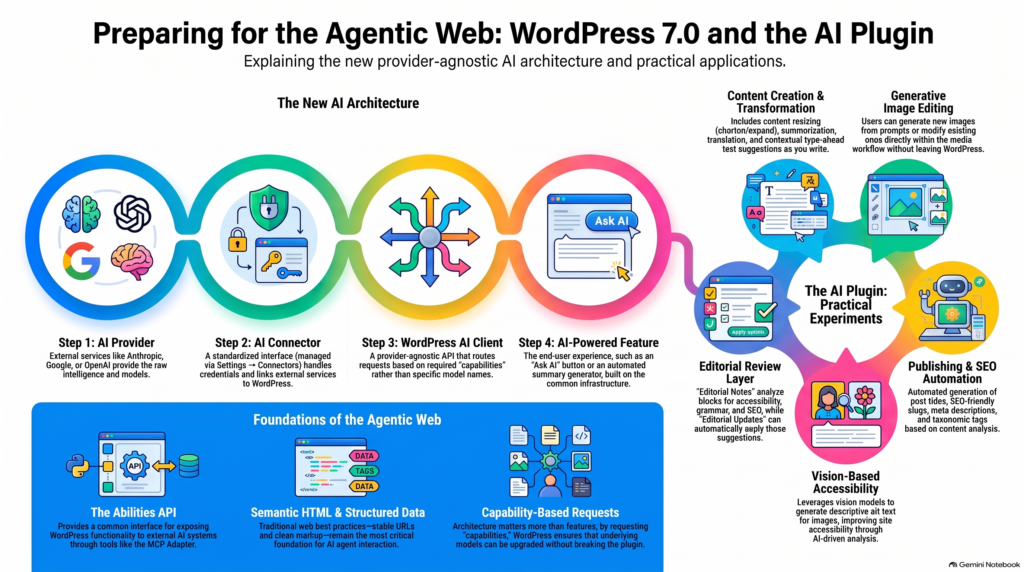
The new architecture follows a specific logical flow to ensure flexibility and security: AI Provider → AI Connector → WordPress AI Client → AI-Powered Feature
- AI Client: A provider-agnostic API built into the core. It allows developers to describe a needed capability (e.g., “generate text”) without hard-coding for a specific model or vendor.
- Connectors API: Manages the connection to external services and handles credentials. A new interface at Settings → Connectors currently supports featured connectors for Anthropic, Google, and OpenAI.
The Significance of Capability-Based Requests
The architecture’s most critical innovation is the separation of provider from capability. Instead of a plugin requesting “OpenAI GPT-4,” it requests a “text generation model.” This allows the underlying model to be changed or upgraded without requiring the feature itself to be rebuilt, ensuring a more durable foundation for AI tools.
The AI Plugin for WordPress: A Practical Demonstration
The “AI plugin for WordPress” serves as a feature plugin—developed by the Core AI team—to test new capabilities and demonstrate the potential of the AI Client and Connectors API.
Core Features and Experiments
The plugin offers a range of tools designed to enhance the editorial workflow and automate routine tasks:
Category Feature Capability Required
Media Image Generation & Editing Image generation models
Writing Content Resizing, Summarization, Translation Text generation models
Writing Type-ahead Text (Ghost-text suggestions) Text generation models
Editorial Editorial Notes & Updates (Accessibility/SEO/Grammar) Text generation models
Publishing Title, Excerpt, and Slug Generation Text generation models
SEO Meta Description Generation Text generation models
Accessibility Alt Text Generation Vision-based image analysis
Organization Content Classification (Tags and Categories) Text generation models
Editorial and Publishing Workflow Impacts
- Editorial Notes and Updates: These tools position AI as an editorial layer. “Editorial Notes” identify issues in readability or SEO, while “Editorial Updates” can automatically apply the suggested changes.
- Refinement over Replacement: Features like “Content Resizing” (shortening or expanding text) are designed to help authors refine their existing work rather than replacing the human writing process entirely.
- Automating Repetition: Tasks like slug generation and metadata creation apply AI to narrowly defined, repetitive tasks that are easy for human authors to evaluate before publishing.
WordPress and the Agentic Web
The “agentic web” refers to a future where AI agents do more than search—they read, understand, and perform actions on websites on behalf of users.
Infrastructure for Agents
WordPress is developing foundational technologies to facilitate this interaction:
- Abilities API: Introduced in version 6.9 and expanded in 7.0, this provides a common interface to expose WordPress functionality to external systems.
- Model Context Protocol (MCP) Adapter: This allows WordPress “abilities” to be made available to external AI agents.
The Ecosystem Gap
Despite core readiness, there is a significant gap in the broader ecosystem:
- Low Adoption: Few third-party plugins are currently exposing meaningful capabilities for AI agents to utilize.
- Agent Behavior: Current AI agents often ignore experimental “agent-ready” techniques (like agent-specific endpoints or llms.txt), relying instead on existing HTML structures.
Conclusions and Strategic Outlook
The integration of AI in WordPress 7.0 focuses on architectural durability rather than simply adding superficial “Ask AI” buttons.
Key Takeaways for Developers
- Provider Independence: Developers should build against the AI Client to ensure their plugins remain functional regardless of which AI vendor a user chooses.
- Fidelity to Web Fundamentals: For websites to be “AI-ready,” owners must prioritize stable URLs, semantic HTML, structured data, and accessible markup. These remain the most effective ways to ensure AI agents can interpret and interact with site content.
- Continuous Exploration: The current state of AI in WordPress is experimental. The goal for developer relations and the community is to determine where these tools are genuinely useful in real-world workflows rather than declaring the platform “AI-native” prematurely.
The AI plugin and the underlying 7.0 APIs represent a shift toward a web where WordPress sites are not just destinations for human readers, but accessible nodes for AI agents and automated editorial processes.