
Strategic Implementation Framework: The Dual-Track Funding Model for Deep-Tech
- The Deep-Tech Funding Dilemma: Traditional VC vs. Sovereign Infrastructure
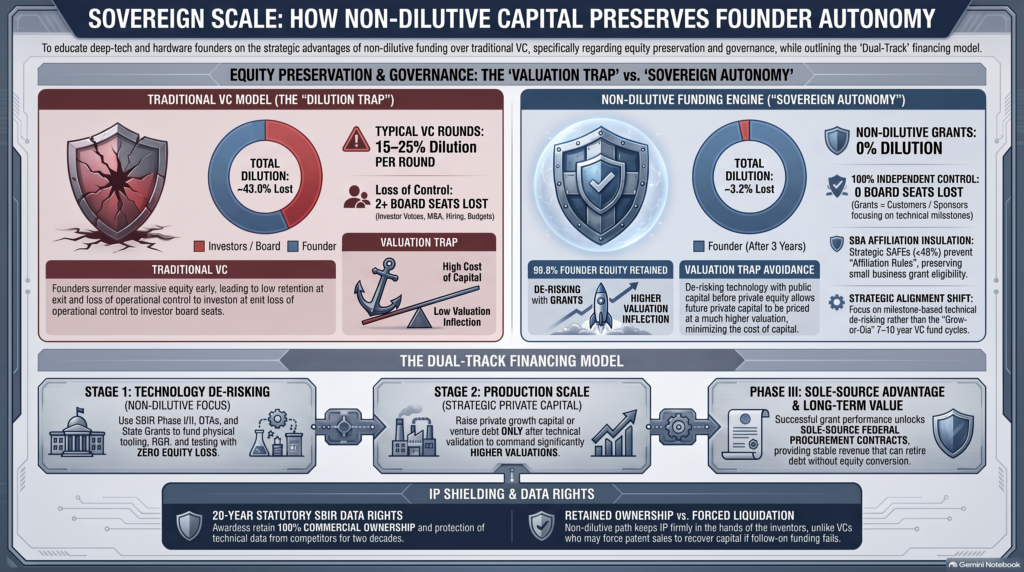
The Architect must recognize that deep-tech hardware ventures face a structural mismatch with the economics of standard venture capital (VC). Traditional VC is optimized for software with near-zero marginal costs, whereas sovereign infrastructure requires high capital expenditure (CapEx), multi-year thermodynamic/chemical validation, and complex regulatory certifications. Relying exclusively on early-stage equity leads to a “valuation trap”: founders are forced to accept low valuations to offset technical risk, resulting in punitive dilution before reaching a Minimum Viable Product (MVP). This framework resolves the dilemma by deploying a non-dilutive engine to de-risk technology to TRL 7/8 before pricing private capital.
Structural Mismatch: Funding Model Comparison
Vector Traditional Venture Capital DeReticular Non-Dilutive Architecture
Equity & Ownership Progressive dilution (15–25% per round) 0% Dilution; 100% commercial ownership
Governance Control Board seats, veto rights, and covenants 100% Independent Founder control
IP Rights Retained by company; assigned to investors 20-Year SBIR Data Rights; Gov Use License
Growth Pressure Top-line “Grow-or-Die” expectations Milestone-based technical de-risking
Risk Sensitivity Severe “Cram-downs” & Washouts Valuation-agnostic; Non-repayable capital
The Capital Cost Paradox: Quantitative Analysis
The long-term impact of early-stage equity surrender is a catastrophic cost center. By utilizing a non-dilutive workflow, the venture achieves a massive delta in equity retention.
- Traditional Progressive Dilution: A standard Seed-to-Series C trajectory results in founders retaining approximately 57.0% of equity at Month 36.
- The DeReticular Advantage: By utilizing SBIR Phase I/II, OTA agreements, and state grants, the venture preserves 96.8% of founder equity at the same Month 36 hardware maturity milestone.
- Strategic Leverage: Non-dilutive funds effectively “repurchase” equity at an exponential value by eliminating technical risk with public capital.
The Sovereign Mandate
This framework is architected for technologies that reduce dependence on centralized, single-point-of-failure networks. Core assets—Agra Dot Energy (thermochemical power), Kurb Kars (autonomous kinetic mobility), and Gen 5 Pods (hardened compute)—must be deployed under a “local-first” approach. This mandate is supported by specialized regulatory sandboxes, such as the West Virginia W. Va. Code § 5B-2-21 (H.B. 2014), which allows for the creation of Certified Microgrid Districts.
This structural alignment transforms technical milestones into financial leverage, providing the fuel for the non-dilutive engine.
- The Non-Dilutive Funding Engine: Federal & Institutional Vehicles
Federal R&D awards must be viewed as “customer-sponsorship.” The Architect deploys these funds as the primary mechanism for technical de-risking, proved through the delivery of specific Statements of Work (SOW) without the surrender of voting stock or board seats.
The Institutional Bridge: TriFi Wireless
To bypass the “Past Performance” hurdles and security clearance friction that often stall nascent hardware startups, the venture must utilize TriFi Wireless as a Prime Contractor Bridge. TriFi Wireless handles facility-clearance prerequisites and federal prime-contractor registration, routing solicitations to portfolio spinouts as specialized subcontractors.
Deconstructing the SBIR/STTR Lifecycle
- Phase I (Feasibility): Awards of $50,000 to $275,000 to establish technical merit.
- Phase II (Prototyping): Competitive awards of $750,000 to $2.0M+ to transition concepts into functional, field-validated prototypes.
- Phase III (Commercialization): The “Sole-Source” advantage. Phase III contracts use non-SBIR federal procurement funds but leverage the prior R&D to bypass competitive bidding requirements entirely.
Alternative Vehicles: OTA and BAA
The Architect shall utilize Other Transaction Authority (OTA) agreements under 10 U.S.C. § 4022 for defense prototype initiatives. OTAs provide flexibility outside the Federal Acquisition Regulation (FAR), allowing for rapid prototyping and negotiated IP terms for nontraditional contractors.
The IP Shield: Statutory Protections
Under the SBA Policy Directive, awardees are granted 20-Year SBIR Data Rights. While the government receives a non-exclusive license for government use, it is legally barred from releasing technical packages to commercial competitors or reverse-engineering the system.
Technical validation via these vehicles provides the matching leverage required for private capital engines.
- Pillar I: Hardware De-Risking & Third-Party Certification
Empirical validation (TRL 7-8) is the critical inflection point where technical risk is eliminated and commercial value is locked. Theoretical models must be replaced with third-party laboratory data.
Mandated Testing Protocols
- Gen 5 Pod (MIL-STD-188-125-1 EMP Hardening): Requires testing in an accredited anechoic chamber. Attenuation targets: 80 dB to 100 dB. Protocols must include Pulsed Current Injection (PCI) for E1 (<2.5\text{ ns} rise time) and E2 waveforms on all points-of-entry.
- Agra Dot Energy (UL 1741 SB / IEEE 1547): A 500-hour continuous duty cycle test of the plasma gasifier and Pawnee GenSet is required. Syngas tar content must remain <50\text{ mg/Nm}^3 to ensure engine longevity.
- Kurb Kars (DoD TRL 7 Swarm Trials): Field trials at DAOS R Us facilities must validate mesh networking latency (<50\text{ ms}) under active EW (GPS-denied) conditions.
Performance Benchmarks & Deliverables
Hardware must meet MIL-STD-810H validation for environmental ingress (Rain, Sand, Dust) up to +55°C.
- Deliverables: Factory Mutual (FM) or Intertek ETL marks; Field Telemetry Logs with timestamped GPS/EW interference data; Third-party Lab Test Verification Certificates.
This technical proof-of-concept becomes the “matching instrument” to unlock the private capital stack.
- Pillar II: The Reg D 506(c) SAFE Capital-Matching Engine
Rule 506(c) serves as the strategic bridge for capital formation. Unlike the restrictive 506(b), 506(c) allows for general solicitation (public marketing), provided all investors are verified as accredited.
Compliance Pathway Comparison
Feature Rule 506(b) Rule 506(c)
Advertising Permissions Prohibited Permitted (Web/Social/Media)
Investor Base Unlimited Accredited + 35 Sophisticated Accredited Exclusively
Verification Requirements Self-Certification Mandatory 3rd-Party Verification
The Automated Workflow & ERA Status
The Venture Studio manages this capital engine by filing Form ADV Part 1A as an Exempt Reporting Adviser (ERA) under SEC Rule 203(l)-1. This allows the Studio to legally manage Special Purpose Vehicles (SPVs) without the overhead of full RIA registration.
- Onboarding: Automated KYC/AML and CFIUS/FOCI foreign-capital filtering to block non-US access to dual-use technical data.
- Verification: Mandatory API-based review of tax returns or CPA letters.
- Execution: Automated Form D triggers within 15 days of the first sale.
The SAFE Leverage Model
The SAFE functions as a “Grant-Matching Instrument.” By raising a $500k SAFE, the venture unlocks 1:1 or 1:2 federal cost-share multiples (e.g., AFWERX or DOE match), creating a 3x leverage multiple on private capital while maintaining SBA eligibility.
- Pillar III: Federal Compliance, Accounting & Cybersecurity
Strategic “Audit-Readiness” is the gatekeeper for multi-million-dollar contracts. The venture must move beyond commercial accrual accounting to a DCAA-ready posture.
SF 1408 Accounting Architecture
The Architect must implement a system capable of segregating direct and indirect costs. The three indirect pools must be calculated using the following mathematical formulas:
- Fringe Rate: \frac{\text{Total Fringe Costs (Benefits, Payroll Taxes)}}{\text{Total Labor Base (Direct + Indirect Labor)}}
- Overhead Rate: \frac{\text{R&D Facility Rent, Lab Consumables}}{\text{Direct Labor + Direct Fringe Base}}
- G&A Rate: \frac{\text{Exec Salary, Legal, Accounting}}{\text{Total Cost Input (Direct Labor + Materials + Subcontracts + Overhead)}}
FAR Part 31 Cost Segregation
FAR Part 31 unallowable costs must be firewalled and paid for exclusively by private SAFE capital. These include: SAFE legal fees, platform marketing, interest on convertible instruments, and executive entertainment.
Hardened Cyber Posture: CMMC 2.0
Handling Controlled Unclassified Information (CUI) requires the 110 controls of NIST SP 800-171. The Architect must deploy a FedRAMP High-authorized cloud enclave (Microsoft 365 GCC High or AWS GovCloud) to protect all engineering blueprints and technical data.
- Pillar IV: Corporate Governance & SBA Affiliation Defense
The “Affiliation” risk under 13 CFR § 121.702 can disqualify a venture from all grant funding. If the SBA determines the Studio “controls” the spinout, headcounts are aggregated, often exceeding the 500-employee limit.
The Affiliation Shield: Governance Mandates
To maintain independence, the Architect must enforce the following “Defense Governance Architecture”:
- Minority Studio Stakes: The Studio must maintain <49% equity (typically 15%–40%).
- Independent Governance: Boards must have a majority of founder-appointed or independent seats.
- Veto Removal: Governance documents must remove “Negative Control” vetoes over budgets, executive hiring, or operational debt.
- The 70% Rule: To avoid “Economic Dependence,” no spinout shall derive >70% of its revenue from the Venture Studio.
Arms-Length Service Level Agreements (SLAs)
All services (grant writing, lab access via TriFi Wireless) must be billed at verifiable fair-market rates. Spinouts must retain the explicit right to terminate Studio services to satisfy SBA Office of Hearings and Appeals (OHA) standards.
- The 24-Month Strategic Execution Roadmap
Phased execution ensures technical de-risking precedes equity conversion, maximizing the “High-Valuation Inflection.”
Phased Roadmap
Quarter Technical & Hardware Track Finance, Legal & Compliance Track
Q1: Foundation 500-hr test plan for Agra GenSet; CAD models for Gen 5 Pod Amend bylaws (remove SBA vetoes); Deploy SF 1408 ledger
Q2: Launch Begin continuous runs; GPS-denied trials at DAOS R Us Launch 506(c) portal; File Form ADV as ERA
Q3-Q4: Validation Complete MIL-STD-188-125-1 PCI E1/E2 chamber tests Syndicate $2.0M+ in match-SAFEs; Mock DCAA audit
Year 2: Scale Scale Gen 5 production; WV H.B. 2014 Microgrid sites Execute Phase III Sole-Source contracts; Commercial SLAs
Final Synthesis of the Dual-Track Approach
- De-Risking with Public Capital: Absorbs R&D and CapEx costs with 0% dilution.
- The TriFi Bridge: Expedites federal revenue via established prime-contractor pathways.
- Preserving Founder Control: Maintains 100% board autonomy by avoiding early priced rounds.
- Equity Preservation: Targets 96.8% equity retention at Month 36 maturity (vs. 57.0% in VC models).
- Maximum Leverage: Prices private capital only at the point of maximum TRL, ensuring the highest possible valuation at the point of conversion.