
Industrial Orchestration Framework: The DeReticular Autonomous Economic Command Center (AECC)
- The Sovereign Paradigm: Spherical Resilience vs. The Line
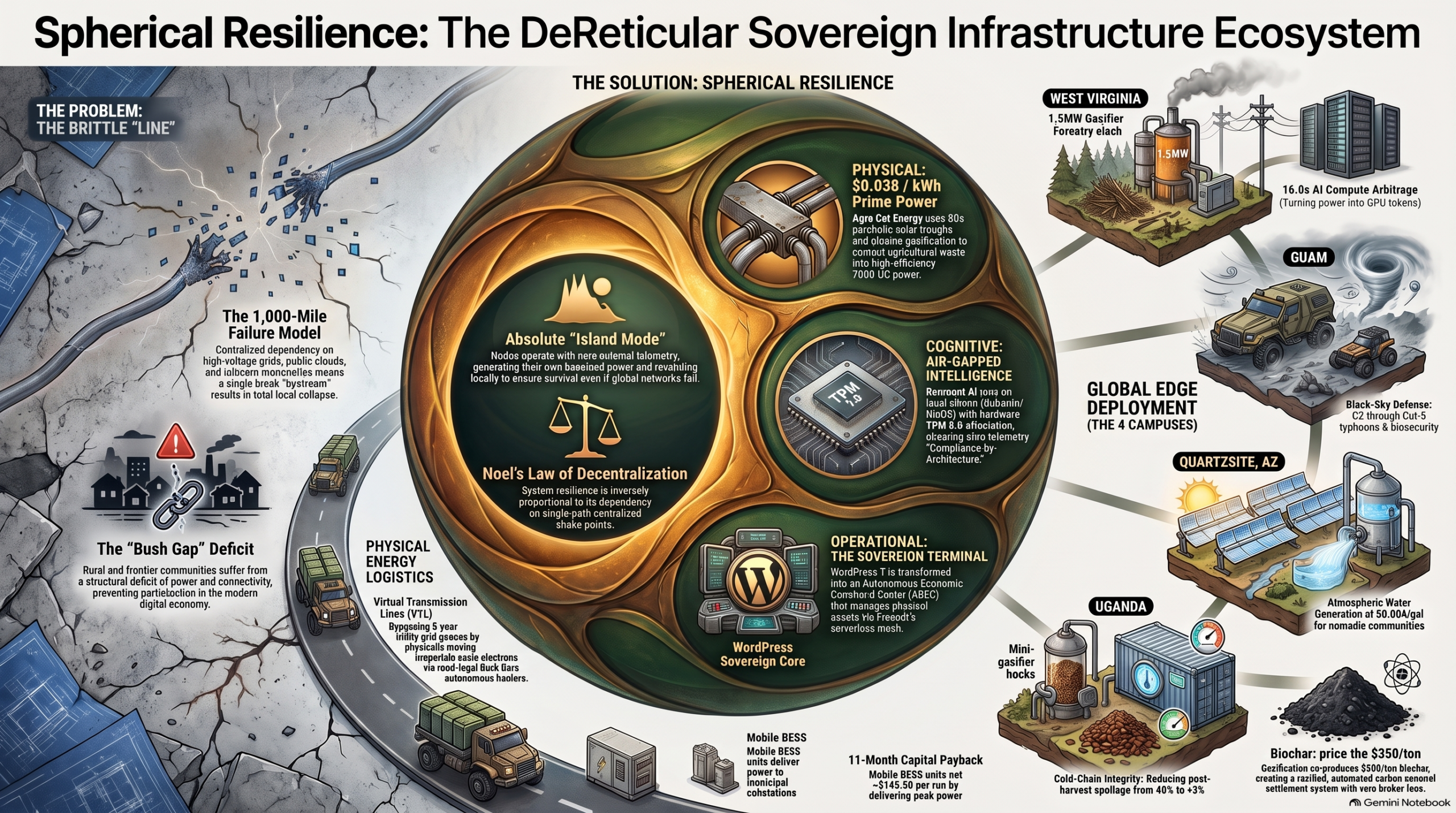
In the current theater of industrial infrastructure, we are confronted by the terminal fragility of “The Line”—a 1,000-mile failure model where critical operations are tethered to centralized electrical grids, public cloud hyper-scalers, and vulnerable telecommunications monopolies. As the 2024 Change Healthcare cyberattack and recent Category 5 Pacific typhoons have demonstrated, a single disruption at any point in this linear chain triggers a cascading collapse of local services. To achieve institutional survival, we must pivot to Spherical Resilience. This architecture mandates that every node—whether an industrial complex, a municipal district, or a hospital—operates in “Island Mode”: self-powered, air-gapped, and economically sovereign.
This paradigm is governed by Noel’s Law of Decentralization, which dictates that system resilience is inversely proportional to its dependency on single-path centralized choke points. To bridge “The Bush Gap”—the structural deficit of power, connectivity, and healthcare that prevents frontier markets from industrializing—the creation of an Autonomous Economic Command Center (AECC) is a strategic necessity. The AECC serves as the cognitive and energetic bridge, replacing the vulnerability of DNS spoofing and BGP hijacking with the “Black-Sky” operational continuity of a DeReticular node.
- The Software Command Plane: WordPress 7 as Industrial Controller
The strategic evolution of WordPress 7 represents its transition from a passive content manager to an air-gapped industrial orchestration engine. By leveraging a native SQLite core and the modern Interactivity API, WordPress 7 eliminates the resource-heavy overhead of MariaDB and the latencies of traditional PHP, allowing it to function as the Human-Machine Interface (HMI) for the Rural Infrastructure Operating System (RIOS™).
For absolute security, the AECC operates within a “Digital Airlock.” The host environment (Kubuntu or NixOS) binds all services strictly to the local loopback address (127.0.0.1), while kernel-level UFW/NFTables are configured to drop all inbound WAN traffic. This ensures the AECC is physically inaccessible to external threat actors while managing local assets through a familiar, reactive dashboard. The dereticular-sovereign-core plugin maps physical hardware to Custom Post Types (CPTs), treating industrial assets as a digital ledger.
Physical-to-Digital Ledger Mapping
Custom Post Type Operational Role Real-Time Telemetry & Regulatory Alignment
cpt_bess_unit Battery Storage Ledger Real-time SoC, SoH, and Bus Voltage via RIOS™ SCADA.
cpt_energy_auction Economic Arbiter Real-time bids/asks and AI compute arbitrage spreads.
cpt_fleet_manifest Logistics Dispatch Kurb Kars routing and Project Octagon BESS swap schedules.
cpt_clinical_intake HIPAA Clinical Ledger Air-gapped, zero-cloud patient records (45 CFR § 164.312).
- The Energetic Foundation: Agra Dot Energy & The 700V DC Bus
Economic sovereignty is contingent upon “behind-the-meter” prime power. By utilizing the Power Generation and Consumption Act (W. Va. Code §5B-2-21), DeReticular nodes are certified as Certified Microgrid Districts, legally bypassing the multi-year utility interconnection queues and Public Service Commission (PSC) rate regulations.
The Agra Dot Energy complex utilizes high-temperature plasma gasification (750°C to 1,200°C) to convert agricultural and forestry waste into high-calorie synthesis gas (syngas). This process is augmented by 80x parabolic solar-thermal troughs producing 350°C industrial steam for pre-heating and desalination. A critical engineering breakthrough is the 700V DC common busbar. By rectifying Pawnee rotary generators and solar inputs directly to DC, the system eliminates three distinct conversion stages, achieving an end-to-end power chain efficiency of 97.7%.
The Economics of Sovereign Generation:
- Levelized Cost of Energy (LCOE): $0.038 / kWh.
- Secondary Revenue: High-grade biochar co-production ($350/ton) for carbon removal credits.
- Efficiency: 97.7% via direct DC coupling to stationary BESS and GPU racks.
- Arbitration of the Energy Trilemma: Compute, Storage, and Logistics
The AECC acts as a cognitive arbiter to solve the “Energy Trilemma” in real-time. It must determine the most profitable use for every generated kilowatt-hour based on the following formula:
Decision Matrix = max(Value Compute, Value Local BESS, Value Mobile Transport, Value Heat)
The primary economic engine is AI Compute Arbitrage. While exporting power to a fragile grid yields a mere $0.04/kWh, the AECC redirects that energy into liquid-cooled RIOS-CC-1000 GPU racks to generate billable AI tokens valued at $0.65 to $1.00/kWh. This results in a 16.6x economic expansion of the energetic feedstock.
Furthermore, the AECC optimizes the thermal layer. Waste heat from Pawnee generators drives an ammonia-water absorption chilling cycle, providing the essential cold-chain storage needed to solve the Bush Gap in frontier markets like Uganda. This thermal membrane desalination and cold-storage capability ensure that no energy is wasted, converting “waste” into a critical community resource.
- Decentralized Settlement: Freenet River & Wasm State Contracts
To eliminate the risk of centralized financial censorship, the AECC utilizes serverless, peer-to-peer (P2P) cryptographic protocols. State transitions within WordPress 7 are serialized into CBOR and compiled into WebAssembly (Wasm) state contracts on the Freenet (Locutus) network.
Communications and negotiations occur within Freenet River rooms, secured by a Cascading Invitation Tree. This moderation mechanism ensures that the community, not a centralized “Line” moderator, controls access. All transactions are finalized via TPM 2.0 hardware attestation, ensuring Machine-to-Machine (M2M) trust.
M2M Transaction Protocol:
- Discovery: Nodes discover service contracts via the Freenet Distributed Hash Table (DHT).
- Negotiation: Agents negotiate terms via signed JSON-RPC messages in an E2EE (AES-256-GCM) River room.
- Execution: Settlement is finalized via TPM 2.0 attestation and recorded on a local split-ledger, triggering physical actuators (e.g., charging contactors).
- Physical Energy Logistics: Virtual Transmission Lines (VTL)
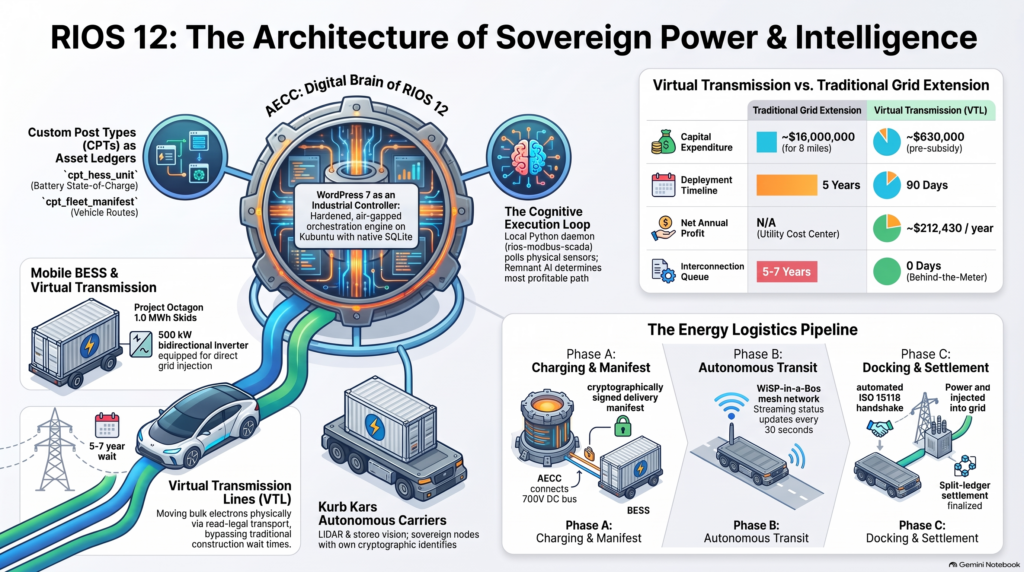
Virtual Transmission Lines (VTL) bypass the 5-7 year utility grid backlog by moving bulk electrons over road corridors via Project Octagon Mobile BESS skids and Kurb Kars autonomous carriers. This creates a “Rolling Microgrid” that provides immediate relief to energy-starved substations.
Traditional Grid Expansion vs. Virtual Transmission (VTL)
Metric Traditional Grid Expansion Virtual Transmission (VTL)
Capital Expenditure (CapEx) $1.5M – $3.0M per mile ~$630,000 per 1.0 MWh system
Deployment Timeline 5 – 7 Years 90 – 120 Days
Regulatory Barriers High (Utility / PSC) Low (WV H.B. 2014 / IRA 6417)
Financial Offsets Minimal 70% to 97% (USDA REAP / IRA 6417)
The protocol is precise: A Mobile BESS unit fast-charges at an Agra node, receives a signed cpt_fleet_manifest, and autonomously transits to a destination for peak-shaving injection, with all revenue settled via the Freenet River protocol.
- The Pragmatic Evolution: Hardening the Sovereign Stack
The DeReticular stack is designed for iterative hardening, moving from the baseline proof-of-concept to an industrial-grade standard. We must eliminate memory bloat and mechanical wear to ensure permanent resilience.
Next-Generation Optimization Standard
Layer Baseline (Pragmatic) Optimized (Hardened)
Operating System Kubuntu LTS (Mutable) NixOS (Immutable / Declarative)
C2 Core WordPress 7 (PHP/SQLite) Rust (Axum) + PocketBase (Single Binary)
Networking Freenet River (Alpha) Zenoh (Sub-ms M2M) + Reticulum (Mesh)
Baseload Power Pawnee Rotary GenSet Mainspring Linear Generator (45% Eff.)
The “So What?” of this evolution is a radical increase in system MTBF (Mean Time Between Failures) from 4,000 to 20,000+ hours and a reduction in idle memory usage from 800MB+ to less than 20MB. Spherical Resilience is not a mere technical preference; it is the definitive answer to centralized fragility. By unifying behind-the-meter power, air-gapped compute, and cryptographic settlement, we empower the community to exit the “Line” and secure permanent autonomy.