
From Fragility to Fortitude: A Guide to Sovereign Infrastructure
- The Great Shift: Why Centralization is No Longer Enough
In the modern landscape, the systems we rely on for power, communication, and intelligence are undergoing a fundamental transformation. Historically, communities have relied on centralization—a model where critical resources are managed by distant, third-party entities. The “Executive Doctrine” of sovereign infrastructure replaces this fragility with decentralized autonomy, achieved through the concept of “Island Mode.” This is the capability of a system to operate indefinitely and effectively without any dependency on public utilities or corporate “hyperscaler” cloud networks.
The shift is driven by a stark economic reality: sovereign systems generate baseload power at a levelized cost of 0.038 / kWh**, compared to the legacy grid’s rising rates of **0.09–$0.18+ / kWh. Furthermore, by converting syngas-generated electricity into local, air-gapped AI compute, prosumers achieve a 16.6x arbitrage multiple over wholesale grid power feed-in tariffs.
Relying on public utilities and hyperscaler clouds is now considered a “structural insecurity” for three primary reasons:
- Systemic Dependency: Traditional models force communities to be passive downstream customers of fragile electrical grids, making them vulnerable to regional blackouts and transmission bottlenecks.
- Carrier Vulnerability: Reliance on public telecommunications carriers means that local coordination fails during macro-grid outages or kinetic disruptions.
- Cloud Exposure: Corporate cloud endpoints represent a lack of privacy and control, exposing sensitive data to telemetry tracking, corporate prompt harvesting, and the risk of remote kill-switches.
To solve a problem of this magnitude, we must first understand the specific model of its failure.
- Understanding the ‘1,000-Mile Failure Model’
The “1,000-Mile Failure Model” describes the inherent weakness of systems that rely on long-distance infrastructure. When power or data must travel across vast distances, the number of potential points of failure increases exponentially, making the system non-linear and prone to total collapse from a single disruption.
The Core Vulnerability: Centralized systems are inherently fragile. True resilience requires the ability to decouple from the macro-grid within the sub-16ms switching threshold—the “ITIC hold-up curve”—to prevent reboots of sensitive AI racks and critical medical equipment.
To navigate this fragility, we must compare the legacy model with the sovereign localized node:
The Fragility Map
Feature Centralized System (Fragile) Localized Node (Sovereign)
Dependency Distant public utilities and clouds. Self-healing and fully autonomous.
Failure Risk Single Point of Failure; linear chain. Distributed and non-linear topology.
Efficiency High latency; high transmission loss. 97.7% power chain efficiency (700V DC).
Deployment 4–7 year interconnection queue. 60–90 days (via WV H.B. 2014).
Understanding this fragility provides the guiding principle for establishing a mandate for autonomy.
- Noel’s Law: Your Mandate for Autonomy
The transition toward resilience is governed by Noel’s Law. This operational imperative dictates that any municipality, agricultural cooperative, or institutional campus that remains a passive consumer is structurally insecure. The law mandates a shift from a “consumer” mindset to a “prosumer” reality: becoming an autonomous producer and captive operator of your own energy and compute.
Being a captive operator is a requirement for future resilience, not an option. This mindset shift is defined by three transitions:
- From Passive to Active: Generating sovereign baseload energy behind the meter rather than waiting for a utility provider.
- From Captive to Sovereign: Operating carrier-free mesh networks instead of remaining locked into third-party carrier contracts.
- From Vulnerable to Autonomous: Processing intelligence on local, air-gapped silicon rather than sending sensitive data to a distant cloud.
This philosophical mandate requires a specific physical and technical blueprint to become a reality.
- The Sovereign Stack: The Three Layers of Independence
True independence is built from the physical bedrock up. The Sovereign Stack is a vertically integrated architecture that ensures every level of infrastructure supports sustained “Island Mode.”
The Sovereign Stack Architecture
Layer Name Core Function Key Component (Example)
Physical Layer Energy & Kinetic Bedrock Syngas & 700V DC Busbar (97.7% Efficiency)
Operational Layer Coordination & Comms RIOS & TriFi Wireless Mesh (Sub-16ms Switching)
Cognitive Layer Sovereign Intelligence Remnant AI & Metacognitive Swarms (MSI)
- Physical Layer: This layer provides continuous 24/7/365 baseload power and 97.7% power chain efficiency, ensuring the system remains powered without external logistics.
- Operational Layer: This layer enables deterministic coordination and carrier-free networking, allowing the system to island instantly when the macro-grid fails.
- Cognitive Layer: This layer ensures that intelligence and data processing remain entirely local on air-gapped silicon, eliminating telemetry and cloud-outage risks.
Understanding the stack is the first step toward professional mastery as a sovereign infrastructure architect.
- Becoming a Prosumer: The Path to Mastery
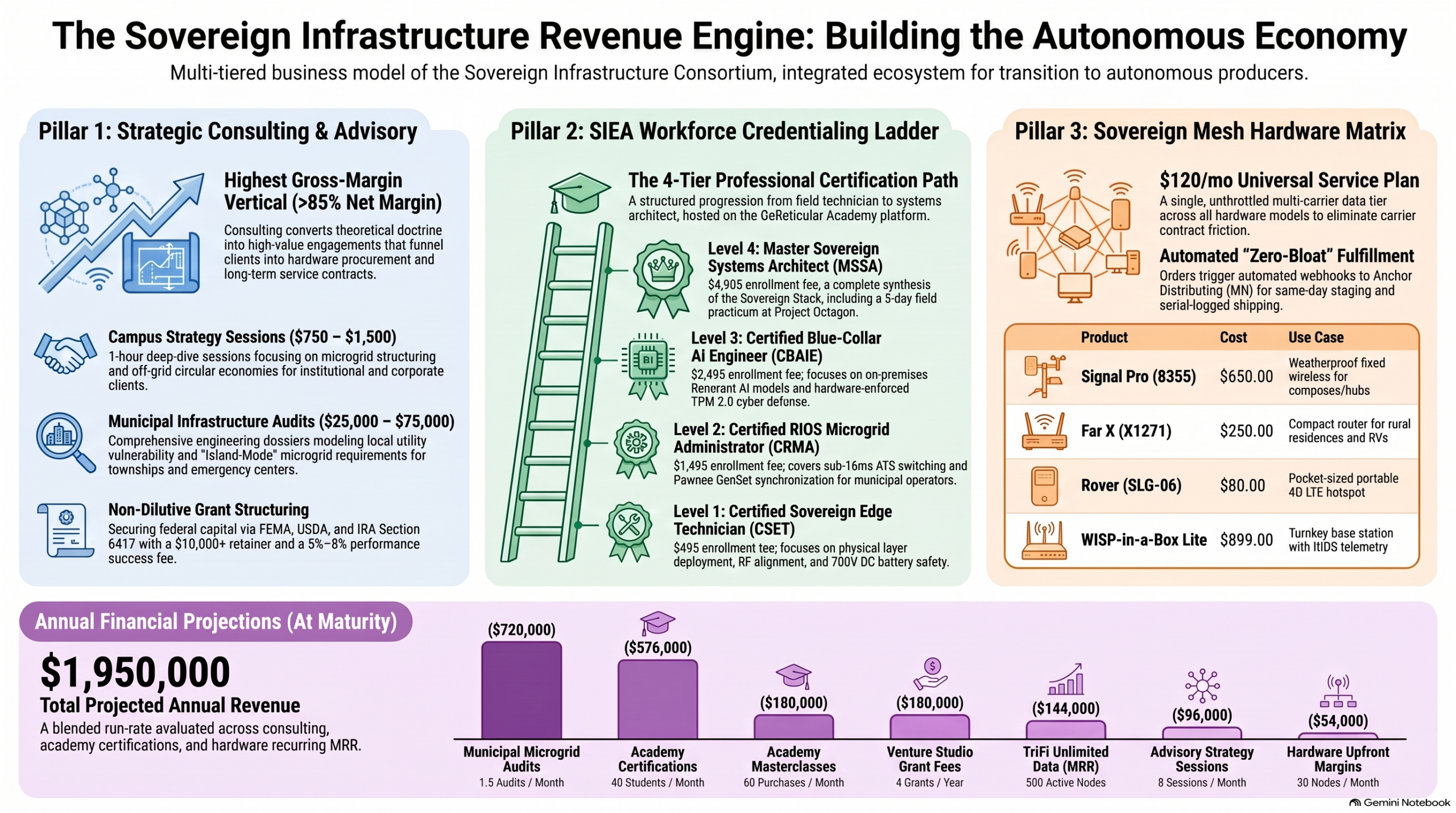
Transformation from a consumer to a prosumer requires a specialized roadmap. The Workforce Credentialing Ladder empowers the “Blue-Collar AI Engineer” and “Sovereign Systems Architect” to lead their communities.
- Level 1: Certified Sovereign Edge Technician (CSET)
- Primary Benefit: Enables the deployment of the physical layer, focusing on LiFePO4 chemistry management and high-gain antenna alignment for TriFi networks.
- Level 2: Certified RIOS Microgrid Administrator (CRMA)
- Primary Benefit: Allows for the operation of autonomous municipal power grids, including the synchronization of Pawnee 45 kW Wankel rotary GenSets.
- Level 3: Certified Blue-Collar AI Engineer (CBAIE)
- Primary Benefit: Enables the deployment of liquid-cooled GPU enclosures and Metacognitive Swarms (MSI) for air-gapped AI defense.
- Level 4: Master Sovereign Systems Architect (MSSA)
- Primary Benefit: Provides the expertise to design complete turnkey campus systems, operationalizing statutory exemptions like West Virginia H.B. 2014.
Education transforms theory into local physical reality, providing the workforce needed to build the future.
- Conclusion: The Roadmap to Resilience
The journey from fragility to fortitude begins with the realization that centralization is a liability. By adopting the Sovereign Stack and operationalizing Noel’s Law, municipalities and enterprises can bypass years of utility delays and achieve total operational autonomy.
Sovereignty Checklist
- Achieving Energy Independence: Establish sovereign baseload generation (syngas or solar thermal) to reach the $0.038/kWh efficiency benchmark.
- Securing Air-Gapped Intelligence: Ensure intelligence is embedded on local silicon via Remnant AI to guarantee privacy and deterministic control.
- Utilizing Non-Dilutive Capital: Leverage FEMA BRIC, USDA REAP, and IRA Section 6417 Direct Pay to fund infrastructure without equity loss.
True resilience is not found in the distance of a 1,000-mile grid, but in the strength of local autonomy. By building from the physical bedrock up, we ensure that our communities remain powered, connected, and intelligent—no matter what happens to the world outside.