Comprehensive Analysis of the DeReticular Sovereign Stack and Decentralized Privacy Protocols
Executive Summary
As of early 2026, the landscape of privacy-focused decentralized computing is characterized by a significant gap between mainstream operating systems and specialized decentralized protocols. While mainstream Linux distributions do not yet offer “out-of-the-box” integration for the Freenet/Hyphanet stack, the manual implementation of these tools on stable foundations like Kubuntu has become the primary path for established workstations.
Parallel to workstation development, the Rural Infrastructure Operating System (RIOS) by DeReticular has emerged as a comprehensive “Sovereign Stack.” This architecture bridges digital privacy with physical infrastructure by anchoring decentralized identity in the laws of physics—specifically through Radio Frequency Fingerprinting (RFF) and TPM 2.0 attestation. By utilizing a “Dual-Stack” approach (Hyphanet for static archival and the New Freenet/Locutus for dynamic state), RIOS provides a framework for “Spherical Resilience,” allowing decentralized nodes to function independently of national backbones.
The core innovation of this system lies in its ability to solve the “Oracle Problem” and the “Sybil Attack” through a Hardware Root of Trust, ensuring that data and identity are mathematically and physically verifiable without reliance on centralized authorities.
——————————————————————————–
1. Feasibility Analysis of Linux Distributions
There is currently no mainstream Linux distribution that comes pre-installed with a comprehensive suite of decentralized privacy tools. Technical and strategic constraints have led to varying levels of suitability across existing distributions.
Comparative Distribution Analysis (2026)
| Distribution | Desktop Environment | Freenet Status | Suitability & Use Case |
| Kubuntu | KDE Plasma | No (Manual Only) | High. Offers stability and a familiar interface; ideal for custom Java-based setups. |
| MOFO Linux | i3 / DWM | Removed | Low. Versions 9.7+ removed tools to save ISO space; older versions (9.6) included them. |
| Linux Kodachi | XFCE | No (Available) | Moderate. Strong focus on Tor/VPN/DNSCrypt; Freenet must be added manually. |
| Septor | KDE Plasma | No | Moderate. Strictly focused on Tor integration. |
| Tails | GNOME | Incompatible | Low. Amnesic design (memory wiping) contradicts Freenet’s requirement for persistent datastores. |
Technical Implementation Barriers
- Amnesic Constraints: Systems like Tails are designed to wipe data upon shutdown, whereas Freenet requires a persistent, encrypted “datastore” on the hard drive.
- Resource Intensity: The legacy Hyphanet client is Java-based and resource-heavy, often leading to its exclusion from “Live” distributions to maintain manageable ISO sizes.
- The Kubuntu Solution: Manual installation on Kubuntu is the recommended strategy. It provides access to massive software repositories (APT/Snap) and supports the performance needs of both legacy Hyphanet and the New Freenet (Locutus/2023).
——————————————————————————–
2. The Sovereign Stack Architecture (RIOS)
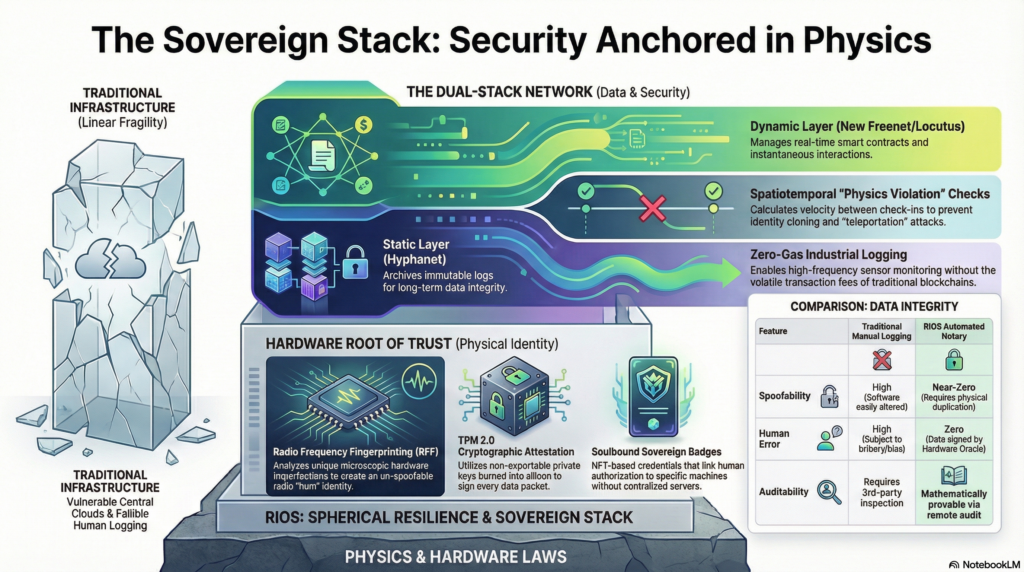
DeReticular’s Sovereign Stack (or “Trinity Stack”) is an architectural framework designed to transition from “Linear Fragility” (dependency on central grids) to “Spherical Resilience” (independent, self-sustaining nodes).
The Trinity Stack Components
- Agra Energy (Electrons): Manages local power generation (e.g., waste-to-energy plasma gasification) to allow “Island Mode” functionality.
- RIOS (Intelligence): The operating system orchestrating data, identity, and hardware.
- DeReticular Academy (Human Capital): The certifying body for human operators within the ecosystem.
Dual-Stack Protocol Integration
RIOS utilizes a parallel protocol approach to manage different data requirements:
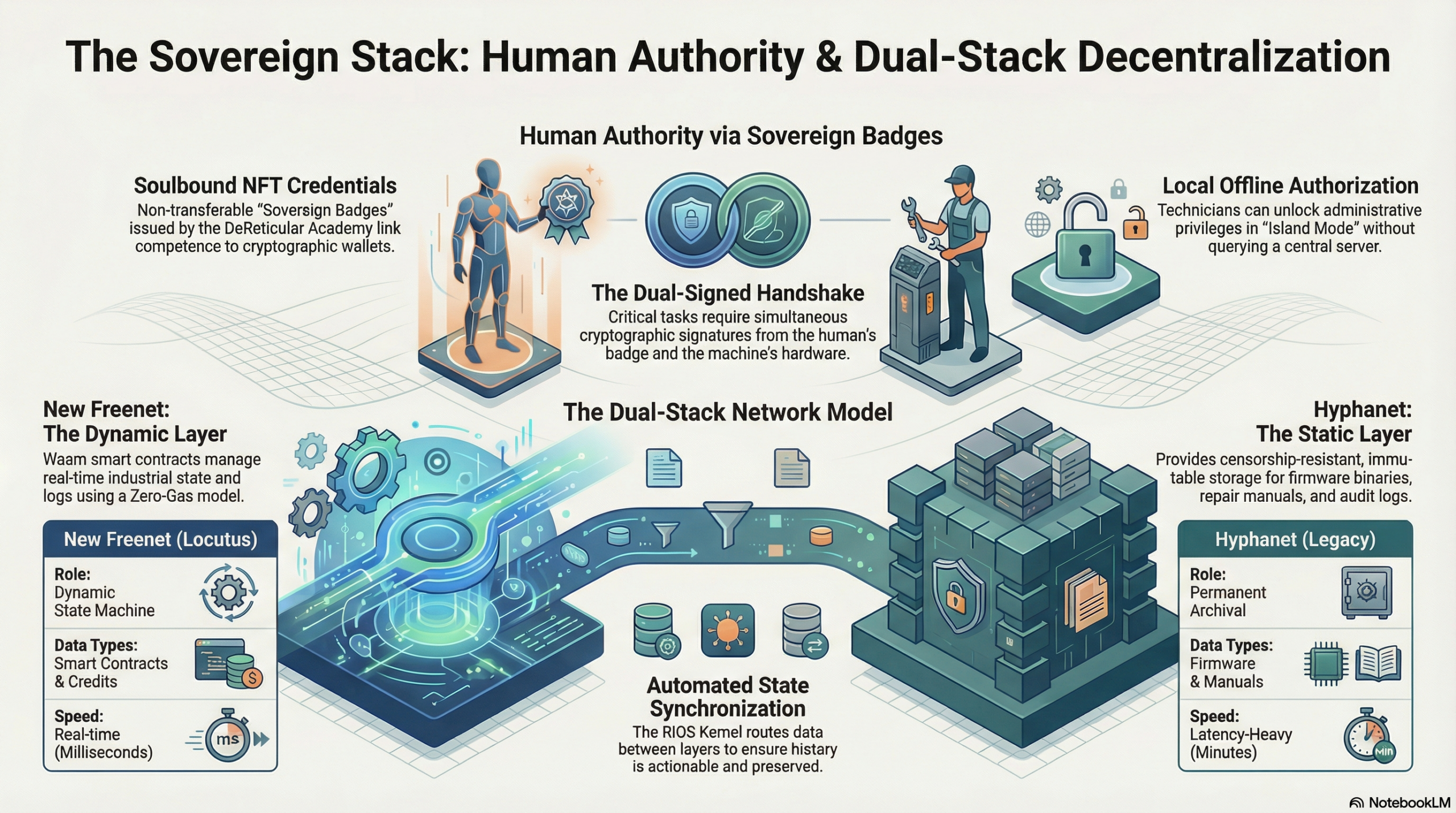
- Hyphanet (Legacy – “Static Layer”): Used for censorship-resistant archival. It stores immutable data such as repair manuals, firmware binaries, and regulatory audit logs.
- New Freenet (Locutus/2023 – “Dynamic Layer”): A high-throughput layer utilizing WebAssembly (Wasm) smart contracts for real-time state management. It handles industrial data, energy credits, and logistics logs via a “Zero-Gas” model, avoiding the volatile fees of traditional blockchains.
——————————————————————————–
3. Hardware Root of Trust: The Physical Identity Layer
To prevent Sybil Attacks (fake identities) and solve the Oracle Problem (ensuring digital logs reflect physical reality), RIOS anchors identity in hardware rather than software.
Primary Authentication Mechanisms
- Radio Frequency Fingerprinting (RFF): Every electronic transmitter has microscopic manufacturing imperfections. Software Defined Radio (SDR) captures this unique “radio hum” to create an un-spoofable digital passport.
- TPM 2.0 Attestation: A non-exportable private key is “burned” into the Trusted Platform Module chip at the factory. Data is cryptographically signed at the point of ingestion, ensuring the machine itself—not just the software—vouchers for the data.
- The Automated Notary: By acting as a hardware oracle, RIOS ensures data integrity before it reaches the network, eliminating the opportunity for human bias or data manipulation (e.g., preventing bribery in crop grading or energy logging).
——————————————————————————–
4. Global Identity Polling and Spatiotemporal Validation
In a decentralized mesh network, verifying the location and uniqueness of an asset is critical to prevent “Physical Double-Spending.”
The Polling Workflow
Rather than flooding the network with queries, RIOS nodes use Distributed State Contracts on the Locutus layer.
- Connection Event: When an entity (e.g., a Kurb Kar drone) attempts to connect, the local node queries the identity’s State Contract in the Distributed Hash Table (DHT).
- Uniqueness Check: If the contract indicates the identity is “Active” at a distant node, the system detects a conflict.
- Physics Violation Detection: The system calculates the required velocity to travel between the last known node and the current node using the Haversine distance. If the speed exceeds the maximum believable velocity (V_{max}), the connection is rejected as an “Impossible Travel” violation, and the identity is locked.
Provenance and Topology Awareness
- Exit Visas: When an asset leaves a node’s range, that node signs a digital “exit visa.” The next node verifies this visa to ensure a contiguous physical path.
- Zero-Knowledge Proofs (ZKPs): To maintain privacy, RIOS utilizes zk-SNARKs. This allows a node to verify that an asset’s path is unbroken and valid without revealing the asset’s entire GPS history or the user’s identity to the node operator.
——————————————————————————–
5. Human Authorization and the Sovereign Badge
Human interaction within RIOS is managed through the Sovereign Badge, which bridges the gap between machine identity and human intent.
NFT-Based Credentials
- Soulbound Nature: Sovereign Badges are Non-Fungible Tokens (NFTs) issued by the DeReticular Academy. They are non-transferable and “soulbound” to the user’s wallet to prevent the sale of credentials.
- Dual-Signed Objects: Critical actions, such as changing firmware or throttling power output, require a “Dual-Signature.” This includes the cryptographic signature of the machine (TPM) and the human operator (Sovereign Badge).
- Trustless Chain of Custody: This system ensures that every action is bound to a specific, certified human and a verified, physical machine, creating a log that remains verifiable even in “Island Mode.”
——————————————————————————–
6. Decentralized Identity Staking Models
Beyond hardware-based systems, broader Web3 identity strategies rely on “Skin in the Game” to ensure Sybil resistance.
Staking Methodologies
- Self-Staking (The Bond Model): Users lock tokens into a smart contract to activate their identity. (e.g., Gitcoin Passport).
- Social Staking (The Vouching Model): Users stake tokens on others to verify their humanity. If the verified user is a bot, the voucher’s tokens are “slashed.” (e.g., Kleros Humanity Court).
- Validation Staking (The Ceremony Model): Requires both a financial stake and the completion of simultaneous Turing tests (e.g., Idena).
Strategic Benefits and Risks
| Feature | Benefits | Risks / Critiques |
| Privacy | Proves humanity without biometrics or government IDs. | Wallet history can link financial life to ID. |
| Security | Creates a quantifiable “Cost of Forgery.” | “Slashing” attacks can destroy digital reputation. |
| Accessibility | Decentralized and trustless. | Plutocracy: Wealthy users can afford more verified identities; the poor may be excluded. |
——————————————————————————–
7. Strategic Outlook and Gap Analysis
The RIOS framework offers a robust solution for emerging transparency mandates, such as the EU Deforestation Regulation (EUDR), by providing mathematically provable origin data and unforgeable chains of custody.
SWOT Analysis
Strengths
- Physical-Digital Bridge: RFF and TPM prevent software-based spoofing.
- Resilience: “Island Mode” allows functionality during backbone outages.
- Economic Viability: Zero-Gas model for high-frequency industrial logging.
Weaknesses
- Hardware Fragility: No “password reset” exists if a TPM chip is destroyed or RF sensors drift.
- Experimental Reliance: Locutus (New Freenet) is currently pre-beta/alpha software.
- Technical Complexity: A steep learning curve exists for non-technical users.
Opportunities
- Compliance Market: Strong alignment with global traceability standards (EUDR).
- DePIN Sector: Positioned as a standard OS for Decentralized Physical Infrastructure.
Threats
- Regulatory Hostility: Potential government opposition to sovereign encryption.
- AI Advancements: Potential for AI-driven “deepfake” attacks against RF Fingerprinting.
Identified Implementation Gaps
- Application Layer: Currently suffers from an “Empty OS” problem; the “Flood the Forge” initiative is designed to recruit developers for user-facing applications.
- Human-Machine Interface: There is a critical need for simplified key management and UI/UX bridges for non-technical rural populations.
- Stability: Using pre-beta software for critical infrastructure (power/water) is a risk managed only through private, stabilized protocol forks.