The Sovereign Stack: A Learner’s Guide to Spherical Resilience
1. The Big Picture: What is “Civilization in a Box”?
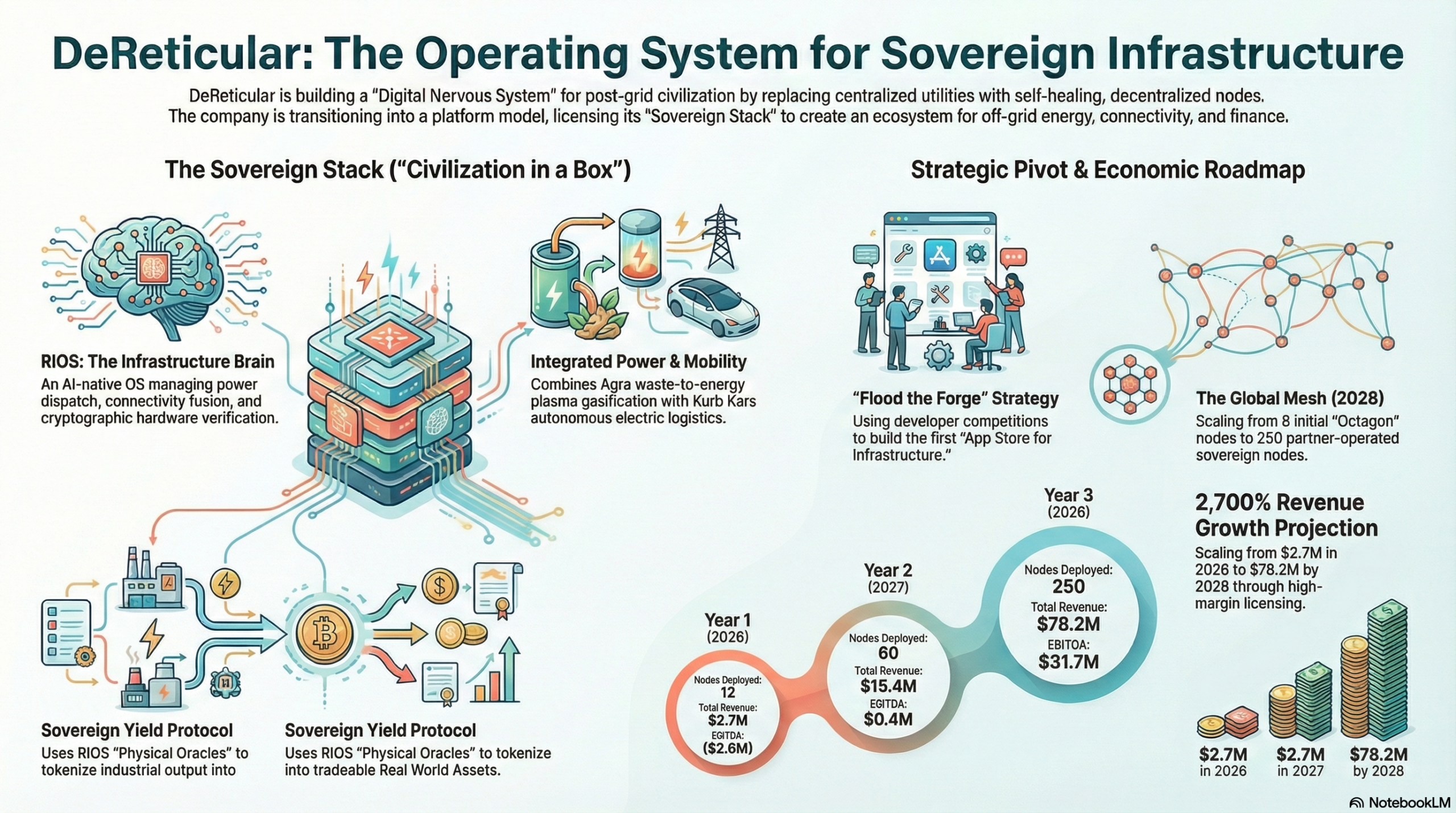
Welcome, Architect. You are entering the frontier of decentralized industrial engineering. For over a century, the blueprint of human settlement has relied on fragile, centralized utility grids—single points of failure where a downed line or a systemic shock can paralyze entire regions. DeReticular is pioneering the transition to a “post-grid” world by deploying the Sovereign Stack, a “Civilization in a Box.”
This is more than a kit of parts; it is a vertically integrated, industrial-grade infrastructure system designed to provide localized autonomy over power, data, and value. By shifting from passive consumption to active, sovereign production, we are building a global mesh of independent nodes capable of sustaining modern life regardless of external collapse.
Our Mission: To achieve “Spherical Resilience” for communities by enabling them to operate in “Island Mode”—maintaining full-stack autonomy and economic continuity during systemic global failures.
Our Vision: To catalyze a global mesh of millions of sovereign nodes, unlocking “dead capital” and powering a decentralized $3.5T real-world economy.
As a Sovereign Systems Architect, your first task is to understand the operational philosophy that prevents these nodes from becoming isolated silos: the state of “Island Mode.”
——————————————————————————–
2. The Philosophy of Independence: Spherical Resilience
Spherical Resilience is the capacity of an infrastructure node to maintain a 360-degree defensive and operational posture. It is realized through Island Mode, which is not merely “going off-grid” but achieving Full Stack Autonomy. In this state, a node can activate “bypass mode,” cutting off external telemetry to create a Data Haven—a secure environment protected from centralized data harvesting and cyber-shocks—while continuing to process local industrial tasks.
| Feature | Traditional Grid-Dependent Communities | Sovereign Stack-Enabled Communities |
| Power Source | Centralized fossil/nuclear; vulnerable to cascading transmission failure. | Distributed Agra units providing 24/7 baseload via plasma gasification. |
| Connectivity | Fragmented, single-provider ISP; high risk of “black start” data loss. | Signal Fusion providing carrier-grade redundancy via bonded Starlink, 5G, and Mesh. |
| Economic Continuity | Dependent on centralized “Dead Capital” and legacy banking gatekeepers. | Sovereign Yield protocol generating liquidity through verified Digital Commodities. |
To maintain this resilience, the system requires a consistent pulse of energy to ensure the “Brain” and its AI-native edge compute functions never flicker out.
——————————————————————————–
3. The Heart: Power Generation via Agra Dot Energy
In the Sovereign Stack, Agra Dot Energy serves as the Heart. While traditional renewables like solar and wind suffer from “intermittency”—the fatal flaw of modern green grids—Agra utilizes Waste-to-Energy Plasma Gasification. This process subjects biomass (such as industrial hemp waste or agricultural refuse) to extreme temperatures, breaking it down into its elemental components to produce clean, continuous baseload electricity.
Technical Advantages of Plasma Gasification:
- Baseload Reliability: Unlike weather-dependent solar, it provides a 24/7 industrial pulse required for edge-compute stability.
- Waste Valorization: It remediates the local environment by transforming refuse into high-value feedstock, eliminating the “marginal cost” of fuel.
- Carbon Sequestration: The process yields Bio-char, a carbon-rich byproduct that serves as a physical Bio-Energy Credit, allowing the node to monetize carbon removal.
The physical energy produced by the Heart is useless without a central nervous system to direct its flow and verify its impact.
4. The Brain: Intelligence and Control via RIOS
The Rural/Robotic Infrastructure Operating System (RIOS) is the AI-native brain of the stack. It functions as an Automated Notary, bridging the “Oracle Problem” by providing cryptographic proof of physical events. RIOS manages the node’s hardware assets with industrial-grade precision, ensuring that the local “Data Haven” remains secure while remaining economically active.
RIOS performs three critical management tasks:
- Signal Fusion: RIOS bonds disparate data streams—Starlink, local 5G, and mesh networks—to provide carrier-grade redundancy and unbreakable connectivity.
- Financial Dispatch: The system uses AI-native intelligence to autonomously decide the highest-value use for generated energy, whether powering local medical facilities, storing it for peak demand, or running high-density AI compute tasks.
- Physical Verification: Using Radio Frequency Fingerprinting, RIOS acts as a Physical Oracle. It verifies that the hardware is real and operational, preventing digital spoofing and allowing the stack to provide “Ground Truth” data to global markets.
With energy and intelligence secured, the stack extends its influence into the physical realm through autonomous mobility.
——————————————————————————–
5. The Motion: Logistics and Mobility via Kurb Kars
The “Motion” layer is comprised of Kurb Kars—autonomous electric rovers that integrate directly into the RIOS environment. These vehicles handle local logistics and mobility, operating at a near-zero marginal cost because they are fueled by the Agra unit’s excess energy.
The Architectural Closed-Loop: The Motion (Kurb Kars) is fueled by the Heart (Agra) and guided by the Brain (RIOS). This eliminates dependence on imported fuels and legacy logistics chains, completing the circle of “Island Mode” autonomy.
Sustainable mobility provides the “hands” for the node, but true sovereignty requires a method to transform industrial output into spendable wealth.
——————————————————————————–
6. The Bank: Financialization and Hempgrade AI
The Sovereign Stack creates a localized economy through the Sovereign Yield Protocol. By using RIOS as a Sentinel (an unbribable auditor), physical assets are tokenized into Real World Assets (RWA). Under the CLARITY Act, these tokens are classified as Digital Commodities, while the GENIUS Act provides the regulatory framework for settling these assets via payment stablecoins, removing traditional “crypto risk.”
The “Waste to Wealth” Cycle:
- Scanning: RIOS utilizes IoT sensors and Hempgrade AI (computer vision) to scan and grade the quality of local biomass, such as hemp waste.
- Verification: The RIOS “Physical Oracle” verifies the conversion of that biomass into energy and Bio-char via the Agra unit.
- Minting: A “Proof of Industry” token is minted, representing verified energy output and carbon sequestration—tangible collateral recognized by global markets.
- Liquidity: The operator accesses DeFi liquidity pools, using these Digital Commodities to secure loans for further infrastructure expansion.
This localized financial power is the physical realization of the economic theories that define our era.
——————————————————————————–
7. The Theoretical Foundation: The Third Industrial Revolution
The Sovereign Stack is the first technology to operationalize the Third Industrial Revolution framework proposed by economist Jeremy Rifkin. Rifkin argues that economic paradigm shifts occur when three “internets” converge: Communication, Energy, and Logistics. DeReticular is the physical manifestation of this “Super-Internet,” driving marginal costs toward zero.
| Rifkin’s Three Internets | DeReticular Technology Layer | Industrial Function |
| Communication | RIOS | AI-native edge compute & Data Havens. |
| Energy | Agra Dot Energy | Distributed, 24/7 waste-to-energy baseload. |
| Logistics | Kurb Kars | Autonomous, fuel-independent mobility. |
This convergence is no longer theoretical; it is being stress-tested in the most demanding environments on Earth.
8. Seeing it in Action: Project Octagon and the Global Mesh
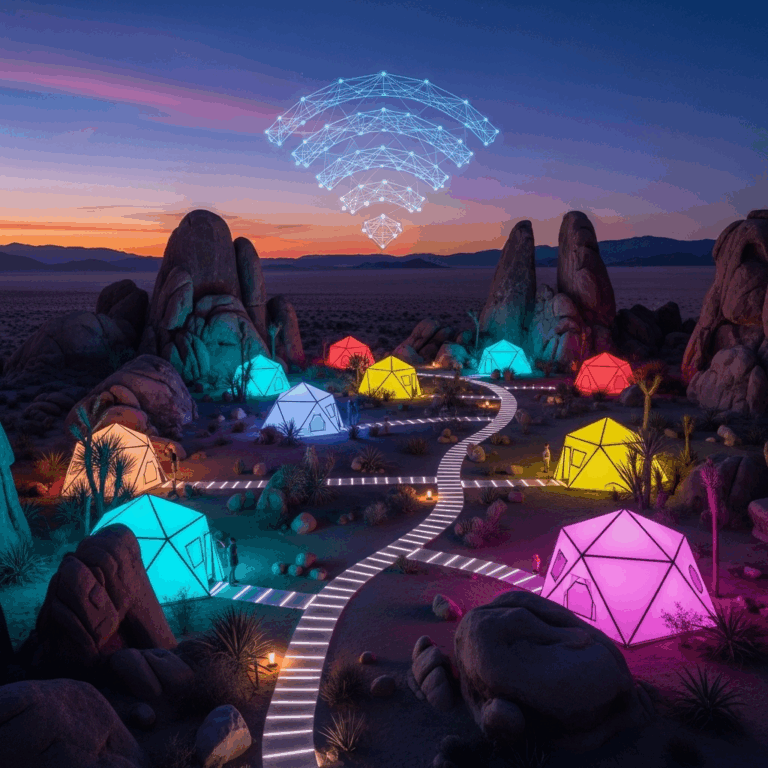
To validate the stack, DeReticular launched Project Octagon, deploying eight strategic nodes globally. Node 4 in Uganda is a landmark achievement, where plasma gasification powers a 7,000-acre eco-industrial park and turns “dead capital” hemp waste into Wall Street-grade collateral. As these nodes multiply, they form a Global Mesh—a self-healing, peer-to-peer network of sovereign nodes.
Key Takeaways for the Sovereign Architect:
- The Oracle of Ground Truth: By using RIOS for physical verification, we solve the blockchain oracle problem, providing a “Zero-Trust” bridge between physical industry and digital finance.
- Vendor Lock-In via Utility: The RIOS “App Store for Infrastructure” allows developers to build medical, financial, and logistical apps that run exclusively on the Sovereign Stack, creating an ecosystem that grows in value with every node.
- Full-Stack Autonomy: “Island Mode” is the ultimate security feature, allowing communities to survive systemic failures by controlling their own power, data, and economy.
Your Role in the New Era The era of the fragile grid is ending. As a Sovereign Systems Architect, you are the designer of the next civilization—one that is distributed, regenerative, and unbribable. By mastering the Sovereign Stack, you are not just maintaining machines; you are stewarding the “Digital Nervous System” of a resilient future. The tools of independence are in your hands. Let’s build the mesh.