The Flight of the Kurb Kar: A Tale of Decentralized Truth
1. Setting the Scene: The Sovereign Stack
Imagine a quiet sunrise in the Arizona desert. A Kurb Kar—a sleek, autonomous electric delivery pod—glides silently from its charging bay. This pod possesses a silent, sovereign intelligence, navigating a landscape where the old world’s “Linear Fragility” has been replaced by DeReticular’s Spherical Resilience.
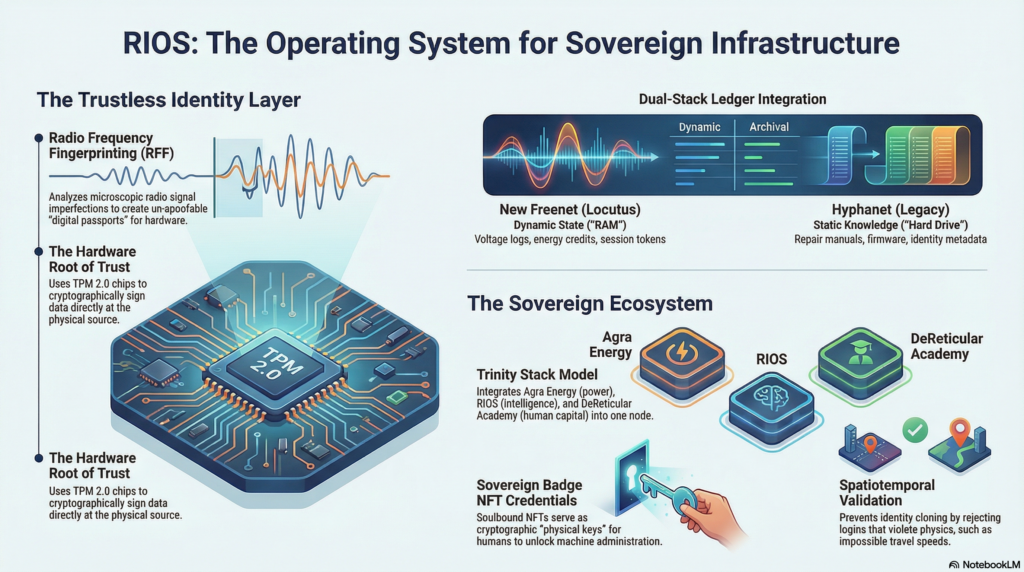
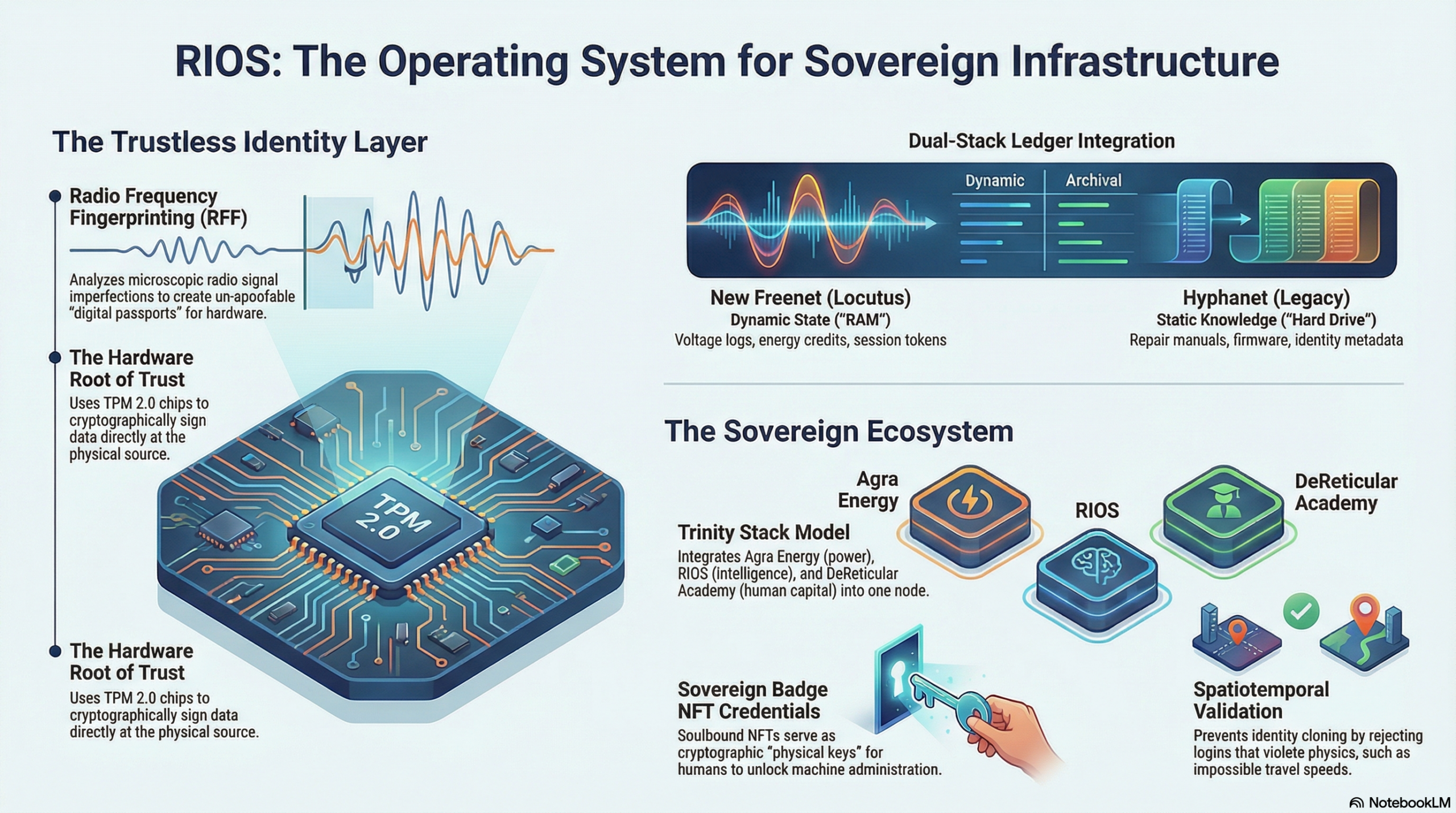
In the old model, we relied on “The Line”—dead, brittle power lines and central data centers that could be severed by a single storm or a remote hack. DeReticular introduces the RIOS (Rural Infrastructure Operating System), which treats every community as an independent, sovereign node. Each node is a “Civilization-in-a-Box,” powered by Agra Energy units utilizing waste-to-energy plasma gasification to provide unbreakable base-load power.
RIOS orchestrates the “Trinity Stack” of three core resources:
- Electrons (Energy): Managing local generation (Agra Energy plasma gasification) and storage to ensure the node can function indefinitely in “Island Mode.”
- Data (Intelligence): Providing secure, local communication through Trifi Wireless (WiFi 7 & 5G mesh) and decentralized governance without Big Tech clouds.
- Mobility (Logistics): Coordinating autonomous transport, like the Kurb Kar, to move medical supplies and goods across the mesh.
As the Kurb Kar prepares for its journey, it doesn’t just check a password; it proves its very existence to the physical world.
2. The Un-spoofable Passport: How a Drone Finds its Soul
In the Sovereign Stack, identity is not a digital file that can be copied; it is a Hardware Root of Trust anchored in physical atoms. The Kurb Kar’s “soul” is tied to its specific hardware components, making its identity as indisputable as a thumbprint.
The Physical Truth Layer
| Feature | Physical Reality Tracked | Digital Result |
| Radio Frequency Fingerprinting (RFF) | Microscopic manufacturing imperfections in radio circuitry, analyzed via Software Defined Radio (SDR) for Transient Response and oscillator drift. | An un-spoofable digital passport based on the unique, microscopic “hum” the device emits. |
| TPM 2.0 Chip | A secure, tamper-resistant crypto-processor with a non-exportable private key “burned” into the silicon at the factory. | A cryptographic signature that proves a specific physical machine sent the data. |
With its hardware identity verified by the local Agra Energy node, the Kurb Kar is granted passage to move between the spheres of influence in the network.
3. The Handover: “Exit Visas” and the Chain of Custody
As the Kurb Kar travels across the Trifi Wireless mesh, it moves from the range of Node A to Node B. Trust is maintained through Provenance—a continuous record of the drone’s physical path. This is achieved through a digital “Exit Visa” system.
The Handshake Protocol:
- The Exit Request: As the drone reaches the edge of Node A’s signal, it requests an “Exit Visa.”
- Signing the Visa: Node A signs a digital packet containing the drone’s ID and a precise exit timestamp.
- The Arrival: The drone enters Node B’s range and presents this visa.
- Verification: Node B verifies Node A’s signature. This proves the drone physically traversed the distance between the nodes.
This process creates Topology Awareness, ensuring the network knows the physical layout of the world and can confirm the drone moved through real space rather than “teleporting” via a software hack. But even this system must defend against the cleverest of villains.
4. The Physics Violation: Why You Can’t Be in Two Places at Once
Consider a hacker attempting a “Sybil Attack.” He creates a software clone of our Kurb Kar’s identity in Texas, while the real drone is making its delivery in Arizona. When the clone tries to connect to a Texas node, the network performs Identity Polling.
The Texas node doesn’t just ask the clone who it is; it checks the global state to see where that identity is “locked.”
Impossible Travel: The system identifies a “Physical Double-Spend.” The node calculates the Haversine distance (the shortest path over the Earth’s sphere) between the current attempt and the last known location. It pulls the GPS coordinates of the previous node from the Hyphanet static registry.
By comparing the Time Delta (the time elapsed since the last check-in), it calculates the required velocity (V_{req}). If V_{req} exceeds the Maximum Believable Velocity (V_{max})—such as moving 1,000 miles in seconds—the system flags an “Impossible Travel” violation.
To ensure privacy, RIOS utilizes Zero-Knowledge Proofs (zk-SNARKs). This allows the network to verify that the drone’s path is unbroken and valid without requiring the node operator to see the drone’s entire GPS history. The node simply receives a mathematical “True” or “False.”
5. The Freenet Layer: The Distributed State Contract
To find this “Global Truth,” the node doesn’t “ping” every other node. Instead, it performs a Distributed Hash Table (DHT) lookup on the New Freenet (Locutus) layer to find the drone’s specific State Contract.
The Dual-Stack Architecture
| Layer | Role | Identity Function |
| Hyphanet (Legacy Freenet) | The Archivist: High-security, static storage for immutable data. | Stores the Static Registry: device schematics, public keys, and node GPS coordinates. |
| New Freenet (Locutus) | The Clerk: Real-time, dynamic state management via Wasm smart contracts. | Acts as the State Registry: tracking if an identity is currently “Active,” “In Transit,” or “Locked.” |
The Texas node sees the drone is “Active” in Arizona and immediately rejects the clone, broadcasting a “Proof of Fraud” to the entire swarm.
6. The Sovereign Badge: The Human Hand on the Tiller
While the machines manage the logistics, we must bridge the Human-Machine Interface Gap. When a technician needs to authorize a mission or perform maintenance, they use a Sovereign Badge—a Soulbound NFT credential issued by the DeReticular Academy.
The Human-Machine Handshake:
- Minting: Upon completing certification, the Academy mints the NFT to the human’s non-custodial wallet.
- Presentation: The technician presents the badge to the node via an encrypted tablet link.
- Local Verification: The node verifies the NFT was signed by the Academy’s Master Key and checks the revocation list.
- Dual-Signing: Any critical action—like a firmware update—creates a “Dual-Signed Object.” This requires the cryptographic signatures of both the human’s Sovereign Badge and the machine’s TPM chip.
This ensures that every action is bound to both a specific, competent human and a verified, physical machine.
7. Conclusion: The Laws of Physics as the Ultimate Security
In the RIOS ecosystem, we have moved beyond “trusting” people or servers. We have replaced fallible human authority with the indisputable laws of math and physics.
Why the Sovereign Stack Prevents Fraud
- Hardware Anchoring: RFF and TPM chips ensure digital identity is physically tied to specific silicon atoms.
- So what? You cannot copy or clone a drone’s identity because software cannot replicate the “Transient Response” of its radio.
- Spatiotemporal Logic: The network enforces the speed of light and maximum velocity via Haversine calculations.
- So what? No entity can commit a “Physical Double-Spend” by being in two places at once.
- State Synchronization: The New Freenet provides a Zero-Gas logging registry for real-time state tracking.
- So what? High-frequency industrial monitoring becomes affordable, creating an unbreakable “Chain of Custody” for energy and goods.
As you step into the world of DeReticular, remember: we aren’t just building a network; we are building a world where the digital is as solid as the physical. Welcome to the future of Physical Truth.