Breaking the Earth Tether: A Learner’s Guide to Federated Learning in Space
To establish an industrial presence on the Moon, we must first confront a harsh reality: we cannot bring the terrestrial internet with us. For decades, space exploration has relied on a digital umbilical cord connecting rovers to supercomputers on Earth. But for industrial lunar mining, this connection is a liability. To survive in deep space, our machines must transition from “dumb terminals” to sovereign entities that think, learn, and act where the dust meets the drill.
1. The “Linear Fragility” Crisis: Why We Can’t Just “Call Home”
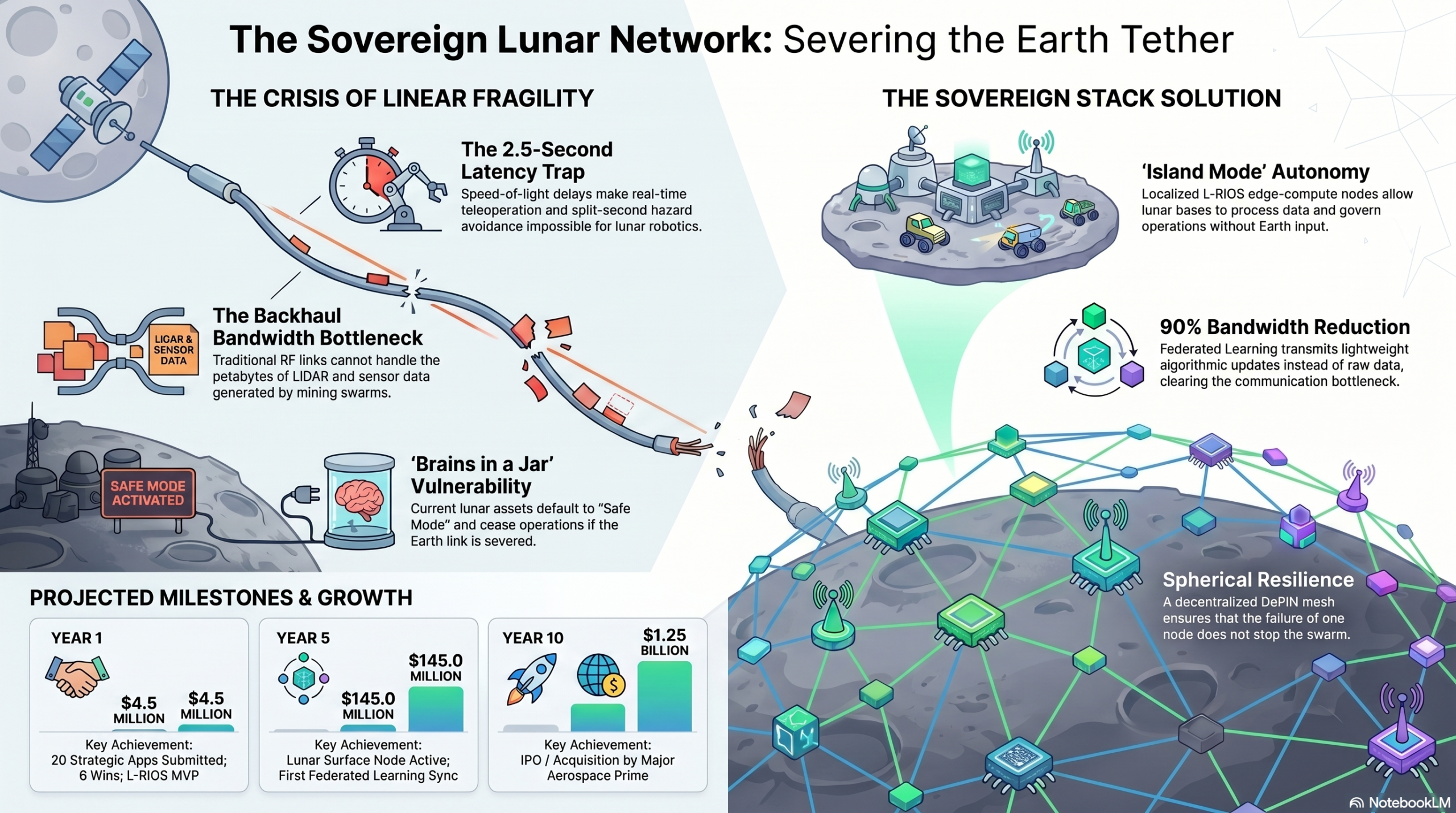
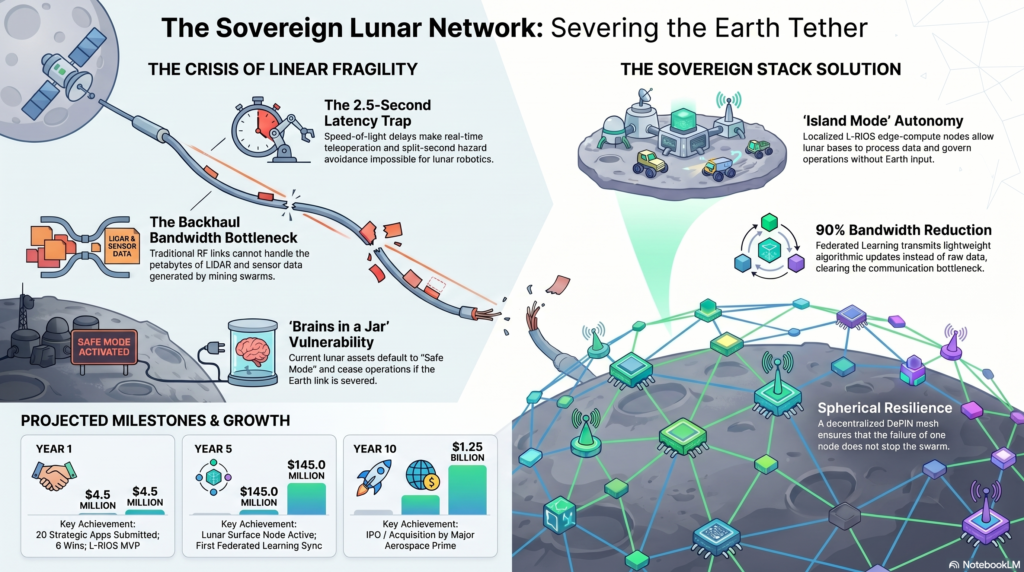
The current model of space communications is defined by Linear Fragility. This is the inherent weakness of a single, long-distance supply chain of data: gathering telemetry on the Moon, passing it through fragile radio bottlenecks to Earth, processing it in a terrestrial cloud, and beaming commands back. This architecture fails for two primary reasons:
- The Deep Space Network (DSN) Bottleneck: Earth’s aging antennas are oversubscribed. They cannot handle the petabytes of LiDAR and video data generated by a fleet of industrial robots.
- The Latency Trap: The minimum 2.5-second round-trip delay between Earth and the Moon makes split-second hazard avoidance—like a drill hitting an unexpected rock—physically impossible.
To resolve this, we must shift from centralized communication to Spherical Resilience—a decentralized mesh architecture where the network is self-healing and has no single point of failure.
| Feature | Current Reality (Centralized Cloud Dependency) | Lunar Requirement (Computational Sovereignty) |
| Decision Location | Terrestrial Data Centers (Earth) | Localized Edge Nodes (Moon) |
| Connection Type | Fragile “Linear” Link | Spherical Resilience (Self-Healing Mesh) |
| Reaction Speed | The 2.5-Second “Latency Trap” | Near-Instant (<20ms) Local Response |
| Survival Mode | “Safe Mode” (Shutdown) if link is lost | Island Mode (Black Start Capability) |
To survive on the Moon, we must stop building bigger antennas on Earth and start building “brains” at the destination.
——————————————————————————–
2. The Edge Solution: Introducing L-RIOS and “Island Mode”
To break the Earth tether, we deploy the Sovereign Stack—a flight-hardened evolution of DeReticular’s terrestrial “Operation Octagon.” This methodology uses the L-RIOS (Lunar Infrastructure Operating System) to grant a colony “Island Mode” capabilities. Most critically, L-RIOS provides a “Black Start”—the ability for a system to reboot and resume complex industrial operations from a total failure without needing a single handshake from Earth.
The Lunar Nexus is composed of three core components, each a direct descendant of terrestrial nodes in Arizona, Uganda, and La Paz:
- The Brain (L-RIOS): The localized edge-AI operating system. Like its Canada-based predecessor (Node 2), it acts as the systems architect, managing the lunar mesh from hardened data centers located in stable lava tubes.
- The Muscle (Agra Dot Astro): Localized power hubs utilizing micro-nuclear fission and solar arrays. This is the lunar evolution of the Uganda powerhouse (Node 4), providing off-grid baseload energy to the swarm.
- The Motion (Kurb Crawlers): Heavy-duty, swarm-capable mining robots. These are the flight-spec successors to the “Kurb Kars” tested in Arizona and La Paz (Nodes 3 and 6), designed to navigate abrasive regolith without a central grid.
By moving the “brain” to the Moon, we link cognitive software directly to physical hardware, allowing machines to learn without clogging the network.
——————————————————————————–
3. Federated Learning: Sharing “Math,” Not “Pictures”
The most significant hurdle in deep space is the backhaul bottleneck. Sending petabytes of raw LiDAR or video data to Earth is physically and economically impossible. This is where Federated Learning transforms the mission. Instead of moving the data to the model, we move the model to the data.
Using Sovereign Sentry AI, machines process their own experiences locally on their onboard GPUs. They train their own internal models and only share the “math”—the tiny, lightweight algorithmic updates that represent what they learned.
A Simple Analogy: Imagine a classroom of students each reading a different book. Instead of every student handing their entire 500-page diary to the teacher to be graded, each student simply writes down a one-sentence definition of a new word they found and shares that tiny note with the class. Everyone learns the new word instantly, but no one had to carry a heavy pile of books.
This shift enables the colony to evolve its collective intelligence while keeping the Earth-link free for only the most critical mission updates.
——————————————————————————–
4. Mission Simulation: The Shackleton Crater Anomaly
To see the Sovereign Stack in action, consider a swarm of twelve Kurb Crawlers operating in the dark, high-metallic environment of the Shackleton Crater.
- The Local Encounter: Rover 1 strikes a pocket of unexpectedly dense, iron-rich basalt. Its drill begins to overheat, threatening a catastrophic failure.
- Local Processing: Using Sovereign Sentry AI, the rover analyzes the thermal resistance locally. It runs a simulation and discovers a new “drill-pulse rhythm” that can penetrate the basalt safely.
- Federated Transmission: Rover 1 does not send a video of the rock to Earth. It packages the solution into a 45 KB algorithmic update and broadcasts it over the Nokia 4G/LTE proximity network to the local Lunar Data Center.
- Swarm Sync: The Data Center instantly synchronizes this 45 KB update across the other eleven rovers. The entire fleet now possesses the “instinct” to handle iron-rich basalt before they even touch it.
- Earth Backhaul (The Data Arbitrage): Periodically, the system performs Zero-Knowledge Data Arbitrage. This process cryptographically verifies and condenses the accumulated intelligence models to “trade” them back to Earth. Scientists receive the optimized solution without ever processing the petabytes of raw telemetry.
This event transforms a collection of individual robots into a single, cohesive “Swarm Instinct.”
——————————————————————————–
5. The “So What?”: Bandwidth Eradication and the Future of the Mesh
Federated Learning is the prerequisite for a multi-planetary economy. By shifting to a decentralized mesh, we achieve:
- Bandwidth Eradication: A >90% reduction in data transmitted to Earth, solving the communication bottleneck forever.
- Zero-Downtime Resilience: Machines stay in “Island Mode” regardless of solar flares or DSN scheduling conflicts.
- Scalability to Mars: This architecture paves the way for “Algorithmic Terraforming.” On Mars, localized “Computational Ecologist” servers will independently manage swarms of bioreactors and gas processors to modify the atmosphere without waiting for a 24-minute round-trip signal from Earth.
Key Takeaways
- [ ] Linear Fragility is a dangerous dependency on Earth-based processing.
- [ ] Spherical Resilience creates a self-healing mesh with no single point of failure.
- [ ] L-RIOS provides the “Black Start” capability for autonomous Island Mode.
- [ ] Sovereign Sentry AI facilitates Federated Learning by sharing 45 KB “math” updates instead of petabytes of raw data.
- [ ] Data Arbitrage ensures that only verified, condensed intelligence is sent back to Earth.
The “Death of the Line” has arrived. By embracing the Sovereign Mesh, we are building a future where space exploration isn’t just about visiting—it’s about infrastructure that can think, learn, and survive on its own.