
The Sovereign Axis: A Strategic Blueprint for Absolute Cognitive Sovereignty
1. The Structural Failure of Centralized Intelligence
The Line is dead. Centralized dependency—the multi-decade reliance on high-voltage transmission and hyperscale cloud clusters—is no longer a strategic advantage; it is a vector of systemic fragility. We are excising the “Line” to move “Above the Line,” where value is found in nodal autonomy rather than rented access. In an era where generic inference “Below the Line” is a free commodity, survival for high-stakes industrial and regulated assets requires transitioning to Absolute Cognitive Sovereignty. This is not a software update; it is a hardware reality.
Deconstructing the Hyperscaler “Dead Zone”
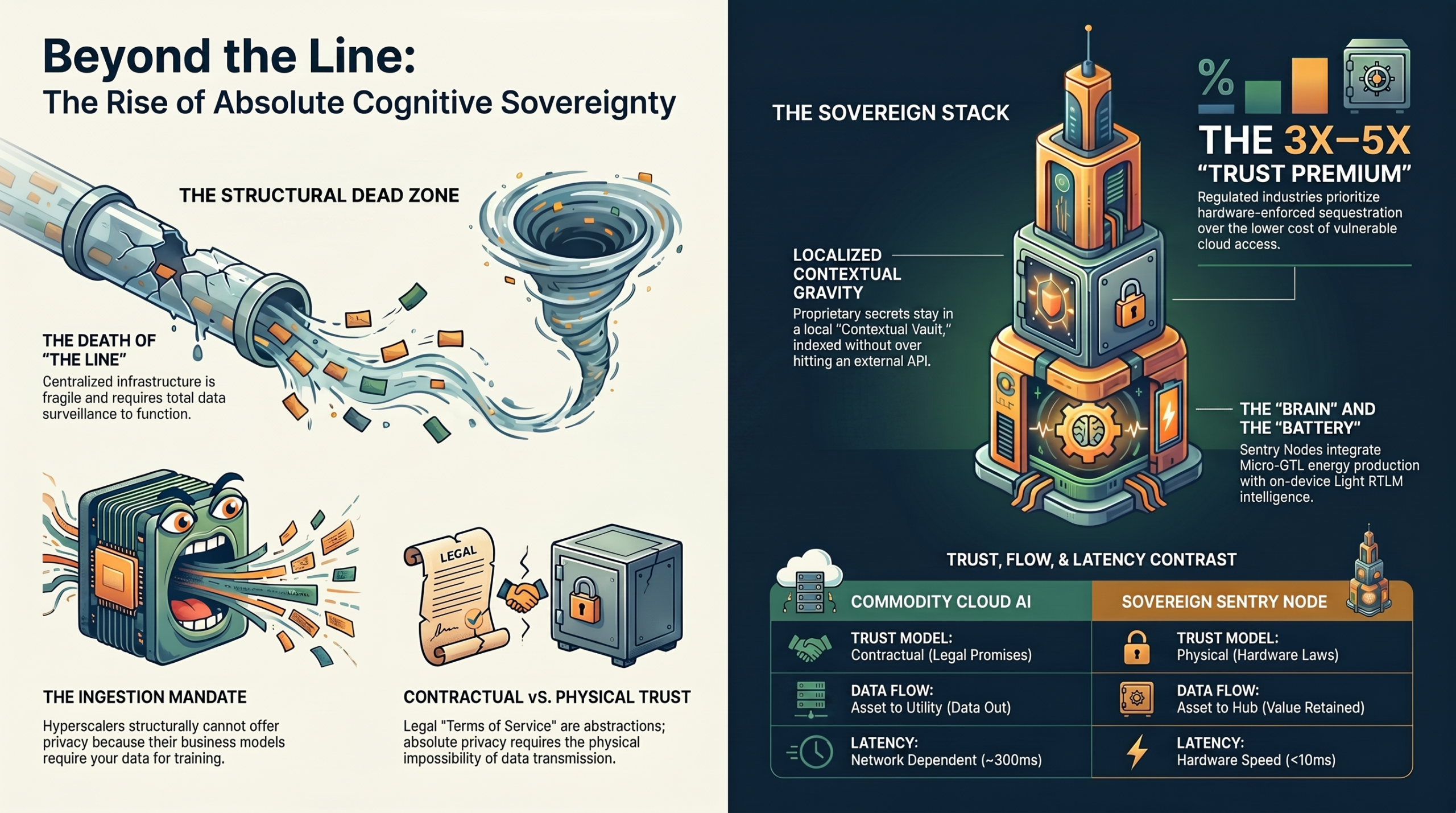
Hyperscalers like Microsoft, Google, and Meta are physiologically and structurally incapable of offering true sequestration. Their multi-trillion dollar valuations are built on a “Cloud Flywheel” that requires the continuous ingestion of user intent. They operate within a “Dead Zone” defined by three inescapable pillars:
- The Observation Requirement: Hyperscalers must prove model improvement to shareholders through telemetry. A sequestered node is a “silent user” who provides no training feedback, effectively starving their central models. To offer sovereignty, they must become blind—an act that contradicts their competitive DNA.
- The Incentive of Ingestion: Big Tech’s business model is “The Total Ingestion of Intent.” Every prompt fed to a cloud-AI helps it understand the world better. By sequestering intelligence, you prevent the cloud from learning your industry secrets, which represents an existential threat to their data-accumulation mandate.
- The Regulatory Chokepoint: Centralized providers maintain a “kill switch” and content filters to minimize their own liability. They cannot verify Terms of Service compliance on a device they cannot monitor. Sovereignty means the user controls the boundaries; Big Tech cannot risk the legal fallout of a model they cannot see or shut down.
video
The Trust Premium: Physical Incapacity vs. Contractual Trust
The market is bifurcating between “Legal Trust”—relying on a Service Level Agreement (SLA)—and “Physical Trust”—relying on the laws of physics. Regulated industries such as Forensic Accounting, Rural Elder Care, and M&A Deal Flows are currently “data-homeless.” For these sectors, being wrongly observed is more expensive than the intelligence itself. Consequently, these enterprises are willing to pay 3x–5x price multiples for Physical Incapacity—the hardware-enforced guarantee that data cannot be leaked because there is no wire—over mere contractual promises.
Sovereign Axis Group (SAG) fills this void. We are not selling a chatbot; we are deploying a cognitive refinery that converts raw, local context into defensible industrial power.
——————————————————————————–
podcast
2. The Sovereign Stack: Engineering Physical Autonomy
The Sovereign Sentry is a modular, NEMA 4X-rated industrial enclosure designed to remove the “brain” and the “battery” from the grid. By placing these assets inside the physical perimeter, we transform AI from a remote utility into a permanent capital asset.
Hardware Architecture: The Physics of Trust
The Sentry Node utilizes NPU-optimized server clusters and edge Tensor Processing Units (TPUs) tuned for high-bandwidth LPDDR5 memory. This architecture bypasses the “Memory Wall” common in edge devices, enabling institutional-grade reasoning. Security is anchored in silicon via TPM 2.0 binding and Trusted Execution Environments (TEE) such as AMD SEV-SNP, which encrypt memory pages to defend against side-channel and cold-boot attacks.
To guarantee a strict air-gap, the Sentry employs a GPIO-controlled physical relay. This mechanism physically de-energizes network transceiver chips, ensuring the node possesses a transmission capacity of exactly zero (T(D_{\text{in}}) = 0) during sensitive operations.
| Feature | Commodity AI (Cloud) | Sovereign Node (Sentry) |
| Data Flow | Asset to Utility (Data Out) | Asset to Hub (Value Retained) |
| Latency | Network Dependent (~300ms+) | Hardware Speed (<10ms Deterministic) |
| Ownership | Rented “Access” | Permanent Capital Asset |
| Confidentiality | Contractual (Legal Promise) | Physical (Hardware Impossibility) |
| Regulatory Compliance | Audit-Heavy / Continuous | Compliance by Omission |
| Energy Dependency | Grid-Tethered / Fragile | Behind-the-Meter / Autonomous |
Light RTLM Logic: Intelligence at the Edge
The Sentry runs Light RTLM (Real-Time Language Models) ranging from 1.5B to 8B parameters. These models are optimized via Quantization-Aware Training (QAT) to INT4 precision, allowing them to maintain the reasoning logic of a 175B parameter cloud model within a localized hardware cache.
Vertical intelligence is maintained through:
- Low-Rank Adaptation (LoRA): Allowing for rapid fine-tuning on proprietary data without high CAPEX.
- Local RAG (Retrieval-Augmented Generation): The node indexes the owner’s trade secrets, soil history, or legal strategies in a localized vector database, creating Contextual Gravity that stays within the node’s physical RAM.
——————————————————————————–
3. The Economic Logic of Nodal Autonomy
The Sovereign Axis operates on the Spark Spread Arbitrage Coefficient (C_{ssa}), determining the profit delta between local fuel costs and the output value of energy/compute. We transform “worthless waste” into high-margin intelligence.
The Energy-Compute Loop: Agra Micro-GTL
Each node is paired with an Agra Micro-GTL (Gas-to-Liquids) system. This uses plasma gasification to convert biomass feedstock (manure, agricultural waste) into Syngas (CO + H_2) and subsequently into Synthetic Diesel (ASF^{TM}) via Fischer-Tropsch Synthesis. This behind-the-meter power fuels the Sovereign Sentry, while recaptured waste heat warms anaerobic digesters to sustain the loop.
Quantifying Unit Economics
The node’s value is driven by a high-margin hardware-software fusion:
- Hardware Build (COGS): $65,000 (Includes GTL Unit + Sovereign Server).
- Knowledge-Pack License: $1,500/month (95% margin) for vertical firmware updates.
- Energy Arbitrage: ~$2,400 monthly in synthetic fuel value, used to offset compute or sold as “Green Compute Credits.”
- Average Contract Value (ACV): $120,000 in Year 1 (Sale + recurring), with a shift toward 95% margin recurring revenue as the node matures.
The system’s logic routes energy dynamically: if C_{ssa} > 0, the system isolates from the grid to dedicate 100% of power to high-value local inference cycles.
——————————————————————————–
4. The Three-Phase Go-To-Market Strategy
Our trajectory evolves from a hardware-intensive startup to a decentralized infrastructure provider.
Phased Expansion
- Phase 1 (Years 1-3): Direct Sales. Targeting high-CAPEX early adopters in agro-industrial sectors and rural power hubs. We solve the “Privacy Pain” of the $120B enterprise risk-mitigation market.
- Phase 2 (Years 4-6): Node-as-a-Service (NaaS). Implementation of revenue-sharing leases. SAG maintains the “Security Move” (Move 12) hardware, while the client retains absolute control over the data context.
- Phase 3 (Years 7-10): Agentic P2P. “Member Nodes” begin trading surplus power and anonymized “Local Knowledge Packs” (refined context deltas) via the Locutus Ledger over secure mesh networks.
The Year 5 Financial Inversion
A critical strategic milestone occurs in Year 5: The Inversion. Subscription and NaaS revenue ($54.9M) overtakes hardware sales. As the cost of generic intelligence hits near-zero, our value increases because we own the context and the sequestration logic. SAG moves from “selling a node” to “managing a sovereign web,” with Year 10 EBITDA projected at $399.5M.
——————————————————————————–
5. Evolution: From Hardware Startup to the Sovereign Web
By Year 10, Sovereign Axis Group will have established a decentralized, un-commoditizable infrastructure. We are building the “Vaults” for the post-cloud era.
Contextual Gravity and the Parallel Economy
The value of a node is not the model it runs, but the hyper-specific, proprietary context it has gathered over a decade. This Contextual Gravity creates an un-killable moat. Through the Model Context Protocol (Web MCP) and decentralized mesh networks (LoRaWAN/Microwave), nodes will communicate and trade resources independently of the public web.
This creates a parallel economy immune to centralized policy shifts, fiber cuts, or global surveillance. We are deploying the 12 Systems of Leverage—from “Software from Spreadsheets” to “Analyst Never Sleeps”—on sequestered hardware, ensuring that our clients’ intelligence remains an asset, not a liability.
Summary Statement: Sovereign Axis Group is the premier architect of the resilient, cognitive refinery. We provide the only industrial asset that offers Absolute Cognitive Sovereignty—guaranteeing that in an era of total surveillance, your intelligence remains yours, powered by your soil, and protected by the laws of physics.