
Understanding the “Layer Cake” Funding Strategy
Introduction: How to Fund a Big Idea
Imagine you want to bake a giant, multi-layered cake for a national competition. You can’t just go to one local store and get everything you need. You’d have to source the basic flour locally, order specialty ingredients from a national supplier, and maybe even partner with an expert decorator for the finishing touches.
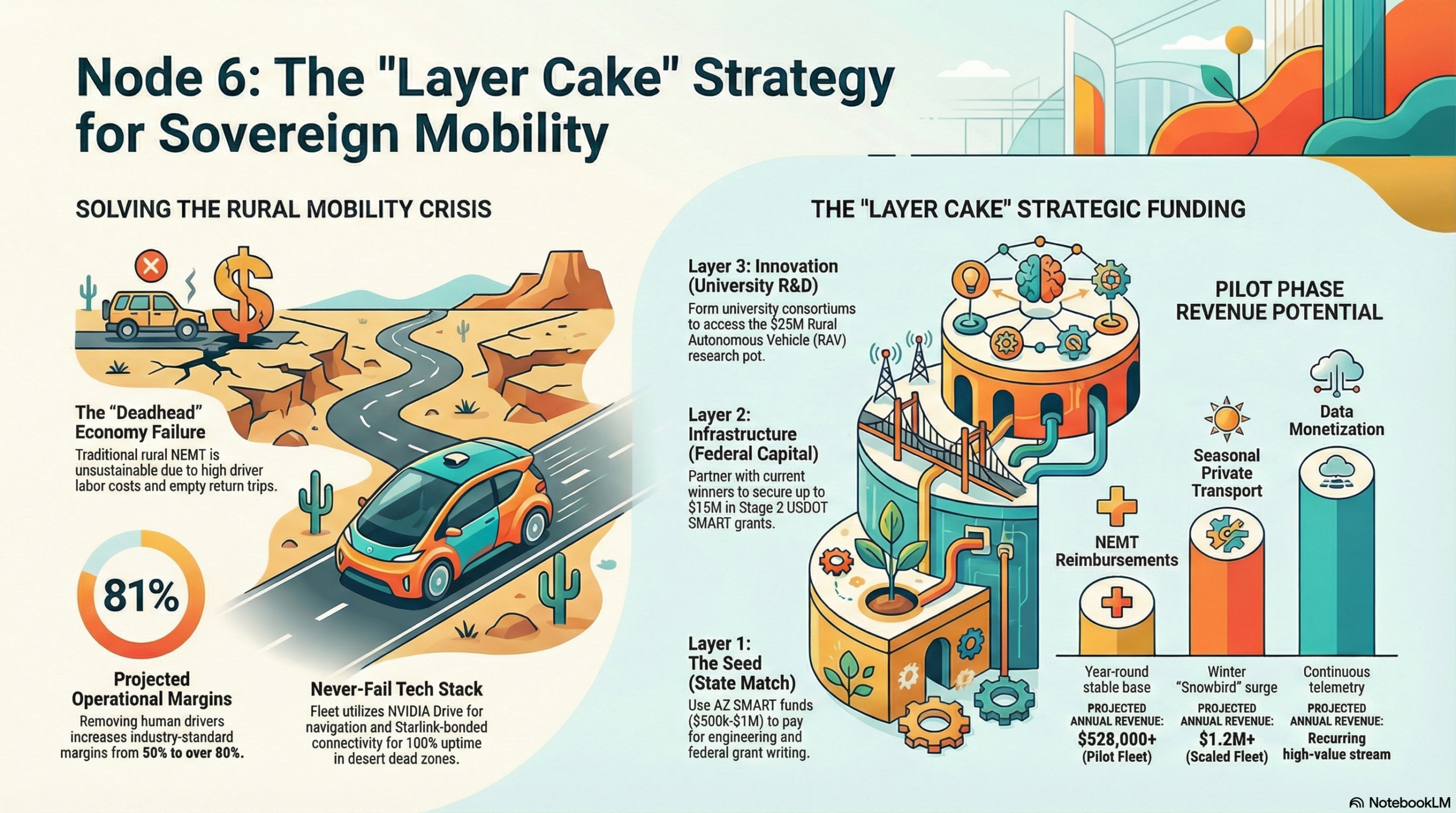
Funding a large, complex technology project is surprisingly similar. The “Layer Cake” funding strategy is a smart approach used by projects like Node 6—an autonomous vehicle service for rural healthcare—to secure money from different sources, each for a specific purpose. Crucially, this strategy shows that a project doesn’t succeed by applying for funds alone, but by building a powerful coalition of partners at the state, university, and regional levels.
This document breaks down this strategy into its three simple layers—Seed, Infrastructure, and Innovation—to show how they stack up to create a successful and fully-funded project.
——————————————————————————–
1. The First Layer: “Seed” Funding (The Ingredients)
This first layer is like getting the essential ingredients for the cake: the flour, sugar, and eggs. Without these basic components, you can’t even begin to bake.
The primary purpose of the Seed layer is to use smaller, local (state) funds to pay for the expensive preparation work needed to apply for much larger national (federal) grants. This initial investment covers critical costs like engineering studies and hiring professional grant writers, which are necessary to create a competitive application.
Example: The AZ SMART Fund
| Grant Name | AZ SMART Fund |
| Source | Arizona State (ADOT) |
| Purpose | To provide cash for design, engineering, and grant-writing services for rural counties like La Paz County. |
| The “So What?” | This is the crucial first step. It provides the money needed to create a professional application that can successfully compete for millions in federal funding. |
The Seed layer is all about preparation. It’s the strategic first move that makes all the subsequent, larger funding possible.
Now that we have the ingredients, it’s time to bake the main cake itself: the Infrastructure.
——————————————————————————–
2. The Second Layer: “Infrastructure” Funding (The Cake)
The Infrastructure layer is the actual cake—the biggest, most substantial part of the project. This is the funding that builds the physical things you can see and touch. For a project like Node 6, this means building the physical grid for its autonomous vehicles, including charging hubs, connectivity towers, and road sensors.
These grants are typically large-scale federal awards designed for major capital projects.
- SMART Grants (USDOT): This grant has a major constraint: only previous winners are eligible to apply for the next stage of funding. The clever strategy for Node 6 is to bypass this restriction by partnering with an existing winner (like the Arizona Commerce Authority) and pitch itself as the perfect rural “testbed” to prove the winner’s technology works in the toughest conditions.
- CFI Grant (FHWA): The most important feature of this grant for a rural project is that it has a special “set-aside” of 50% specifically for rural areas. To qualify, Node 6 strategically frames its charging depots not just as private assets, but as “Public Community Charging Hubs” that serve the entire community.
This layer provides the physical foundation and the “roads” that the high-tech service will run on. Without this substantial funding, the innovative ideas would have no real-world place to operate.
With the physical cake baked, the final step is to add the icing and decorations that make it truly special: the Innovation.
——————————————————————————–
3. The Third Layer: “Innovation” Funding (The Icing & Decorations)
The Innovation layer is the icing and decorations on the cake. This is the funding for the specialized, cutting-edge technology that makes the project unique and “smart.”
For a project like Node 6, this means funding the research and development (R&D) for the autonomous vehicle AI, the software that connects patients to vehicles, and the systems needed to operate the healthcare service itself.
- Rural Autonomous Vehicle (RAV) Research Program: This $25 million grant is specifically for rural AV research, making it a perfect fit. However, it has a crucial restriction: the application must be led by a university. The strategy here is not to apply alone but to form a consortium, with a university like ASU as the lead applicant and Node 6 acting as the official “test site” for the research.
- FTA Section 5311 (Formula Grants for Rural Areas): This is the “bread and butter” funding for operations. It allows Node 6 to be designated as a rural public transit operator, providing the funds needed to run the day-to-day healthcare service. This is the grant that turns the innovative R&D into a sustainable, real-world operation.
While the infrastructure layer builds the body, the innovation layer provides the “brains” of the operation. It funds the research, software, and operational know-how that make the service truly autonomous and effective.
Each layer is critical, but the real magic happens when you see how they all stack up to create a complete recipe for success.
——————————————————————————–
4. Conclusion: A Recipe for Success
The Layer Cake strategy provides a clear and methodical path to funding a complex project. The Seed layer buys the ingredients, the Infrastructure layer bakes the cake, and the Innovation layer adds the finishing touches. Crucially, the layers must be built in order, as each one depends on the one before it.
The Partnership & Funding Roadmap
This approach can be mapped out over a year to show how the layers build on each other through strategic partnerships.
| Timeline | Action Item & Target Grant | Required Partner |
| Q1 | Secure Seed Cash <br>(Target: AZ SMART Fund) | La Paz County (as Applicant) |
| Q1 | Form Research Consortium <br>(Target: RAV Program) | ASU or U of A (as Lead Applicant) |
| Q2-Q3 | Submit Infrastructure Bids <br>(Targets: CFI & SMART Grants) | WACOG & Arizona Commerce Authority |
| Q4 | Secure Operational Funding <br>(Target: FTA Section 5311) | ADOT Transit Division |
The ultimate benefit of the “Layer Cake” strategy is that it allows a project to secure millions of dollars in non-dilutive capital. In simple terms, this means the project can be fully funded using grants and public money without its creators having to give up ownership or equity. It’s a powerful recipe for building a big idea from the ground up.