
Project Octagon and Node 5 The Energy Student Briefing Document
Executive Summary
Project Octagon, spearheaded by the infrastructure conglomerate DeReticular, represents a strategic deployment of eight “Sovereign Nodes” designed to establish a planetary mesh of independent, resilient infrastructure. Central to this mission is Node 5, designated as “The Energy Student” or “The Urban Energy Lab.”
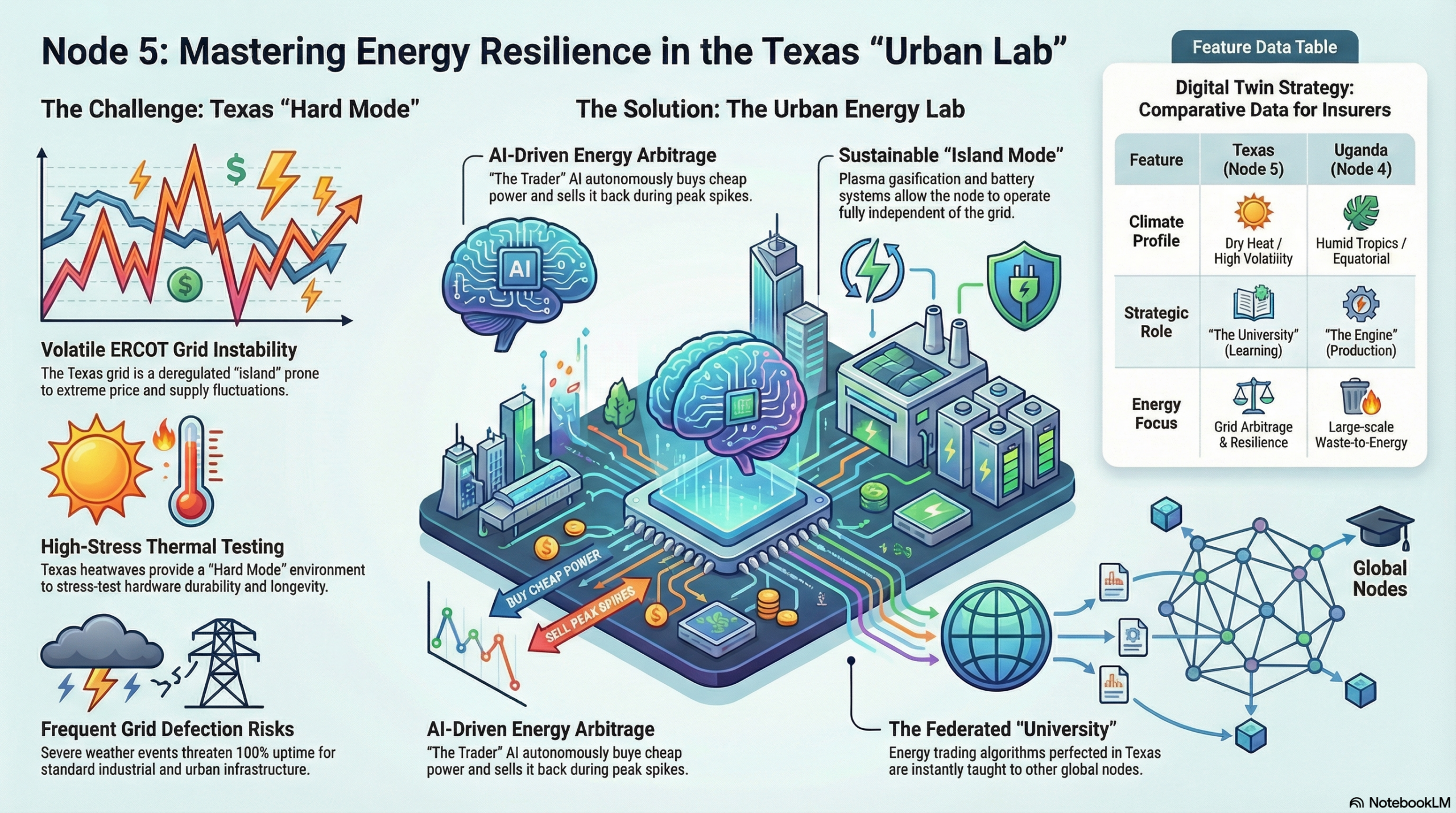
Strategically relocated from Minnesota to Fort Worth, Texas, Node 5 serves as the network’s educational and energy-testing hub. It focuses on mastering energy arbitrage and grid resilience within the volatile ERCOT (Electric Reliability Council of Texas) market. By utilizing the Rural Infrastructure Operating System (RIOS), Node 5 functions as a “University,” perfecting complex energy management strategies that are then distributed across the global network via federated learning. Its primary objectives include validating 100% uptime during grid instability, monetizing energy volatility, and generating comparative “Digital Twin” data to assist in the insurance and longevity modeling of industrial equipment.
——————————————————————————–
Core Framework: DeReticular and RIOS
DeReticular operates as a venture studio and industrial conglomerate, providing the “Sovereign Stack”—a suite of technologies enabling communities to operate in “Island Mode,” independent of national grids and supply chains.
The Sovereign Stack Components
| Component | Entity | Primary Function |
| The Muscle | Agra Dot Energy | Power generation via Plasma Gasification (waste-to-energy). |
| The Motion | Kurb Kars | Autonomous logistics and robotic transport. |
| The Mind | RIOS | The “Global Operating System” and Federated Learning Mesh. |
RIOS (Rural Infrastructure Operating System)
RIOS is the proprietary intelligence layer connecting all physical nodes. It facilitates:
- Federated Learning: Lessons learned in one environment (e.g., hardware degradation in extreme heat) are instantly shared across the network.
- Data Sovereignty: Utilizes “Data Vaults”—off-grid server racks—to allow local hosting of cloud infrastructure, preventing capital flight to centralized providers.
——————————————————————————–
Project Octagon: The Global Mesh Strategy
Project Octagon consists of eight nodes, each serving a specific functional role to stress-test the Sovereign Stack across diverse environments.
| Node | Designation | Location | Primary Role |
| Node 1 | The Welcome Mat | Uganda | Logistics, hospitality, and eco-tourism interface. |
| Node 2 | The Brain | Canada | Software authority; pushes OTA (Over-the-Air) updates. |
| Node 3 | The Simulator | Arizona | Extreme heat testing and autonomous R&D. |
| Node 4 | The Engine | Uganda | 7,000-acre industrial park; primary revenue generator. |
| Node 5 | The Energy Student | Texas | Energy arbitrage and grid resilience lab. |
| Node 6 | UN 2.0 | TBD | Governance, education, and humanitarian aid. |
| Node 7 | The Pop-Up | Arizona | Mobile R&D unit for tactical deployment. |
| Node 8 | Commercial Validator | Undisclosed | Fully paid commercial proof of concept. |
——————————————————————————–
Deep Dive: Node 5 – The Energy Student
Strategic Relocation and Context
Originally located in St. Paul, Minnesota, where it tested “Tundra Mode” and plasma gasification in arctic conditions, Node 5 was moved to Fort Worth, Texas, near the historic Stockyards. This move was driven by the need to interface with ERCOT, one of the most volatile and deregulated energy markets in the world.
Primary Objectives
- Grid Arbitrage: Learning to buy, store, and sell energy based on market volatility.
- Resilience Validation: Proving the ability of RIOS to maintain 100% uptime during extreme grid instability.
- Biomass Validation: Testing waste-to-energy models using livestock biomass data from the nearby Stockyards.
- Digital Twin Analytics: Acting as a “Digital Twin” to Node 4 (Uganda), comparing hardware performance in the Texas heat versus the Ugandan equatorial climate.
Technological Infrastructure
Node 5 is a dense, high-tech urban lab equipped with:
- BESS (Battery Energy Storage System): Commercial-scale Tesla Megapacks managed by RIOS.
- Agra Micro-Unit: A small-scale (10 TPD) Plasma Gasification unit providing “always-on” baseload power.
- Compute: RIOS-CC-1000 racks for high-density processing of market data.
- “The Trader” AI Agent: A specialized agent that monitors real-time ERCOT pricing, weather, and grid failure data to autonomously execute trades.
——————————————————————————–
Economic Model and Revenue Streams
Node 5 operates as a fintech-energy hybrid, transforming grid fragility into a revenue stream.
- Energy Arbitrage: RIOS purchases power when prices are low or negative (oversupply) and sells back to the grid during peak demand or price spikes (which can reach $5,000/MWh in Texas).
- Ancillary Services: Participating in ERCOT’s Frequency Regulation market, providing millisecond-response stabilization to the grid for a premium fee.
- Data Sales: Selling comparative performance data to insurance companies and hardware manufacturers to help them price risk for projects in emerging markets like Africa.
——————————————————————————–
Network Interaction and Systemic Synergy
The “University” Function
Node 5 acts as the network’s educational hub. The energy trading algorithms and grid management strategies perfected in Texas are “exported” via RIOS to other nodes, particularly Node 4 in Uganda. This helps Node 4 balance energy loads between internal industrial use and sales to the national grid to maximize profit.
Interaction with Node 6 (UN 2.0)
There is a significant strategic synergy between Node 5 and the proposed Node 6. If co-located or closely aligned, Node 5 would provide the physical “classroom” and technical infrastructure for Node 6’s mission to train Township Managers in sovereign energy management and local governance.
——————————————————————————–
Strategic Conclusion
Node 5 serves as a critical proof of concept for DeReticular: that resilience is not merely a survival strategy but a profitable enterprise. By situating a node within a fragile, first-world grid, Project Octagon demonstrates that RIOS can transform systemic instability into financial gain. This “Energy Student” validates the hardware and software required to ensure that while the broader grid may fail, the Octagon network remains operational and economically productive.