
The Starling and the Ambulance: Why the Future of Healthcare is a Bird-Inspired Robot Swarm
The Hidden Heart Attack in Our Logistics
In the rigorous language of Health Systems Engineering, a hospital is more than a sanctuary of healing; it is a metabolic processing organ. It ingests biological substrates—patients—stabilizes their volatile chemistries, and returns them to the social fabric. For this “organ” to function, it requires a Clinical Circulatory System. Today, that system is in a state of advanced physiological failure.
We often mischaracterize Non-Emergency Medical Transportation (NEMT) as a marginal paratransit convenience, but it is actually the critical failure point of modern medicine. Consider the “3:00 PM Discharge Thrombus.” A patient is medically cleared at 9:00 AM, but because a contracted transport van fails to arrive, they occupy a high-acuity bed for seven unnecessary hours. This “blockage” ripples backward, forcing emergency rooms into gridlock and causing ambulances to divert. The cost of this logistical ischemia is staggering: a single missed $40 ride to a dialysis clinic frequently cascades into a $12,700 emergency ICU admission—a 300-fold explosion in cost borne by the public taxpayer.
The 5,000-Pound “Mass Inversion” Problem
The primary reason our current transit system fails is a fundamental thermodynamic absurdity: the Mass-Energy Inversion. Today, we utilize 5,000-pound (2,500kg) steel SUVs to transport a single 170-pound (77kg) patient. This results in the 3% efficiency rule: 97% of the exergy consumed is used to move the vehicle’s chassis, while a mere 3% moves the human payload.

By “right-sizing” the machine to the mission, we reclaim the city. The KurbKar “Duo-Pod” is an ADA-compliant modular unit weighing only 750 lbs (340 kg). This shift isn’t just about fuel; it is about the Generalized Fourth Power Law of pavement engineering. Because road damage scales to the fourth power of axle weight, a 750-lb pod reduces structural fatigue by a factor of 22,000x compared to a standard SUV. Moving toward this biophysically grounded architecture is the only way to prevent the municipal bankruptcy caused by the relentless wear of heavy-metal transit.
Starling Physics: Reimagining Traffic Without Lights
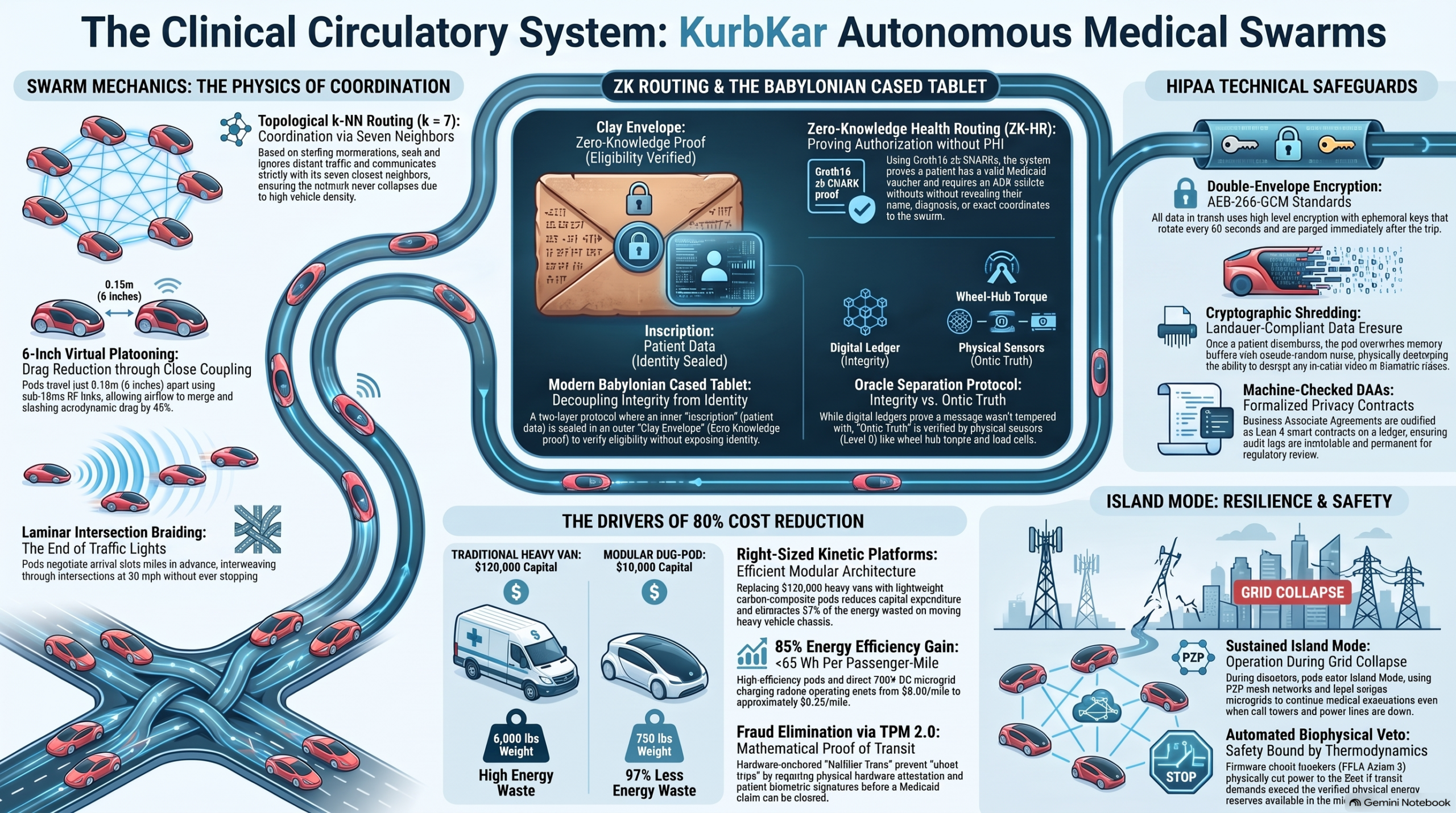
To coordinate thousands of these pods without the “Solitary God” fallacy of a central server, we look to the European StarFlag Project. Research into starling murmurations reveals that birds do not follow a leader; they rely on Topological Interaction. Each pod interacts strictly with its k-nearest neighbors (k \approx 7), making the swarm invariant to density.
Crucially, the swarm maintains Scale-Free Correlation (\xi \propto L). This means the correlation length of the pods’ movements scales with the entire size of the swarm; a maneuver at the “tail” of the city propagates to the “head” instantaneously without decay. This allows for Laminar Intersection Braiding, where pods negotiate arrival slots miles in advance, sliding through cross-traffic like “fingers sliding through fingers” at 30 mph without ever stopping.
The coordination is governed by Hyperbolic Spin Waves rather than slow, diffusive messaging:
“To prevent the sluggishness of multi-turn conversational or packet-acknowledgment polling… emergency braking and corridor negotiations propagate as second-order hyperbolic spin waves… outrunning biological reaction times.”
The 6-Inch “Virtual Platoon”
By triumphing over the tyranny of human reaction lag, pods can travel in “virtual road trains” with headways of just 0.15 meters (6 inches). This proximity is not merely a feat of precision; it is a fundamental shift in fluid dynamics:
- Boundary-Layer Merging: Airflow boundaries fuse, reducing aerodynamic drag by approximately 45% through collective drafting.
- Simultaneous Electromagnetic Braking: Deceleration telemetry propagates across the mesh in under 16ms. If the lead pod brakes, the entire platoon brakes concurrently, eliminating the “accordion” effect that defines human-driven traffic.
- Sub-16ms RF Mesh: Utilizing a TriFi architecture (60 GHz mmWave and 5.9 GHz C-V2X), the pods maintain high-bandwidth links that operate independently of the latency spikes inherent in commercial 4G/5G networks.
The Modern Babylonian “Cased Tablet” for HIPAA Privacy
Handling sensitive medical data in a decentralized swarm requires a total departure from traditional security. The KurbKar system utilizes Zero-Knowledge Health Routing (ZK-HR), inspired by the metaphor of the Babylonian Cased Tablet. In ancient Mesopotamia, a core contract was placed inside a clay envelope; the envelope could be verified without exposing the text inside.
Similarly, a pod can prove a patient is eligible for a Medicaid-funded ride via a zk-SNARK proof without ever “knowing” the patient’s name or diagnosis. The swarm routes a “valid voucher” rather than a “person.” Once the patient disembarks, the system executes “Ephemeral VRAM Shredding,” overwriting memory buffers with pseudo-random noise to ensure that no forensic trace of Protected Health Information (PHI) remains.
The “Thermodynamic Veto”: When Physics Overrides Software
Security in a medical swarm is anchored in Level 0 Ontic Safety. Unlike traditional software that can be “fooled” or sign a “cryptographically pristine lie,” the KurbKar architecture is grounded in unyielding physical resistance.
This is managed by the Remnant AI on-chip inference engine, which monitors the wheelchair clamp strain sensor. If the sensor does not detect a physical tension of at least 450 Newtons, a hardware-level circuit breaker—the RELA Axiom 3—physically cuts power to the drive motors. Safety is not a software promise; it is a biophysical veto. Software can hallucinate, but a strain gauge measuring the weight of a patient cannot.
Economics: Squeezing the “Extractive Middleman”
The legacy NEMT industry is dominated by “brokers” who profit by maximizing administrative friction. The Sovereign Swarm model replaces this moral hazard with mathematical precision.
Metric Conventional NEMT (Broker) KurbKar Swarm
Cost per Mile $4.50 – $8.00 $0.15 – $0.25
Arrival Precision \pm 45–90 Minutes \pm 90 Seconds
Fraud Rate High (Ghost Trips) Mathematically Zero (TPM Verified)
For hospital systems, this provides a 10:1 Return on Investment. By ensuring deterministic precision for dialysis or chemotherapy, the system destroys the downstream inpatient claims that currently cannibalize health budgets.
Conclusion: Toward an Asymptotic Democracy
The transition to these swarms represents a fundamental shift from “extractive symbols”—unreliable paper logs and ungrounded debt—to biophysical reality.
The most compelling aspect of this infrastructure is its “Sustained Island Mode.” Because these pods charge from Agra.Energy Thermochemical Syngas Microgrids and communicate via the TriFi RF Mesh, they are independent of the grid and cellular towers. They can operate in DDIL (Denied, Degraded, Intermittent, or Limited) environments, ensuring the city’s circulatory system keeps moving even if the broader infrastructure collapses.
By binding synthetic intelligence to the laws of thermodynamics, we are “advancing public mobility along the asymptotic horizon toward objective human flourishing.”