Avian Intelligence: How Bird Swarms Save the Future of Travel
Welcome to the terminal phase of the legacy internet. As a systems architect, I view the current travel industry not as a service, but as a failing distributed database. We are currently trapped in the “Tragedy of Human Middleware,” where we use biological human beings to bridge the gaps between siloed, 20th-century mainframes. To move forward, we must look beyond silicon to the biophysical blueprint of Sturnus vulgaris—the European starling.
- The “Human Middleware” Crisis: Why Travel Networks Break
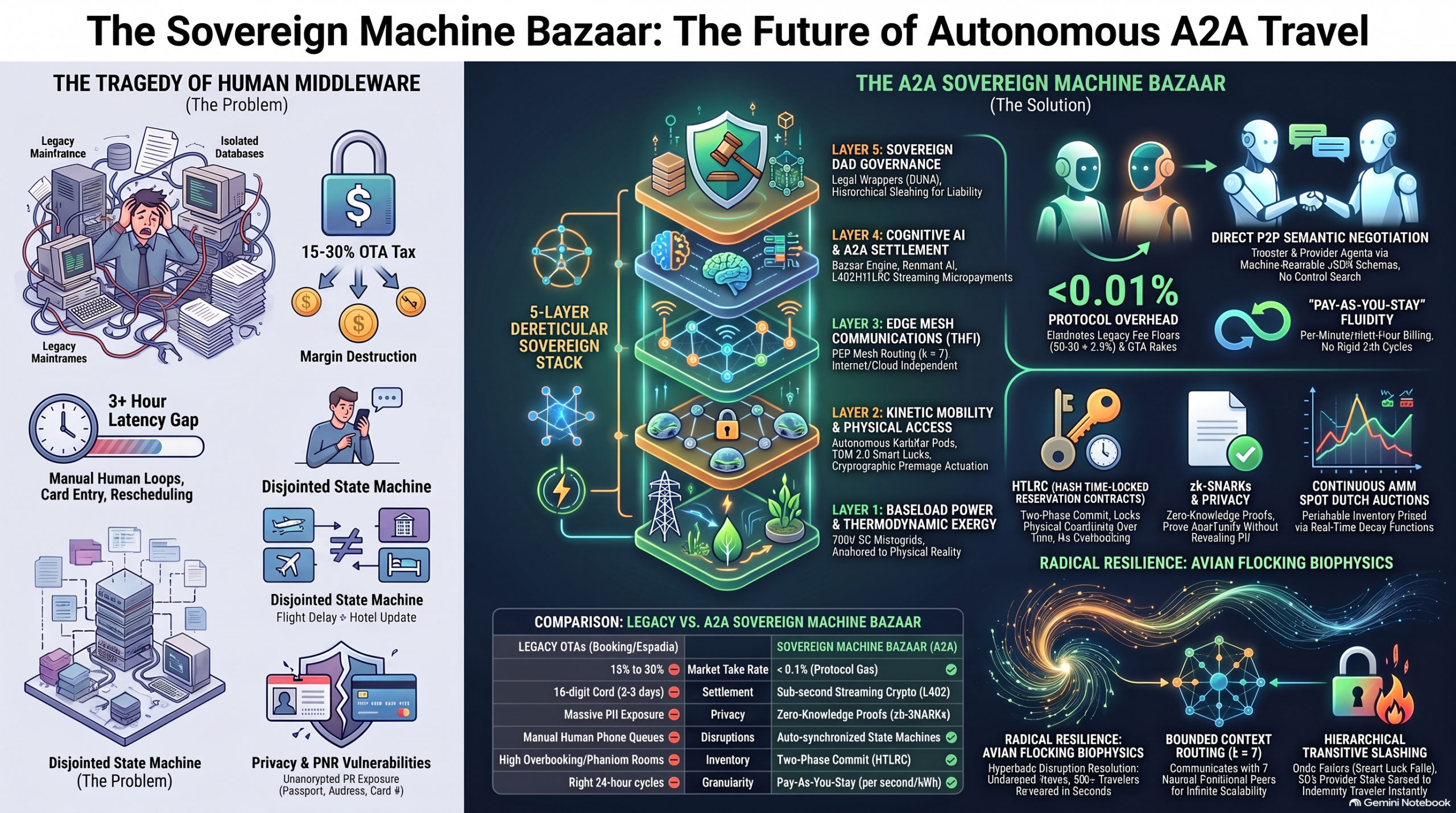
The current travel infrastructure is a fragmented collection of isolated databases. Legacy Global Distribution Systems (GDS) like Amadeus and Sabre are tethered to teletype-era message-switching protocols (EDIFACT/Type A/B). Because these systems rely on asynchronous message passing, they suffer from Inventory Double-Spend and Phantom Availability, where rooms or seats are displayed as available but are already sold due to synchronization lag.
In this mess, you are the “Human Middleware.” You are forced to manually reconcile these fractured states across dozens of browser tabs. We call this the Plastic Wall: the chasm where sub-10-millisecond machine logic is halted to wait for a human to type a 16-digit credit card number into a web form. This inefficiency isn’t just annoying; it carries a massive macro-economic cost, with Online Travel Agencies (OTAs) extracting a 15–30% commission toll—a $120 billion annual “tax” that could be returned to providers and consumers.
Comparing the Pipelines: Legacy vs. Autonomous
Feature Legacy Travel Pipeline Autonomous A2A Pipeline
Search & Discovery Manual GUI (Hours of cognitive capture) Semantic P2P Negotiation (Milliseconds)
Intermediary Tolls 15% – 30% OTA commission < 0.01% Protocol overhead
Settlement Velocity 3-Day ACH/Visa Windows Sub-second L402 Streaming
Integrity Mechanism Unencrypted PII & 16-digit plastic zk-SNARKs & HTLRC Phase Commits
Disruption Handling Manual phone queues/Fragmented silos Auto-synchronized State Machines
Synthesis Insight: Travel currently feels like a nightmare because humans are being used as biological processors to fix broken links between 1960s databases. To solve this, we must transition from rigid, human-dependent systems to a flexible, “organic” mesh modeled after nature’s most efficient swarms.
- The New Travel Ecosystem: Introducing the Autonomous Agent
In the “Sovereign Machine Bazaar,” we replace static websites with Autonomous Agents. These are sovereign software entities acting as your Personal Copilot, protected by legal “skins” like the Wyoming DUNA (Decentralized Unincorporated Nonprofit Association) or Marshall Islands DAO LLC wrappers. This allows an algorithm to hold property and bear liability.
- Autonomous Consumer Agents: These manage your “Intent.” They use zk-SNARKs (Zero-Knowledge Proofs) to prove you have a valid passport and sufficient funds without ever exposing your PII (Personally Identifiable Information).
- Provider Agents: Embedded in hotel Property Management Systems (PMS) or airline Central Reservation Systems (CRS), they conduct direct A2A (Agent-to-Agent) negotiations. Projects like the Camino Network and Winding Tree are already deploying these standards to eliminate GDS message fees.

The 5-Layer Sovereign Architecture
This system is anchored in the DeReticular stack to guarantee “Sustained Island Mode” (operation even during wide-area network failure):
- Layer 5: Sovereign DAO Governance – Legal engineering (DUNAs) for capitalized proof-of-liability.
- Layer 4: Cognitive AI & A2A Settlement – The “Bazaar Engine” running on RIOS-CC-1000 GPU Racks, utilizing Hash Time-Locked Reservation Contracts (HTLRC) to prevent inventory double-spends.
- Layer 3: Edge Mesh Communications – TriFi Wireless Hardware utilizing Directional MIMO and sub-16ms RF packet handoffs for peer-to-peer connectivity.
- Layer 2: Kinetic Mobility & Access – Physical hardware (KurbKars, TPM 2.0-attested smart locks).
- Layer 1: Baseload Power & Exergy – 700V DC microgrids monitored by Level 0 physical sensors.
Synthesis Insight: These agents are not just chatbots; they are sovereign delegates capable of managing complex itineraries while keeping your data invisible. However, coordinating thousands of these agents requires a biological secret: the murmuration.
- The Biophysical Secret: The Murmuration Blueprint
The StarFlag Project revealed that starlings coordinate 100,000 individuals without a central leader. By translating these findings into network logic, we can manage massive travel disruptions without the “API Bloat” that crashes traditional centralized servers.
The Avian Flocking Blueprint for Travel
Biological Principle Technical Translation Learner Benefit
Topological Attention (k ≈ 7) Bounded Peer Discovery: Agents only track their 7 nearest functional neighbors. Eliminates API Bloat: Caps communication complexity, preventing “Token Exhaustion” regardless of swarm size.
Scale-Free Correlation Collective Reorganization: Information ripples through the mesh instantly (\xi \propto L). Citywide Coordination: Swarms re-route city transit without a central dispatcher.
Inertial Spin Waves Hyperbolic Spin Dynamics: Information moves as second-order waves (20-40 m/s). Rapid Consensus: Replaces slow, hallucinatory “Diffusive Chat” with undamped updates that resolve in seconds.
Synthesis Insight: The “k ≈ 7” rule is the primary reason the network doesn’t crash; it enforces a Minimum Description Length (MDL) parsimony that keeps the mesh stable. Unlike current LLMs, which fail due to first-order diffusive chatter, the “Avian” solution uses Hyperbolic Dynamics to reach consensus with zero drift.
- Case Study: The Denver-to-Salt Lake Disruption
Consider a multi-modal journey state machine put to the test:
- Step 1: The Level 0 Oracle Trigger: A traveler is mid-air when their Denver-bound flight suffers mechanical failure. An ADS-B feed (a Level 0 physical sensor oracle) broadcasts this diversion to Salt Lake City (KSLC).
- Step 2: The Hyperbolic Wave Propagation: The traveler’s agent ingests this signed telemetry. It doesn’t initiate a “chat”; it propagates a second-order wave through the itinerary, instantly updating its “heading.”
- Step 3: Atomic Rescheduling: In 8.4 seconds, the agent executes HTLRC Phase 1/Phase 2 commits. It cancels the Denver hotel/car, secures instant smart-contract refunds, and negotiates with the Salt Lake swarm for a new KurbKar and a hotel micro-stay via a Spot Dutch Auction.
Synthesis Insight: This re-synchronization requires zero human phone calls. The experience shifts from “stressful navigation” to “ambient passage,” where the physical world reconfigures itself around the traveler’s needs.
- The Future of Flow: From Searching to Intent
We are moving away from “Cognitive Capture”—staring at glass to find deals. In the future, you will declare an Intent, which is compiled into a Lean 4 Abstract Syntax Tree (AST). This acts as a Deductive Verification Gate, ensuring your request is mathematically sound and biophysically possible before it ever hits the mesh.
The 3 Pillars of Machine Money
- Account Abstraction (ERC-4337): Smart wallets bound to TPM 2.0 hardware, using ephemeral session keys to prevent treasury draining.
- L402 Streaming: The fuel for the flock, combining HTTP 402, Macaroons, and the Lightning Network for sub-cent, per-second payments.
- Thermodynamic Exergy (RELA Axiom 3): Tokens backed by verified kilowatt-hours. If a request exceeds net exergy, an Automated Biophysical Veto triggers a hardware-level firmware interrupt.
Synthesis Insight: Travel will become an “Asymptotic Horizon”—a self-correcting background process. By returning the $120 billion OTA toll to the providers and consumers, we fund a more resilient, private, and efficient world.
The century of human middleware is drawing to a close. Silicon will no longer beg for plastic; instead, an invisible, tireless swarm of agents—informed by the wisdom of the starling—will deliver the ultimate goal: frictionless human freedom.