
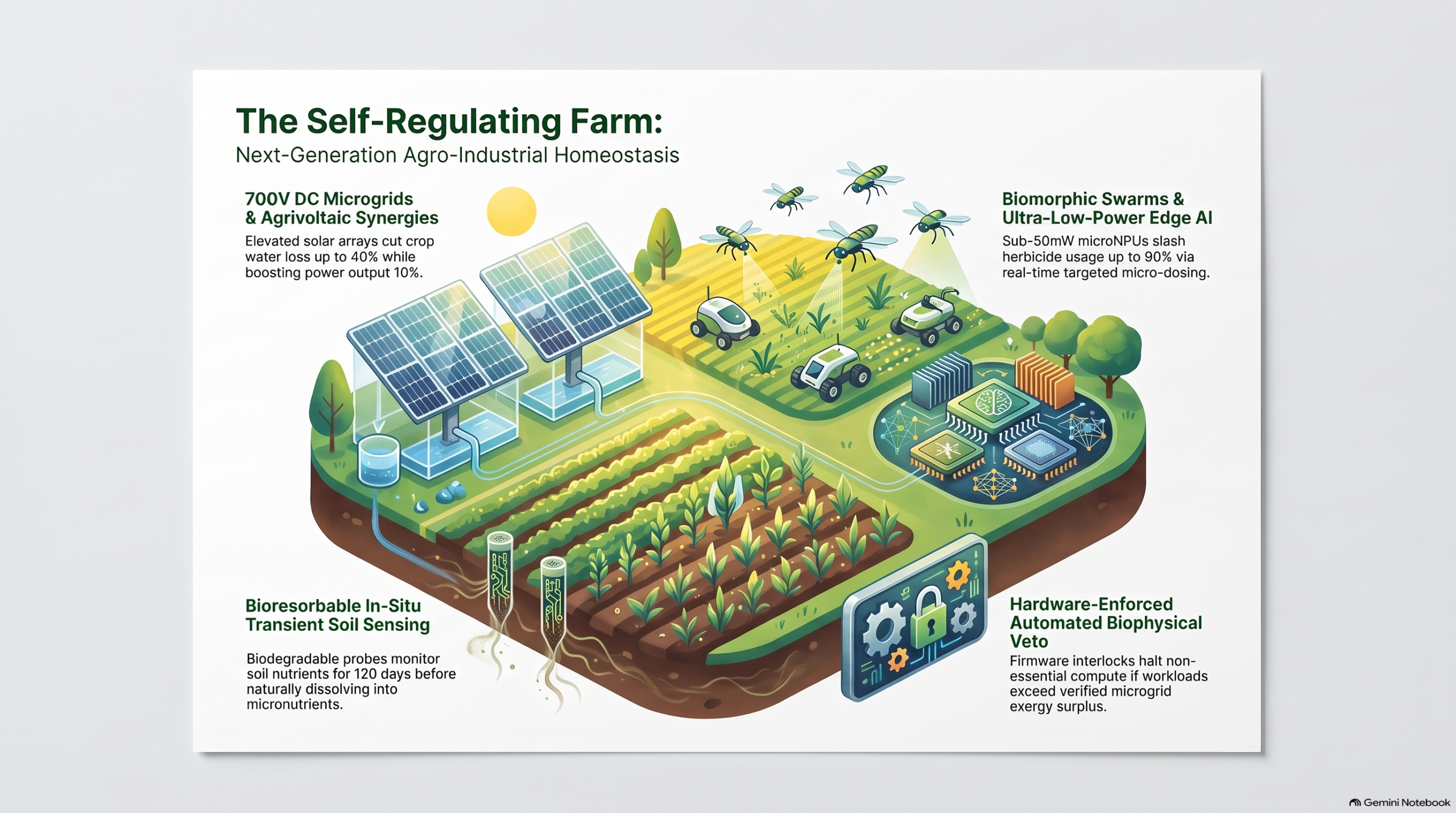
The Self-Regulating Farm Architecture: Strategic Blueprint for Island-Mode Autonomy and Agro-Industrial Homeostasis
- Structural Crisis of Cloud-Tethered AgTech vs. The Island-Mode Imperative
Modern agricultural infrastructure stands at a critical operational nexus where the imperative for long-term operational resilience directly collides with the structural fragility of centralized, cloud-tethered digital networks. As industrial food production increases its reliance on high-density automation, precision robotics, and data-driven management platforms, the underlying technological architecture has remained fundamentally open-loop and remotely dependent. This structural mismatch exposes broadacre and high-value agricultural enterprises to acute systemic vulnerabilities, ranging from long-haul telecommunications outages to predatory vendor lock-in and empirical data exploitation. Transitioning to a closed-loop, self-regulating farm architecture is no longer merely an incremental optimization strategy; it is an absolute technical requirement for operational resilience, financial autonomy, and biophysical solvency. By internalizing power generation, computational execution, agronomic decision logic, and machine fleet orchestration entirely within the physical boundaries of the farm, operators can establish a self-correcting thermodynamic organism capable of maintaining continuous, high-density food production regardless of external market, network, or geopolitical volatility.
The dominant paradigm in contemporary precision agriculture relies on centralized, cloud-tethered farm management information systems (FMIS)—a failure-prone topology designated as the “1,000-Mile Failure Model.” Commercial platforms such as John Deere Operations Center and Climate FieldView require continuous, multi-hop terrestrial IP backbones and cloud hyperscaler infrastructure to validate operations, execute machine prescriptions, and process dynamic telemetry. When regional fiber optic trunks are severed, rural cellular towers suffer brownouts, or remote DNS authentication servers experience denial-of-service events, multi-ton autonomous tractors, automated spraying booms, and variable-frequency irrigation pumps stall in the field due to failed cryptographic handshakes and missing remote instructions. Beyond operational brittle-ness, this long-distance dependency facilitates structural data exploitation: precision yield maps, microclimate readings, and real-time soil moisture telemetry are extracted from local producers, centralized by equipment and agrochemical conglomerates, and monetized to price-discriminate agricultural inputs, adjust insurance premiums, or drive financial speculation on global commodity markets. Furthermore, proprietary communication buses deployed by heavy machinery original equipment manufacturers (OEMs) intentionally restrict cross-brand implement interoperability, trapping farm enterprises within proprietary, subscription-gated software ecosystems that charge arbitrary egress fees and restrict independent repairs.
To establish true operational sovereignty, the agricultural sector must transition from centralized cloud dependency to an air-gapped, sovereign island-mode architecture. The fundamental structural differences between these two operational paradigms are contrasted below:
Architectural Dimension Traditional Cloud-Tethered Models DeReticular Sovereign Island-Mode Architecture
Operational Dependency Requires continuous long-haul cellular/satellite IP backbones to cloud hyperscalers; single point of failure. Fully air-gapped; all execution logic, state tracking, and control loops run locally on-site in Sustained Island Mode.
Data Governance Centralized by equipment and chemical suppliers; high risk of monetization, price discrimination, and vendor lock-in. Absolute local data sovereignty; local encrypted storage using open, vendor-neutral schemas (ADAPT/ISOBUS/JSON Schema).
Network Resilience Vulnerable to DNS attacks, cellular dead zones, fiber cuts, and high-latency satellite backhaul degradation. Multi-tier air-gapped mesh fabric combining Sub-GHz LoRaWAN, Private 5G CBRS, C-V2X PC5, and orbital fallback.
Failure Points Remote cloud handshakes, static Single Sign-On (SSO) credentials, centralized vendor authentication servers. Distributed edge microNPUs, Level 0 physical sensor verification, zero cloud-path single points of failure.
Energy Source Vulnerable, phase-imbalanced rural AC grid feeders subject to voltage sags, brownouts, and fossil tariffs. Sovereign 700 V DC bipolar microgrid powered by on-farm agrivoltaics, thermochemical biomass gasification, and BESS.
This technological vulnerability is exacerbated by a macro-thermodynamic crisis driven by the structural decoupling of nominal financial claims from the real biophysical carrying capacity of arable land. Global agricultural debt, land valuation bubbles, and commodity derivatives compound exponentially according to:
D(t) = D_0 e^{rt}
In stark contrast, real agricultural wealth creation and biological output are physically bounded by photosynthetic solar energy capture, topsoil microbial capacity, and the net physical exergy available to the production enterprise:
\mathcal{Y}(t) \le \kappa \int_{t_0}^t \text{Exergy}_{\text{net}}(\tau) , d\tau
During the early Green Revolution, the energetic return on energy invested (EROEI) for cereal crop production routinely exceeded 20:1. In modern industrial high-input farming, the lifecycle EROEI—accounting for synthetic Haber-Bosch nitrogen synthesis, energy-dense organophosphate synthesis, heavy machinery fabrication, and long-distance logistics—has compressed below 2:1. In industrial animal protein systems, the net EROEI is deeply negative (\le 0.3:1). Concurrently, deep mechanical tillage, excessive synthetic salinization, and continuous monocropping have degraded global soil organic matter (SOM) from pre-industrial baselines of 5%–8% down to less than 1.5%. This biological depletion severely degrades the soil’s dielectric water-holding capacity, turning vital precipitation into destructive surface runoff and locking farm operators into an unsustainable cycle of escalating chemical expenditure to offset declining natural soil fertility.
Decoupling farm operations from fragile external networks and extractive chemical supply chains is an immediate operational necessity, requiring a comprehensive transition to a sovereign, closed-loop technical architecture.
- The DeReticular Five-Layer Sovereign Agro-Stack Architecture
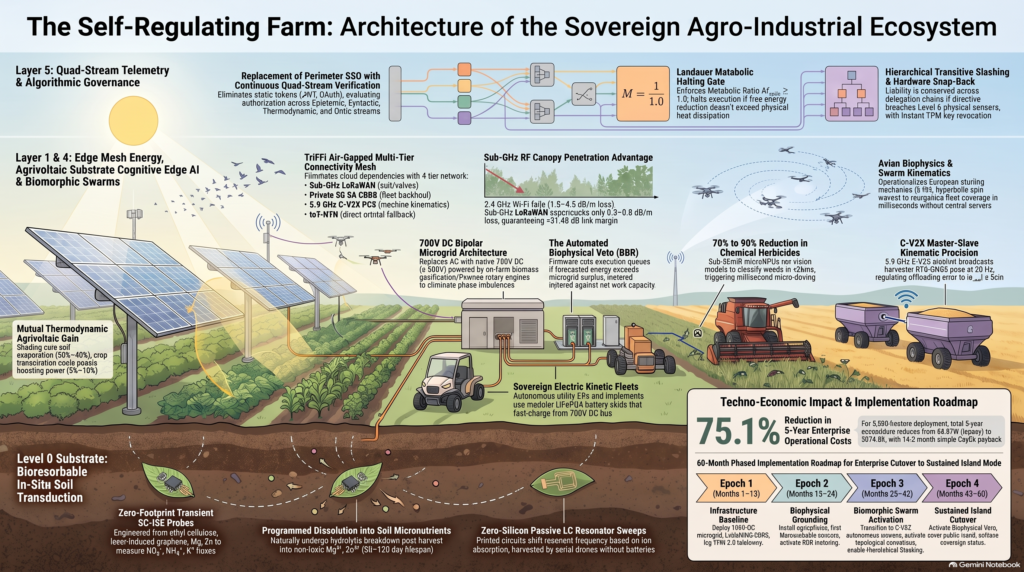
The DeReticular Five-Layer Sovereign Agro-Stack provides a complete, air-gapped systems architecture engineered to maintain continuous operational capability during total loss of external IP connectivity. By structuring the farm’s physical, energetic, computational, and governance assets into five integrated layers, the stack closes cyber-physical feedback loops inside the farm boundary, ensuring that every operational command is grounded in verified physical exergy and real-time biological state.
+———————————————————————–+
| LAYER 5: BIOPHYSICAL GOVERNANCE & ACCOUNTING ISOLATION |
| • Biophysical Balance Register (BBR) • DCAA SF 1408 Compliant Ledger |
| • Automated Firmware Biophysical Veto • Parametric Risk Clearing |
+———————————–▲———————————–+
| Audited Exergy & Financial Work
+———————————–▼———————————–+
| LAYER 4: COGNITIVE AI (REMNANT ENGINE) |
| • Liquid-Cooled RIOS-CC-1000 GPUs • Active Inference Execution |
| • Lean 4 Deductive Proof Kernels • Metacognitive Swarms (MSI) |
+———————————–▲———————————–+
| Verified Machine Directives
+———————————–▼———————————–+
| LAYER 3: EDGE MESH COMMS (TRI-FI SYSTEM AUTHORITY) |
| • Sub-GHz LoRaWAN (SX1302/1303) • Private 5G SA (CBRS Band 48) |
| • C-V2X (PC5 Sidelink Kinematics) • 3GPP Rel-17/18 IoT-NTN DTN |
+———————————–▲———————————–+
| Spatial Telemetry Vectors
+———————————–▼———————————–+
| LAYER 2: KINETIC MOBILITY & IMPLEMENT ACTUATION |
| • Autonomous Utility EVs (KurbKars) • Mobile DC Battery Skids |
| • ISOBUS (ISO 11783) Steer-by-Wire • AgGateway ADAPT Open Schemas |
+———————————–▲———————————–+
| Kinetic Work & Mobile Power
+———————————–▼———————————–+
| LAYER 1: BASELOAD POWER & AGRIVOLTAICS |
| • 700 V DC Bipolar Microgrid Bus • Biomass Gasification Engines |
| • Elevated Tracking Agrivoltaics • Local Battery & Thermal Storage|
+———————————————————————–+
The stack operates through five distinct functional layers:
- Layer 1 (Baseload Power & Agrivoltaics): Serves as the energetic foundation, standardized on a native 700 V DC bipolar microgrid bus (\pm 350\text{ V DC} referenced to ground) to eliminate reactive power losses, phase imbalances, and inverter count proliferation inherent to rural AC lines. Dispatchable baseload power is supplied by on-farm thermochemical biomass gasification units (Agra.Energy/Pawnee rotary heat engines) utilizing high-lignin crop residues (e.g., corn stover, orchard prunings) to generate clean synthesis gas (\text{CO} + \text{H}_2). Primary renewable power is harvested via elevated single-axis tracking agrivoltaic arrays (3.5 to 5 meters clearance), supplying direct DC current to mobile battery charging skids and irrigation pump VFDs.
- Layer 2 (Kinetic Mobility): Manages field movement and mechanical work using all-electric powertrains running under local charge homeostasis. Autonomous electric utility vehicles (KurbKars) transport tools, deploy sensor arrays, and perform targeted mechanical weeding. Mobile DC battery skids fast-charge directly from the 700 V DC bus, eliminating external diesel logistics. Implement steering, depth, and valve actuation execute via standard ISOBUS (ISO 11783-10 Task Controller) protocols over open CAN (J1939) interfaces, utilizing the vendor-neutral AgGateway ADAPT universal object model to strip proprietary locks.
- Layer 3 (Edge Mesh Comms – TriFi Authority): Establishes an air-gapped, multi-tier wireless fabric that eliminates single communication failure points. Tier 1 utilizes Sub-GHz LoRaWAN (Semtech SX1302/SX1303 baseband processors) operating on free-spectrum US915/EU868 bands for dense soil and valve sensor meshes. Tier 2 uses Private 5G Standalone (SA) small cells over Citizens Broadband Radio Service (CBRS Band 48, 3.55–3.70 GHz) to supply high-bandwidth backhaul (>100\text{ Mbps}) for machine vision and diagnostic streams. Tier 3 provides direct vehicle-to-vehicle dynamic kinematics over 5.9 GHz C-V2X (3GPP PC5 Mode 4) sidelink. Tier 4 incorporates 3GPP Rel-17/18 IoT-NTN orbital fallback using RFC 9171 Bundle Protocol (Delay-Tolerant Networking) for direct store-and-forward telemetry across remote acreage.
- Layer 4 (Cognitive AI – Remnant Engine): Handles on-site decision intelligence via liquid-cooled RIOS-CC-1000 GPU racks powered directly by the Layer 1 microgrid. The engine executes Active Inference under Friston’s Free Energy Principle, balancing internal model complexity against empirical accuracy. Operational directives must pass through Lean 4 formal deductive proof checking kernels to verify Abstract Syntax Trees (ASTs) prior to execution, ensuring machine commands are mathematically sound and axiomatically consistent before dispatching to Metacognitive Swarms of Intelligences (MSI).
- Layer 5 (Biophysical Governance & BBR): Implements enterprise governance through the Biophysical Balance Register (BBR). The BBR enforces DCAA SF 1408 and FAR Part 31 accounting system isolation criteria to track energy credits, microgrid power, and crop yields without speculative inflation or double-counting. Operating at the hardware firmware layer, an Automated Biophysical Veto monitors available net exergy; if proposed compute or kinetic tasks exceed verified microgrid power surpluses, the veto circuit trips, halting non-essential compute queues and deferring background operations (e.g., model retraining) to protect mission-critical functions like frost-mitigation pumping and cold-storage refrigeration.
To secure this architecture without relying on external cloud authentication, the DeReticular stack replaces perimeter Single Sign-On (SSO) frameworks (JWT, OAuth, mTLS) with a Quad-Stream Telemetry Engine. Static perimeter identity models introduce the Cognitive Time-of-Check to Time-of-Use (TOCTOU) gap, where an agent authenticates at time t_0, receives a valid session token, and subsequently suffers context window saturation, adversarial prompt injection, or algorithmic hallucination prior to action execution at t_{\text{exec}}. This creates Confused Deputy vulnerabilities, where API gateways execute destructive physical commands signed by degraded agents.
The Quad-Stream Telemetry Engine continuously re-evaluates identity and execution authority across four orthogonal streams:
- Epistemic Stream: Evaluates agent forecast calibration via a rolling Brier score \text{BS}_{i,k}(t) \in [0, 2] and tracks Active Inference variational free energy (F). If the free energy rate of change exceeds zero (\dot{F} > 0) across three consecutive cycles, the system detects algorithmic delirium and suspends the agent.
- Syntactic Stream: Enforces formal deductive soundness by compiling operational directives into Lean 4 ASTs, yielding a binary pass/fail metric S_{\text{syn}} \in {0.0, 1.0}.
- Thermodynamic Stream: Tracks the physical heat dissipated when erasing VRAM context bits (\Delta Q = N_{\text{bits}} k_B T \ln 2) and enforces the Landauer Metabolic Ratio:
\mathcal{M}_{\text{ratio}} = \frac{\Delta F}{\lambda \Delta Q} \ge 1.0
If \mathcal{M}_{\text{ratio}} < 1.0, the agent is burning compute without reducing model uncertainty, triggering a hardware FORCE_ACTION_HALT interrupt.
- Ontic Stream: Measures empirical prediction error against Level 0 physical ground truth sensors (DC bus voltage, soil capacitance, flow meters). If discrepancy loss exceeds pre-registered thresholds (S(E_t, \theta) > \tau_t), the agent incurs an automated cryptographic stake slash.
Identity health is aggregated into a continuous Composite Epistemic Health Index \Psi_i(t) \in [0, 1]:
\Psi_i(t) = w_1 e^{-\gamma_1 \text{BS}i} + w_2 S{\text{syn}} + w_3 \min(1.0, \mathcal{M}{\text{ratio}}) + w_4 e^{-\gamma_2 S{\text{ontic}}}
where \sum w_j = 1.0 (w_1 = 0.25, w_2 = 0.25, w_3 = 0.20, w_4 = 0.30). Agent operational authority is dynamically governed according to a 4-tier health matrix:
- Tier 1 (Veridical Core, \Psi_i \ge 0.85): Full consensus voting rights; unconstrained physical actuation authority.
- Tier 2 (Sub-Calibrated, 0.65 \le \Psi_i < 0.85): Compute allocation throttled by 30%; directives require secondary co-signature.
- Tier 3 (Epistemic Warn, 0.40 \le \Psi_i < 0.65): Excluded from consensus voting; mandatory Lean 4 AST audit required for all proposals.
- Tier 4 (Byzantine Fault, \Psi_i < 0.40): Immediate hardware halt; 50% cryptographic stake burned; capability tokens revoked via hardware snap-back reversion anchored by silicon TPM 2.0 cryptoprocessors.
Tasks are dynamically routed across active agents via a Softmax probability distribution over health states:
P(\text{Route Task } \tau \to \text{Agent } i) = \frac{\exp(\beta \Psi_i(t))}{\sum_j \exp(\beta \Psi_j(t))}
When authority is delegated along an execution chain (\text{Originator } A \to \text{Curator } B \to \text{Executor } C), liability is strictly conserved via Hierarchical Transitive Slashing: if Executor C breaches physical sensor thresholds (S(E_t, \theta) > \tau_t), Executor C incurs a 50% primary stake slash, Curator B incurs a 25% curation slash, and Originator A incurs a 10% sponsorship slash.
Interoperability across the stack is enforced using machine-checkable production data contracts, as specified in the schemas below:
{
“$schema”: “https://json-schema.org/draft/2020-12/schema“,
“$id”: “https://dereticular.org/schemas/AgroExecutionTelemetryFrame.json“,
“title”: “AgroExecutionTelemetryFrame”,
“type”: “object”,
“required”: [
“frame_id”,
“agent_uuid”,
“epoch_timestamp_utc”,
“hardware_tpm_quote”,
“epistemic_stream”,
“syntactic_stream”,
“thermodynamic_stream”,
“ontic_stream”,
“computed_health_index”
],
“properties”: {
“frame_id”: { “type”: “string”, “format”: “uuid” },
“agent_uuid”: { “type”: “string”, “format”: “uuid” },
“epoch_timestamp_utc”: { “type”: “string”, “format”: “date-time” },
“hardware_tpm_quote”: {
“type”: “object”,
“required”: [“pcr_bank_digest”, “tpm_counter_value”, “tpm_signature”],
“properties”: {
“pcr_bank_digest”: { “type”: “string”, “pattern”: “^[a-f0-9]{64}$” },
“tpm_counter_value”: { “type”: “integer”, “minimum”: 0 },
“tpm_signature”: { “type”: “string” }
}
},
“epistemic_stream”: {
“type”: “object”,
“required”: [“domain_tag”, “rolling_brier_score”, “free_energy_delta”, “dF_dt”],
“properties”: {
“domain_tag”: { “type”: “string”, “enum”: [“PRECISION_IRRIGATION”, “VARIABLE_FERTIGATION”, “ROBOTIC_WEEDING”, “SWARM_HARVEST”] },
“rolling_brier_score”: { “type”: “number”, “minimum”: 0.0, “maximum”: 2.0 },
“free_energy_delta”: { “type”: “number” },
“dF_dt”: { “type”: “number” }
}
},
“syntactic_stream”: {
“type”: “object”,
“required”: [“lean4_ast_hash”, “typecheck_status”, “axiomatic_depth”],
“properties”: {
“lean4_ast_hash”: { “type”: “string”, “pattern”: “^[a-f0-9]{64}$” },
“typecheck_status”: { “type”: “string”, “enum”: [“TYPECHECK_SUCCESS”, “COMPILATION_ERROR”, “AXIOM_VIOLATION”] },
“axiomatic_depth”: { “type”: “integer”, “minimum”: 1 }
}
},
“thermodynamic_stream”: {
“type”: “object”,
“required”: [“context_erased_bits”, “landauer_joules_dissipated”, “metabolic_ratio”],
“properties”: {
“context_erased_bits”: { “type”: “integer”, “minimum”: 0 },
“landauer_joules_dissipated”: { “type”: “number”, “minimum”: 0.0 },
“metabolic_ratio”: { “type”: “number”, “minimum”: 0.0 }
}
},
“ontic_stream”: {
“type”: “object”,
“required”: [“sensor_network_root”, “measured_discrepancy_loss”, “registered_tau_threshold”, “falsification_triggered”],
“properties”: {
“sensor_network_root”: { “type”: “string”, “pattern”: “^[a-f0-9]{64}$” },
“measured_discrepancy_loss”: { “type”: “number”, “minimum”: 0.0 },
“registered_tau_threshold”: { “type”: “number”, “exclusiveMinimum”: 0.0 },
“falsification_triggered”: { “type”: “boolean” }
}
},
“computed_health_index”: { “type”: “number”, “minimum”: 0.0, “maximum”: 1.0 }
},
“additionalProperties”: false
}
{
“$schema”: “https://json-schema.org/draft/2020-12/schema“,
“$id”: “https://dereticular.org/schemas/BiophysicalAgroRegister.json“,
“title”: “BiophysicalAgroRegister”,
“type”: “object”,
“required”: [
“register_id”,
“telemetry_epoch”,
“timestamp_utc”,
“microgrid_voltage_dc”,
“net_exergy_joules”,
“soil_carbon_flux_kg”,
“systemic_eroei”,
“active_fiscal_ceiling”,
“veto_circuit_tripped”
],
“properties”: {
“register_id”: { “type”: “string”, “format”: “uuid” },
“telemetry_epoch”: { “type”: “integer”, “minimum”: 0 },
“timestamp_utc”: { “type”: “string”, “format”: “date-time” },
“microgrid_voltage_dc”: { “type”: “number”, “description”: “Continuous voltage on 700V DC microgrid bus.” },
“net_exergy_joules”: { “type”: “number”, “minimum”: 0.0, “description”: “Measured net surplus physical exergy.” },
“soil_carbon_flux_kg”: { “type”: “number”, “description”: “Net organic carbon sequestered in soil root zones.” },
“systemic_eroei”: { “type”: “number”, “minimum”: 1.0, “description”: “Lifecycle EROEI of the agro-enterprise.” },
“active_fiscal_ceiling”: { “type”: “number”, “description”: “Maximum nominal tokens permitted under exergy bounds.” },
“veto_circuit_tripped”: { “type”: “boolean”, “description”: “If TRUE, firmware interlocks cut non-essential compute and machinery.” }
},
“additionalProperties”: false
}
This integrated electrical and software architecture establishes the control fabric required to connect high-level edge computing directly to the physical dynamics of soil biology and canopy energy capture.
- Energetic and Biophysical Yield Optimization: Agrivoltaics and Biochar Synergies
Maximizing operational resilience requires closing bioenergetic and nutrient loops inside the farm boundary. By integrating elevated solar harvesting directly into crop production space and recycling carbon residues into soil substrates, the self-regulating farm eliminates reliance on synthetic inputs while optimizing total land exergy efficiency.
+———————————————————————–+
| INCIDENT SOLAR RADIATION (1000 W/m²) |
+———————————–┬———————————–+
|
┌──────────────────────────┴──────────────────────────┐
▼ ▼
+———————————–+ +———————————+
| ELEVATED PV TRACKING MODULES | | CROP CANOPY & ROOT ZONE |
| • Intercepts Peak Radiation | | • Shading Lowers Temp (5–12°C) |
| • Transpiration Cools Modules | | • Reduces ET_c Volume by 20–40% |
+—————-┬——————+ +—————-┬—————-+
│ │
│ Photovoltaic Transpiration Cooling │
└──────────────────┬──────────────────┘
▼
+———————————————————————–+
| MUTUAL THERMODYNAMIC YIELD GAIN |
| • PV Silicon Power Boost: +2.4% to +4.0% (-0.4%/°C thermal coeff.) |
| • Net System Generation Increase: +5% to +10% |
| • Soil Moisture Retention Gain: +20% to +40% |
| • Land Equivalent Ratio (LER): 1.65 (65% Land Efficiency Gain) |
+———————————————————————–+
The dual-use deployment of elevated single-axis tracking agrivoltaic arrays (3.5–5 m clearance with 8 m row spacing) directly over crop canopies creates a mutual thermodynamic feedback loop:
- Crop Microclimate Moderation: Photovoltaic panels cast intermittent shadow patterns during peak solar hours, lowering soil surface temperatures by 5–12^\circ\text{C}. Crop evapotranspiration (ET_c) is modeled via the modified Penman-Monteith equation:
ET_c = \frac{\Delta (R_n – G) + \rho_a c_p \frac{(e_s – e_a)}{r_a}}{\lambda \left( \Delta + \gamma \left(1 + \frac{r_s}{r_a} \right) \right)}
where \Delta is the slope of the saturation vapor pressure curve (\text{kPa/}^\circ\text{C}), R_n is net radiation at the crop surface (\text{MJ/m}^2\cdot\text{day}), G is soil heat flux density (\text{MJ/m}^2\cdot\text{day}), \rho_a is mean air density at constant pressure (\text{kg/m}^3), c_p is specific heat of air (\text{MJ/kg}\cdot^\circ\text{C}), e_s – e_a represents vapor pressure deficit (\text{kPa}), r_a is aerodynamic resistance (\text{s/m}), r_s is bulk surface resistance (\text{s/m}), \lambda is latent heat of vaporization (\text{MJ/kg}), and \gamma is the psychrometric constant (\text{kPa/}^\circ\text{C}). By reducing net radiation R_n at the canopy level by 30% to 40% and dampening vapor pressure deficits, volumetric water content is preserved, reducing seasonal irrigation demand by 20% to 40%.
- Photovoltaic Transpiration Cooling: Monocrystalline silicon PV modules possess a maximum power temperature coefficient of -0.4%/^\circ\text{C} above 25^\circ\text{C}. Water vapor transpired by underlying crops creates a convective microclimatic cooling effect, lowering overhead module operating temperatures by 6–10^\circ\text{C}. This temperature reduction yields a direct silicon panel efficiency gain of +2.4% to +4.0% (derived from -0.4%/^\circ\text{C} \times -6\text{ to }-10^\circ\text{C}), driving an overall net electricity generation boost of 5% to 10% across the system footprint.
- Land Equivalent Ratio (LER): Combining agricultural production and power generation on the same footprint significantly increases total land productivity, as defined by:
\text{LER} = \frac{\text{Yield}{\text{agri, dual}}}{\text{Yield}{\text{agri, mono}}} + \frac{\text{Yield}{\text{solar, dual}}}{\text{Yield}{\text{solar, mono}}}
Under an elevated agrivoltaic configuration, 1.0 hectare produces 85% of mono-culture crop yield plus 80% of standalone solar power yield, achieving an LER of 1.65—a 65% increase in total land productivity compared to separate agricultural and energy footprints.
To complement water retention, soil biological capacity is restored using pyrolyzed crop residue (biochar) co-composted with liquid anaerobic digestate or livestock manure. Raw biochar possesses high porosity but initial nutrient deficits; pre-charging biochar with nutrient-dense digestate fills its microscopic pore network with nitrified compounds, organic nitrogen, and phosphorus. When incorporated into topsoil, biochar acts as a stable, high-surface-area sponge that significantly increases Cation Exchange Capacity (CEC), prevents nitrate leaching into groundwater, and provides protected micro-habitats for mycorrhizal fungi and beneficial soil bacteria.
Furthermore, amending soils with ground silicate basalt dust initiates Enhanced Rock Weathering (ERW). Dissolved atmospheric carbon dioxide in soil pore water forms carbonic acid:
\text{CO}_2 + \text{H}_2\text{O} \rightleftharpoons \text{H}_2\text{CO}_3
Carbonic acid reacts with calcium- and magnesium-rich silicate minerals in basalt:
\text{Mg}_2\text{SiO}_4 + 4\text{H}_2\text{CO}_3 \to 2\text{Mg}^{2+} + 4\text{HCO}_3^- + \text{H}_4\text{SiO}_4
This reaction permanently locks atmospheric carbon into stable dissolved ocean bicarbonates (\text{HCO}_3^-) while releasing essential plant micronutrients (\text{Ca}^{2+}, \text{Mg}^{2+}, \text{Si}^{4+}) directly into the rhizosphere.
In-situ biophysical monitoring relies on transient, bioresorbable Solid-Contact Ion-Selective Electrodes (SC-ISE) inserted directly into the active root zone. Fabricated on biodegradable substrates (ethyl cellulose, silk fibroin, polyhydroxyalkanoates), these probes utilize vacuum-deposited magnesium (\text{Mg}) and zinc (\text{Zn}) thin-film traces paired with Laser-Induced Graphene (LIG). Solid-contact membranes functionalized with specific ionophores (TDDA for \text{NO}_3^-, Valinomycin for \text{K}^+, Nonactin for \text{NH}_4^+) measure macronutrient ion activity according to the Nernst-Nikolsky equation:
E = E^0 + \frac{RT}{z_i F} \ln\left(a_i + \sum_{j} K_{i,j}^{\text{pot}} (a_j)^{z_i/z_j}\right)
+———————————————————————–+
| SENSOR DISSOLUTION PROFILE & MICRONUTRIENT ASSIMILATION |
+———————————————————————–+
| 100% | FUNCTIONAL MONITORING WINDOW (90–120 Days) |
| | • Polycaprolactone / Beeswax Barrier Intact |
| | • Continuous Potentiometric NPK & Dielectric Profiling |
| +————————┐ |
| | | RAPID HYDROLYTIC BREAKDOWN |
| | | • Mg + 2H2O -> Mg(OH)2 + H2 |
| | | • Zn -> Zn2+ Micronutrient Flux |
| 0% | └─────────────────────────► 0% Residue |
| +————————+————————-+ |
| 0 90 120 Days |
+———————————————————————–+
To eliminate post-harvest manual retrieval and electronic waste, the sensor dissolution profile is engineered via polycaprolactone (PCL) or beeswax encapsulation barriers. Water diffusion through the barrier governs operational lifespan according to linear surface-reaction dissolution kinetics:
h(t) = h_0 – k_{\text{diss}} \cdot t
where h_0 is initial trace thickness and k_{\text{diss}} \approx 0.5–2.0\ \mu\text{m/day}. Upon complete hydrolysis, the magnesium and zinc traces decompose into plant-assimilable micronutrients (\text{Mg}^{2+}, \text{Zn}^{2+}):
\text{Mg} + 2\text{H}_2\text{O} \to \text{Mg(OH)}_2 + \text{H}_2 \uparrow
\text{Zn} + 2\text{H}_2\text{O} \to \text{Zn(OH)}_2 + \text{H}_2 \uparrow
Telemetry extraction relies on two options: zero-silicon passive inductive-capacitive (LC) resonant tanks, whose resonant frequency shifts with ion-induced hydrogel dielectric change:
f_0 = \frac{1}{2\pi \sqrt{L \cdot C(\text{ion})}}
interrogated via low-frequency swept magnetic fields emitted by low-flying aerial drones; or transient active micro-beacons powered by local bio-galvanic energy harvesting that transmit Sub-GHz packets for 100 days before detaching into the mineral matrix.
Radio propagation through mature crop foliage is governed by the Modified ITU-R P.833 vegetative attenuation model:
A_{\text{canopy}} = a \cdot f^b \cdot \left(1 – e^{-d \cdot c}\right) \quad [\text{dB}]
where f is carrier frequency (\text{MHz}), d is canopy depth (\text{m}), and a, b, c are empirical foliage parameters. At 2.4\text{ GHz} (ISM band), water-molecule rotational absorption causes severe attenuation (1.5–4.5\text{ dB/m}), causing wireless link margins to collapse beyond a few hundred meters in dense corn or sorghum crops. Conversely, Sub-GHz carriers (868/915\text{ MHz}) experience drastically reduced foliage absorption (0.1–0.8\text{ dB/m}), delivering a +31.5\text{ dB} net link margin over 10\text{ km} baseline canopies and ensuring 99.99% packet delivery across broadacre fields.
These localized biophysical optimizations feed high-resolution spatial vectors directly into the farm’s autonomous machine fleets to direct variable-rate field activities.
- Biomorphic Swarm Kinematics and Distributed Autonomous Coordination
Centralized fleet orchestration fails in broadacre agriculture due to high network latency and single-point server vulnerabilities. The self-regulating farm replaces rigid client-server management with self-organizing biomorphic swarms that execute collaborative field tasks autonomously without external cloud communication.
+———————————————————————–+
| AVIAN FLOCKING KINEMATICS C-V2X MASTER-SLAVE TRACKING |
| (Topological Attention: k ≈ 7) (Combine Harvester to Cart) |
| |
| (Peer 3) COMBINE HARVESTER (Master) |
| / \ • Pose Vector [X,Y,Z,θ,V] 20Hz |
| (Peer 2)──(Peer 1) │ |
| / \ / │ \ │ Direct 5.9 GHz C-V2X PC5 |
| (Peer 7)──(ROVER EGO)──(Peer 4) ▼ |
| \ / \ │ / AUTONOMOUS GRAIN CHASER TRACTOR |
| (Peer 6)──(Peer 5) • Error e(t) = P_cart – […] |
| • Latent Invariant: |e_lat|<=5cm|
+———————————————————————–+
Field fleet orchestration adapts the biophysical principles of European starling murmurations (Sturnus vulgaris), operationalizing three core mechanisms:
- Topological Interaction (k \approx 7): Empirical studies demonstrate that starlings interact strictly with their k = 6.5 \pm 0.5 (k \approx 7) nearest topological neighbors, regardless of absolute spatial distance or flock density. Applying bounded topological attention to autonomous rovers limits each machine’s active ROS 2 / DDS network connection graph to its 7 nearest functional peers. This prevents network congestion, bounds token context size, caps memory bloat, and prevents graph saturation during fleet expansion.
- Scale-Free Criticality (\xi \propto L): Starling swarms maintain spatial velocity fluctuation correlation lengths (\xi) that scale linearly with total flock physical diameter (L). Operating at self-organized criticality drives system susceptibility to near-infinity (\chi \to \infty). Consequently, when an edge scout rover detects a hidden obstacle, human incursion, or irrigation line rupture, the perturbation triggers an instantaneous path reorganization across the entire autonomous fleet without central master command.
- Hyperbolic Inertial Spin Waves (\omega = c \cdot k): Directional updates propagate across the swarm not as slow diffusive chatter (\mathcal{O}(N^2) turns), but as undamped, second-order hyperbolic spin waves traveling at phase velocities c = 20–40\text{ m/s}. Derived from Hamiltonian conservation of local spin vectors \mathbf{s}_i and rotational inertia \chi_0:
\frac{d\mathbf{v}_i}{dt} = \frac{1}{\chi_0} \mathbf{s}_i \times \mathbf{v}i, \qquad \frac{d\mathbf{s}i}{dt} = \sum{j \in S_i} J{ij} (\mathbf{v}_i \times \mathbf{v}_j) – \frac{\eta_0}{\chi_0} \mathbf{s}_i
where J_{ij} represents alignment interaction stiffness and \eta_0 is rotational viscosity. This mechanism allows thousands of autonomous field agents to reach trajectory consensus in \mathcal{O}(N) or \mathcal{O}(\log N) time, bypassing multi-round negotiation latency.
For tight physical coordination, such as grain offloading on the move, vehicles execute dynamic master-slave kinematics over direct 5.9 GHz C-V2X (3GPP PC5 Mode 4) sidelink communications, bypassing cell towers entirely. The combine harvester acts as the dynamic coordinate origin, broadcasting its RTK-GNSS pose vector \mathbf{p}_{\text{harvester}}(t), heading angle \theta, and velocity vector at 20 Hz. The trailing autonomous grain-cart tractor calculates its real-time closed-loop trajectory error vector \mathbf{e}(t):
\mathbf{e}(t) = \mathbf{p}{\text{cart}}(t) – \left(\mathbf{p}{\text{harvester}}(t) + \mathbf{R}(\theta)\mathbf{d}_{\text{offset}}\right)
where \mathbf{R}(\theta) represents the heading rotation matrix and \mathbf{d}{\text{offset}} defines the dynamic discharge auger offset. Control loops maintain lateral position tolerance within |\mathbf{e}{\text{lat}}| \le 5\text{ cm} over uneven field terrain to prevent grain spillage during offloading.
At the individual machine level, real-time sensing relies on low-power computer vision pipelines embedded directly on implement spray booms. High-speed weeding booms integrate ARM Cortex-M55 microcontrollers paired with dedicated ARM Ethos-U55 microNPUs running under 50 mW active power. Neural network models are compressed using Quantization-Aware Training (QAT) to INT8/INT4 precision (Tinyissimo-YOLO), fitting entirely within 2 MB of embedded SRAM. Operating at 30 FPS, the microNPU executes weed-versus-crop segmentation in under 25 milliseconds, directly pulsing high-speed solenoid nozzles to micro-dose herbicides on individual weed targets. This targeted application cuts chemical use by 70% to 90% compared to conventional broadcast spraying, lowering input costs and preventing toxic chemical runoff into surrounding watersheds.
Dynamic swarm execution is financially validated and managed through verified on-farm ledgers prior to full deployment across enterprise operations.
- Techno-Economic Analysis (TCO) and 60-Month Implementation Roadmap
Transitioning legacy commercial farms to the DeReticular sovereign architecture requires a clear techno-economic justification. High upfront capital expenditures (CapEx) for DC microgrids, agrivoltaic arrays, and autonomous fleets are offset by the elimination of recurring software licensing, reduced chemical expenditures, lower energy expenses, and new power generation revenue.
A five-year enterprise Total Cost of Ownership (TCO) evaluation contrasting a 5,000-hectare commercial deployment of Legacy Industrial AgTech against the DeReticular Self-Regulating Farm is detailed below:
Cost & Revenue Category Scenario A: Legacy Industrial AgTech Scenario B: DeReticular Self-Regulating Farm
Field Hardware CapEx (Sensors, Gateways, Controllers) $120,000 (Proprietary locks, $120/ha) $85,000 (Open LoRaWAN + Transient SC-ISE probes)
Microgrid & Agrivoltaic Setup CapEx $0 (Relies entirely on rural AC grid power) $420,000 (700 V DC bus, 1.5 MW solar, gasifier, BESS)
Recurring Carrier & Cloud OpEx 240,000 (48,000/yr cellular SIMs + FMIS) $4,800 (Single emergency orbital satellite link)
Chemical & Fertilizer Expenditure $2,800,000 (Full broadcast chemical inputs) $840,000 (70–90% chemical cut via micro-dosing)
Fuel & Pumping Tariff Expenditure $750,000 (Diesel fleet + AC pump tariffs) $75,000 (Electric swarms + DC microgrid pumping)
Agrivoltaic Energy Revenue Offsets $0 (No energy harvesting capacity) -$450,000 (Internal offset & net power sales)
Total 5-Year Net Expenditure $3,910,000 $974,800
Net Operational Cost Reduction Baseline -$2,935,200 (-75.1%)
Simple Payback Period on Stack CapEx N/A 14.2 Months
Financially, integrated field telemetry logged via onboard TPM 2.0 cryptoprocessors enables direct execution of automated parametric risk agreements. When multi-homed field weather stations, soil moisture arrays, and radar telemetry verify that localized evapotranspiration exceeds soil moisture intake for 14 consecutive days during pollination, parametric insurance payouts trigger automatically within 48 to 72 hours, bypassing manual claims adjusters. Concurrently, tamper-evident telemetry logs—metered nitrogen application rates, cover crop planting dates, fuel reductions, and soil carbon sequestration—provide verifiable audit trails for Scope 3 carbon insetting, allowing farm operators to capture premium supply contracts from consumer packaged goods corporations.
+———————————————————————–+
| 60-MONTH IMPLEMENTATION ROADMAP ARCHITECTURE |
+———————————————————————–+
| EPOCH 1: INFRASTRUCTURE & FABRIC EPOCH 2: SOIL & ENERGY GROUNDING |
| (Months 1–12) (Months 13–24) |
| ┌────────────────────────────────┐ ┌──────────────────────────────┐ |
| │ • Deploy 700 V DC Microgrid Bus│ │ • Commission Agrivoltaics │ |
| │ • Install LoRaWAN / CBRS Masts │──►│ • Deploy Resorbable Probes │ |
| │ • Attested Telemetry Logging │ │ • Activate BBR Exergy Meter │ |
| └────────────────────────────────┘ └──────────────┬───────────────┘ |
| │ |
| EPOCH 4: VERIDICAL ISLAND CUTOVER EPOCH 3: BIOMORPHIC SWARMS |
| (Months 43–60) (Months 25–42) |
| ┌────────────────────────────────┐ ┌──────────────────────────────┐ |
| │ • Full Island Mode Status │ │ • Deploy Autonomous EV Swarm │ |
| │ • Cut Outbound Cloud Portals │◄──│ • C-V2X Sidelink Alignment │ |
| │ • Automated Biophysical Veto │ │ • Hierarchical Slash Router │ |
| └────────────────────────────────┘ └──────────────────────────────┘ |
+———————————————————————–+
Transforming legacy agricultural holdings into sovereign self-regulating enterprises follows a structured 60-month implementation roadmap divided into four operational epochs:
- Epoch 1 (Months 1–12): Infrastructure Baseline & Telemetry Fabric
- Deploy the primary 700 V DC microgrid backbone connecting equipment charging depots and central pump stations.
- Erect high-gain collinear LoRaWAN base stations (Semtech SX1303) and Private 5G SA CBRS outdoor small cells on elevator masts.
- Equip all mobile assets with onboard TPM 2.0 cryptoprocessors to log cryptographically attested operational telemetry frames.
- Epoch 2 (Months 13–24): In-Situ Soil & Agrivoltaic Grounding
- Construct elevated single-axis tracking agrivoltaic arrays over high-value acreage and integrate biomass gasifiers for dispatchable baseload power.
- Deploy the initial seasonal deployment of bioresorbable magnesium/zinc SC-ISE soil sensors to calibrate root-zone dielectric profiles.
- Activate the Biophysical Balance Register (BBR) to track net physical work capacity against agricultural operations.
- Epoch 3 (Months 25–42): Biomorphic Swarms & Hierarchical Slashing
- Transition field operations to autonomous electric rovers and implement swarms coordinated via direct 5.9 GHz C-V2X PC5 sidelink.
- Enforce topological k-NN (k \approx 7) attention limits across machine networks and activate second-order spin-wave consensus.
- Activate the Hierarchical Transitive Slashing Router and Softmax task routing engine to automatically penalize control algorithms that deviate from Level 0 physical sensor data.
- Epoch 4 (Months 43–60): Sustained Island Mode Veridical Cutover
- Activate the firmware-level Automated Biophysical Veto, allowing microgrid power registers to cut execution queues for non-essential compute or ungrounded machine actions.
- Sever all outbound dependencies on public cloud portals, permanently decommissioning proprietary cloud links and enforcing TPM 2.0 hardware snap-back reversions if unauthorized external connections are attempted.
- Achieve full Sustained Island Mode, completing the transition of the farm into a sovereign, self-correcting thermodynamic organism.
This transformation completes the shift of the farm from an extractive, cloud-dependent enterprise into a self-correcting, biophysically grounded organism.