
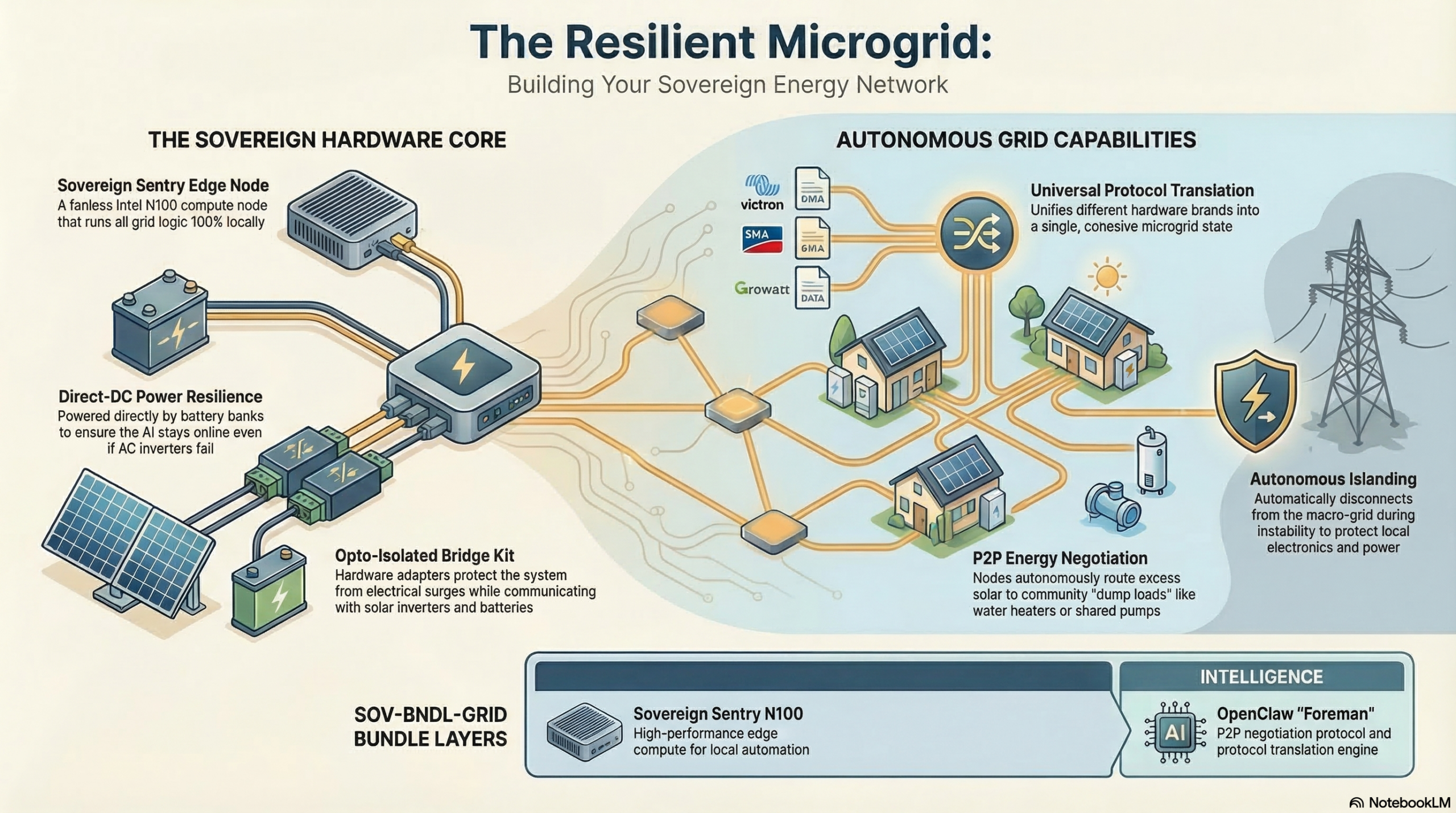
The Resilient Microgrid: A Guide to Autonomous Energy Integration
1. Introduction: From Centralized Fragility to Community Resilience
Modern energy infrastructure suffers from inherent centralized fragility: a single point of failure in the macro-grid can destabilize entire regions. The Resilient Microgrid represents a paradigm shift toward an anti-fragile, community-driven architecture. By transitioning from passive consumption to active, decentralized orchestration, homeowners and municipal planners can ensure that critical resources remain operational regardless of the state of the primary utility.
Vision Statement: To replace vulnerable, centralized power dependencies with a decentralized network of autonomous nodes that negotiate energy distribution in real-time, ensuring that community resources—like clinics, farms, and water systems—remain powered through localized intelligence and peer-to-peer resource sharing.
This transition requires more than just hardware; it requires a systemic integration of compute power and communication protocols. To move from the philosophy of independence to the reality of a self-healing grid, we must first establish the physical foundation of the system.
2. The Physical Brain: The Sovereign Sentry Hardware
The orchestration of a microgrid requires a dedicated edge compute node capable of processing industrial protocols in real-time without the latency or security risks of cloud-based systems. This “Physical Brain” is the Sovereign Sentry.
| Hardware Component | Role in Your Microgrid |
| Sovereign Sentry (Intel N100, 16GB RAM, 500GB NVMe) | The primary Edge Compute Node. The Intel N100 architecture is selected for its high performance-to-watt ratio, ensuring minimal parasitic draw on the battery bank while the 16GB RAM handles concurrent protocol translations. |
| Fanless Industrial Chassis | Eliminates mechanical failure points and prevents internal debris accumulation, ensuring 100% uptime in unconditioned environments like utility sheds or barns. |
| 12V/24V/48V DC-DC Step-Down Converter | Provides a direct-current power path from the battery bank to the Sentry, maximizing efficiency by bypassing AC inverter conversion losses. |
| Weather-Resistant Field Box | A ruggedized enclosure that provides physical protection and organized cable management for the system’s internal electronics. |
Key Insight: The Direct-DC Advantage In traditional setups, control systems rely on the AC output of an inverter. If the inverter fails or enters a fault state, the control system dies with it. By utilizing the DC-DC Step-Down Converter, the Sovereign Sentry remains energized directly by the battery bank. This ensures the “brain” stays alive to diagnose faults, manage recovery, and maintain the orchestration layer even if the primary power conversion hardware is offline.
While the Sentry provides the logic, it requires a robust interface to interact with the energy production hardware.
3. The Nervous System: Bridging the Hardware Gap
A resilient microgrid must achieve interoperability between disparate hardware ecosystems. The Solar/Battery Bridge Kit acts as the system’s nervous system, facilitating “Protocol Translation” between the Sentry and equipment from various manufacturers like Victron, SMA, and Growatt.
The physical connection is established through three specialized modules:
- 2x Opto-isolated USB-to-RS485 Serial Adapters: These create the communication pathways to inverters and charge controllers, allowing the system to poll Modbus registers for real-time generation data.
- 1x USB-to-CAN Bus Interface Module: This enables high-speed communication with smart Battery Management Systems (BMS) to monitor cell-level metrics and state-of-charge (SoC).
Safety Note: Opto-Isolation (Risk R-VOLT-01) High-voltage energy systems are prone to ground loops and electrical surges. To protect the Sovereign Sentry’s logic board, all RS485 adapters feature physical opto-isolators. These components use light to transmit data across an air gap, shielding the compute node from surges of up to 3kV.
With the physical “nerves” connected, the hardware layer is now primed for the orchestration layer to initiate protocol handshakes.
——————————————————————————–
4. The Digital Manager: Meet the “Foreman”
The transition from raw data to actionable intelligence is managed by the OpenClaw “Foreman” and the Node-RED Logic Engine. The Foreman serves as the industrial translator, while Node-RED acts as the executive decision-maker, enforcing deterministic logic across the microgrid.
Upon system initialization, the Foreman executes an automated Discovery Phase:
- Hardware Path Scan: The agent interrogates all connected USB interfaces to identify active serial and CAN paths.
- Autonomous Detection: The system probes the devices to identify the manufacturer and model (e.g., “Growatt Inverter Identified”).
- Register Map Loading: The Foreman automatically loads the corresponding Modbus register maps, allowing the system to instantly interpret machine data without manual user programming.
Key Insight: Hysteresis Enforcement (Risk R-LOG-01) To ensure the physical longevity of the grid’s mechanical components, the system utilizes “Hysteresis Enforcement.” This acts as a Smart Cooling Period for heavy relays. If solar production fluctuates rapidly due to intermittent cloud cover, the logic engine enforces a mandatory 5-minute state-hold. This prevents “relay chatter,” protecting your expensive switchgear from premature mechanical wear.
——————————————————————————–
5. The Collaborative Network: P2P Energy Negotiation
The ultimate evolution of the Resilient Microgrid is the transition from an isolated home to a collaborative community node. Using the Grid Negotiator Protocol over a local Wi-Fi or LoRaWAN mesh, individual nodes communicate their energy states. Security is maintained through X.509 Mesh Identity Certificates, which serve as a Hardware Root of Trust (Risk R-SEC-01). This ensures that only verified nodes can participate in the grid, preventing “Grid Spoofing” by malicious actors attempting to broadcast fraudulent data.
| Scenario | System Action | Operational Result |
| Excess Generation (Node A at 100% SoC) | The P2P daemon broadcasts surplus availability; the Foreman triggers a local smart relay. | Thermal Storage: Excess electrons are routed to a community water heater or clinic boiler rather than being wasted. |
| Grid Frequency Anomaly (Brownout Risk) | The Sentry detects macro-grid voltage instability via the RS485 link. | Autonomous Islanding: The node instantly commands the inverter to disconnect, shielding local electronics from surge damage. |
| Community Load Balancing | Node B (Clinic) reports a critical load spike; the local mesh negotiates shared capacity. | Mesh Resilience: Nearby nodes route energy to support the clinic, utilizing the P2P daemon’s real-time metrics to maintain balance. |
In this architecture, “Dump Loads” are redefined as Community Resilience. Excess energy is no longer a waste product but a shared resource that provides hot water, agricultural pumping, and emergency stability for the entire mesh.
——————————————————————————–
6. Summary: The Autonomous Advantage
The integration of the Sovereign Sentry and the OpenClaw Foreman provides a “digital employee” capable of managing complex energy environments with zero reliance on the cloud. By moving intelligence to the edge, you ensure that your power remains sovereign, secure, and collaborative, even when the global internet or the macro-grid fails.
The Three Pillars of Your New Grid:
- Hardware Autonomy: Utilizing N100-driven edge compute nodes and Direct-DC power paths to ensure the control logic survives even when the main inverter fails.
- Software Intelligence: Automated hardware discovery and industrial-grade hysteresis logic that protects your equipment while maximizing energy harvesting.
- Community Connection: A secure, P2P mesh network protected by X.509 encryption that transforms individual homes into a unified, resilient energy collective.