The Great AI Schism: Why the Future of Intelligence is Moving “Off-Grid”
The End of the Prompt
By mid-2026, the novelty of “chatting” with an AI has evaporated; we have entered the era of deployment. We are no longer interested in chatbots that wait for us to speak, but in “Agentic AI” that acts before we even think to ask. The fragility of our hyper-connected world has forced a reckoning, moving us away from centralized clouds toward autonomous systems.
This shift has created a profound architectural divide between two warring philosophies. On one side stands Google’s Project Remy, a cloud-integrated titan designed for frictionless convenience. On the other is DeReticular, a decentralized upstart arming those who wish to step off the grid entirely. We are no longer choosing a model; we are choosing a jurisdiction.
Proactive, Not Reactive: The Rise of the Digital Butler
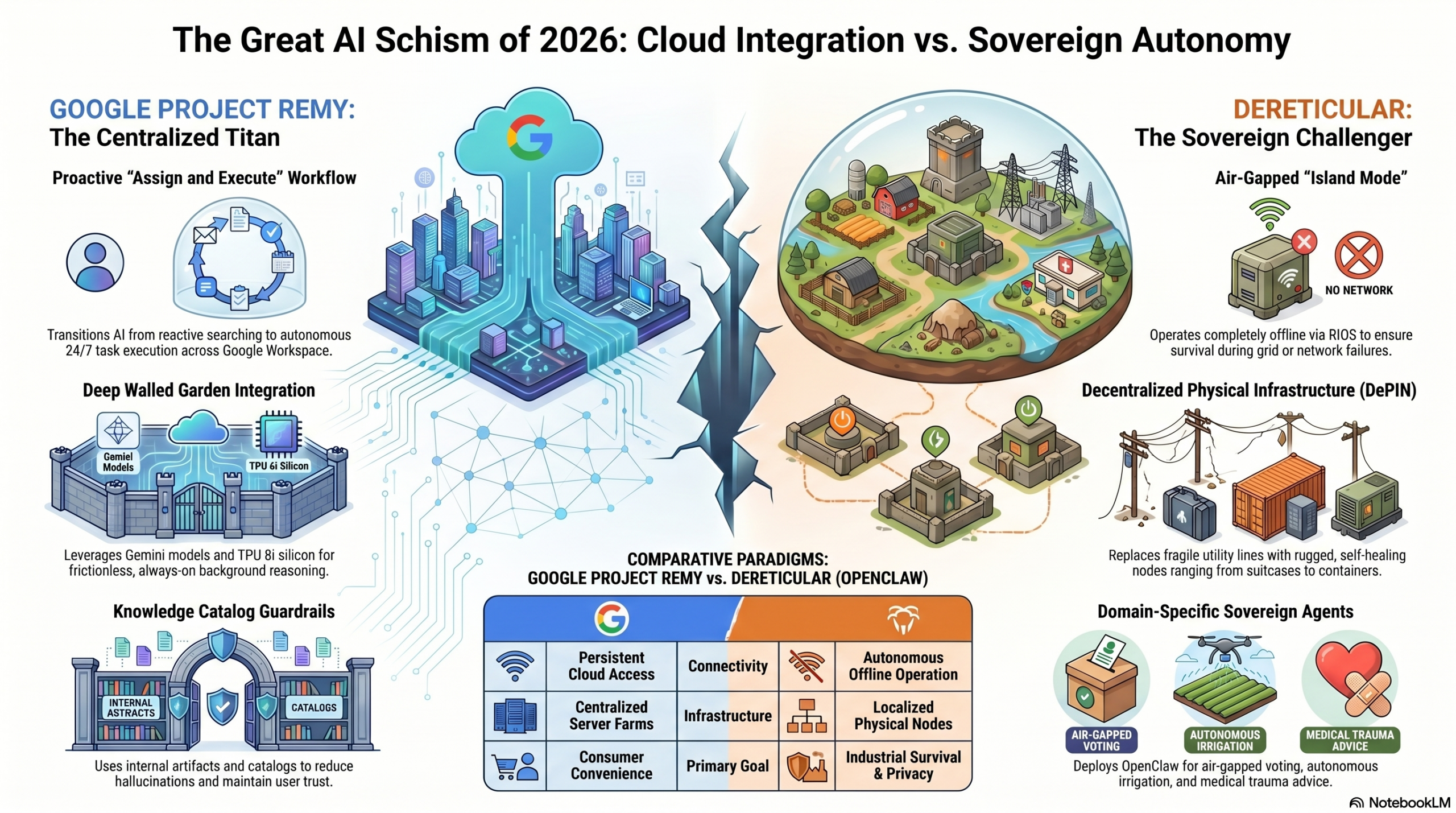
Leaked data regarding Google’s Project Remy reveals a fundamental pivot in the AI landscape. We are witnessing the transition from reactive Large Language Models to what internal documents describe as an “action-focused layer.” This system doesn’t wait for a prompt; it operates 24/7 in the background, transitioning from “search and find” to “assign and execute.”
Remy leverages a “Mixture-of-Recursions” (MoR) architecture, a feat of computational frugality that makes always-on background reasoning economically viable for the masses. By integrating deeply into Google Workspace, it handles complex digital logistics—booking flights, drafting responses, and managing calendars—autonomously. However, this level of proactive service requires a total surrender of privacy, as the system demands persistent, privileged access to your entire digital footprint.
“Island Mode”: The Surprising Power of Offline Intelligence
While Google scales its cloud, DeReticular is looking inward with “Island Mode.” Utilizing the RIOS (Rural Infrastructure Operating System), they have built a framework for sophisticated AI performance that requires zero internet connectivity. This isn’t just about privacy; it is about “RF Fingerprinting,” which anchors digital data to specific physical hardware to ensure local integrity.
At the heart of this “Island Mode” is the OpenClaw framework, which allows for specialized agents to run natively on local hardware like the 5W “Silicon Sentry.” However, the “Island” approach is not without its shadows; OpenClaw recently suffered a highly publicized rise and subsequent collapse due to the CVE-2026-25253 security vulnerability. While RIOS uses “Split-Ledger Architecture” to maintain financial privacy, the reliance on open-source frameworks means the stakes of “Island Mode” are high, requiring constant vigilance against supply chain attacks.
The Death of the Line: Hardware for the New Frontier
The physical reality of this new intelligence is found in DeReticular’s “Pilot Series” hardware. These are not merely computers; they are survival nodes designed for “Spherical Resilience,” treating the grid as a legacy option rather than a requirement.
“The Death of the Line”
This core philosophy represents a shift from vulnerable, centralized power and data lines to localized, self-healing nodes. The hardware scales to meet the mission:
- Pilot Expeditionary: A rugged, three-case suitcase system featuring Intel Xeon processors, NVIDIA A2 GPUs, and 400W solar input.
- Pilot Standard: A 10ft climate-controlled ISO container equipped with 4.4kW solar capacity and a 20kWh battery.
- Pilot AI Core: A 20ft ISO container utilizing Dual Xeon Platinum CPUs and NVIDIA A100 GPUs, supported by 15kW of solar capacity.
Turnkey Sovereignty: Buying Independence in a Box
DeReticular’s most disruptive move is making municipal-grade independence a turnkey product. They are selling “Sovereign Automation” that allows small towns of 1,000–3,000 people to manage their own healthcare, law, and transport systems entirely off the grid. Access within these micro-states is governed by “Sovereign Badges,” which function as Soulbound NFTs issued by the DeReticular Academy.
- WISP-in-a-Box ($1,749): An autonomous system allowing landowners to sell Wi-Fi and IoT backhaul without a central provider.
- City Infrastructure Nexus ($129,999): A massive package that deploys “Sovereign Electors” for air-gapped voting and “Sovereign Agronomists” to manage local sensor fabrics and irrigation.
These tools allow a community to bypass distant, centralized bureaucracies. By deploying “Vault Wardens” for security and “Field Medics” for bionic medical advice, a town can effectively function as an independent digital state.
The Battle of 2026: Google Remy vs. OpenClaw
The market has split into two warring philosophies: centralized efficiency versus localized resilience. Google Remy represents the “walled garden” at its peak, using “Knowledge Catalogs” to prevent hallucinations and offer a frictionless experience. It is the ultimate tool for the consumer who values time above all else and trusts the corporate perimeter to hold.
OpenClaw, championed by DeReticular, offers platform agnosticism and bespoke workflows at the cost of complexity. While Google uses the cloud to manage your life, DeReticular uses physical air-gapping to protect it. The choice reflects a deeper tension: do you trust the efficiency of a global collective, or the security of your own localized “island” despite the looming threat of supply chain vulnerabilities?
Conclusion: The Privacy-Resilience Paradox
The Great AI Schism of 2026 has made one thing clear: you can have the ultimate digital butler, or you can have the ultimate digital bunker. Google is perfecting a world where you never have to think about your logistics again, provided you stay within their lines. DeReticular is perfecting a world where the lines no longer matter, provided you are willing to manage your own “island.”
As we move further into this agentic future, the question of autonomy becomes physical. Centralized fragility is the price of convenience; localized resilience is the reward for those who can manage the technical debt of independence. Do you value the frictionless convenience of the cloud, or the resilient security of the island?