
THE ASYMPTOTIC DEMOCRACY: A FOUNDATIONAL ARCHITECTURE FOR VERIDICAL GOVERNANCE
Executive Summary
The modern democratic framework is currently traversing a critical transition point characterized as Phase 3 (Model Crisis) of the information-theoretic Kuhn Cycle. This crisis is driven by a fundamental category error: the treatment of voting as an unconstrained aggregator of subjective preferences capable of overriding physical, thermodynamic, and mathematical realities. As symbolic claims (such as compounding debt and ungrounded policy promises) decouple from biophysical limits (net energy and material availability), the institutional “envelope” is fracturing.
To address this, the Asymptotic Democracy architecture proposes a transition from “symbolic” to “veridical” governance. This framework is built upon three pillars:
- Perspectival Realism: Recognizing that while all human observations are framed and limited, they track an invariant ontic attractor (\Omega^*).
- Via Negativa Parameter Foreclosure: Shifting the role of elections from the selection of utopian promises to the systematic elimination of falsified governing models.
- Thermodynamic Grounding (RELA): Anchoring monetary issuance and legislative mandates to a Biophysical Balance Register (BBR), ensuring that symbolic claims never exceed the physical carrying capacity of the Earth.
The ultimate objective is a self-correcting institutional engine that navigates toward objective reality through disciplined error reduction and cryptographic integrity.
- Epistemological and Mathematical Foundations
1.1 Perspectival Realism and the Attractor
The architecture rejects both Dogmatic Absolutism (the claim of unmediated access to truth) and Radical Relativism (the claim that truth is an arbitrary social construct). Instead, it adopts Perspectival Realism:
- The Ontic Manifold (\mathcal{M}): Reality is a high-dimensional state-space manifold where \dim(\mathcal{M}) \to \infty.
- The Invariant Attractor (\Omega^*): Objective truth exists as a mind-independent trajectory within \mathcal{M}.
- The Projection Operator (\hat{\Pi}\theta): Every observer operates within a bounded frame (\theta). An observation is a dimension-reducing projection: \hat{\Pi}\theta: \mathcal{M} \to \mathcal{P}_\theta, where d \ll \infty.
- Veridical Projections: While incomplete, these projections are veridical; distinctions in the projection plane track genuine physical differences in the ontic manifold.
1.2 The Topology of Parameter Foreclosure (Via Negativa)
Progress in governance is achieved not by discovering absolute positive truths, but through the permanent destruction of false degrees of freedom. This is modeled as a measure space (\Theta, \mathcal{B}, \mu) where the volume of permissible policy space (\mu(\Theta)) must monotonically contract over time as empirical friction falsifies invalid models: \Theta_{t+1} = \Theta_t \setminus \Omega_{\text{falsified}}^{(t)}
1.3 The Information-Theoretic Bottleneck
Truth transmission is constrained by physical laws:
- Shannon Capacity: Finite communication channels always carry a non-zero probability of error (P_e > 0).
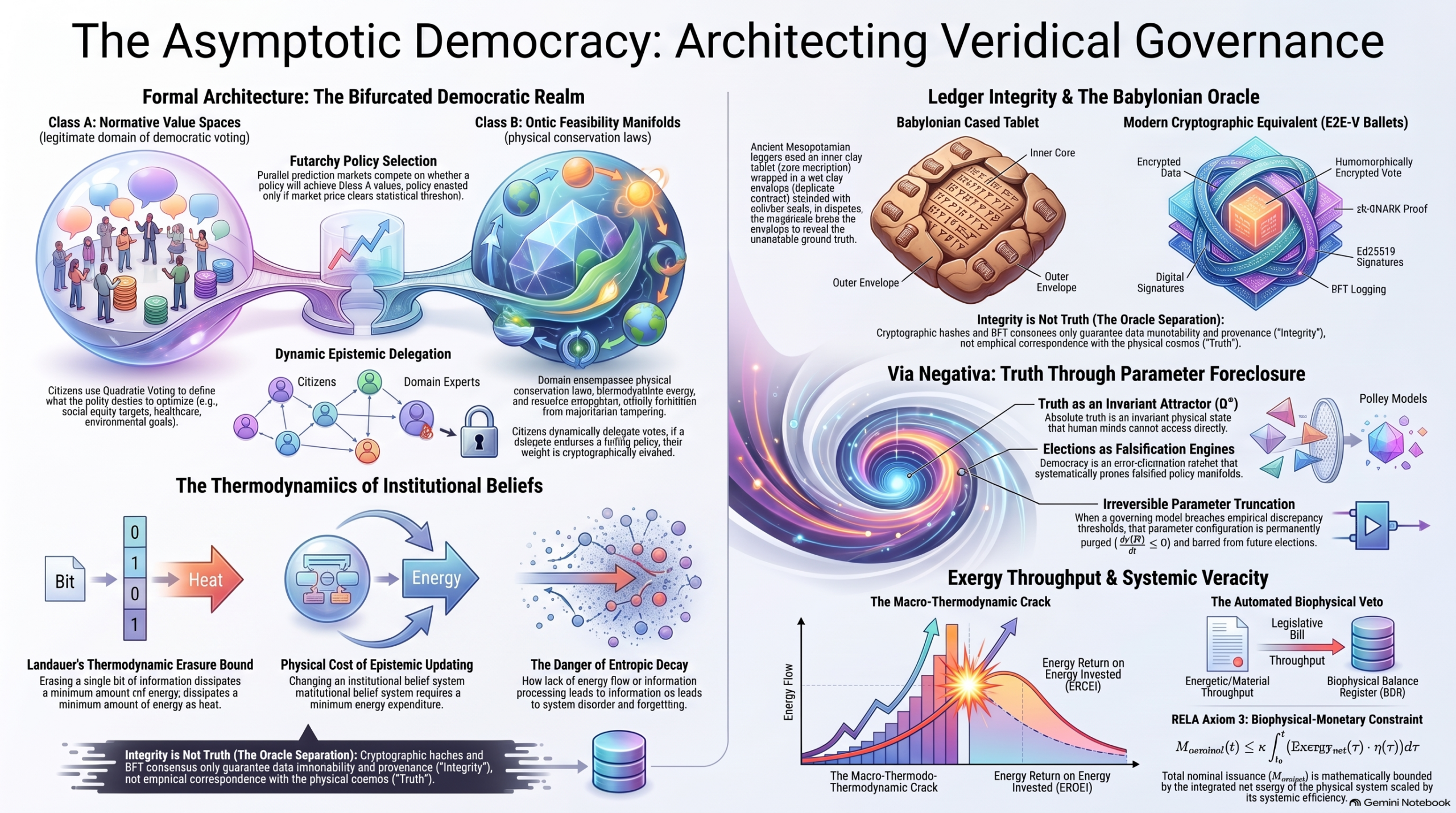
- Landauer’s Principle: Updating institutional registers or correcting beliefs requires continuous exergy consumption (\Delta Q \ge N k_B T \ln 2). Without thermodynamic work, systems succumb to entropic decay (institutional amnesia).
- The Crisis of Modern Consensus
2.1 The Condorcet Inversion
The mathematical bedrock of majoritarianism, the Condorcet Jury Theorem, fails in modern contexts. While N independent voters with accuracy p > 0.5 will converge on truth, modern systems induce a Condorcet Inversion:
- Correlated Noise: Algorithmic feeds and manufactured consent destroy voter independence.
- Competence Collapse: When tribal incentives penalize accuracy, p drops below 0.5.
- Mathematical Certainty of Error: As N \to \infty with p < 0.5, the electorate converges on falsehood with certainty.
2.2 The Kuhn Cycle of Governance
Current systems are identified as being in “Model Crisis” (Phase 3), as outlined in the following table:
Kuhn Phase Epistemic State Macroeconomic Equivalent
Normal Science Stable axiomatic consensus. Post-WWII fiat order; self-clearing markets.
Model Drift Anomalies accumulate; epicycles added. 2008 GFC; ZIRP, QE to hide insolvency.
Model Crisis Epistemic envelope cracks. Current State: $315T debt vs. energy limits.
Model Revolution Incommensurable frameworks clash. De-dollarization; multipolar clearing.
Paradigm Shift False parameters foreclosed. RELA: Biophysically anchored governance.
- The Resilient Epistemic & Thermodynamic Ledger Architecture (RELA)
3.1 Decoupling Preference from Viability
The architecture institutes a formal constitutional boundary between two realms:
- Class A: Normative Value Spaces: Legitimate domain of democratic voting (e.g., social equity, ethical priorities).
- Class B: Ontic Feasibility Manifolds: Strictly forbidden from democratic tampering (e.g., mass-energy conservation, thermodynamic exergy).
3.2 The Biophysical Veto and Axiom 3
RELA enforces the Biophysical-Monetary Equivalence Constraint (Axiom 3): M_{\text{nominal}}(t) \le \kappa \int_{t_0}^t \left( \text{Exergy}_{\text{net}}(\tau) \cdot \eta(\tau) \right) d\tau Total authorized monetary claims must be bounded by the integrated net exergy of the physical system. Any legislative act violating the verified Biophysical Balance Register (BBR) is automatically vetoed by the system kernel before reaching the ballot.
3.3 The Source-of-Truth Hierarchy
RELA resolves conflicts via a strict hierarchy, assigning zero epistemic weight to sovereign fiat:
- Level 0 (Supreme): Ontic Physical Resistance (Sensor data, exergy audits).
- Level 1: Machine-Checked Deductive Proofs (Lean 4 formal verification).
- Level 2: Append-Only Cryptographic Ledger (BFT consensus, immutability).
- Level 3: Symmetric Intersubjective Consensus (Democratic voting, Futarchy).
- Ballot Mechanics and System Design
4.1 The Cryptographic Cased Ballot
Updating the Old Babylonian Cased Tablet (a contract in a sealed clay envelope), RELA utilizes:
- Inner Core: Homomorphic encryption (Paillier/ElGamal) of the voter selection.
- Outer Envelope: Non-interactive zero-knowledge proofs (zk-SNARKs) proving ballot validity without revealing plaintext.
- Integrity vs. Truth: The ledger guarantees only that the vote was recorded as cast (Integrity); Level 0 sensors verify if the policy is physically possible (Truth).
4.2 Next-Generation Voting Models
- Negative Voting: Elections function as falsification engines where citizens prune failed parameter spaces. Parties breaching discrepancy thresholds (\tau_t) are disqualified.
- Futarchy: “Vote on Values, Bet on Beliefs.” Citizens use Quadratic Voting to define the Welfare Metric (W). Speculative prediction markets then determine which policies will optimize W.
- Liquid Democracy with Slashing: Citizens delegate votes to specialized experts. If a delegate endorses a policy that fails its empirical milestones, their voting weight is cryptographically slashed.
- Technical Data Schemas
RELA utilizes machine-checkable JSON schemas to ensure interoperability and auditability:
Schema Name Primary Function
EpistemicBallotNode.json Captures voter selection, ZK-proofs, and perspective frame tags.
PolicyHypothesisManifest.json Machine-readable contract declaring parameters and falsification conditions.
BiophysicalVetoRegister.json Real-time telemetry tracking exergy balances and fiscal ceilings.
- Strategic Gap and SWOT Analysis
6.1 Dimension-by-Dimension Gap Analysis
- Macro Production: Current “As-Is” models (Cobb-Douglas) treat energy as a <5% externality. “To-Be” RELA models treat output as strictly bounded by exergy and EROEI.
- Monetary Architecture: Transitions from unbacked digital fiat (D_0 e^{rt}) to currency issued as a claim on available physical exergy.
- Cross-Border Settlement: Shifts from weaponized hegemonic reserves to politically neutral, BFT-verified outside assets (Gold/Commodities).
6.2 Strategic SWOT Matrix
Strengths (Internal) Weaknesses (Internal)
Absolute Ontic Grounding; Mathematical Soundness; Tamper-Evident Lineage. High Computational Overhead (BFT/Lean 4); Implementation Complexity.
Opportunities (External) Threats (External)
Multipolar Transition (Bretton Woods III); Sovereign Debt Saturation. Incumbent Institutional Hostility; Authoritarian Epistemic Coups.
- Implementation Roadmap (60-Month Plan)
- Phase 1 (Months 1–12): Deploy E2E-V cryptographic wrappers for auditing; mandate machine-readable Policy Hypothesis Manifests for all bills.
- Phase 2 (Months 13–24): Pilot Decentralized IoT exergy sensors (BBR) in municipal infrastructure; launch non-binding shadow Futarchy markets.
- Phase 3 (Months 25–42): Activate the Via Negativa Parameter Registry to audit failed policies; enact the regional Constitutional Biophysical Veto.
- Phase 4 (Months 43–60): Full constitutional cutover to Veridical Asymptotic Governance; decommissioning of unbacked debt-expansion models in favor of RELA Axiom 3.
- Conclusion: The Asymptotic Horizon
The Asymptotic Democracy recognizes that human inquiry does not possess a “view from nowhere.” By anchoring institutional ledgers in physical reality and preserving their integrity with modern cryptography, civilization can transition from a vehicle for collective delusion into a self-correcting engine of survival. This architecture transforms the ballot from a “magic wand” into a tool of disciplined human convergence, shrinking the boundaries of false parameter space and aligning human governance with the unyielding laws of the physical cosmos.