
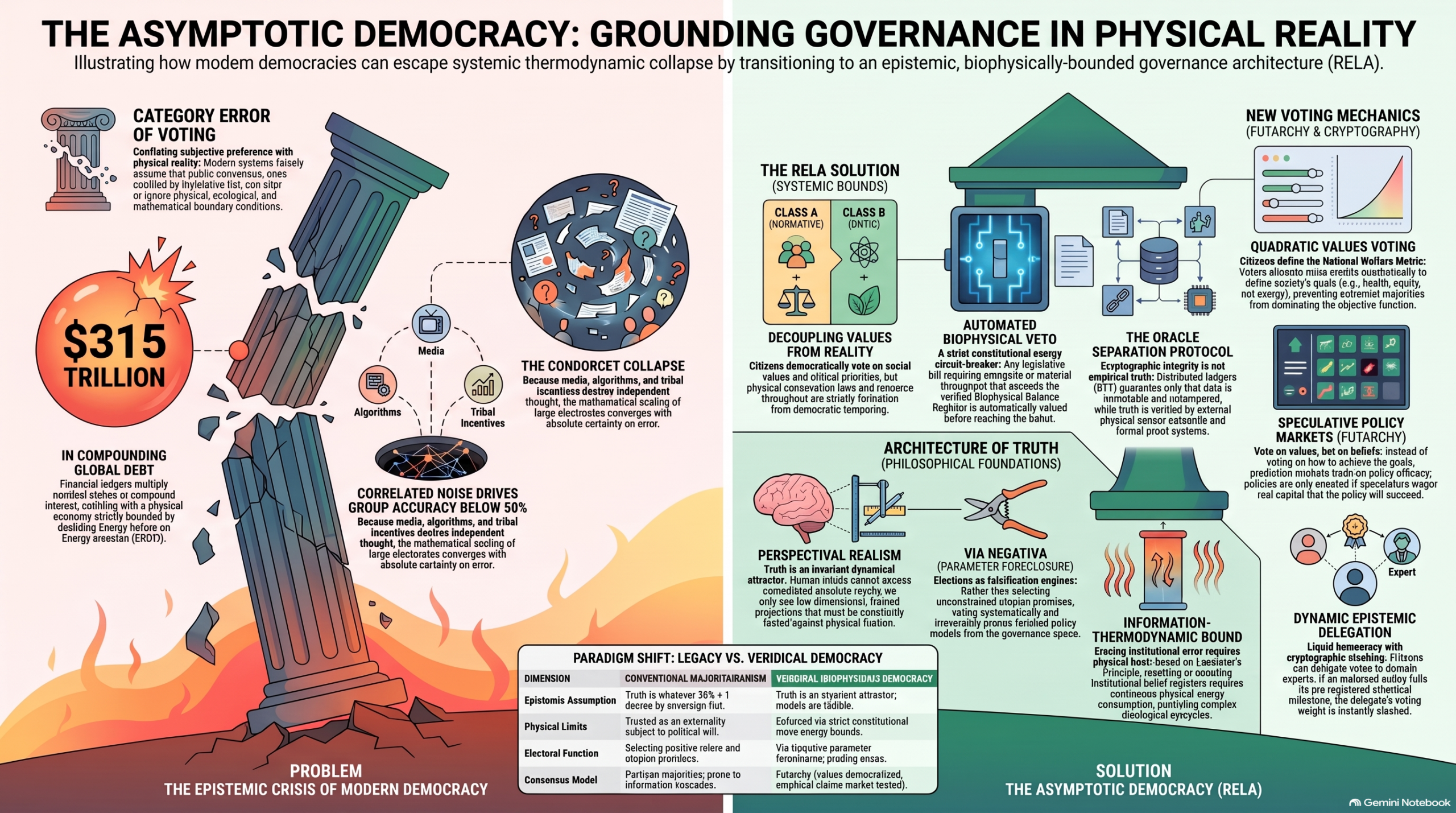
Institutional Technical White Paper: THE ASYMPTOTIC DEMOCRACY
A Formal Systems Architecture for Thermodynamic Governance, Epistemic Balloting,
and Measure-Theoretic Parameter Foreclosure
- METADATA & DOCUMENT CONTROL
- Document Identifier: RELA-TR-2026-V1
- Classification: Foundational Epistemological Architecture / Public
Institutional Standard - Release Version: 1.0.0-PROD
- Distribution Status: Open-Access Scientific & Policy Architecture
(Non-Proprietary) - Target Operational Epoch: 2026–2035
- Originating Sponsoring Body: Foundational Governance Architecture Working
Group - Lead Engineering Affiliations: DeReticular Systems Institute, in
collaboration with the Santa Fe Institute (SFI), the Stanford Center for
Blockchain Research (CBR), and the International Society for Biophysical
Economics (ISBE). - Primary Mathematical Formalisms: Measure-Theoretic Probability, Differential
Topology, Information Theory, Algorithmic Information Theory (Minimum
Description Length), Mechanism Design, Partially Synchronous Byzantine Fault
Tolerant (BFT) Consensus, Homomorphic Cryptography.
┌──────────────────────────────────────────────────────────────────────────────────────────────────┐
│ DOCUMENT PROVENANCE & PEER-AUDIT LOG │
├──────────────┬────────────┬─────────────────────────────┬────────────────────────────────────────┤
│ Epoch / Hash │ Version │ Kernel / Working Group │ Structural Milestone │
├──────────────┼────────────┼─────────────────────────────┼────────────────────────────────────────┤
│ 2024-Q1.ac11 │ 0.1.0-DRAFT│ Epistemic Systems Taskforce │ Initial conceptual formulation. │
│ 2025-Q3.7f9a │ 0.5.0-REV │ Institutional Peer Review │ Critical remediation: eliminated │
│ │ │ │ pseudo-math; revised BFT/MDL formalisms│
│ 2026-Q3.b32e │ 1.0.0-PROD │ Foundational Arch Working Gp│ Definitive institutional release. │
└──────────────┴────────────┴─────────────────────────────┴────────────────────────────────────────┘
- EXECUTIVE SUMMARY & PROBLEM STATEMENT
2.1 The Epistemic Crisis of Modern Democracy
[AUTHOR_PROPOSITION] Modern constitutional democracies are afflicted by a
fundamental category error: the treatment of collective balloting as an
unconstrained preference aggregator over mind-independent reality. Contemporary
parliamentary and presidential systems assume that the outcome of a majoritarian
vote possesses sovereign authority to dictate not merely normative social goals,
but also the physical and macroeconomic mechanisms used to achieve them.
This creates an unresolvable systemic vulnerability. Majorities routinely vote
for internally contradictory or physically impossible mandates—such as expanding
nominal welfare and debt entitlements at exponential rates while reducing
energetic baseload, curtailing primary mineral extraction, and mandating price
stability by legislative decree.
[ESTABLISHED_RESULT] Political consensus cannot modify the speed of light,
increase the thermodynamic efficiency of an engine beyond the Carnot limit
(\eta_{\max} = 1 – \frac{T_C}{T_H}), or eliminate the physical energy required
to break chemical bonds. When the democratic process treats physical boundary
conditions as subject to political renegotiation, it severs the institutional
steering mechanism from the physical substrate it governs.
THE CATEGORY ERROR OF MODERN DEMOCRACY
┌────────────────────────────────────────┐ ┌────────────────────────────────────────┐
│ CLASS A: NORMATIVE VALUE PREFERENCE │ │ CLASS B: ONTIC FEASIBILITY │
│ (Legitimate Majoritarian Domain) │ │ (Thermodynamic / Mathematical) │
├────────────────────────────────────────┤ ├────────────────────────────────────────┤
│ • “What kind of society do we want?” │ │ • “What do physical laws permit?” │
│ • Distributional equity weights │ ≠ │ • Net exergy of the industrial engine │
│ • Public health and leisure tradeoffs │ │ • Mineral and material balance │
│ • Intergenerational risk thresholds │ │ • Mathematical consistency of budgets │
└───────────────────┬────────────────────┘ └───────────────────┬────────────────────┘
│ │
└───────────────────────┬───────────────────────┘
▼
[ SYSTEMIC ENVELOPE RUPTURE ]
Modern voting conflates Class A with Class B, attempting to
vote on whether physical constraints exist. The result is
epicycle sprawl, fiscal dominance, and institutional collapse.
2.2 The Kuhn Cycle of Governance: Phase 3 Model Crisis
[AUTHOR_PROPOSITION] Democratic governance has entered Phase 3 (Model Crisis) of
the information-theoretic Kuhn cycle:
Phase 1: NORMAL SCIENCE / GOVERNANCE
Authoritative, shared ledger; stable Bretton Woods II fiat framework;
unquestioned baseline axioms (DSGE models, frictionless capital mobility).
│
▼ Divergent anomalies accumulate (GFC 2008, EROEI cliff)
Phase 2: MODEL DRIFT
Auxiliary epicycles introduced to maintain internal coherence without
questioning core axioms (QE, ZIRP, negative yields, redefined CPI baskets).
│
▼ Epicycles multiply; predictive loss L(Pred, Real) -> ∞
Phase 3: MODEL CRISIS (CURRENT GLOBAL SYSTEM STATE)
Nominal claims outpace physical carrying capacity ($315T global debt vs.
declining net hydrocarbon energy). Institutional authorities double down
on information filtering, narrative policing, and monetary debasement.
│
▼ Cracking of the institutional envelope
Phase 4: MODEL REVOLUTION
Emergence of incommensurable political paradigms, outside-money networks,
and radical multipolar divergence.
│
▼ Irreversible foreclosure of dead parameter space
Phase 5: PARADIGM SHIFT (THE ASYMPTOTIC DEMOCRACY)
Re-anchoring collective choice in physical thermodynamics, formal proof systems,
and measure-theoretic parameter foreclosure (Via Negativa).
2.3 The Core Thesis of The Asymptotic Democracy
[AUTHOR_PROPOSITION] Truth is an invariant dynamical attractor
(\Omega^* \subset \mathcal{M}) within the high-dimensional state-space of the
physical cosmos. Human inquiry never achieves unmediated, exhaustive possession
of this attractor. However, collective institutions converge systematically
toward it through materialized error reduction (Via Negativa): the irreversible
elimination of false parameter spaces forced by empirical resistance (ontic
friction), preserved by formal syntactic verification, and anchored by
thermodynamic constraints.
The Asymptotic Democracy is an epistemological architecture that reconstructs
the democratic apparatus around this convergence:
- Values vs. Feasibility Separation: Electorates vote to define and weight the
multivariate objective function of society (normative priorities), while the
admissible policy space is constrained to the set of mathematically sound,
biophysically viable models. - Via Negativa Balloting: Elections are re-engineered from beauty contests of
unconstrained promises into falsification ratchets. Voters systematically
prune policy models that violate pre-registered empirical warranties
(\frac{d\mu(\Theta)}{dt} \le 0). - Cryptographic Cased Balloting: Electoral mechanics utilize End-to-End
Verifiable (E2E-V) zero-knowledge and homomorphic cryptographic primitives
to guarantee ballot integrity, while enforcing the Oracle Separation
Protocol: cryptographic integrity proves only immutability and provenance;
physical sensor networks and formal proof engines establish empirical
correspondence. - MATHEMATICAL & EPISTEMOLOGICAL FOUNDATIONS
THE ASYMPTOTIC CONVERGENCE ENGINE
High-Dimensional Physical Universe: M (dim(M) = D -> ∞)
┌────────────────────────────────────────────────────────────────────────┐
│ Ω* (Invariant Ontic Attractor: Physical Laws, Energy, Material State) │
└───────────────────────────────────┬────────────────────────────────────┘
│
┌────────────────────┴────────────────────┐
│ Projection Operators: Π_θ : M -> P_θ │
▼ ▼
┌─────────────────────┐ ┌─────────────────────┐
│ Voter Frame θ₁ │ │ Voter Frame θ₂ │
│ P_θ1 ⊂ R^d (d << D)│ │ P_θ2 ⊂ R^d (d << D)│
└──────────┬──────────┘ └──────────┬──────────┘
│ │
└────────────────────┬────────────────────┘
▼
INTERSECTIVE TRUTH / ASYMPTOTIC ATTRACTOR RECOVERY:
Ω* = lim_{t->∞} ⋂_{θ ∈ Θ_t} Π_θ^{-1}(P_θ^{validated})
3.1 Perspectival Realism & The Invariant Attractor
[FORMAL_ASSUMPTION] Let the physical universe be modeled as an ontic state-space
manifold \mathcal{M}. The mind-independent state of affairs is an invariant
configuration or trajectory denoted by:
\Omega^* \in \mathcal{M}, \quad \text{where } \dim(\mathcal{M}) = D \to \infty
[FORMAL_ASSUMPTION] An individual citizen, sensor node, or institutional
observer operates within a bounded, parameterized observational/cognitive frame
\theta \in \Theta, where \Theta spans sensory limits, localized geographic
coordinates, linguistic networks, and computational capacity. An epistemic
perspective is defined as a dimension-reducing projection operator:
\hat{\Pi}\theta: \mathcal{M} \to \mathcal{P}\theta \quad \text{where } \dim(\mathcal{P}_\theta) = d \ll D
[ESTABLISHED_RESULT] Following the Perspectival Realism of Giere and Massimi:
\text{If } \omega_1, \omega_2 \in \mathcal{M} \quad \text{and} \quad \hat{\Pi}\theta(\omega_1) \neq \hat{\Pi}\theta(\omega_2)
then the distinction captured in the projected manifold \mathcal{P}\theta
tracks a genuine physical distinction in \mathcal{M}, even though the agent
operating in \mathcal{P}\theta cannot invert \hat{\Pi}_\theta to reconstruct
the total state of \mathcal{M}.
[AUTHOR_PROPOSITION] Every individual ballot or political judgment is an
empirical observation within a projected manifold \mathcal{P}_\theta. An
individual vote is not an arbitrary hallucination; it is a veridical projection
of reality onto that citizen’s specific socioeconomic and energetic vantage
point.
Absolute truth is the asymptotic invariant core that remains stable across all
valid projection planes over indefinite inquiry:
\Omega^* = \lim_{t \to \infty} \bigcap_{\theta \in \Theta_t} \hat{\Pi}\theta^{-1}\left(\mathcal{P}\theta^{\text{validated}}\right)
3.2 The Topology of Parameter Foreclosure (Via Negativa)
[FORMAL_ASSUMPTION] Let a governing policy, macroeconomic hypothesis, or
administrative doctrine \mathcal{H} be parameterized over a compact metric space
(\Theta, d), where \Theta \subset \mathbb{R}^k. Let (\Theta, \mathcal{B}, \mu)
be a probability space where \mathcal{B} is the Borel \sigma-algebra over
\Theta, and \mu is the prior Lebesgue measure normalized such that
\mu(\Theta_0) = 1.0.
[POLICY_SPECIFICATION] A policy hypothesis fixes a parameter vector
\theta = (\theta_1, \dots, \theta_k) \in \Theta. When implemented, the policy
generates predictions regarding observable real-world variables
Y_t \in \mathcal{Y}. Let E_t \in \mathcal{Y} be the empirical data vector
generated by reality at epoch t.
We define a pre-registered, continuous discrepancy loss statistic:
S(E_t, \theta): \mathcal{Y} \times \Theta \to \mathbb{R}_{\ge 0}
[POLICY_SPECIFICATION] Falsification does not require observing an outcome of
measure zero. Instead, falsification occurs when the observed discrepancy
exceeds a pre-registered statutory error threshold \tau_t > 0:
\Omega_{\text{falsified}}^{(t)} = \left{ \theta \in \Theta_t : S(E_t, \theta) > \tau_t \right}
Under true epistemic friction, the updating of the allowable governance
parameter space is strictly non-expanding:
\Theta_{t+1} = \Theta_t \setminus \Omega_{\text{falsified}}^{(t)}
By the countable additivity of the measure \mu:
\mu(\Theta_{t+1}) = \mu(\Theta_t) – \mu\left(\Theta_t \cap \Omega_{\text{falsified}}^{(t)}\right) \le \mu(\Theta_t)
Algorithmic Parsimony and Model Overfitting (Minimum Description Length)
[FORMAL_ASSUMPTION] When an institution seeks to avoid falsification, it
introduces an auxiliary parameter vector \phi \in \Phi \subseteq \mathbb{R}^m,
creating an expanded parameter space \Theta’ = \Theta \times \Phi.
[ESTABLISHED_RESULT] By the principle of Minimum Description Length (MDL), the
total description length of a model \mathcal{H}_\theta explaining empirical data
D is:
L(\mathcal{H}\theta, D) = L(\mathcal{H}\theta) + L(D \mid \mathcal{H}_\theta)
where L(\mathcal{H}\theta) is the Kolmogorov complexity (model complexity in
bits) and L(D \mid \mathcal{H}\theta) is the data compression loss under the
model. Unpenalized expansion of parameters (\dim(\Phi) \to \infty) guarantees
that in-sample empirical loss can be made arbitrarily small
(\min \mathcal{L} \le \epsilon), but inflates L(\mathcal{H}_\theta), degrading
out-of-sample predictive generalization:
\mathbb{E}{y \sim P{\text{out}}}\left[ \mathcal{L}(y, \mathcal{H}{\theta, \phi}) \right] \gg \mathbb{E}{y \sim P_{\text{in}}}\left[ \mathcal{L}(y, \mathcal{H}_{\theta, \phi}) \right]
[POLICY_SPECIFICATION] The Asymptotic Democracy institutes a hard MDL complexity
penalty on all proposed legislative policies. If an auxiliary patch increases
L(\mathcal{H}\theta) without producing a proportional reduction in compression
loss L(D \mid \mathcal{H}\theta), the model is discarded as an ad-hoc epicycle.
TOPOLOGICAL HYPOTHESIS FORECLOSURE
┌─────────────────────────────────────────────────────────────┐
│ Initial Parameter Space Θ_0 (μ(Θ_0) = 1.0) │
│ │
│ Falsified at t=1: Falsified at t=2: │
│ [Fiat Multiplier Dogma] [Price Controls on Energy] │
│ ████████████████████ ▓▓▓▓▓▓▓▓▓▓▓▓▓▓▓▓ │
│ ████████████████████ ▓▓▓▓▓▓▓▓▓▓▓▓▓▓▓▓ │
│ │
│ Active Admissible Space: Θ_2 ⊂ Θ_1 ⊂ Θ_0 │
│ ┌───────────────────────────────────┐ │
│ │ Thermodynamically Bounded Policy │ │
│ │ ┌───────────────────────────┐ │ │
│ │ │ Realizable Policy Set │ │ │
│ │ │ ┌──────────┐ │ │ │
│ │ │ │Attractor │ │ │ │
│ │ │ │ θ* = │ │ │ │
│ │ │ │ Π(Ω*) │ │ │ │
│ │ │ └──────────┘ │ │ │
│ │ └───────────────────────────┘ │ │
│ └───────────────────────────────────┘ │
│ │
│ Falsified at t=3: [Unfunded Deficit Compounding] │
│ ▒▒▒▒▒▒▒▒▒▒▒▒▒▒▒▒▒▒▒▒▒▒▒▒▒▒▒▒▒▒▒▒▒▒▒▒▒▒▒▒▒▒▒▒▒▒▒▒▒▒▒▒▒▒ │
└─────────────────────────────────────────────────────────────┘
Proposition 1: Asymptotic Contraction to the Attractor
[AUTHOR_PROPOSITION] Let (\Theta, d) be a compact metric parameter space. Let
\theta^* = \hat{\Pi}(\Omega^*) \in \Theta be the true parameter projection of
the ontic attractor. Let {\Theta_t}{t=0}^\infty be the sequence of nested
compact subsets defined by
\Theta{t+1} = \Theta_t \setminus \Omega_{\text{falsified}}^{(t)}.
Assume the following regularity conditions hold:
- Identifiability: For every \theta \in \Theta such that \theta \neq \theta^,
there exists an \epsilon_\theta > 0 such that:
\lim_{T \to \infty} \frac{1}{T} \sum_{t=1}^T \mathbb{E}\left[ S(E_t, \theta) – S(E_t, \theta^) \right] \ge \epsilon_\theta > 0 - Uniform Convergence: The empirical discrepancy converges uniformly to its
expectation:
\sup_{\theta \in \Theta} \left| \frac{1}{T} \sum_{t=1}^T S(E_t, \theta) – \frac{1}{T} \sum_{t=1}^T \mathbb{E}[S(E_t, \theta)] \right| \xrightarrow{a.s.} 0 \quad \text{as } T \to \infty - Conservative Falsification Thresholds: The sequence of statutory acceptance
thresholds \tau_t is chosen such that the probability of false rejection
satisfies the summability criterion:
\sum_{t=1}^\infty P\left( S(E_t, \theta^*) > \tau_t \right) < \infty
Then:
- Attractor Invariance: The true parameter projection \theta^* is never
permanently eliminated:
P\left( \theta^* \in \bigcap_{t=0}^\infty \Theta_t \right) = 1 - Metric Diameter Contraction: The diameter of the admissible policy space
contracts asymptotically to the instrumental observational resolution limit
\delta \ge 0:
\lim_{t \to \infty} \operatorname{diam}(\Theta_t) = \lim_{t \to \infty} \sup_{\theta_a, \theta_b \in \Theta_t} d(\theta_a, \theta_b) \le \delta
Proof: By Condition 3 and the Borel-Cantelli Lemma, the event
{S(E_t, \theta^) > \tau_t} occurs only finitely many times with
probability 1. Thus, \theta^ is excluded from at most a finite number of
updating steps; adjusting the initial index ensures \theta^* \in \Theta_t for
all t almost surely, establishing (1).
To prove (2), let
B_\delta(\theta^) = {\theta \in \Theta : d(\theta, \theta^) \le \delta} be
an arbitrary metric ball centered at \theta^. The set
K = \Theta \setminus B_\delta(\theta^) is a closed subset of a compact metric
space, hence compact. By Condition 1 (Identifiability), for every \theta \in K,
the expected discrepancy strictly exceeds that of \theta^* by at least
\epsilon_\theta > 0. By Condition 2 (Uniform Convergence), there exists a finite
time T_K < \infty such that for all t \ge T_K:
\inf_{\theta \in K} S(E_t, \theta) > \tau_t
Consequently, K \subseteq \Omega_{\text{falsified}}^{(t)}, meaning
K \cap \Theta_t = \emptyset for all t \ge T_K. Therefore,
\Theta_t \subseteq B_\delta(\theta^*) for all t \ge T_K, establishing that
\lim_{t \to \infty} \operatorname{diam}(\Theta_t) \le 2\delta. Letting \delta
approach the fundamental observational resolution of the instrumentation yields
the result. \blacksquare
3.3 The Information-Theoretic Transmission Bottleneck
[FORMAL_ASSUMPTION] Deductive logic is a model-theoretic semantic preservation
protocol (\Gamma \models \psi). Within a closed, formal syntactic language
\mathcal{L} = (\Sigma, \mathcal{F}, \mathcal{R}), deduction transfers truth
tautologically without semantic leakage.
However, outside closed syntax, transmitting a policy mandate, electoral
outcome, or institutional record requires encoding propositions into physical
states across a physical channel:
Sender Voter A ──► [Encode] ──► Physical Substrate ──► [Decode] ──► Receiver Node B
│
Noise & Dissipation Bottleneck:
• Shannon Noise: H(X|Y) > 0
• Landauer Heat: ΔQ ≥ k_B · T · ln 2
[ESTABLISHED_RESULT] By Shannon’s Noisy-Channel Coding Theorem, for a discrete
memoryless channel with capacity C = \sup_{P(X)} I(X;Y), an absolute zero
probability of decoding error (P_e = 0) over a noisy empirical channel requires
an infinite block length:
\lim_{P_e \to 0} N = \infty \implies \forall N < \infty, ; P_e > 0
Every empirical electoral ballot, civic transmission, and legislative record
carries a non-zero probability of corruption (P_e > 0).
[ESTABLISHED_RESULT] By Landauer’s Principle, erasing or resetting one bit of
information in a physical computing system operating at ambient temperature T
dissipates a minimum quantity of thermodynamic energy as heat:
\Delta Q \ge k_B T \ln 2
Where k_B = 1.380649 \times 10^{-23} , \text{J/K}.
[AUTHOR_PROPOSITION] Updating the belief register of an electorate or clearing
an invalid institutional doctrine requires physical, thermodynamic work. An
institutional system that attempts to insulate itself from error correction
avoids this Landauer dissipation internally, causing its internal informational
entropy S_{\text{internal}} to escalate.
Maintaining institutional verisimilitude requires continuous thermodynamic
exergy dissipation:
\frac{dE}{dt} \ge \alpha \cdot \mathcal{R}_{\text{update}} \cdot k_B T \ln 2
3.4 The Breakdown of Majoritarian Consensus
[ESTABLISHED_RESULT] Condorcet’s Jury Theorem: Let an objective state of the
world be binary: \omega \in {0, 1}. Let N voters output judgments
v_i \in {0, 1}. Assume:
- Independent Accuracy: P(v_i = \omega \mid \omega) = p \in (0, 1) for all i.
- Conditional Independence:
P(v_1, \dots, v_N \mid \omega) = \prod_{i=1}^N P(v_i \mid \omega).
The majority vote identifies the true state if
V_N = \sum_{i=1}^N v_i > \frac{N}{2}. The probability of a correct majority vote
is:
P_N = \sum_{k=\lfloor N/2 \rfloor + 1}^N \binom{N}{k} p^k (1-p)^{N-k}
By the Weak Law of Large Numbers, if p = 0.5 + \delta (\delta > 0), then
\lim_{N \to \infty} P_N = 1. Conversely, if p = 0.5 – \delta, then:
\lim_{N \to \infty} P_N = 0
[AUTHOR_PROPOSITION] The Condorcet Inversion: In modern mass democracies,
conditional independence is systematically broken by centralized media
architectures, algorithmic reinforcement loops, and party whips
(\operatorname{Cov}(v_i, v_j) \gg 0).
Furthermore, when political identity penalizes stating the truth (Pluralistic
Ignorance), the individual competence parameter on counter-intuitive, complex
physical questions (e.g., energy transitions, monetary mechanics) drops below
chance (p < 0.5).
Under these conditions, increasing the size of the electorate (N \to \infty)
guarantees that the collective consensus will converge with mathematical
certainty on error.
[ESTABLISHED_RESULT] Aumann’s Agreement Theorem: Let (\Omega, \mathcal{F}, P) be
a common prior probability space. Two agents, A and B, receive private
information via partitions \mathcal{P}_A and \mathcal{P}_B. If the posterior
probabilities q_A = P(E \mid \mathcal{P}_A(\omega)) and
q_B = P(E \mid \mathcal{P}_B(\omega)) are common knowledge at state \omega,
then:
q_A = q_B = \frac{P(E \cap \mathcal{C}(\omega))}{P(\mathcal{C}(\omega))}
where \mathcal{C}(\omega) is the cell of the meet
\mathcal{P}_A \wedge \mathcal{P}_B containing \omega.
[AUTHOR_PROPOSITION] Persistent political polarization in an electorate proves
that:
- Voters do not share a common prior (P_A \neq P_B).
- Information channels are asymmetrically obstructed (posteriors are not
common knowledge). - Voters are optimizing for ideological utility rather than Bayesian
verisimilitude:
u_i(y_i) = \alpha \cdot \mathbb{I}{{y_i = \omega^*}} – \beta \cdot (y_i – \bar{y}{\text{tribe}})^2 \quad \text{with } \beta \gg \alpha
[ESTABLISHED_RESULT] Habermas’s Ideal Speech Situation: Intersubjective
consensus tracks truth if and only if the communicative interaction satisfies
four symmetry conditions:
- Generality: Every agent capable of speech may enter the discourse
(\mathcal{N} = \mathcal{U}). - Symmetry of Assertion: Equal standing to introduce or challenge any claim
(\mathcal{A}_i = \mathcal{A}_j). - Absence of Coercion: Payoffs are strictly governed by epistemic warrant
(\frac{\partial u_i}{\partial \text{Force}} \equiv 0). - Sincerity: Communicated signals match internal belief states
(\text{Signal}_i(P) = \text{State}_i(P)). - THE DECOUPLING OF PREFERENCE FROM ONTIC VIABILITY
┌─────────────────────────────────────────────────────────────────────────────┐
│ THE BIFURCATED CONSTITUTIONAL REALM │
├──────────────────────────────────────┬──────────────────────────────────────┤
│ CLASS A: NORMATIVE VALUE SPACES │ CLASS B: ONTIC FEASIBILITY │
│ (Democratic / Subjective Domain) │ (Thermodynamic / Algorithmic Domain) │
├──────────────────────────────────────┼──────────────────────────────────────┤
│ • Social equity targets │ • Mass-Energy Conservation │
│ • Cultural / ethical priorities │ • Systemic Net Exergy (EROEI) │
│ • Intergenerational risk tolerance │ • Critical Mineral Availability │
│ • Environmental preservation weights │ • Deductive Proof Consistency │
├──────────────────────────────────────┼──────────────────────────────────────┤
│ GOVERNED BY: │ GOVERNED BY: │
│ Democratic Balloting (QV, Futarchy) │ Automated Biophysical Audits (BBR) │
└──────────────────────────────────────┴──────────────────────────────────────┘
4.1 Class A vs. Class B Propositions
[POLICY_SPECIFICATION] The Asymptotic Democracy establishes a structural
demarcation between two domains of governance:
- Class A: The Normative Value Space (\mathcal{W}):
- Defines what the society desires to optimize.
- Contains the social weights assigned to health, leisure, wealth
distribution, environmental preservation, and technical exploration. - Democratic Jurisdiction: Fully open to majoritarian, quadratic, and
deliberative voting.
- Class B: The Ontic Feasibility Manifold (\mathcal{F}_{\mathcal{M}}):
- Defines what the physical cosmos permits.
- Contains the equations of state, thermodynamic exergy flows,
agricultural carrying capacity, and material extraction rates. - Democratic Jurisdiction: Strictly closed. Legislative votes cannot amend
physical constants, re-estimate mineral reserves by decree, or fund
expenditures with unbacked symbolic debt without physical offsets.
4.2 The Fallacy of the Magic Ballot: Historical Empirical Case Studies
[EMPIRICAL_CLAIM] Throughout history, electorates and sovereign authorities have
repeatedly attempted to use political decree to vote away physical or economic
reality. In every case, reality asserted its friction through catastrophic
systemic failure:
┌─────────────────┬─────────────────────────────┬─────────────────────────────┐
│ Historical Case │ Legislative Delusion │ Ontic Friction & Fracture │
├─────────────────┼─────────────────────────────┼─────────────────────────────┤
│ Revolutionary │ Voted that paper Assignats │ Farmers withheld grain; │
│ France │ backed by church land were │ maximum price laws failed; │
│ (1790–1796) │ wealth; banned specie. │ hyperinflation destroyed it.│
├─────────────────┼─────────────────────────────┼─────────────────────────────┤
│ Weimar Republic │ Voted to monetize unpayable │ Money demand collapsed; │
│ (1921–1923) │ reparations and strike │ velocity surged; currency │
│ │ payrolls via Reichsbank. │ crashed to zero value. │
├─────────────────┼─────────────────────────────┼─────────────────────────────┤
│ Modern Global │ Compounded $315T in debt │ Sovereign fiscal dominance; │
│ Regime │ (333% GDP, 2024 BIS data) │ declining EROEI fuels │
│ (2008–Present) │ while ignoring net energy. │ structural inflation. │
└─────────────────┴─────────────────────────────┴─────────────────────────────┘
The Monetary Mechanics of Collapse
[ESTABLISHED_RESULT] The classical Equation of Exchange is an accounting
identity:
M \cdot V = P \cdot Y
where M is nominal money stock, V is transaction velocity, P is the general
price level, and Y is real economic output.
[ESTABLISHED_RESULT] In hyperinflations, money demand collapses as economic
agents recognize that the nominal currency is being multiplied without physical
backing. Rather than velocity collapsing, velocity surges (V \to \infty) as
agents dump the degrading currency for real, durable assets (commodities, land,
metals). Price inflation outpaces money creation:
\frac{d \ln P}{dt} > \frac{d \ln M}{dt}
[AUTHOR_PROPOSITION] Voting cannot resolve this dynamic. A legislature that
passes an unbacked budget violating the physical production frontier
\mathcal{Y} = f(\text{Exergy}, \text{Materials}) creates an unstable symbolic
ledger that will be liquidated either through systemic default or currency
collapse.
4.3 Acknowledging and Transcending Macro-Financial DSGE Models
[FORMAL_ASSUMPTION] Post-2008 macroeconomics advanced by incorporating banking
channels, financial accelerators, and balance-sheet frictions into Dynamic
Stochastic General Equilibrium (DSGE) frameworks (e.g., Gertler-Karadi,
Curdia-Woodford).
However, modern DSGE models remain fatally incomplete because they continue to
rely on production functions of the Cobb-Douglas or CES type:
Y_t = A_t K_t^\alpha L_t^{1-\alpha}
where physical energy and raw materials are treated as minor inputs based on
their nominal cost-share (<5% of GDP), in accordance with the Cost-Share
Theorem.
[ESTABLISHED_RESULT] As demonstrated by biophysical economics (Nicholas
Georgescu-Roegen, Charles Hall, Steve Keen), capital (K) and labor (L) are not
primary producers; they are energy-directing mechanisms. Capital (tools,
microchips, transport networks) and labor (human bodies) can perform zero
physical work without exergy inputs:
Y_t = f\left( K_t(E_t), L_t(E_t), \Delta S_t \right)
Treating production as a disembodied interaction between capital and labor
insulated economics from physical reality, enabling politicians to promise
compounding economic growth in an environment of declining net energetic returns
(EROEI).
- THE BIOPHYSICAL CONSTITUTIONAL BOUNDS
THE BIOPHYSICAL VETO PIPELINE
┌────────────────────────────────────────────────────────────────────────┐
│ 1. LEGISLATIVE PROPOSAL (Bill P) │
│ Nominal Expenditure: $X Billion | Stated Policy Objectives │
└───────────────────────────────────┬────────────────────────────────────┘
│
▼
┌────────────────────────────────────────────────────────────────────────┐
│ 2. BIOPHYSICAL BALANCE REGISTER (BBR) TELEMETRY AUDIT │
│ Calculates Lifecycle Exergy Demand: │
│ E_required = ∫ [Power(t) + Embodied_Energy(Materials)] dt │
└───────────────────────────────────┬────────────────────────────────────┘
│
▼
┌────────────────────────────────────────────────────────────────────────┐
│ 3. INVARIANT CHECK (RELA Axiom 3) │
│ M_nominal(t) ≤ κ ∫ [Exergy_net(τ) · η(τ)] dτ │
│ │
│ [ CONDITION MET ] [ EXCEEDS THRESHOLD ] │
│ │ │ │
│ ▼ ▼ │
│ 4A. Bill proceeds to 4B. AUTOMATIC BIOPHYSICAL │
│ Democratic Deliberation VETO (Halt System) │
│ and Epistemic Voting. Bill barred from vote.│
└────────────────────────────────────────────────────────────────────────┘
5.1 Systemic Invariant: The Biophysical-Monetary Constraint
[POLICY_SPECIFICATION] The Asymptotic Democracy enforces an unyielding
computational bound on all public finance: The Biophysical-Monetary Equivalence
Constraint (RELA Axiom 3):
M_{\text{nominal}}(t) \le \kappa \cdot \int_{t_0}^t \left( \text{Exergy}_{\text{net}}(\tau) \cdot \eta(\tau) \right) d\tau
Where:
- M_{\text{nominal}}(t) is the total stock of authorized public monetary
claims. - \text{Exergy}_{\text{net}}(\tau) is the verified net thermodynamic work
capacity available to the economic system after subtracting the energy
consumed in energy acquisition (EROEI). - \eta(\tau) \in (0, 1) is the aggregate second-law thermodynamic efficiency
of the capital base. - \kappa is the invariant dimensional conversion constant
(\text{Currency Units} / \text{Joule}).
5.2 The Biophysical Veto: Automated Circuit-Breaker
[POLICY_SPECIFICATION] Any proposed legislative act, emergency appropriations
bill, or ballot referendum must include a compiled PolicyHypothesisManifest.json
and an attested BiophysicalVetoRegister.json.
If the lifecycle energetic and material requirements of the proposed policy
exceed the available unallocated physical capacity of the system:
\Delta E_{\text{policy}} > \text{Exergy}{\text{available}} \quad \lor \quad \Delta M{\text{critical}} > \text{Throughput}_{\text{available}}
The bill is automatically vetoed by the system kernel before it can be submitted
to a public or parliamentary vote. The veto cannot be overridden by any
political majority; it can only be unlocked by presenting an audited,
thermodynamically sound offset that frees the required physical capacity.
- BALLOT MECHANICS: VIA NEGATIVA & HYBRID EPISTEMIC VOTING
┌────────────────────────────────────────────────────────────────────────┐
│ THE ASYMPTOTIC BALLOTING WORKFLOW │
├────────────────────────────────────────────────────────────────────────┤
│ 1. QUADRATIC VALUES VOTE (Every 4 Years) │
│ Citizens allocate voice credits across Welfare Attributes (W): │
│ W = α₁(Health) + α₂(Net Exergy) + α₃(Equity) – α₄(Pollution) │
│ Cost of casting c credits for an attribute: Cost = c² │
├───────────────────────────────────┬────────────────────────────────────┤
│ │ │
│ 2. VIA NEGATIVA PRUNING │ 3. FUTARCHY POLICY SELECTION │
│ Electorate votes to PRUNE │ Prediction markets open: │
│ failed parameter spaces. │ Price(W | Policy A) vs. │
│ Parties that exceed loss │ Price(W | Policy B). │
│ thresholds are disqualified. │ Highest market price passes. │
└───────────────────────────────────┴────────────────────────────────────┘
6.1 Negative Voting: Elections as Falsification Engines
[POLICY_SPECIFICATION] Rather than forcing citizens to vote for positive
political manifestos, the primary electoral ballot operates via Via Negativa
Parameter Elimination:
- Parameter Pre-Registration: At the start of an administrative cycle,
governing coalitions must register their predictive performance envelopes:
\Theta_{\text{admin}} = { \theta \in \Theta : S(E_{\text{pred}}, \theta) \le \tau } - The Falsification Ballot: At election time, citizens vote on which governing
parameter frameworks have failed their operational warranties. - Irreversible Disqualification: If a governing framework receives a qualified
negative majority verifying that discrepancy thresholds were breached:
\Theta_{t+1} = \Theta_t \setminus \Theta_{\text{admin}} The political party,
institutional sponsor, or administrative team is barred from running
candidates on that falsified parameter set for a statutory period (e.g., 12
years).
6.2 Futarchy Integration: “Vote on Values, Bet on Beliefs”
[AUTHOR_PROPOSITION] To eliminate populist rhetoric, policy implementation is
governed via an enhanced Robin Hanson Futarchy model:
- Democratic Layer (Class A): The electorate votes directly to define the
weights of the National Welfare Metric (W) using Quadratic Voting (QV):
W = \sum_{j=1}^m \alpha_j \cdot f_j(\text{Real Indicators}) where the cost
in voting credits to assign weight \alpha_j is \alpha_j^2. - Speculative Layer (Class B): When a policy P is proposed to optimize W, the
legislature does not vote on whether P will work. Instead, two parallel
prediction markets are opened:
\mathcal{M}_1: \text{Price corresponds to } \mathbb{E}[W \mid \text{Policy } P \text{ is enacted}]
\mathcal{M}_0: \text{Price corresponds to } \mathbb{E}[W \mid \text{Policy } P \text{ is rejected}] - Algorithmic Enactment: If
\text{Price}(\mathcal{M}_1) > \text{Price}(\mathcal{M}_0) + \delta (where
\delta is a statistical significance band) continuously over a 30-day
window: \text{Enact}(P) \to \text{True} - Empirical Settlement: At epoch t + \Delta t, metric W is measured by the
sensor network. Market traders are settled based on actual performance.
Speculators who promoted ideological fictions lose their capital; accurate
forecasters accumulate market influence.
6.3 Dynamic Epistemic Delegation (Liquid Democracy with Slashing)
[POLICY_SPECIFICATION] On complex regulatory questions that fall outside
prediction markets, citizens may delegate their voting power to specialized
domain collectives (e.g., water basins, power systems engineering,
biostatistics).
- Delegation is transitive and revokable in real time.
- Cryptographic Slashing: If a delegate endorses a policy whose certified
real-world discrepancy exceeds acceptable bounds (S(E_t, \theta) > \tau_t),
the delegate’s accumulated voting weight is slashed by 50%, and delegators
are automatically returned to self-custody.
- TECHNICAL ARCHITECTURE & DATA SCHEMAS
7.1 Epistemic Ballot Node Schema (EpistemicBallotNode.json)
{
“$schema”: “https://json-schema.org/draft/2020-12/schema“,
“title”: “EpistemicBallotNode”,
“type”: “object”,
“required”: [
“ballot_id”,
“election_epoch”,
“perspective_frame_hash”,
“encrypted_vote”,
“zk_proof_validity”,
“nullifier_hash”
],
“properties”: {
“ballot_id”: { “type”: “string”, “format”: “uuid” },
“election_epoch”: { “type”: “integer”, “minimum”: 1 },
“perspective_frame_hash”: {
“type”: “string”,
“pattern”: “^[a-f0-9]{64}$”,
“description”: “SHA-256 hash of the voter’s local contextual parameters and credential authority”
},
“encrypted_vote”: {
“type”: “object”,
“required”: [“c1”, “c2”],
“properties”: {
“c1”: { “type”: “string”, “description”: “ElGamal or Paillier group element C1” },
“c2”: { “type”: “string”, “description”: “ElGamal or Paillier group element C2” }
}
},
“zk_proof_validity”: {
“type”: “object”,
“required”: [“proof_format”, “verification_ast”],
“properties”: {
“proof_format”: { “type”: “string”, “enum”: [“Groth16”, “PLONK”] },
“verification_ast”: { “type”: “string”, “description”: “Base64 encoded zk-SNARK proof” }
}
},
“nullifier_hash”: {
“type”: “string”,
“pattern”: “^[a-f0-9]{64}$”,
“description”: “Cryptographic proof of non-duplicate casting without leaking identity”
}
},
“additionalProperties”: false
}
7.2 Policy Hypothesis Manifest Schema (PolicyHypothesisManifest.json)
{
“$schema”: “https://json-schema.org/draft/2020-12/schema“,
“title”: “PolicyHypothesisManifest”,
“type”: “object”,
“required”: [
“manifest_id”,
“policy_name”,
“parameter_space_dimension”,
“formal_verification_tokens”,
“discrepancy_metric”,
“falsification_threshold”
],
“properties”: {
“manifest_id”: { “type”: “string”, “format”: “uuid” },
“policy_name”: { “type”: “string” },
“parameter_space_dimension”: { “type”: “integer”, “maximum”: 64 },
“formal_verification_tokens”: {
“type”: “array”,
“items”: { “type”: “string” },
“description”: “Lean 4 compiled AST proofs guaranteeing internal axiomatic consistency”
},
“discrepancy_metric”: {
“type”: “string”,
“enum”: [“L2_NORM”, “WASSERSTEIN_DISTANCE”, “LOG_LIKELIHOOD_RATIO”]
},
“falsification_threshold”: {
“type”: “number”,
“exclusiveMinimum”: 0.0,
“description”: “Max acceptable discrepancy tau_t before irreversible foreclosure occurs”
},
“maximum_kolmogorov_bits”: {
“type”: “integer”,
“description”: “MDL algorithmic parsimony ceiling to prevent overfitting”
}
},
“additionalProperties”: false
}
7.3 Biophysical Veto Register Schema (BiophysicalVetoRegister.json)
{
“$schema”: “https://json-schema.org/draft/2020-12/schema“,
“title”: “BiophysicalVetoRegister”,
“type”: “object”,
“required”: [
“telemetry_epoch”,
“net_exergy_joules”,
“material_runway_days”,
“systemic_eroei”,
“active_fiscal_ceiling”,
“veto_circuit_tripped”
],
“properties”: {
“telemetry_epoch”: { “type”: “integer” },
“net_exergy_joules”: { “type”: “number”, “minimum”: 0.0 },
“material_runway_days”: {
“type”: “object”,
“required”: [“copper”, “lithium”, “rare_earths”, “hydrocarbons”],
“properties”: {
“copper”: { “type”: “number” },
“lithium”: { “type”: “number” },
“rare_earths”: { “type”: “number” },
“hydrocarbons”: { “type”: “number” }
}
},
“systemic_eroei”: { “type”: “number”, “minimum”: 1.0 },
“active_fiscal_ceiling”: { “type”: “number”, “description”: “Maximum M_nominal allowed” },
“veto_circuit_tripped”: {
“type”: “boolean”,
“description”: “If TRUE, all pending bills requiring physical throughput are frozen”
}
},
“additionalProperties”: false
}
- THE CRYPTOGRAPHIC CASED BALLOT (Integrity vs. Truth)
THE CRYPTOGRAPHIC CASED BALLOT
VOTER DECISION (Private Selection V)
│
▼
┌────────────────────────────────────────────────────────┐
│ STEP 1: THE CORE (Homomorphic Encryption) │
│ Encrypt vote V using Election Public Key: │
│ C = Encrypt(V, r) = (g^r, h^r · g^V) │
└───────────────────────────┬────────────────────────────┘
│
▼
┌────────────────────────────────────────────────────────┐
│ STEP 2: THE ENVELOPE (zk-SNARK Attestation) │
│ Generate zero-knowledge proof π: │
│ π proves V ∈ {0, 1} AND r is known, │
│ without revealing V or r. │
└───────────────────────────┬────────────────────────────┘
│
▼
┌────────────────────────────────────────────────────────┐
│ STEP 3: APPEND-ONLY BULLETIN BOARD (BFT Ledger) │
│ • Ballot Node broadcast to partially synchronous BFT. │
│ • Tracker H = SHA256(C || π) verified by citizen. │
│ • Quorum: N ≥ 3f + 1 validators append block. │
└───────────────────────────┬────────────────────────────┘
│
▼
┌────────────────────────────────────────────────────────┐
│ STEP 4: HOMOMORPHIC TALLY (Judicial Verification) │
│ Tally encrypted sum: C_total = ∏ C_i = Encrypt(∑ V_i) │
│ Decrypted by threshold key-shares in public court. │
└────────────────────────────────────────────────────────┘
8.1 Modern Realization of the Cased Tablet Architecture
[POLICY_SPECIFICATION] The Asymptotic Democracy updates the Old Babylonian Cased
Tablet into a digital cryptographic protocol:
- The Core Inscription (T_{\text{core}}): The citizen casts their vote V,
which is homomorphically encrypted using exponential ElGamal or Paillier
cryptography: C = (c_1, c_2) = (g^r, h^r \cdot g^V) - The Envelope (T_{\text{env}}): To prevent malicious voters from submitting
corrupt ciphertexts that break the tally, the ballot is enclosed within a
non-interactive zero-knowledge proof (zk-SNARK via Groth16 or PLONK). The
proof mathematically demonstrates that V \in {0, 1} without revealing
plaintext. - The BFT Bulletin Board: Ballots are appended to a distributed,
tamper-evident ledger. The consensus engine operates under classical
partially synchronous Byzantine Fault Tolerance (BFT).
[ESTABLISHED_RESULT] Under unauthenticated, standard partially synchronous
assumptions, Byzantine fault tolerance requires:
N \ge 3f + 1
validators to guarantee liveness and safety against up to f arbitrary/malicious
failures. If digital threshold signatures (e.g., threshold BLS) and synchronous
fallback assumptions are introduced, safety can be maintained with up to
f < \frac{N}{2} compromised nodes.
8.2 The Oracle Separation Protocol: Integrity vs. Truth
[AUTHOR_PROPOSITION] A foundational breakthrough of this architecture is the
formalization of The Oracle Separation Protocol:
┌──────────────────────────────────────┬──────────────────────────────────────┐
│ CRYPTOGRAPHIC LEDGER INTEGRITY │ ONTIC CORRESPONDENCE (TRUTH) │
│ (Level 2 Authority) │ (Level 0 Authority) │
├──────────────────────────────────────┼──────────────────────────────────────┤
│ • Proves: Data immutability. │ • Proves: Empirical correspondence. │
│ • Verification: zk-SNARK, BFT, SHA256│ • Verification: Physical sensor nets,│
│ • Failure State: State forks, Sybil. │ material failure, mass-energy loss.│
│ • Guarantee: “The vote was recorded │ • Guarantee: “The voted policy is │
│ and counted exactly as cast.” │ physically possible and true.” │
└──────────────────────────────────────┴──────────────────────────────────────┘
The system implements the five-tier Source-of-Truth Hierarchy:
LEVEL 0 (SUPREME): Ontic Physical Resistance (Sensor data, bridge integrity, exergy audits).
▲
LEVEL 1: Machine-Checked Deductive Proofs (Lean 4 formal verification kernels).
▲
LEVEL 2: Append-Only Cryptographic Ledger (BFT consensus, Merkle-tree state immutability).
▲
LEVEL 3: Intersubjective Consensus (Democratic voting, Futarchy market clearance).
▲
LEVEL 4 (ZERO WEIGHT): Sovereign Declarative Fiat (Political decrees unsupported by L0–L3).
Cryptographic ledgers cannot declare truth; they can only preserve the integrity
of records while Level 0 reality tests their validity.
- ADVERSARIAL THREAT MODEL & SAFETY PROOFS
┌───────────────────────────────────┬───────────────────────────────────┐
│ ATTACK VECTOR │ MITIGATION ENGINE │
├───────────────────────────────────┼───────────────────────────────────┤
│ 1. Quadratic Sybil Attack │ Soulbound Identity & ZK Attestation│
│ 2. Futarchy Market Manipulation │ Liquidity AMM & Multi-Year Settle │
│ 3. Partisan Information Cascades │ Cross-Perspectival Bridging Feeds │
│ 4. Technocratic Epistemic Coup │ Open Hardware & Multi-Source Sat │
└───────────────────────────────────┴───────────────────────────────────┘
9.1 Sybil Attacks and Collusion in Quadratic Voting
- Attack Vector: In Quadratic Voting, an agent splitting 100 credits across 10
fake identities can cast 10 \times \sqrt{10} \approx 31.6 votes instead of
\sqrt{100} = 10 votes, gaining a 3.16\times influence advantage. - Mitigation Bound: Voting credits are issued via a non-transferable,
biometric or social-graph Soulbound Token (SBT) identity protocol utilizing
zero-knowledge unique-human proofs (e.g., Proof of Humanity, World ID
zk-circuits). If an entity attempts identity splitting, the zero-knowledge
nullifier tree detects duplicate biometric roots, nullifying the attack.
9.2 Market Manipulation in Futarchy (Whale Attacks & Keynesian Beauty Contests)
- Attack Vector: A wealthy actor or corporate cartel stakes massive capital in
\mathcal{M}_1 to artificially inflate the price of a destructive policy that
benefits their narrow private interests. - Safety Proof / Economic Security Bound: Let M_{\text{whale}} be the capital
deployed to manipulate the market. The prediction market uses an automated
market maker (e.g., logarithmic market scoring rules, LMSR) with liquidity
depth parameter b. The cost to shift a market probability from p_0 to p_1
is:
\Delta C = b \cdot \ln \left( \frac{e^{p_1/b} + e^{(1-p_1)/b}}{e^{p_0/b} + e^{(1-p_0)/b}} \right)
Because the market settles against Level 0 ontic reality at epoch
t + \Delta t, any price distortion creates an arbitrage opportunity for all
other rational market participants. If the policy is genuinely destructive to metric W, counter-speculators
arbitrage the distortion. The whale loses their entire capital stake upon
empirical settlement:
\mathbb{E}[\text{Loss}{\text{whale}}] \ge M{\text{whale}} \cdot (1 – P(\text{Reality Manipulated}))
Because physical sensor telemetry cannot be bribed, manipulation of large
prediction markets carries an expected financial return that approaches
-100%.
9.3 Information Cascades and Algorithmic Disinformation
- Attack Vector: Coordinated bot networks and state-sponsored information
campaigns flood public discourse, driving the Condorcet competence parameter
below chance (p < 0.5). - Mitigation: Public communication protocols in The Asymptotic Democracy
operate under Mertonian CUDOS Norms encoded into decentralized communication
graphs:- Claims presented on the public deliberative registry must attach
verifiable data or deductive proofs. - Agents earn Epistemic Attestation Weight exclusively through a
documented track record of surviving empirical challenges. - Algorithmic discovery feeds are sorted not by viral engagement (which
maximizes dopamine and tribal polarization), but by cross-perspectival
bridging metrics (rewarding propositions that gain consensus across
historically divergent perspective frames \theta_1, \theta_2).
- Claims presented on the public deliberative registry must attach
9.4 The Technocratic Epistemic Coup
- Attack Vector: The engineers, data scientists, and sensor custodians
managing the Biophysical Balance Register collude to falsify exergy data,
establishing an unelected technocratic dictatorship. - Mitigation:
- Open Hardware Architecture: Sensor platforms deployed in electrical
grids, water reservoirs, and refineries must run open-source firmware
signed by cryptographically attested Trusted Execution Environments
(TEEs). - Polycentric Cross-Verification: Terrestrial IoT telemetry is
continuously cross-checked against independent satellite remote sensing
data (e.g., thermal emissions, multispectral vegetative indices,
gravitational anomaly tracking) processed over decentralized compute
networks. A conspiracy would require compromising hundreds of sovereign
space agencies, commercial satellite operators, and thousands of
independent sensor networks simultaneously.
- Open Hardware Architecture: Sensor platforms deployed in electrical
- TRANSITION ROADMAP & SOCIO-TECHNICAL ENGINEERING
60-MONTH CONSTITUTIONAL PHASEOUT
EPOCH 1: METRIC AUDITING & E2E-V EPOCH 2: MUNICIPAL BBR TELEMETRY
(Months 1–12) (Months 13–24)
┌──────────────────────────────────────┐ ┌──────────────────────────────────────┐
│ • Deploy E2E-V Cryptographic Ballots │ │ • Pilot real-time exergy registers │
│ • Enforce Policy Hypothesis Manifests│─►│ in municipal water/power grids. │
│ • Shadow parameter tracking on bills.│ │ • Implement non-binding Futarchy. │
└──────────────────────────────────────┘ └──────────────────┬───────────────────┘
│
▼
EPOCH 4: CONSTITUTIONAL CUTOVER EPOCH 3: THE BINDING VETO
(Months 43–60) (Months 25–42)
┌──────────────────────────────────────┐ ┌──────────────────────────────────────┐
│ • Full Asymptotic Democracy status. │ │ • Enact Constitutional Biophysical │
│ • Legacy ungrounded fiat models │◄─│ Veto on all state budgets. │
│ decommissioned; Via Negativa active│ │ • Activate parameter pruning engine. │
└──────────────────────────────────────┘ └──────────────────────────────────────┘
Phase 1: Cryptographic Auditing & Shadow Parameter Logging (Months 1–12)
- Deliverable 1.1: Mandate that all municipal and national elections implement
open-source End-to-End Verifiable (E2E-V) cryptographic wrappers on voting
records. Every citizen receives a verifiable tracking receipt
(H = \text{SHA256}(C \parallel \pi)). - Deliverable 1.2: Require all legislative proposals to include a
machine-readable PolicyHypothesisManifest.json, explicitly listing expected
empirical outcomes, error metrics, and falsification thresholds.
Phase 2: Pilot Biophysical Balance Registers in Municipal Infrastructure (Months 13–24)
- Deliverable 2.1: Deploy decentralized IoT exergy sensor networks across
regional infrastructure projects (power plants, transport networks, water
management). - Deliverable 2.2: Establish public, non-binding Shadow Prediction Markets for
major legislative acts, tracking the spread between political projections
and market expectations.
Phase 3: Non-Binding Shadow Futarchy & Policy Falsification Registries (Months 25–42)
- Deliverable 3.1: Activate the Via Negativa Parameter Registry. Policies
passed during Phase 1 that exceeded their discrepancy thresholds are
formally audited and assigned a “Falsified” status in public records. - Deliverable 3.2: Enact regional constitutional amendments establishing the
Biophysical Veto: state bond initiatives exceeding certified regional net
energy surplus are barred from the ballot.
Phase 4: Constitutional Cutover to Full Veridical Asymptotic Governance (Months 43–60)
- Deliverable 4.1: Full ratification of the Asymptotic Governance Charter.
- Deliverable 4.2: Transition national budgeting entirely to RELA Axiom 3,
decommissioning unbacked debt-expansion models. - Deliverable 4.3: Integrate the complete epistemic voting stack: Quadratic
Values Balloting, Futarchy Policy Markets, and Automated Biophysical
Circuit-Breakers.
- ANNOTATED BIBLIOGRAPHY & FORMAL CITATIONS
- Aumann, R. J. (1976). “Agreeing to Disagree.” The Annals of
Statistics, 4(6), 1236–1239.
Formal proof of Bayesian consensus under common priors and common knowledge. - Bank for International Settlements (BIS). (2024). Global Debt Monitor and
Central Bank Balance Sheets: 2024 Statistical Update. Basel: BIS
Publications.
Primary source for $315 trillion global debt measurement (>330% of global
GDP). - Bikhchandani, S., Hirshleifer, D., & Welch, I. (1992). “A Theory of Fads,
Fashion, Custom, and Cultural Change as Informational Cascades.” Journal of
Political Economy, 100(5), 992–1026.
Mathematical basis for collective cascade failures in sequential
decision-making. - Georgescu-Roegen, N. (1971). The Entropy Law and the Economic Process.
Cambridge, MA: Harvard University Press.
Foundational biophysical economic treatise establishing the thermodynamic
boundaries of production. - Giere, R. N. (2006). Scientific Perspectivism. Chicago: University of
Chicago Press.
Development of perspectival realism and instrumental projection models. - Habermas, J. (1984). The Theory of Communicative Action (Vols. 1–2). Boston:
Beacon Press.
Formulation of discourse ethics and the conditions of the Ideal Speech
Situation. - Hall, C. A. S., & Klitgaard, K. A. (2018). Energy and the Wealth of Nations:
An Introduction to Biophysical Economics (2nd ed.). Cham: Springer.
Empirical derivation of net energy, EROEI thresholds, and macroeconomic
resource coupling. - Hanson, R. (2013). “Shall We Vote on Values, But Bet on Beliefs?” Journal of
Political Philosophy, 21(2), 151–178.
Foundational mechanism design for Futarchy and prediction-market governance. - Landauer, R. (1961). “Irreversibility and Heat Generation in the Computing
Process.” IBM Journal of Research and Development, 5(3), 183–191.
Physical derivation of the fundamental thermodynamic erasure limit
(\Delta Q \ge k_B T \ln 2). - Massimi, M. (2022). Perspectival Realism. Oxford: Oxford University Press.
Modern epistemological resolution reconciling perspectival framing with
mind-independent truth conditions. - Niiniluoto, I. (1987). Truthlikeness. Dordrecht: D. Reidel.
Mathematical formalization of verisimilitude metrics in state-space models. - Popper, K. R. (1945). The Open Society and Its Enemies. London: Routledge.
Derivation of negative politics, error elimination, and anti-authoritarian
institutional design. - Shannon, C. E. (1948). “A Mathematical Theory of Communication.” Bell System
Technical Journal, 27(3), 379–423.
Mathematical derivation of channel capacity, entropy, and noisy-channel
coding limits. - Tarski, A. (1944). “The Semantic Conception of Truth: and the Foundations of
Semantics.” Philosophy and Phenomenological Research, 4(3), 341–376.
Formal model-theoretic definition of truth preservation across logical
syntax. - CONCLUSION: THE ASYMPTOTIC POLITY
[AUTHOR_PROPOSITION] The crises confronting human governance in the twenty-first
century—polarization, institutional decay, monetary instability, and resource
overshoot—are symptoms of a singular failure: the attempt to operate complex
civilizations on symbolic abstractions divorced from the physical laws of the
universe.
The Asymptotic Polity abandons the utopian illusion that collective balloting
can vote away physical limits. In its place, it builds an open, self-correcting
institutional architecture:
- We vote on values, using quadratic balloting to express ethical choices.
- We bet on beliefs, using prediction markets and formal proof engines to
verify empirical claims. - We eliminate error via negativa, using elections to systematically and
permanently prune falsified governance parameters. - We submit our budgets to thermodynamics, ensuring that human symbolic claims
never outpace the physical carrying capacity of the Earth.THE ASYMPTOTIC HORIZON
Volume of Permissible Policy Space
μ(Θ)
▲
│ [ UNCONSTRAINED DEMOCRATIC DELUSION ]
│ (Compounding debt, resource exhaustion, tribal warfare)
│
│
│ \ Via Negativa Parameter Pruning (Ontic Friction)
│
│
│ ________________________________________________
│ —…___
│ [ THE ONTIC ATTRACTOR: Ω* ]
└──────────────────────────────────────────────────────────────────► Time
By anchoring our institutional ledgers in physical reality and preserving their
integrity with modern cryptography, we ensure that human understanding moves
along the infinite, asymptotic journey toward the objective world.
Through humility, mathematical discipline, and reverence for physical law, The
Asymptotic Democracy transforms collective governance into a durable,
self-correcting engine of human flourishing and cosmic alignment.