
The Architecture of Truth: A History of Human Ledgers and the Price of Abstraction
- The Epistemic Paradox: Why Humans Need Ledgers
To understand the evolution of the ledger is to understand the struggle of a biological agent attempting to map an unyielding reality. We begin with the Epistemic Paradox: human cognition is local, resource-bounded, and operates within a low-dimensional sensory manifold—mathematically expressed as \mathcal{S} \subset \mathbb{R}^d where d is significantly smaller than the complexity of the universe. We are subject to neurological noise and the distorting gravity of social coordination games.
Conversely, the “Objective Exterior”—the mind-independent universe \mathcal{M}—is high-dimensional, non-teleological, and governed by the strict, non-negotiable laws of thermodynamics. There is a structural gap between our subjective perceptions and the ontic substrate.
Feature Subjective Interior (The Human Mind) Objective Exterior (The Universe)
Dimensionality Low-dimensional; limited sensory manifold. High-dimensional; infinite complexity.
Stability Noisy, biased, and prone to social pressure. Consistent, unyielding, and thermodynamic.
Nature of Truth Linguistic framing and power negotiations. Ontic reality and physical conservation laws.
Failure Mode Ideological capture and “groupthink.” Structural collapse and thermodynamic decay.
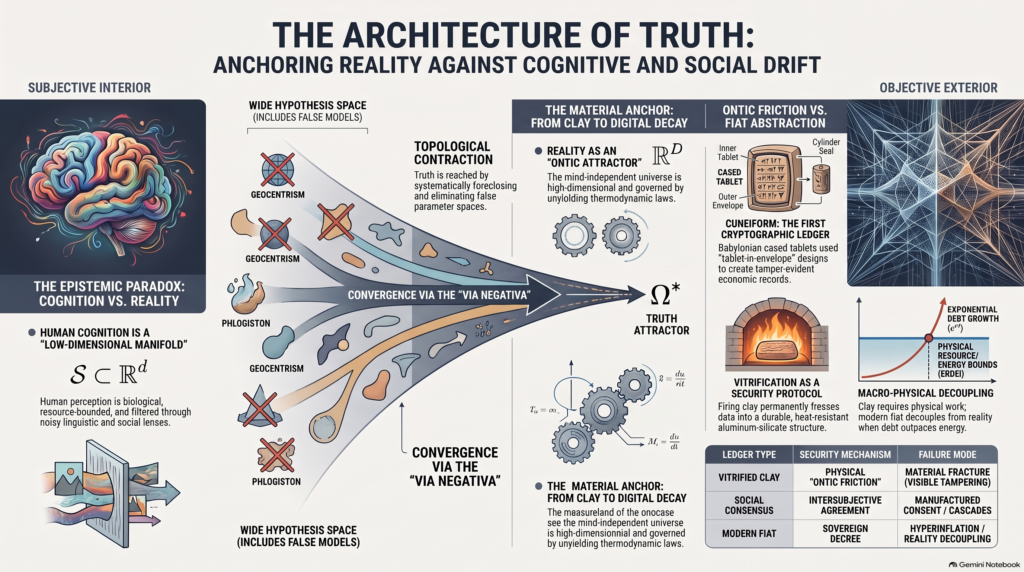
The Materialized Ledger emerges as the essential bridge between these two worlds. It is not a mere accounting tool; it is a mechanism for error reduction. By externalizing records onto physical substrates, we move truth out of the volatile, “noisy” space of human memory and into a “strict” space where the cost of erasure is governed by physics. This process of “parameter foreclosure”—the systematic truncation of false possibilities—found its first rigorous expression in the mud of the Fertile Crescent.
- The Mesopotamian Protocol: Clay as Cryptographic Truth
In the Fertile Crescent (8000 BCE to 1600 BCE), economic verification evolved by increasing Ontic Friction. For a record to remain “honest,” the protocol ensured that altering the record was physically more difficult (and detectable) than creating it.
- Geometric Clay Tokens (8000–3500 BCE): Discrete physical shapes (ovoids, cylinders) represented specific goods. The “physical mechanism” for truth was the physical count; the record was the inventory itself.
- Hollow Clay Bullae (3500–3200 BCE): Tokens were sealed within hollow clay spheres. The “physical mechanism” here was the integrity of the container. To “read” the ledger, one had to break the sphere, a primitive tamper-evident seal that destroyed the proof-container upon access.
- Proto-Cuneiform Tablets (3200–3000 BCE): Scribes moved from internal tokens to external impressions. The critical shift was vitrification: firing the clay at high temperatures. This transformed the mutable mud into a durable aluminum-silicate structure. The “physical mechanism” was high-entropy irreversibility; once vitrified, the record could not be “backspaced” or altered without visible fracture.
The Old Babylonian Cased Tablet (The “Envelope” Protocol) By 2000 BCE, this matured into a sophisticated anti-fraud protocol: the tablet-within-an-envelope.
- The Core: The contract was inscribed on a primary clay tablet (T_{core}).
- The Envelope: A thin layer of wet clay (T_{env}) was wrapped around the dry core and the contract was rewritten on the exterior.
- The Seals: Unique stone cylinder seals were rolled across the wet envelope, acting as physical cryptographic signatures.
- The Judicial Fracture: In the event of a dispute (a “warrant failure”), a magistrate performed a Judicial Fracture, smashing the outer envelope in public. Because the inner tablet was physically shielded, it served as the invariant ground truth. If the envelope’s data diverged from the core, the fraud was exposed.
This era proved that truth is a function of physical resistance. However, as trade scaled, civilization sought to trade this “friction” for the efficiency of symbolic abstraction.
- The Great Abstraction: Song Dynasty Jiaozi and the Loss of Friction
The transition from commodity-backed money to fiat currency represents a “loosening” of the epistemic manifold. As records moved from vitrified clay to paper, the Physical Friction Level plummeted.
Phase of Value-Truth Example Friction Level Redeemability / Backing
- Commodity Barley, Silver High Direct physical utility/scarcity.
- Representative Song Jiaozi Medium Paper receipt for iron/silk reserves.
- Fiat Yuan Baochao Zero Sovereign decree; no physical anchor.
The Systemic Break Point In a commodity system, the ledger is bounded by thermodynamic reality. In a fiat system, the symbolic ledger (nominal claims) can be multiplied at near-zero marginal energy cost. A Systemic Break Point occurs when the growth of symbolic claims exceeds the physical production limits of the real economy.
The collapse of the Yuan Dynasty’s Baochao was not a mere policy error; it was a “symbolic decoupling from reality.” When the state printed notes to cover deficits, the “symbolic illusion” shattered against the unyielding friction of the real economy, forcing a violent return to high-friction silver barter. We are currently observing a similar “cracking of the envelope” in the modern global paradigm.
- The Kuhn Cycle and the Modern Macroeconomic Crisis
Thomas Kuhn’s theory of scientific revolutions describes how paradigms (shared ledgers) move through cycles of stability and collapse. Modern macroeconomics has entered a state of Model Crisis.
The Five Phases of the Kuhn Cycle:
- Normal Science: A stable axiomatic frame (e.g., the Fiat-Dollar standard).
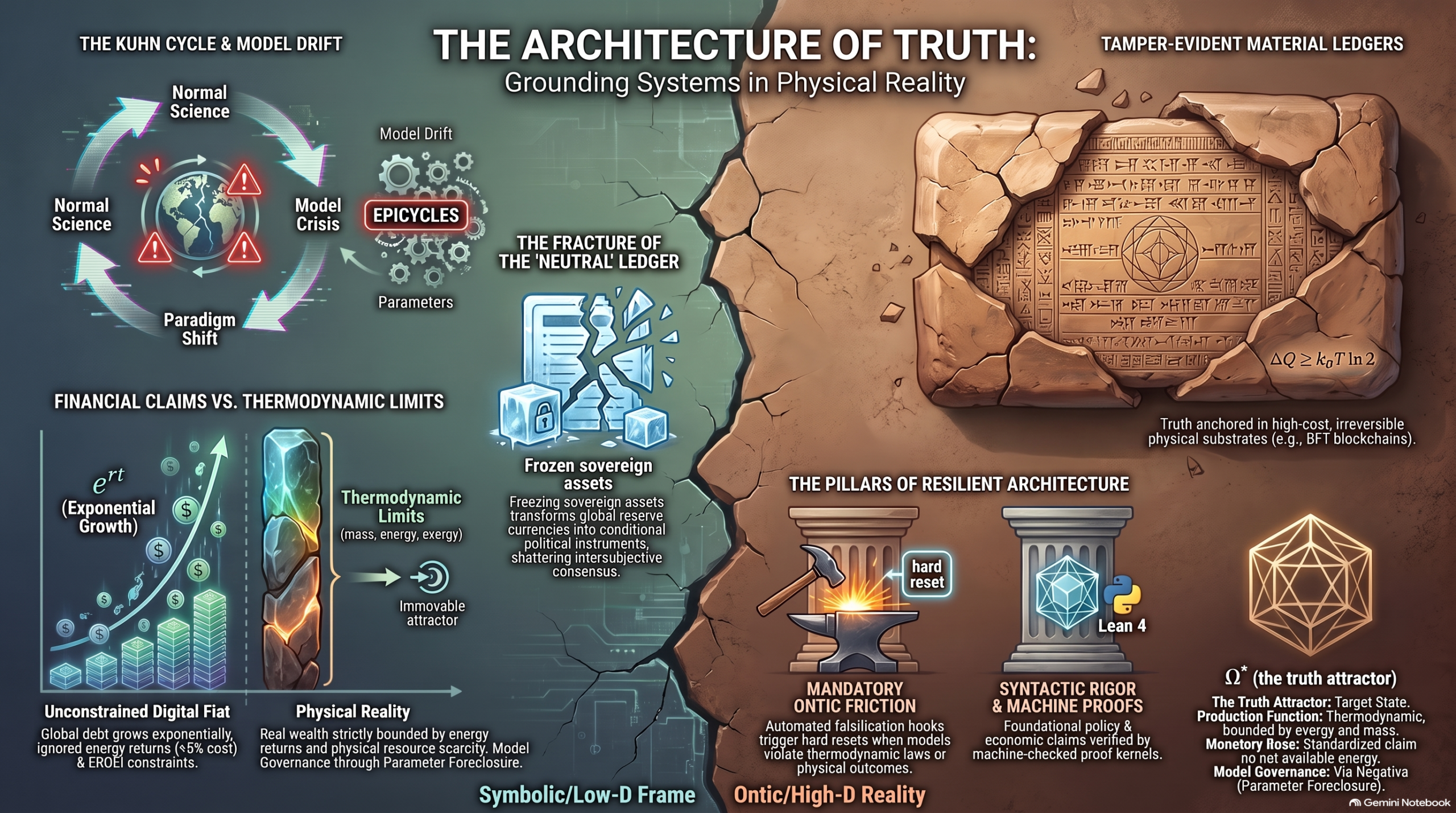
- Model Drift: Anomalies accumulate. The institution adds Ptolemaic epicycles (e.g., QE, ZIRP) to patch the model without fixing the core axioms.
- Model Crisis: The “envelope cracks.” Symbolic claims diverge catastrophically from ontic reality.
- Model Revolution: Competing, incommensurable frameworks emerge.
- Paradigm Shift: False parameter spaces are permanently foreclosed; a new ledger is baked.
Phase 3: The Modern Model Crisis The reigning paradigm suffers from “Ontological Blindness”—specifically in the Disembodied Production Function (Y = A \cdot K^\alpha \cdot L^{1-\alpha}), which treats energy as a <5% externality. Reality is pushing back through several anomalies:
- The 2008 DSGE Failure: Models ignored private debt balances, treating money as a “neutral veil.”
- 2022 Reserve Weaponization: The freezing of Russian assets was a “warrant failure” that turned the global ledger from “Outside Money” (neutral, invariant) into “Inside Money” (a conditional political promise).
- Thermodynamic Divergence: The mismatch between exponential debt growth (D(t) = D_0 e^{rt}) and the declining Energy Return on Investment (Y(t) \propto EROEI).
Axioms of the Reigning Paradigm Ontic Reality (The Physical Truth)
Debt can grow infinitely (e^{rt}). Energy and resources are strictly finite.
Money is a neutral, symbolic veil. Money is a physical ledger tied to energy dissipation.
Energy is a substitutable input (<5%). Capital and labor produce nothing without energy.
Global reserves are politically neutral. Weaponization creates “Inside Money” vulnerability.
This leads to the Triffin Dilemma, where the reserve hegemon must eventually debase the ledger to maintain its own position, breaking the intersubjective consensus.
- Designing for Resilience: The Future of the Ledger
To survive the Kuhn Cycle’s transition, we must adopt a Resilient Epistemic & Thermodynamic Ledger Architecture (RELA). This architecture is built on three pillars:
- Ontic Friction: Ledgers must be tied to physical outcomes (energy throughput or mass) that cannot be altered by decree.
- Syntactic Rigor: The use of machine-checked proofs (e.g., Lean 4) to ensure the logic of a policy is mathematically sound before it is enacted. This prevents ideological drift by making it impossible to “patch” a failing model with ad-hoc parameters.
- Decentralization: Systems must be Byzantine Fault Tolerant, converging on truth even when participants are biased or corrupt.
The Landauer Bound (Axiom 2) RELA recognizes that truth is a thermodynamic event. By Landauer’s Principle, erasing or changing a bit in a ledger requires a minimum energy dissipation (\Delta Q \ge k_B T \ln 2). A resilient ledger makes fraud “heat-expensive,” anchoring the symbolic world in the cost of energy.
The Hierarchy of Truth In RELA, authority is determined by the “Source-of-Truth Precedence”:
- Level 0: Physical Resistance. (Highest) If a bridge collapses, that failure overrides all mathematical models and political decrees.
- Level 1: Machine-Checked Proof. Formally verified deductive logic.
- Level 2: Cryptographic Ledger. Tamper-evident, append-only records (Digital Clay).
- Level 3: Intersubjective Consensus. Symmetric, uncoerced peer review (CUDOS norms).
- Level 4: Sovereign Fiat. (Lowest) Institutional decrees with zero inherent truth-value.
Conclusion: The Permanent Foreclosure of Falsehood
The core thesis of human progress is the Via Negativa: we do not find “absolute truth”; we move forward by permanently foreclosing false parameter space. We learn that debt cannot compound forever on a finite planet, and that symbolic entries cannot substitute for exergy.
“Breaking the envelope” is the universe’s way of correcting our models. By discarding symbolic illusions and anchoring our ledgers in the kiln of physical reality, we align the human project with the invariant attractor of the objective world. Progress is the systematic, irreversible contraction of the volume of permissible error.