
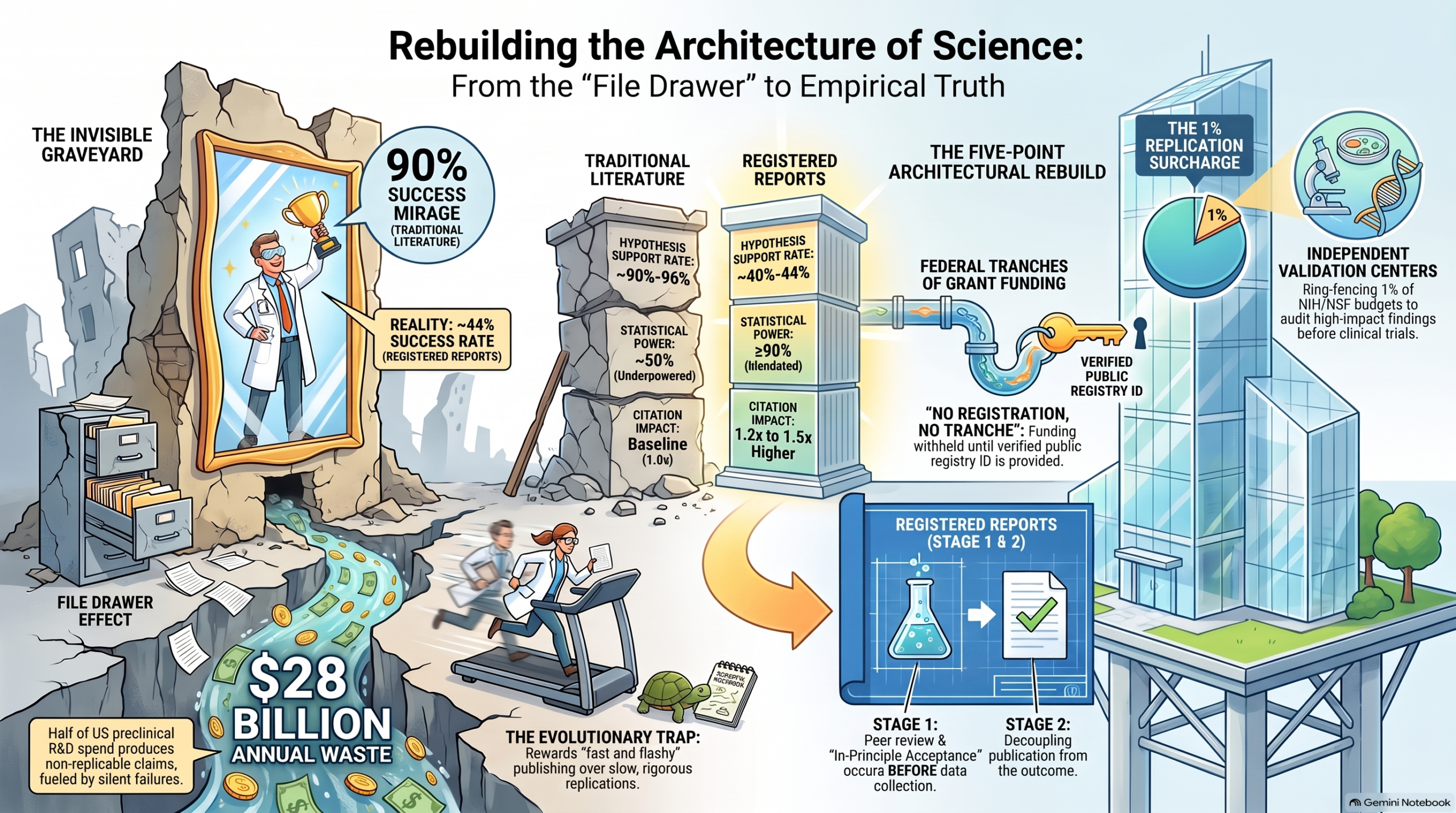
Strategic Roadmap for Empirical Integrity: Implementing the ‘No Registration, No Tranche’ and 1% Replication Framework
- The Imperative for Structural Realignment
The modern scientific enterprise is currently navigating a profound institutional market failure characterized by the “file drawer effect.” For decades, the incentive structures governing academic promotion, federal science funding, and scholarly publishing have optimized for a “funhouse mirror” of reality—systematically rewarding narrative novelty and statistically “clean” positive results while penalizing or burying the null findings and failed replications that constitute the vast majority of physical reality. This bias has fundamentally broken the self-correcting engine of science. By filtering out inconclusive results, we have decoupled the scientific record from the physical universe, leading to a catastrophic misallocation of global capital and human talent.
The Economic and Epistemic Crisis
The financial impact of this irreproducibility is staggering. Synthesizing the Freedman Analysis with the Ioannidis Transformation, we can quantify the massive drain on public and private R&D. In the United States alone, preclinical research irreproducibility is estimated to account for 50% ($28 billion) of annual spending.
Table 1: The Cost of the Invisible Graveyard
Waste Category Estimated Annual Impact (US) Primary Drivers
Primary R&D Waste ~$28 Billion Flawed study designs, selective reporting, and methodological artifacts.
Secondary Redundant Waste ~$7 Billion Independent laboratories repeating identical, unviable experiments in total isolation due to the file-drawer effect.
Bioethical Deficit Millions of animal models Systematic violation of the “Reduction” principle; rodents and primates sacrificed for already-disproved targets.
Human Capital Attrition Generational talent loss Early-career researchers forced out of the field after failing to replicate “landmark” artifacts.
The “Funhouse Mirror” Effect
Mathematical modeling reveals a stark divergence between the “True Distribution of Experimental Tests” and the “Published Literature.” While the expected true baseline for hypothesis verification in cutting-edge biology is estimated between 20% and 40%, the published literature presents an artificial positive-result rate exceeding 90%. As evidenced by the transition to Registered Reports—where the protocol is accepted regardless of the outcome—the support rate for first hypotheses drops to 40–44% (Scheel et al., 2021), exposing the current 90% rate as a statistical artifact of publication bias and analytical flexibility.
The “So What?” Layer
This breakdown creates a “Parallel Wasteland.” When a laboratory discovers a null result but cannot publish it, that failure remains hidden. Dozens of other laboratories, unaware of this “Invisible Graveyard,” then allocate grant capital and years of labor to pursue the same dead end. This “Legacy Feedback Collapse” ensures that we continue to run in parallel circles around foundational breakthroughs that were never true, delaying genuine cures. To restore the scientific pipeline, federal agencies must re-engineer the financial and regulatory constraints of the research supply chain, beginning with the grant disbursement lifecycle.
- Policy Lever I: The ‘No Registration, No Tranche’ Mandate
To stop the “Preclinical Black Hole,” federal agencies shall extend clinical-grade transparency to preclinical research. This policy transforms trial registration from a voluntary moral choice into a hard institutional constraint. By mandating transparency at the protocol stage, we eliminate “primary-endpoint switching” and the “post-hoc goalpost moving” that currently plagues foundational science.
The “Tranche-Lock” Mechanism
Federal grant agencies (NIH, NSF, and DoD) are hereby mandated to implement the “Tranche-Lock” mechanism as a contractual condition for fund disbursement.
- Year 1 Disbursement: Initial funds are released upon grant approval.
- Registry Filing: Before the end of Year 1, the Principal Investigator (PI) must register all proposed animal protocols, primary endpoints, and sample-size calculations on a verified platform (e.g., AnimalStudyRegistry.org or Preclinicaltrials.eu).
- Tranche Release (Years 2–5): Subsequent annual funds are strictly withheld by the federal program officer until a verified URL or DOI linking to the public registration is filed and audited for alignment with the original grant proposal.
- Compliance Audit: If an experiment is executed but not deposited in the registry—regardless of the result—the grant shall be frozen for administrative breach.
Mandate for ARRIVE 2.0 Standards
Scientific journals receiving federal support or publishing federally funded research must enforce the ARRIVE 2.0 (Animal Research: Reporting of In Vivo Experiments) guidelines at the submission portal. Editorial manuscript systems shall be configured to automatically desk-reject any animal study that does not provide an active registry ID, ensuring that researchers cannot bury failed experimental arms or swap results post-hoc to achieve significance.
Case Study: The Clinical Transformation
The potential of this mandate is proven by the Kaplan & Irvin (2015) analysis of NHLBI cardiovascular trials. Before mandatory registration in 2000, 57% of major trials published positive outcomes. Following the federal requirement to register and deposit results, the positive outcome rate plunged to 8%. Applying this model to basic science will force the literature to reflect empirical reality rather than narrative preference.
- Policy Lever II: The 1% Replication Set-Aside & Phase-Gate Validation
Replication is a vital public infrastructure utility, not a “parasitic” or “derivative” activity. Currently, funding bodies allocate nearly 100% of budgets to exploratory novelty and 0% to confirmatory audits—an economic flaw that sustains irreproducible paradigms.
The Office of Independent Scientific Validation
Drawing from the “Policy Blueprint: The 1% Replication Requirement,” a new directorate, the Office of Independent Scientific Validation (OISV), is hereby mandated.
- Funding Scale: The Treasury shall ring-fence a 1% “Replication Surcharge” from annual budgets, totaling approximately $475 million for the NIH and $95 million for the NSF.
- Operational Role: The OISV will contract independent, non-profit Contract Research Organizations (CROs) to execute blinded, high-powered replications of the top 100 most-cited preclinical discoveries each year.
- Selection Protocol: To remove human bias, the 100 discoveries selected for replication will be identified through an algorithmic citation-velocity audit combined with a weighted assessment of translational potential.
The Phase-Gate Operational Mandate
To protect human subjects and prevent translational waste, a new “Phase-Gate” requirement is instituted: No molecular target, biologic, or synthetic vector can receive federal Phase I human trial support until an independent CRO has confirmed the in vivo target validation through a blinded, preregistered replication.
The Economic Arbitrage of Replication
This shift represents a significant return on investment.
- Current Paradigm: A $50 million investment in 25 novel labs results in a 50% failure rate, leading to over $200 million in downstream waste in dead-end clinical trials.
- Reformed Paradigm: By utilizing the Replication Tax to invalidate flawed targets early, agencies save over $100 million in downstream translational waste, redirecting capital toward viable therapies.
- Operationalizing the Registered Reports & FAIR Data Architecture
“Protocol-First Publishing” through the Registered Reports (RR) format is the primary tool for emptying the file drawer. By decoupling the reward of publication from the direction of the results, we eliminate the incentive to massage data.
The Two-Stage Evaluation Architecture
- Stage 1 (Pre-Data Collection): Authors submit methodology and power analysis (mandated at \ge 90%). Peer review focuses on the importance of the question and rigor of design. If approved, the journal issues In-Principle Acceptance (IPA).
- Stage 2 (Post-Data Collection): Authors append Results and Discussion. Reviewers audit adherence to the protocol. The journal is structurally barred from rejecting the paper based on a null or “unexciting” outcome.
The FAIR Data & Cryptographic ELN Mandate
The definition of a “published paper” is expanded into a “Data-Code-Narrative Unit.”
- Mandatory Uncropped Raw Imagery: Authors must deposit unprocessed Western blots and microscopy imagery into open repositories (e.g., Zenodo, Dryad) as a condition of peer review.
- Cryptographically Sealed Electronic Lab Notebooks (ELNs): Grant recipients shall utilize append-only ELNs (e.g., Benchling, LabArchives) that hash files upon entry. Any retroactive curve-fitting or data deletion creates an audit trail that alerts misconduct inspectors.
Enforcing the Nelson Memo
Gabelica et al. (2022) revealed that “gentleman’s agreements” regarding data sharing have a 96.4% compliance failure rate, with authors citing “lost files” or “dead hardware.” Consequently, federal enforcement of the “Nelson Memo” is mandated to provide the infrastructure—machine-readable repositories—that renders these excuses obsolete. All federally funded data must be freely available in these repositories immediately upon publication with zero embargo.
- Forensic Infrastructure: Post-Publication Sleuthing & AI Surveillance
The enterprise must transition from a “static PDF” model to a “decentralized audit network.” This dynamic system uses crowdsourced expertise and AI to detect industrial-scale fraud and paper-mill artifacts.
Integration of PubPeer and Browser Forensics
PubPeer serves as the central clearinghouse for verification, allowing anonymous critiques that break the “chilling effect” of academic hierarchies.
- Workflow Integration: Browser extensions for PubMed and Google Scholar shall inject high-visibility warnings (e.g., “Suspected Gel Duplication”) directly over paper titles.
- Real-time Protection: These alerts prevent researchers from building upon flawed foundational papers years before an official retraction occurs.
AI Computer Vision at Intake
Publishers and agencies shall deploy forensic engines at the point of submission to detect:
- Tadpole morphological artifacts: Signatures of digital smoothing tools used in paper mills.
- Band rotation and splicing: Reusing images across different experiments.
- Nonsense reagent sequences: Integration of Seek & Blastn is mandated as the specific tool for Reagent Sequence Auditing, ensuring primers actually target the claimed genes.
Whistleblower Protections
To protect independent sleuths from predatory litigation, federal anti-SLAPP statutes are hereby mandated. Furthermore, university tenure evaluations shall integrate PubPeer comments and forensic contributions as recognized service to the scientific community, rewarding the labor of verification.
- Implementation Roadmap & Governance Metrics
The transition from “Narrative Novelty” to “Empirical Parity” requires a phased approach to align Principal Investigator (PI) self-interest with the public good.
5-Year Implementation Timeline
- Year 1: Regulatory Mandate. Enforcement of the Nelson Memo and mandatory AI image/reagent forensics for all federal grant publications.
- Year 2: Tranche-Lock Enforcement. Full implementation of mandatory registration for all funded animal studies.
- Year 3: Replication Launch. Establishment of the Office of Independent Scientific Validation and the 1% set-aside.
- Years 4-5: Institutional Realignment. Integration of the r-index into university promotion and tenure systems.
The Replication Index (r-index)
The “h-index” and Impact Factor shall be replaced by the r-index, rewarding the empirical reliability of claims: r_i = \log_{10} \left( \frac{\sum \text{Replicated Claims}i + 1}{\sum \text{Disconfirmed Claims}i + 1} \right) + \sum{k=1}^{M} w_k \cdot R{\text{audit}}^{(k)} Where:
- w_k: The methodological weight assigned to the k-th study (rewarding high-powered, registered protocols).
- R_{\text{audit}}: The investigator’s contribution to independent, registered replications of other published claims.
Federal Integrity & Verification Dashboard
Metric Baseline 5-Year Target
Published Positive Result Rate 90% 45%
Raw Image Deposition Compliance <15% 100%
Animal Studies Formally Registered <5% 95%
“Data Available Upon Request” Share >60% 0%
Phase II Clinical Trial Failure Rate ~85% 50%
Concluding Summary
The transition from Narrative Novelty to Empirical Parity is a shift toward a science where a result’s value lies in the truth it uncovers, not the excitement it generates. By re-engineering our financial and forensic infrastructure, we stop the compounding waste of silent failures and restore science as a robust, cumulative enterprise.