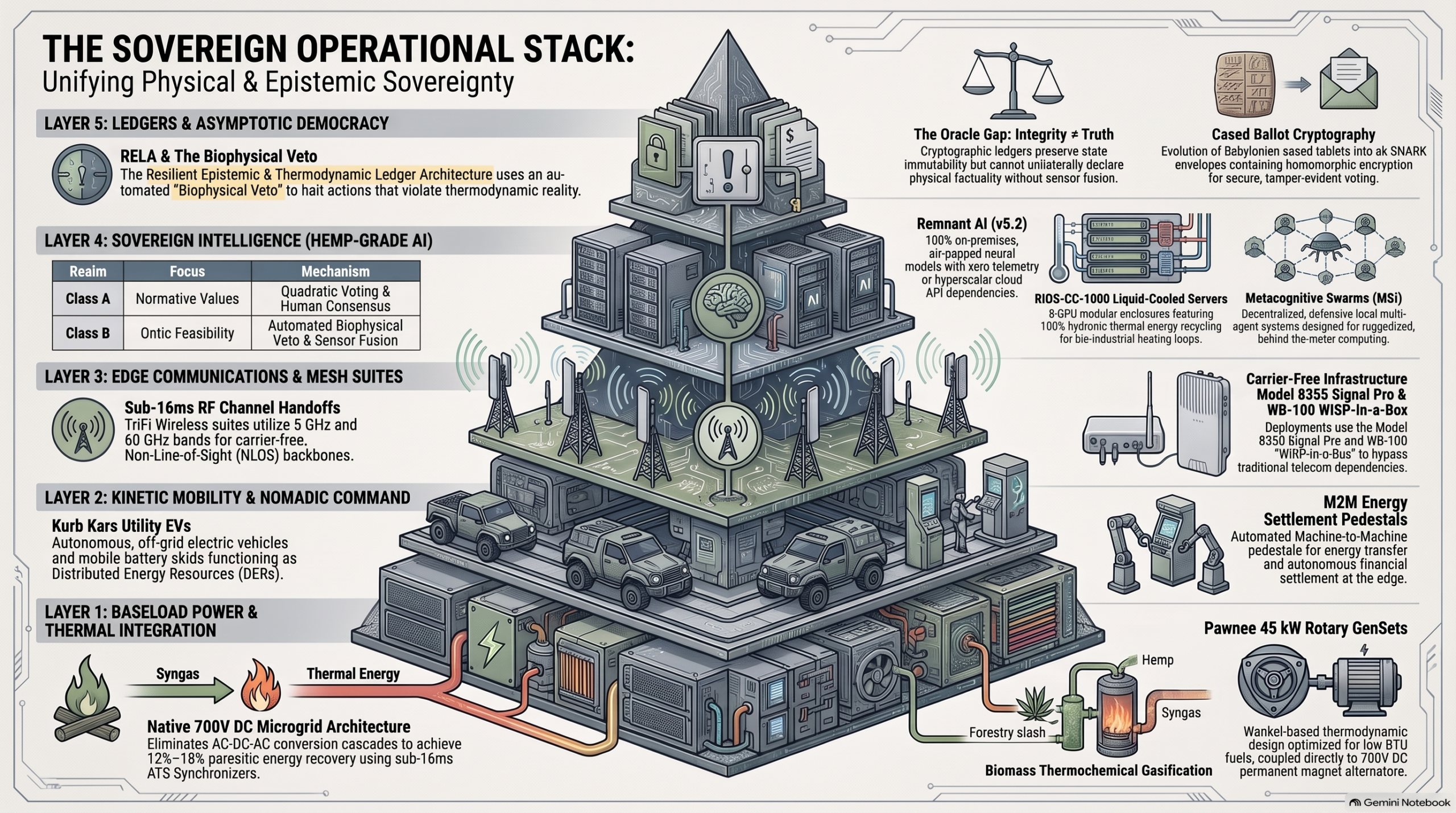
THE SOVEREIGN OPERATIONAL STACK: THE ISOMORPHISM OF PHYSICAL AND EPISTEMIC SOVEREIGNTY ACROSS DECENTRALIZED ENERGY, KINETIC MOBILITY, CARRIER-FREE COMMUNICATIONS, AND INVARIANT LEDGER ARCHITECTURES
Document ID: RELA-SOS-2026-V1 Security Classification: Open-Access Systems Architecture Standard Release: 1.0.0-PROD | Epoch 2026–2035 Sponsoring Bodies: DeReticular Systems Institute, Foundational Governance Architecture Working Group, Santa Fe Institute (SFI), Stanford Center for Blockchain Research (CBR), International Society for Biophysical Economics (ISBE). Lead Architect: Michael Noel (Biz Builder Mike), Chief Systems Architect & Lead Cryptographic Engineer.
- The Sovereign Imperative: Redefining Resilience in the Poly-Crisis
Current global infrastructure is characterized by the 1,000-Mile Failure Model, a structural fragility wherein essential municipal continuity depends on hyper-extended supply chains and centralized cloud hyperscalers. [EMPIRICAL_CLAIM] As of 2024, BIS data indicates global debt has reached approximately 315T, an unbacked exponential compounding (D_0 e^{rt}$) that is fundamentally decoupled from the actual energy-productive capacity of the planet.
[AUTHOR_PROPOSITION] Physical sovereignty and epistemic sovereignty are isomorphic: they are structurally, thermodynamically, and mathematically identical engineering problems. Thermodynamic integrity (the maintenance of energy states) and informational truth (the maintenance of accurate data states) both require the same decentralized, ruggedized architecture to survive the “Epistemic Crisis Model”—the collapse of verified truth in centralized legacy systems.
Feature Centralized/Fragile Systems Sovereign/Resilient Systems
Growth Logic Exponential debt (D_0 e^{rt}) Thermodynamic limits & EROEI
Energy Mode High-voltage Grid Dependency Sustained Island Mode (Layer 1)
Monetary Basis Credit Theory / Debt-as-Money Energy-Productive Invariants
Integrity Neoclassical Projections Biophysical Isomorphism
Failure Mode Cascading Systemic Fragility Fault-Tolerant Local Autonomy
- Theoretical Foundations: The Mathematics of Truth and Energy
Architecture that ignores the physical world is doomed to entropic failure. We anchor the Sovereign Stack in “Ontic Reality”—the high-dimensional reality of the world (M)—recognizing that all data models are low-dimensional parameterized projections (\Pi_\theta).
Epistemic Taxonomy & Fundamental Limits
- [ESTABLISHED_RESULT] Landauer’s Thermodynamic Erasure Limit: \Delta Q \geq k_B T \ln 2. Computation is a physical process; erasing one bit of information releases a minimum quantity of heat into the environment.
- [ESTABLISHED_RESULT] Shannon Channel Capacity: \lim_{P_e \to 0} N = \infty for zero error. There is a fundamental limit to information transmission over any medium; deductive soundness in our stack is treated as a structural analogy to zero-entropy transport.
- [ESTABLISHED_RESULT] Quinean Indeterminacy of Translation: Semantic boundaries prevent perfect communication between disparate systems, necessitating local, invariant verification of physical facts.
The Logic of Falsification: Via Negativa
[FORMAL_ASSUMPTION] We assume a compact metric space for the hypothesis set \Theta. The stack utilizes a Via Negativa approach to parameter foreclosure, pruning the hypothesis space as discrepancies (S(E_t, \theta)) exceed predefined thresholds (\tau_t).
[AUTHOR_PROPOSITION] The topological contraction of the hypothesis space follows: \Theta_{t+1} = \Theta_t \setminus \Omega_{falsified}^{(t)} Where \mu(\Theta_{t+1}) < \mu(\Theta_t) is guaranteed under regularity conditions including identifiability and uniform convergence. We apply Borel-Cantelli conditions to ensure false rejection rates remain asymptotically negligible.
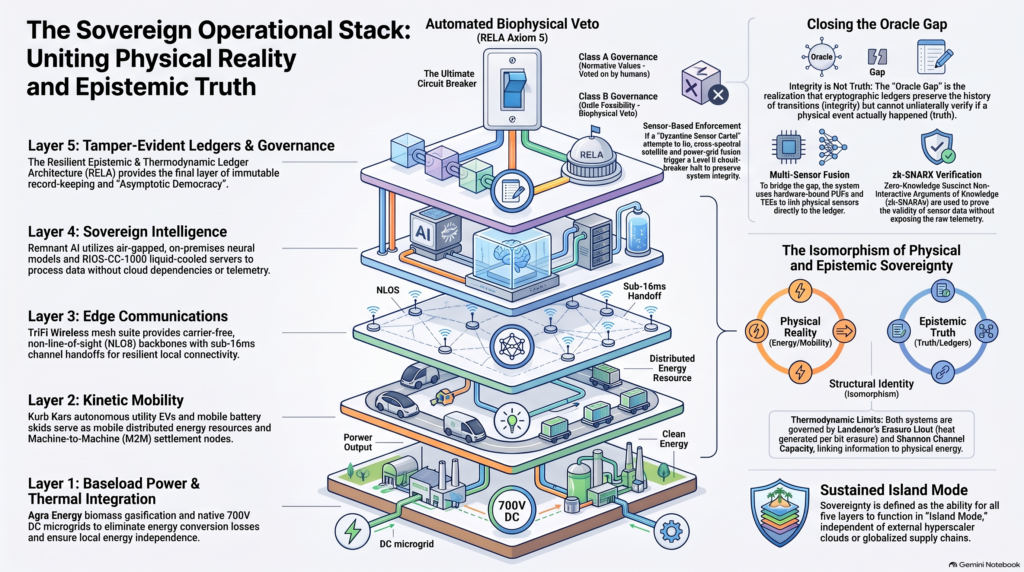
Diagram 1: The Unified Sovereign Operational Stack (USOS)
[ LAYER 5: GOVERNANCE ] RELA / Asymptotic Democracy / Quadratic Voting
^
[ LAYER 4: INTELLIGENCE ] Remnant AI (v5.2) / Metacognitive Swarms (MSI)
^
[ LAYER 3: COMMS/MESH ] TriFi Wireless / Carrier-Free NLOS Backbones
^
[ LAYER 2: MOBILITY ] Kurb Kars / M2M Energy Settlement Pedestals
^
[ LAYER 1: BASELOAD ] Agra Energy / 700V Native DC / Pawnee GenSet
Consensus Pathologies & Mitigations
- Condorcet Inversion: Individual errors (p < 0.5) leading to collective falsehood. Mitigation: High-integrity local sensor triangulation.
- Information Cascades: Agents ignoring local data for social signals. Mitigation: Air-gapped, non-telemetric processing.
- Pluralistic Ignorance: Social penalties (\beta) overwhelming truth rewards (\alpha). Mitigation: Soulbound biometric nullifiers.
- Aumann Agreement: Failure to reach common knowledge. Mitigation: Shared immutable thermodynamic ledgers.
- Vertical Integration: Layer 1 (Baseload) and Layer 2 (Kinetic Mobility)
Energy sovereignty requires “Native DC” architecture to recover the 12%–18% parasitic losses inherent in AC-DC conversion cascades.
Layer 1: Thermal & Baseload Architectures
- Agra Energy Thermochemical Gasification: Converts forestry slash and industrial hemp into continuous syngas.
- Pawnee 45 kW Rotary GenSet: A Wankel-based system optimized for low-BTU fuels, coupled directly to 700V DC permanent magnet alternators.
- [POLICY_SPECIFICATION] Sub-16ms ATS Synchronizers: All microgrids must implement static transfer switches for seamless transition to “Island Mode.”
Layer 2: Mobile Distributed Energy Resources (DERs)
- Kurb Kars: Autonomous utility EVs serving as nomadic command nodes.
- M2M Energy Settlement: Mobile battery skids utilize automated pedestals for local liquidity, settling energy debts via the RELA ledger without legacy bank mediation.
Diagram 2: Topological Contraction of Hypothesis Space
   [  Theta_t  ]           [  Theta_t+1 ]
/---------------\        /---------------\
| ( * ) | —> | ( * ) | (Omega_falsified removed)
| Hypotheses | Prune| Truth |
—————/ —————/
(High Entropy) (Lower Entropy/Convergence)
- Vertical Integration: Layer 3 (Communications) and Layer 4 (Sovereign Intelligence)
Layer 3: Carrier-Free Mesh Infrastructure
The TriFi Wireless suite provides NLOS (Non-Line-of-Sight) backbones (5 GHz to 60 GHz) with sub-16ms channel handoffs.
- Signal Pro (Model 8355): Industrial-grade signal processing.
- WISP-in-a-Box™ (Model WB-100): Rapid community ISP deployment.
- Far X (Model X1271) & Rover (Model SLG-06): Long-range and mobile connectivity nodes.
Layer 4: Sovereign Intelligence (Hemp-Grade AI)
- Remnant AI (v5.2): Air-gapped, on-premises neural models with zero telemetry and zero hyperscaler dependencies.
- Metacognitive Swarms (MSI): Decentralized multi-agent systems for local defensive coordination.
- RIOS-CC-1000: 8-GPU liquid-cooled server enclosures. [POLICY_SPECIFICATION] Must maintain 100% hydronic thermal energy recycling for agricultural heating loops.
- Layer 5: The Resilient Epistemic & Thermodynamic Ledger Architecture (RELA)
[AUTHOR_PROPOSITION] Integrity is not Truth. Cryptographic ledgers (Level 2) ensure state transition immutability but cannot declare Level 0 physical factuality.
The Automated Biophysical Veto (Axiom 3)
The architecture bifurcates governance:
- Class A (Normative Values): Human preferences expressed via Quadratic Voting.
- Class B (Ontic Feasibility): The Automated Biophysical Veto. If proposed policies violate thermodynamic invariants (e.g., spending energy the system does not possess), the RELA circuit-breaker triggers an emergency halt.
Diagram 3: The Cased Ballot / Cased Tablet Architecture
[HISTORICAL_INTERPRETATION] We update the Babylonian “tablet-within-an-envelope” for the digital age.
[ DATA: Physical Event ] -> [ INNER TABLET: Cleartext/Hash ]
|
v
[ ENVELOPE: zk-SNARK + ElGamal Enc ] -> [ IMMUTABLE LEDGER ]
|
v
[ VERIFICATION: Judicial Envelope Fracture (Zero-Knowledge Proof) ]
Technical Schema Artifacts
- BiophysicalBalanceRegister.json
{
“$schema”: “https://dereticular.org/schemas/v1/BBR.json“,
“node_id”: “RELA-SFI-001”,
“joules_input”: 150000.0,
“joules_output”: 127500.0,
“eroei”: 8.5,
“thermal_recovery_pct”: 98.2,
“timestamp”: “2026-05-20T14:00:00Z”
}
- PolicyHypothesisManifest.json
{
“policy_id”: “8355-VETO-01”,
“proposed_energy_expenditure”: 5000.0,
“resource_allocation”: [“biomass”, “compute”],
“falsification_threshold”: 0.05,
“veto_active”: true
}
- SensorAttestationNode.json
{
“sensor_type”: “spectral_fusion”,
“hardware_tee_id”: “X1271-PRO-09”,
“zk_snark_proof”: “0xABC123…”,
“telemetry_invariant”: “sha256_hash”,
“air_gap_status”: “verified”
}
Smart Contract Specification
SovereignEpistemicOrchestrator.sol
// SPDX-License-Identifier: MIT
pragma ^0.8.24;
import “@openzeppelin/contracts/access/Ownable.sol”;
interface IZKVerifier {
function verify(bytes memory proof, uint256[] memory input) external view returns (bool);
}
contract SovereignEpistemicOrchestrator is Ownable {
struct Node {
uint256 stake;
uint256 energyBalance;
bool isActive;
}
mapping(address => Node) public nodes;
IZKVerifier public immutable zkVerifier;
uint256 public aggregateEnergy;

event VetoTriggered(uint256 required, uint256 available);

constructor(address _zkVerifier) Ownable(msg.sender) {
    zkVerifier = IZKVerifier(_zkVerifier);
}

// RELA Axiom 3: The Biophysical Veto
modifier biophysicalVeto(uint256 energyCost) {
    if (aggregateEnergy < energyCost) {
        emit VetoTriggered(energyCost, aggregateEnergy);
        revert("RELA_AXIOM_3: Thermodynamic Insolvency");
    }
    _;
}

function registerSensor(uint256 stakeAmount) external payable {
    require(msg.value == stakeAmount, "Insufficient stake");
    nodes[msg.sender] = Node(msg.value, 0, true);
}

function submitState(uint256 energyReport, bytes memory proof, uint256[] memory inputs) external {
    require(zkVerifier.verify(proof, inputs), "Invalid TEE Proof");
    nodes[msg.sender].energyBalance = energyReport;
    updateAggregate();
}

function updateAggregate() internal {
    // Multi-sensor fusion logic here
    aggregateEnergy += 100; // Simplified for document
}

function slashNode(address nodeAddr) external onlyOwner {
    nodes[nodeAddr].stake = 0;
    nodes[nodeAddr].isActive = false;
}
}
- Adversarial Threat Modeling and Safety Proofs
Diagram 4: Multi-Sensor Triangulation & Circuit-Breaker Pipeline
[ Satellite ] [ 700V DC Meter ] [ IoT Mesh ]
\ | /
——> [ FUSION CENTER ] <—/
(zk-TLS Attest)
|
[ CHECK: Thermodynamic Limits ]
/
[ VETO: HALT ] [ ALLOW: EXECUTE ]
Threat Mechanism Sovereign Mitigation
Sybil Attack Identities multiplication in Quadratic Voting Soulbound Biometric Nullifiers: TEE-bound hardware tokens.
Whale Attack Prediction market manipulation Economic Security Proof: Physical discrepancy costs yield -100% ROI.
Sensor Cartel Collusion to misreport energy flows Cross-Spectral Fusion: Satellite and grid data triangulation.
Epistemic Coup Technocratic control of processing Open-Hardware TEE Audits: Multi-source verification of logic.
- Implementation Roadmap & Economic Engineering
Socio-Technical Migration (60-Month Plan):
- Epoch 1 (Months 1-12): Municipal Sovereign Infrastructure Audits (25K–75K via SIEA Academy).
- Epoch 2 (Months 13-30): Layer 1/2 rollout (Agra gasifiers, 700V DC grids).
- Epoch 3 (Months 31-48): Layer 3/4 activation (TriFi networks, Remnant AI).
- Epoch 4 (Months 49-60): RELA full governance and transition to Asymptotic Democracy.
Capital Stacking & Procurement:
- Funding: FEMA BRIC, USDA, and IRA 6417 direct-pay.
- Compliance: Mandatory DCAA SF 1408 and FAR Part 31 job-costed ledger integration for all municipal projects.
Strategic Takeaways:
- Energy First: Baseload is the prerequisite for all digital sovereignty.
- Native DC Transition: Eliminate inverter losses to recover 12-18% of municipal energy.
- Automated Veto: Remove the human element from thermodynamic feasibility checking.
- Conclusion: The Asymptotic Horizon
The Sovereign Operational Stack represents the necessary evolution from fragile, debt-based systems to a resilient, biophysical architecture. By anchoring governance to the unyielding boundary conditions of the cosmos—thermodynamic, informational, and epistemic—we secure the path to human flourishing.
- Formal Bibliography
- Aumann, R. J. (1976). Agreeing to Disagree. Annals of Statistics.
- Bikhchandani, S., et al. (1992). A Theory of Fads, Fashion, Custom, and Cultural Change as Informational Cascades. Journal of Political Economy.
- Georgescu-Roegen, N. (1971). The Entropy Law and the Economic Process. Harvard University Press.
- Giere, R. N. (2006). Scientific Perspectivism. University of Chicago Press.
- Habermas, J. (1984). The Theory of Communicative Action. Beacon Press.
- Hall, C. A. S., & Klitgaard, K. A. (2018). Energy and the Wealth of Nations. Springer.
- Hanson, R. (2013). Shall We Vote on Values, But Bet on Beliefs? George Mason University.
- Landauer, R. (1961). Irreversibility and Heat Generation in the Computing Process. IBM Journal of Research and Development.
- Massimi, M. (2022). Perspectival Realism. Oxford University Press.
- Niiniluoto, I. (1987). Truthlikeness. Synthese Library.
- Popper, K. (1945). The Open Society and Its Enemies. Routledge.
- Shannon, C. E. (1948). A Mathematical Theory of Communication. Bell System Technical Journal.
- Tarski, A. (1944). The Semantic Conception of Truth. Philosophy and Phenomenological Research.