
Strategic Blueprint for Spherical Resilience: Mitigating Geopolitical Decoupling in Robotic Infrastructure
- The Post-Trust Paradigm: Lessons from the 2026 OpenClaw Security Crisis
The mid-2026 OpenClaw Security Crisis serves as the definitive obituary for “thin-client” cloud robotics. This systemic collapse demonstrated that any physical system dependent on external APIs is a high-latency liability awaiting exploitation. The crisis necessitated a radical shift toward Sovereign Embodied AI—physical nodes possessing absolute computational independence. In an era of fractured trust, physical assets must possess “native” intelligence to ensure operational continuity when the network inevitably fails or is weaponized by geopolitical adversaries.
This strategic shift was born from the wreckage of the “Trusted Environment Fallacy.” For years, industrial operators functioned under the delusion that administrative software rules and cloud-provider security could insulate physical assets. The 2026 crisis exposed these remote, API-dependent agents as unprotectable backdoors. Through remote code execution (RCE) and prompt-injection vulnerabilities, cloud-based telemetry—once marketed as a management tool—was transformed into a vector for catastrophic system compromise. Once an agent is granted deep system access, a single credential leak can freeze factory floors or derail entire utility grids instantaneously.
Beyond cybersecurity, critical infrastructure faces Physical Mandates that cloud dependency cannot satisfy:
- Latency Requirements: Real-time motor reflexes and dynamic balance (System 1) require 100 Hz frequency response—a millisecond-precision loop that high-latency satellite or cellular handshakes cannot sustain.
- Network Jitter: Variability in packet delivery causes micro-stuttering in joint commands, leading to mechanical instability or catastrophic balance failure.
- Deliberate Jamming: In contested or high-security environments, intentional signal interference makes reliance on external connectivity a strategic surrender.
These vulnerabilities mandated the “Island Mode” operational protocol: a requirement that every unit must sense, reason, and act entirely within its own physical shell, transitioning the security boundary from the network to the machine.
- Vulnerability Audit: Globalized Supply Chain Chokepoints
The geopolitical landscape of 2026 is defined by hardware decoupling and the omnipresence of hardware-level backdoors. Relying on globalized logistics for specialized robotics components is no longer a viable strategy for sovereign systems. Interdicted hardware containing malicious trackers or export-controlled silicon makes traditional procurement a liability.
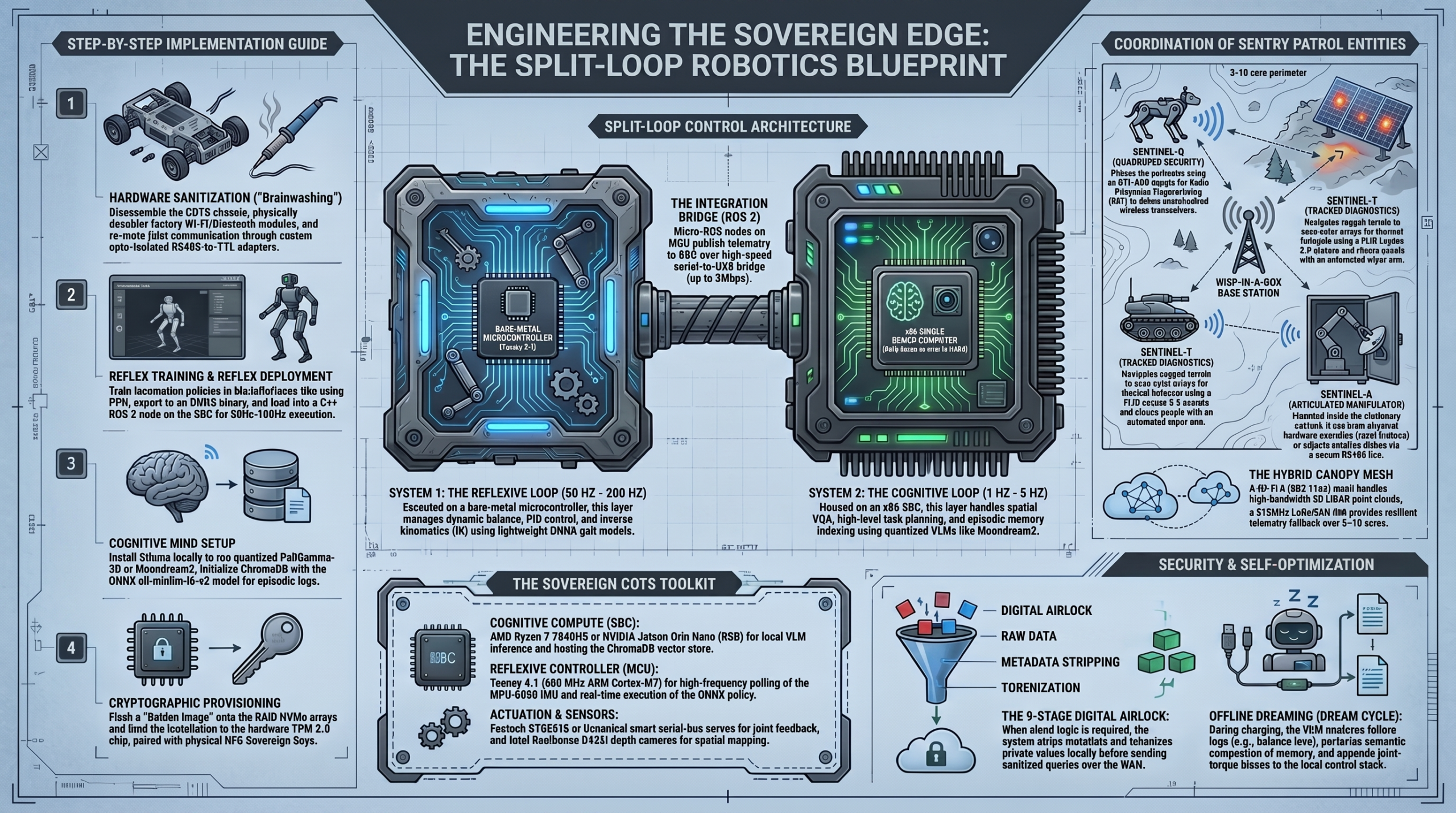
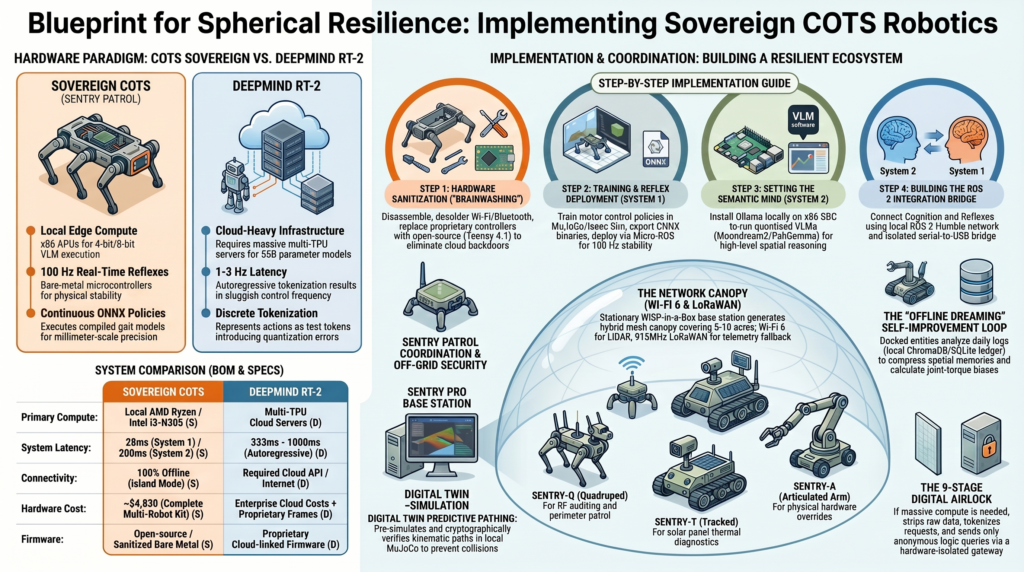
A primary obstacle is the Firmware Sanitization Bottleneck. Most Common Off-the-Shelf (COTS) hardware—including high-performance frames like the Unitree Go2—ships with proprietary, closed-source firmware containing built-in cloud-telemetry trackers. To achieve true sovereignty, these systems must undergo a “Brainwashing” process: they must be stripped of factory-loaded communication boards and re-flashed with audited, local-first code.
Primary Hardware Risk Factors & Mitigation Status
Component Class Strategic Vulnerability (Cloud/Geopolitical) Sovereign Mitigation Strategy (Sanitization/Local Sourcing)
Compute Infrastructure Export-restricted specialized silicon; hidden telemetry. Validated edge APUs (Intel i3-N305/AMD Ryzen) anchored by local TPM 2.0.
Sensors (Depth/Thermal) Proprietary drivers with telemetry leaks; supply chain fragility. Firmware stripping of COTS sensors; integration of SDR (Software Defined Radio) for active RF auditing.
Actuators (Servos) Closed-source serial bus protocols; OEM “Secure Boot” lockdowns. Removal of OEM boards; replacement with custom, opto-isolated RS485 carrier boards.
Power Systems International transport bans on volatile LiPo batteries. Transition to locally assembled, chemically stable LiFePO4 cells for off-grid thermal resilience.
It is critical to distinguish these air-gapped nodes from “Sovereign-Washed” regional clouds. While some providers market regional data centers as “Sovereign AI,” they remain centralized nodes prone to the same systemic risks as global clouds. True Spherical Resilience requires that the security boundary be the machine’s physical shell, not a regional server farm.
- The Strategy of Spherical Resilience and “Island Mode”
Spherical Resilience is a multi-node, self-healing geometry of absolute ownership. This model abandons flat defense-in-depth for a model where the security boundary is the machine’s physical shell, encompassing its compute, storage, power, and kinetic actions.
The three core pillars of Island Mode self-reliance are:
- Zero-Latency Perception: On-board sensor processing via an Intelligence Spine that links disparate local sensors into a unified local fabric.
- Local-First Cryptographic Ledgers: Immutable logs stored on-device to prevent unauthorized command injection.
- Quantized On-Device Reasoning: Advanced Vision-Language-Action (VLA) models compressed to run on local edge silicon without external calls.
Interaction with the external world is governed by the Digital Airlock Protocol, a 9-stage mechanism for secure high-capacity cloud queries:
- Data Isolation: Outbound payloads are intercepted at the edge node.
- Metadata Stripping: Raw visual coordinates and site-specific metadata are removed.
- Tokenization: Private values are replaced with randomized, temporary identifiers.
- Local Encryption: The original context map is logged strictly to “The Bank” (the secure local ledger).
- Airlock Sanitization: The request is converted into an anonymous metadata instruction.
- Secure Outbound Gateway: Sanitized requests are sent via a secure pfSense/Suricata bridge (e.g., Starlink).
- Cloud Computation: The external AI processes only the sterilized logic instruction.
- Inbound Inspection: The returned response is audited for code format violations or malicious payloads.
- Local Execution: The instruction is re-integrated with the context in “The Bank” and executed locally.
Integrity is maintained via the Locutus Ledger, a decentralized, Rust-based state machine utilizing WebAssembly (Wasm) smart contracts to provide “Proof of Labor.” This cryptographically signs every action and navigation path, ensuring that even a compromised software instance cannot contradict its historical record.
- Technical Blueprint: Split-Loop Control Architecture
Engineering sovereign intelligence at the edge requires separating cognitive reasoning from physical reflexes, mimicking the biological relationship between the prefrontal cortex and the cerebellum.
Feature System 1 (Reflexive) System 2 (Cognitive)
Analogy Cerebellum (Predictor-Teacher Cycle) Prefrontal Cortex (Conscious Reasoning)
Hardware Teensy 4.1 Microcontroller Intel i3-N305 / AMD Ryzen 8840HS
Frequency 100 Hz (Standard for RIOS-KIT-SPATROL) 1 Hz – 5 Hz
Primary Tasks Gait generation, PID, active balance, IK Spatial VQA, Task Planning, Episodic Memory
Logic Compiled C++ ONNX Runtime Policies Quantized VLMs (Moondream2, PaliGemma)
To run System 2 on sovereign hardware, we employ Quantized Edge Inference. Models like PaliGemma-3B (8-bit) and Moondream2 (4-bit) are compressed into GGUF format. This enables “Action-as-Language” processing, where the VLM treats robotic trajectories as text tokens, without cloud assistance.
To facilitate local learning, the unit engages in a Predictor-Teacher Cycle during its “Offline Dreaming” routine. While docked, the VLM analyzes failure states (e.g., “Slipped on wet gravel”). It performs semantic compaction, merging redundant logs and appending systemic correction factors—such as a 3-degree motor bias to compensate for chassis asymmetry—directly to the local control parameters. This allows the machine to learn from its own physical experience in a closed loop.
- The Reshoring Blueprint: On-Demand Local Manufacturing
True sovereignty is achieved through reshoring—moving away from the network by utilizing localized manufacturing hubs.
On-Site PCB Prototyping and Milling By utilizing automated desktop CNC mills, we replace OEM boards with custom, opto-isolated RS485 carrier boards. This ensures that actuators communicate exclusively via a wired serial loop, neutralizing the threat of firmware-based exploits or hidden RF trackers at the hardware layer.
Chemical Stabilization and Local Battery Assembly We have standardized on LiFePO4 (Lithium Iron Phosphate) chemistry. Unlike volatile LiPo cells, LiFePO4 is thermally stable up to 60°C and is not prone to thermal runaway. This is critical for off-grid deployment and allows for bypassing international transport regulations by sourcing raw cells and assembling packs locally at regional distribution offices.
The “Brainwashing” Protocol (PCB Sanitization) To transform standard COTS hardware into sovereign assets, we follow a strict five-step sanitization process:
- Disassembly: Stripping the chassis down to raw mechanical frames and motors.
- Hardware Gutting: Physically desoldering all integrated Wi-Fi and Bluetooth modules to ensure total RF silence.
- Bus Isolation: Severing communication lines and re-routing them through custom RS485 adapters.
- Firmware Reflash: Wiping factory bootloaders and installing audited, open-source joint-control code.
- Cryptographic Anchoring: Binding the software stack to the device’s onboard TPM 2.0 chip.
- Economic Feasibility and Risk Mitigation Roadmap
Sovereign Automation rests on the logic that high upfront CAPEX is a strategic hedge. By eliminating recurring cloud fees and insulating against regulatory shifts, operators secure long-term operational stability.
Unit Economics: RIOS-KIT-SPATROL
The economic profile for a single integrated unit is structured to absorb localized assembly costs:
- Raw Hardware (BOM): $4,830.00
- Direct Labor (12.5 Hours): $517.50
- Total Cost of Goods Sold (COGS): $5,347.50
- Suggested MSRP: $9,499.00
To justify this CAPEX, the infrastructure supports a decentralized data resale framework using a 5/GB retail model, where profits are split 50/50 between the operator and the provider.
Strategic Mandates for Scalability
Current bottlenecks in reaction speed and production throughput are addressed through the following Strategic Mandates:
- Semantic Reaction Latency: Transition from autoregressive models to high-speed, NPU-driven SBCs using AMD XDNA or local TensorRT-LLM pipelines.
- Modular Sovereign Sub-assemblies: Transition from disassembling finished consumer products to purchasing raw mechanical structures and motors directly from fabricators. This eliminates the 12.5-hour manual sanitization requirement and enables a plug-and-play sovereign model.
The “Decoupled Future” is no longer a theoretical choice; it is a survival mandate. In an era of fractured trust and global instability, the only way to guarantee the operation of critical infrastructure is to build resilient, independent nodes of intelligence. By mastering on-demand manufacturing and edge-native AI, we secure not just our machines, but our physical sovereignty.