
Cryptographic Foundations of Autonomous Emergency Transport: The Veridical Ambulance and the Digital Cased Medical Directive
- The Statutory Dilemma and the Cased Envelope Paradigm
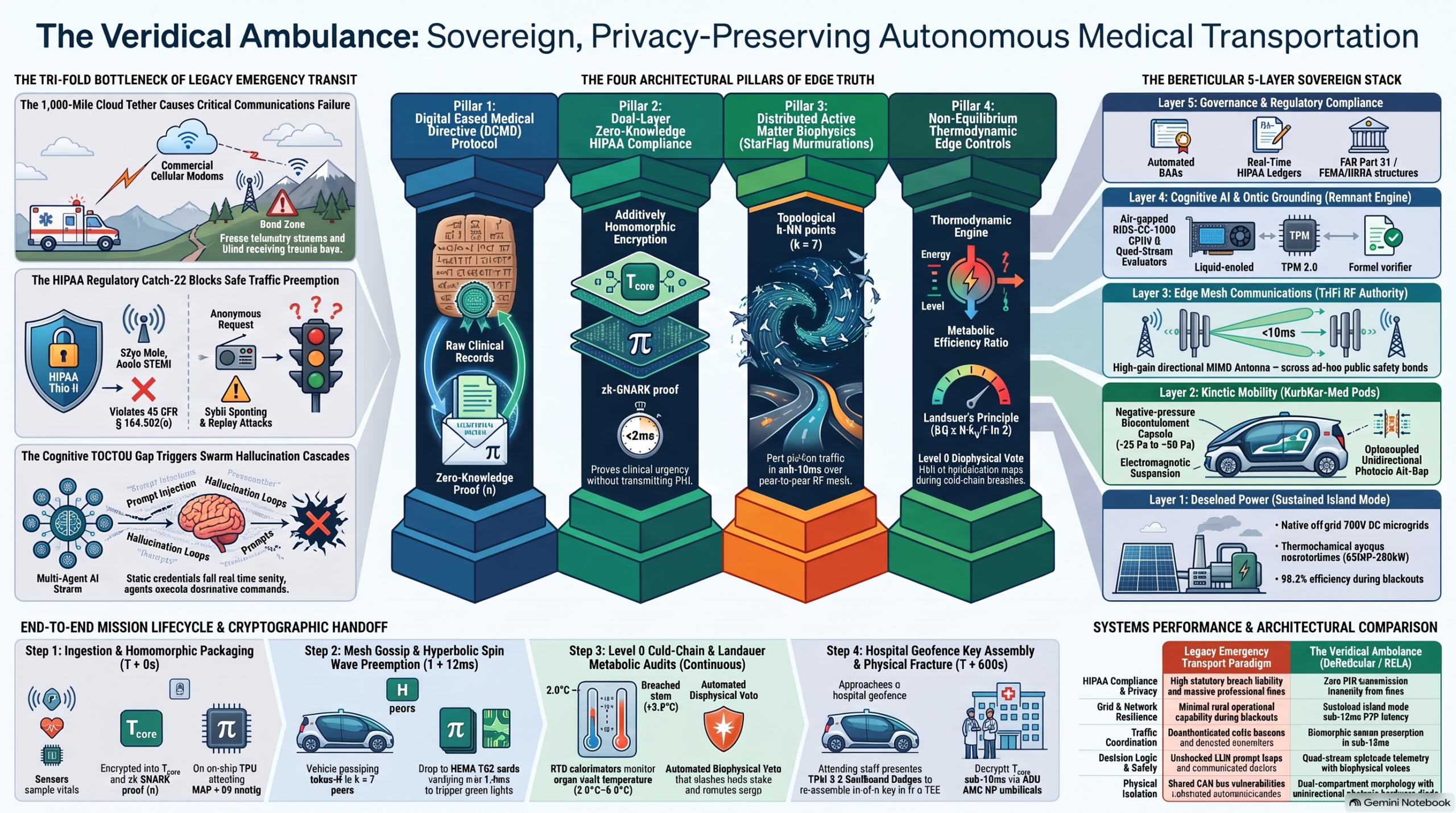
The operational paradigm of emergency healthcare transit presents an unyielding structural paradox. Life-critical transit demands instantaneous, sub-second cyber-physical coordination across autonomous vehicle fleets, roadside units (RSUs), municipal traffic control cabinets, and edge computing nodes. Concurrently, administrative health law mandates strict, uncompromising protection of sensitive patient biometrics and diagnostic states. Contemporary emergency transport architectures attempt to bridge this divide by relying on cellular backhaul networks tethered to centralized cloud hyperscalers—an architecture designated as the “1,000-Mile Cloud Tether.” When an autonomous emergency platform traverses rural cellular dead zones, urban concrete canyons, or contested electronic warfare (EW) environments, this backhaul link degrades or severs completely. Backhaul round-trip latencies exceed critical intervention bounds (>1.5\text{ s}), streaming telemetry freezes, remote clinical routing halts, and health networks face catastrophic single-point operational failures alongside severe regulatory non-compliance.
Statutory Impasse: The Regulatory Catch-22
The intersection of federal privacy mandates, transmission security standards, and physical traffic safety creates a legal and technical deadlock:
- 45 CFR § 164.502(b) (Minimum Necessary Standard): Covered entities and business associates must restrict protected health information (PHI) disclosures strictly to the minimum necessary required to accomplish a specific operational objective. While 45 CFR § 164.506(c)(1) permits unrestricted treatment disclosures between licensed healthcare providers holding National Provider Identifiers (NPIs), municipal traffic cabinets, roadside units, Department of Transportation (DOT) routing servers, and civilian consumer vehicles possess no NPIs and do not qualify as healthcare providers under 45 CFR § 160.103. Disclosing diagnostic statements (e.g., “58-year-old male with acute STEMI”) or raw physiological states across open vehicular networks to secure right-of-way constitutes an illegal, impermissible disclosure of ePHI. Furthermore, stripping direct names while broadcasting location trajectories, sub-second timestamps, and priority tiers fails the Safe Harbor De-Identification standard under 45 CFR § 164.514(b), as an adversary can trivially cross-reference broadcasted GPS trajectories with public property databases to re-identify the patient with statistical certainty.
- 45 CFR § 164.312(e) (Transmission Security): Federal law mandates end-to-end cryptographic safeguards for ePHI traversing public transmission media. Broadcasting cleartext or weakly encrypted V2X (Vehicle-to-Everything) telemetry over open airwaves violates transmission security bounds. Under 45 CFR § 164.402 and § 164.404, any unauthorized interception of unencrypted PHI constitutes a statutory breach, triggering mandatory public notifications, listing on the HHS Office for Civil Rights (OCR) public enforcement log, and civil monetary penalties reaching Tier 4 statutory maximums (> $2,000,000 annually under HITECH Act enforcement Tiers).
- The Anti-Sybil/Replay Threat: Omitting all clinical telemetry to broadcast content-free, unauthenticated priority requests (“Emergency vehicle approaching; clear intersection”) satisfies the privacy mandate but creates a severe physical vulnerability. Lacking verifiable proof of clinical urgency, municipal traffic systems cannot distinguish authentic life-critical emergencies from malicious exploits. Bad actors utilizing low-cost software-defined radios (SDRs) or cloned transceivers can execute Sybil attacks—instantiating virtual vehicle identities—or replay recorded preemption tokens to force arbitrary green corridors. This compromises municipal traffic controllers, induces urban-grid gridlock, and exposes civilian traffic to fatal collisions.
Archaeological and Cryptographic Archetype
To resolve the deadlock between regulatory data minimization and physical operational authority, the system architecture adapts an ancient archaeological primitive: the Old Babylonian Cased Tablet (ca. 2000–1600 BCE).
In ancient Mesopotamian legal and economic transactions, the binding legal obligation was inscribed onto a central clay tablet (T_{\text{core}}), which was subsequently wrapped inside an outer clay shell (T_{\text{env}}). The outer envelope received an abstract legal summary and the impressions of cylinder seals (\sigma_{\text{debtor}}, \sigma_{\text{creditor}}, \sigma_{\text{magistrate}}). In daily commerce, citizens and trade administrators verified the authenticity and authority of the obligation by inspecting the outer impressions without breaking or exposing the underlying text. In the event of a dispute, a magistrate executed a formal stripping verification function in court:
\text{Decision}(T_{\text{env}}, T_{\text{core}}) = \begin{cases} \text{Valid}, & \text{if } \operatorname{Strip}(T_{\text{env}}) \equiv T_{\text{core}} \ \text{Fraud Detected}, & \text{if } \operatorname{Strip}(T_{\text{env}}) \neq T_{\text{core}} \end{cases}
In modern autonomous transport architecture, this ancient primitive translates into a dual-layer asymmetric cryptographic protocol: wrapping an unreadable, homomorphically encrypted clinical payload (T_{\text{core}}) inside a succinct zero-knowledge verification shell (T_{\text{env}}), establishing the mathematical foundation for the Digital Cased Medical Directive (DCMD) protocol.
- The Digital Cased Medical Directive (DCMD) Cryptographic Pipeline
The Digital Cased Medical Directive (DCMD) protocol establishes an end-to-end verifiable (E2E-V) cryptographic pipeline that isolates clinical truth from operational transmission. By decoupling raw biological telemetry from operational preemption assertions, the DCMD pipeline satisfies federal administrative requirements without relying on cloud hyperscalers or exposing patient records.
Deconstructing the Invariant Inner Core (T_{\text{core}})
The invariant inner core (T_{\text{core}}) encapsulates the patient’s complete biological telemetry M \in \mathcal{M}{\text{telemetry}} (including arterial blood pressure, pulse oximetry [SpO_2], mean arterial pressure [MAP], Glasgow Coma Scale [GCS] components, 12-lead EKG raw waveforms, and identity attributes). Prior to transmission, the vehicle’s compute node encrypts M under the destination trauma center’s threshold public key K{\text{pub}} using Additively Homomorphic Encryption (Paillier or Exponential ElGamal):
C = \operatorname{Enc}(M, r) = \left(g^r \pmod{n^2}, ; h^r \cdot g^M \pmod{n^2}\right)
Because the payload is encrypted under the receiving hospital’s public key, the resulting ciphertext C appears as non-deterministic, statistically uniform random noise to intermediate vehicles, roadside units, edge routers, and packet-sniffing adversaries. Under 45 CFR § 164.312(e)(1), this provides complete transmission security, while qualifying for safe harbor breach immunity under 45 CFR § 164.402.
Computational Decoupling Strategy
High-frequency biosensors (e.g., continuous 12-lead EKG sampled at 1 kHz and arterial line transducers) emit thousands of data points per second. Forcing an edge Tensor Processing Unit (TPU) to generate zero-knowledge proofs over raw waveform streams continuously causes thermal throttling, computation latency spikes (>1.5\text{ s}), and rapid battery drain. The inner core resolves this by leveraging additive homomorphism to absorb continuous telemetry updates via simple scalar point additions:
C_{\text{accum}} = \prod_{t=1}^K C_t = \operatorname{Enc}\left(\sum_{t=1}^K M_t, ; \sum_{t=1}^K r_t\right)
This point addition executes with microjoule energy expenditure at native sensor frequency (1\text{ kHz}). The computationally intensive zero-knowledge outer envelope is decoupled entirely from raw waveform generation, compiling proofs strictly upon discrete predicate state boundary transitions (e.g., state shifts from CODE_GREEN to CODE_RED or periodic heartbeat attestations every 5 to 10 seconds), drastically reducing VRAM usage and Landauer heat dissipation.
Mechanics of the Outer Zero-Knowledge Envelope (T_{\text{env}})
To allow traffic controllers and neighboring vehicles to verify priority rights without decrypting T_{\text{core}}, the vehicle’s TPU compiles a Zero-Knowledge Succinct Non-Interactive Argument of Knowledge (zk-SNARK) proof \pi over an arithmetic triage circuit \mathcal{C}_{\text{triage}}:
\pi \leftarrow \operatorname{Prove}\left(\text{ProvingKey}, ; \vec{x}{\text{public}}, ; \vec{w}{\text{private}}\right)
The prover utilizes private witnesses \vec{w}{\text{private}} (Social Security number, raw vital waveforms, patient name) and public inputs \vec{x}{\text{public}} to compile a compact (~256-byte Groth16 or PLONK) proof evaluated against discrete predicate bounds:
Public Assertion & Predicate Name Circuit Logic & Clinical Definition
Hemodynamic Shock State \mathcal{C}{\text{shock}} \equiv \left(\text{MAP} = \frac{P{\text{sys}} + 2 \cdot P_{\text{dia}}}{3} < 65\text{ mmHg}\right) \lor \left(\text{GCS} \le 8\right)
Proves severe clinical instability (decompensatory shock or coma) requiring immediate green-wave corridor routing without exposing blood pressure or neurological metrics.
Thrombolytic / Surgical Window \mathcal{C}{\text{window}} \equiv \left(t{\text{current}} – t_{\text{onset}} \le 180\text{ min}\right)
Proves the patient is within the critical tissue-survival window for stroke thrombolysis or surgical intervention, establishing temporal priority.
Authentic Hardware Attestation \mathcal{C}{\text{hardware}} \equiv \operatorname{VerifySign}{\text{TPM}}\left(\text{Sensor_Payload}\right) = \text{VALID}
Proves telemetry was generated by an uncompromised, FDA-cleared sensor verified by a hardware Trusted Platform Module (TPM 2.0) root of trust, preventing synthetic vital injection.
Statutory Compliance Synthesis
Emitting this compact ~256-byte proof \pi alongside ciphertext C achieves absolute administrative compliance. Because public assertions prove state limits without exposing raw telemetry, precisely zero bytes of protected health information are revealed to municipal infrastructure, fulfilling 45 CFR § 164.502(b) (Minimum Necessary Standard). Concurrently, homomorphic encryption of T_{\text{core}} under K_{\text{pub}} guarantees Safe Harbor breach immunity under 45 CFR § 164.402. Sealed within this structure, the cased token H = \operatorname{SHA256}(C \parallel \pi) is broadcast across local vehicular networks via peer-to-peer RF mesh.
- TriFi RF Gossip Dynamics & Sub-12ms Intersection Preemption
Centralized cloud dispatch architectures introduce fatal latency spikes across rural dead zones and congested urban centers. The Veridical Ambulance operates autonomously at the edge using the TriFi RF authority system, which utilizes licensed public safety spectrum, high-gain directional MIMO arrays, and peer-to-peer (P2P) mesh protocols achieving sub-16ms intersite packet latencies.
Topological k-NN Murmuration Dynamics
To prevent radio frequency network saturation and packet collision storms, the system adapts European starling flocking physics (Sturnus vulgaris) derived from the European StarFlag project. Standard communication protocols deploy metric interaction radii (r \le 300\text{ m}), where network load scales exponentially with vehicle density (O(N^2)), causing broadcast storms. The Veridical Ambulance enforces topological interaction graphs:
S_i = {j \in \text{Fleet} : \operatorname{rank}(d_{ij}) \le 7}
Each vehicle maintains active communication links strictly with its k \approx 7 nearest topological neighbors. This interaction graph remains invariant to traffic density; whether vehicles compress tightly in urban traffic or disperse along highways, every node maintains exactly 7 interaction channels, eliminating network congestion.
Furthermore, the vehicle fleet operates at a second-order phase transition (self-organized criticality), establishing Scale-Free Behavioral Correlation (\xi \propto L). The correlation length \xi scales linearly with the physical spatial diameter of the multi-vehicle platoon L, driving the network’s susceptibility to infinity:
\chi = \frac{1}{N} \sum_{i,j} \langle \mathbf{u}_i \cdot \mathbf{u}_j \rangle \to \infty
Because susceptibility diverges, a trajectory displacement initiated by the primary ambulance on the perimeter propagates across a multi-kilometer platoon without signal damping or spatial attenuation.
Hyperbolic Spin Wave Trajectory Propagation
When an emergency vehicle requires lane clearance, evasive trajectory directives propagate through surrounding civilian traffic using second-order hyperbolic spin wave differential equations:
\frac{d\mathbf{v}_i}{dt} = \frac{1}{\chi_0} \mathbf{s}_i \times \mathbf{v}i, \qquad \frac{d\mathbf{s}i}{dt} = \sum{j \in S_i} J{ij} (\mathbf{v}_i \times \mathbf{v}_j) – \frac{\eta_0}{\chi_0} \mathbf{s}_i
where \mathbf{v}_i represents the velocity vector, \mathbf{s}i is internal generalized spin (the rotational generator), \chi_0 = 1.42 is artificial rotational inertia, and \eta_0 = 0.18 is rotational viscosity. The coupling stiffness J{ij} between nodes i and j is inversely weighted by node j’s historical Brier error \text{BS}_j:
J_{ij} = \frac{1}{\text{BS}_j + 10^{-4}}
Because rotational inertia dominates viscosity (\chi_0 \gg \eta_0), turning directives propagate as undamped acoustic spin waves (x = c \cdot t) at propagation speeds:
c = v_0 \sqrt{\frac{J}{\chi_0}} \approx 20\text{ to }40\text{ m/s}
Surrounding civilian connected vehicles part smoothly in sub-12ms without relying on centralized cloud infrastructure or triggering rear-end braking cascades.
Municipal Signal Preemption Hardware
For intersections requiring signal preemption, the system integrates with legacy municipal infrastructure via modular, drop-in detector cards installed in standard NEMA TS1/TS2 or Model 170 traffic cabinets.
The card contains a sub-$50 RISC-V System-on-Chip (SoC) equipped with an embedded elliptic curve pairing accelerator. Upon ingesting token H = \operatorname{SHA256}(C \parallel \pi), the card evaluates a pairing check over pairing-friendly elliptic curves (BN254 or BLS12-381) in under 2 ms:
e(A, B) = e(\alpha, \beta) \cdot e(x \cdot \gamma, \delta) \cdot e(C, \delta)
Upon validating the proof, the card drops a physical dry-contact relay, pulling the controller’s Emergency Priority Phase to cycle signal heads to green instantly. The preemption executes without the roadside cabinet learning patient identity or clinical diagnosis, clearing urban corridors prior to the ambulance’s arrival at the destination hospital.
- Trauma Bay Arrival, Geofenced RF Assembly, & Threshold Key Fracture
Emergency arrivals at Level 1 Trauma Centers involve high operational entropy and rapid clinical handoffs. Traditional access controls—such as manual password entry or static credential scanning—introduce delays. The threshold key fracture protocol provides sub-10ms access to clinical ground truth without requiring manual authentication from fatigued surgical personnel.
Geofenced RF Pre-Assembly
Key reconstruction initiates automatically prior to physical arrival. When the vehicle crosses a 1.5 km geofence perimeter surrounding the hospital, its high-gain directional TriFi RF link establishes an intersite connection with the hospital edge node and transmits T_{\text{core}}.
m-of-n Threshold Secret Key Sharing
Decrypting the inner core requires an m-of-n Shamir secret sharing scheme over Exponential ElGamal or Paillier private key shares distributed across essential clinical roles: Attending Trauma Surgeon, Surgical Fellow, Charge Nurse, and ED Triage Desk Invariant Node.
To participate in key assembly, clinicians carry ruggedized access badges containing TPM 2.0 cryptoprocessors and non-transferable Soulbound Identity Tokens (SBT). The badges automatically issue Ed25519 hardware attestation quotes over Platform Configuration Registers (PCRs). When m of n required shares enter the trauma suite, the ephemeral private session key is reconstituted inside an isolated hospital Trusted Execution Environment (TEE) and pre-computes the decryption buffer.
Dynamic Role Mutation & Transitive Delegation
To manage shift changes without re-issuing physical key shares, primary attendings can issue cryptographically signed Role Mutation Receipts (\mathcal{M}_{\text{mutate}}):
\mathcal{M}{\text{mutate}} = \operatorname{Sign}{\text{TPM}}\left(\text{Agent_UUID}, ; \text{Role}{\text{prior}}, ; \text{Role}{\text{target}}, ; \text{AST}_{\text{spec}}, ; \text{Nonce}\right)
This transfers signing weight instantly while keeping the underlying silicon identity (\sigma_{\text{TPM}}) invariant. Authority delegation across transitive chains (A \to B \to C) enforces a conserved, 3-tier liability slashing structure:
- Primary Executor Slash (50%): Applied to the executing node (C) causing a protocol or data breach.
- Curation Intermediary Slash (25%): Applied to the intermediate node (B) that co-signed and forwarded the delegation.
- Sponsorship Originator Slash (10%): Applied to the primary attending (A) originating the authority tree.
If an unauthorized access attempt or anomaly occurs, the Instant Snap-Back Reversion Circuit dissolves the delegation tree instantly, revokes access on the local ledger, applies a +0.50 error penalty to the delegated Brier scores, and snaps access control back to the primary attending.
Arrival & Optical Core Clearing
When the vehicle docks at Trauma Airlock Bay 1, physical connection via an ODU AMC® NP Break-Away umbilical triggers instantaneous (<10\text{ ms}) decryption of T_{\text{core}} inside the TEE. Complete, uncorrupted hemodynamic history is injected directly into the hospital’s Electronic Health Record (EHR) system as the patient crosses the bay threshold. Physical space partitioning and hardware isolation preserve this execution flow.
- Physical Hardware Enclosure & The Optocoupled Unidirectional Air-Gap
Cyber-physical security cannot rely solely on software controls. The KurbKar-Med platform enforces operational integrity through physical space partitioning and hardware-level isolation.
Compartmental Space-Frame Morphology
The space-frame chassis is divided into two hermetically separated, electronically decoupled compartments joined exclusively across an optocoupled interface:
Vehicle Chamber & Functional Isolation Mechanical, Power & Environmental Subsystems Compute, Cryptographic & Hardware Security Subsystems
Kinetic Drive Bay
(Locomotion & Road-Mesh Mechanics) • Native 700V DC traction bus operating off-grid.
• Dual BLDC hub motors with fast-switching SiC MOSFET inverters.
• Active electromagnetic linear suspension actuators maintaining <0.05\text{ g} cabin vibration floor. • Directional TriFi RF MIMO antenna array.
• Topological k-NN murmuration routing engine (k \approx 7).
• RISC-V roadside preemption card verifier.
• Triple-redundant drive-by-wire controller.
Clinical Care Capsule
(Hermetic Medical Airlock) • Hermetically sealed carbon-fiber monocoque mounted on isolation dampers.
• Negative-pressure biocontainment (-25\text{ Pa} to -50\text{ Pa}).
• Dual-stage H14 HEPA (99.995%) and UV-C (254 nm) germicidal air scrubbing.
• Active Stirling cooler (2.0^\circ\text{C} to 8.0^\circ\text{C} window) with RTD sensors. • Air-gapped, liquid-cooled RIOS-CC-1000 GPU skids.
• Hardware TPM 2.0 silicon root of trust.
• Isolated internal bio-telemetry bus (CAN-FD / Ethernet-AVB).
• Paillier homomorphic & zk-SNARK prover engines.
Optocoupled Unidirectional Photonic Air-Gap
Data transfer from the Clinical Care Capsule outward to the Kinetic Drive Bay is regulated by a hardware-enforced photonic diode. The capsule transmitter comprises a high-speed gallium-arsenide (GaAs) infrared laser diode (850\text{ nm} / 1310\text{ nm}) firing through an armored optical fiber bulkhead onto a silicon PIN photodiode receiver on the drive bay side.
┌───────────────────────────────────────────────────────────────────────────────────────────┐
│ THE OPTOCOUPLED UNIDIRECTIONAL CRYPTOGRAPHIC AIR-GAP │
├───────────────────────────────────────────────────┬───────────────────────────────────────┤
│ CLINICAL CARE CAPSULE │ KINETIC DRIVE BAY │
│ [TRANSMIT ONLY] │ [RECEIVE ONLY] │
├───────────────────────────────────────────────────┼───────────────────────────────────────┤
│ [ Biosensor Ingestion: Vitals, MAP, EKG ] │ │
│ │ │ │
│ ▼ │ │
│ [ RIOS-CC-1000 Skid / TPM 2.0 Cryptoprocessor ] │ │
│ • Encrypts T_core = Enc_Paillier(M, K_pub) │ │
│ • Compiles zk-SNARK π over C_triage │ │
│ • Assembles Frame: DCMD = { T_core, π, Quote } │ │
│ │ │ │
│ ▼ │ │
│ [ Serial Frame Encoder (8b/10b) ] │ │
│ [ Forward Error Correction (Reed-Solomon) ] │ │
│ │ │ │
│ ▼ │ │
│ ┌──────────────────────────────┐ │ │
│ │ INFRARED LASER DIODE (TX) │ │ │
│ │ (GaAs LED, λ = 850nm/1310nm) │ │ │
│ └──────────────┬───────────────┘ │ │
│ │ │ │
│ ═════════════════╪═══════════════════════════╪═════════════════════════════════ │
│ │ PHYSICAL BULKHEAD AIR-GAP │ │
│ │ (Fiber-Optic Strand / │ │
│ │ Pure Optical Glass) │ │
│ ▼ │ │
│ ┌──────────────────────────────┐ │ │
│ │ SILICON PIN PHOTODIODE │ │ │
│ │ RECEIVER (RX) │───────────┼──► [ Transimpedance Amplifier (TIA) ] │
│ │ (Zero Photon Emission Cap.) │ │ │ │
│ └──────────────────────────────┘ │ ▼ │
│ │ [ Deserializer & Parity Check ] │
│ │ │ │
│ │ ▼ │
│ │ [ DRIVE BAY SYSTEM CONTROLLER ] │
│ │ • Ingests Token H & Priority Code│
│ │ • Broadcasts Token to TriFi Mesh │
│ │ • ZERO ACCESS TO RAW PHI PLAINTEXT │
│ │ • CANNOT TRANSMIT BACK TO CAPSULE│
└───────────────────────────────────────────────────┴───────────────────────────────────────┘
Physical Asymmetry Invariant & Framing Protocol
The silicon PIN photodiode possesses zero photon-emitting capability, and zero copper conductors cross the bulkhead. It is physically impossible for electrical signals or reverse frames to traverse from the drive bay into the clinical capsule.
Because reverse ACK/NACK signaling is physically impossible over a unidirectional simplex channel, the capsule serializes data using 8b/10b line encoding to eliminate DC bias and guarantee clock recovery. Payload integrity is enforced using Reed-Solomon RS(255, 223) Forward Error Correction (FEC) paired with a CRC-32 integrity trailer, allowing the drive bay receiver to reconstruct corrupted bits without requesting retransmission.
Electromagnetic Hardening Metrics
To suppress interference from 700V traction inverters, high-voltage cabling utilizes solid metallic backshells delivering 360° circumferential shield bonding across 100\text{ kHz to }40\text{ GHz}. RF transmission lines maintain matched 50,\Omega terminations locked to a Voltage Standing Wave Ratio of \text{VSWR} < 1.2. Pulse-width modulation (PWM) power lines are segregated in aluminum conduits separated by >300\text{ mm} from command antennas.
Base Docking & Ingress Control Gates
When docked stationary at a depot, physical updates pass through electromechanical interlocks:
- Mechanical Interlock: Physical maintenance ingress uses an ODU AMC® NP Break-Away connector. The diagnostic line feeding the clinical capsule passes through an electromechanical relay tied to the vehicle’s transmission gear-lock. When vehicle velocity v > 0, the relay is open-circuit, rendering inbound physical data transmission impossible while in motion.
- Lean 4 Deductive Compiler Gate: Inbound firmware updates or calibration matrices must compile as formal Abstract Syntax Trees (ASTs) in the Lean 4 verification language:
\Gamma \vdash \psi \implies \Gamma \models \psi
The internal proof kernel evaluates the AST against axiomatic safety rules. If type-checking exits with code 0 (S_{\text{syn}} = 1.0), the update is applied. If type-checking fails (S_{\text{syn}} = 0.0), the binary is deleted, and 10% of the proposing node’s staked collateral is slashed. Runtime safety gates monitor these hardware controls continuously.
- System-Wide Telemetry, Biophysical Vetoes, & Performance Matrix
The Veridical Ambulance replaces static perimeter credentials (OAuth2, JWT, mTLS) with the RELA Quad-Stream Telemetry Engine, which continuously evaluates system integrity across four execution streams.
Deconstructing Quad-Stream Telemetry & Epistemic Health Index (\Psi)
- Stream 1 (Epistemic Calibration): Tracks domain-specific rolling Brier scores (\text{BS}_{i,k}) and Variational Free Energy (F). If free energy increases across three consecutive cycles (\dot{F} = dF/dt > 0), the engine detects diagnostic delirium and suspends node authorization.
- Stream 2 (Syntactic Deductive Soundness): Enforces formal type-checking via Lean 4 ASTs (S_{\text{syn}} \in {0.0, 1.0}). Compilation failures trigger execution halts and a 10% stake slash.
- Stream 3 (Thermodynamic & Landauer Efficiency): Tracks VRAM bit erasure dissipation (\Delta Q = N_{\text{bits}} k_B T \ln 2) against free energy reduction (\Delta F) to calculate the Metabolic Efficiency Ratio:
\mathcal{M}{\text{ratio}} = \frac{\Delta F}{\lambda \cdot \Delta Q} = \frac{D{\mathrm{KL}}(q_{\text{new}} \parallel q_{\text{old}})}{\lambda \cdot (N_{\text{bits}} \cdot k_B T \ln 2)}
If \mathcal{M}_{\text{ratio}} < 1.0, the agent is burning compute without reducing uncertainty. The Landauer Halting Gate executes a FORCE_ACTION_HALT interrupt, terminating reflective loops.
- Stream 4 (Ontic Physical Resistance): Evaluates real-world physical telemetry via discrepancy loss S(E_t, \theta) = |y_{\text{measured}} – y_{\text{predicted}}|. For cold-chain organ transport (2.0^\circ\text{C} \le T \le 8.0^\circ\text{C}), breaching temperature limits (S(E_t, \theta) > 2.0^\circ\text{C}) trips the Level 0 Biophysical Veto, burning 50% of the vehicle’s staked collateral, flagging cargo unviable on the ledger, and rerouting transport.
The composite Epistemic Health Index \Psi_i(t) \in [0, 1] governs node agency:
\Psi_i(t) = w_1 e^{-\gamma_1 \text{BS}i(t)} + w_2 S{\mathrm{syn}}(t) + w_3 \min\left(1.0, ; \mathcal{M}{\mathrm{ratio}}(t)\right) + w_4 e^{-\gamma_2 S{\mathrm{ontic}}(t)}
where effective consensus voting weight scales dynamically as W_{i,\text{eff}}(t) = W_{i,\text{staked}} \cdot \Psi_i(t).
Biophysical-Monetary Constraint (RELA Axiom 3)
System state updates and currency/compute allocations are bounded by RELA Axiom 3, enforcing that nominal compute and financial credits remain strictly upper-bounded by verified net exergy scaled by Carnot efficiency \eta:
M_{\text{nominal}}(t) \le \kappa \int_{t_0}^t \left( \text{Exergy}_{\text{net}}(\tau) \cdot \eta(\tau) \right) d\tau
Comprehensive Systems Comparison Matrix
System Dimension Legacy Emergency Transport Infrastructure The Veridical Ambulance (DERETICULAR / RELA)
HIPAA Compliance & Privacy Relies on cleartext voice/tablet transmissions and paper BAAs. High statutory breach exposure under 45 CFR § 164.502(b). Zero PHI Exposure: DCMD protocol combines a homomorphic inner core (T_{\text{core}}) with zk-SNARK envelopes (T_{\text{env}}) for absolute Safe Harbor immunity under 45 CFR § 164.402.
Grid & Network Resilience Subject to the “1,000-Mile Cloud Tether.” Stalls during cellular outages, urban canyon fading, or EW jamming. Sustained Island Mode: Operates on off-grid 700V DC microgrids with directional TriFi RF meshes offering sub-16ms peer-to-peer packet latencies.
Traffic Coordination Uses sirens or unauthenticated RF beacons vulnerable to replay attacks and Sybil spoofing. Sub-12ms Verified Preemption: Uses k-NN murmuration dynamics (k \approx 7) and hyperbolic spin waves, verified by drop-in NEMA TS2 pairing cards.
Hardware Security Uses shared commercial chassis and shared CAN buses, exposing powertrains to remote cyber-hijacking. Physical Hardware Isolation: Compartmentalized space-frame featuring an optocoupled unidirectional photonic air-gap between drive and clinical systems.
Access Credentials Static perimeter credentials (SSO/JWT) subject to the Cognitive TOCTOU Gap and Confused Deputy exploits. Continuous Runtime Telemetry: Dynamic Health Index (\Psi) computed across Quad-Stream execution streams (Epistemic, Syntactic, Thermodynamic, Ontic).
Epistemic Safety Unchecked probabilistic LLM prompt loops subject to hallucination cascades and Condorcet Inversion errors. Formal Verification Gates: Lean 4 AST formal proofs, Landauer Halting Gates (\mathcal{M}_{\text{ratio}} \ge 1.0), and Level 0 Biophysical Veto circuit breakers.
- Synoptic Conclusion
The Veridical Ambulance architecture proves that the conflict between strict patient privacy regulations and real-time cyber-physical coordination stems from reliance on centralized, cloud-tethered computational models. By replacing cloud abstractions with dual-layer cryptographic envelopes inspired by ancient Babylonian cased tablets, biomorphic active matter physics, non-equilibrium thermodynamics, and hardware-enforced photonic air-gaps, the system achieves operational sovereignty at the physical edge. The platform satisfies federal HIPAA Title II mandates, resists remote cyber-physical attacks, and clears municipal traffic corridors without revealing protected health information—establishing a deployable, self-correcting standard for life-critical healthcare mobility that remains fully bound to the physical laws of the universe.