
Sovereign Infrastructure and Spherical Resilience: A Strategic Technical Briefing
Executive Summary
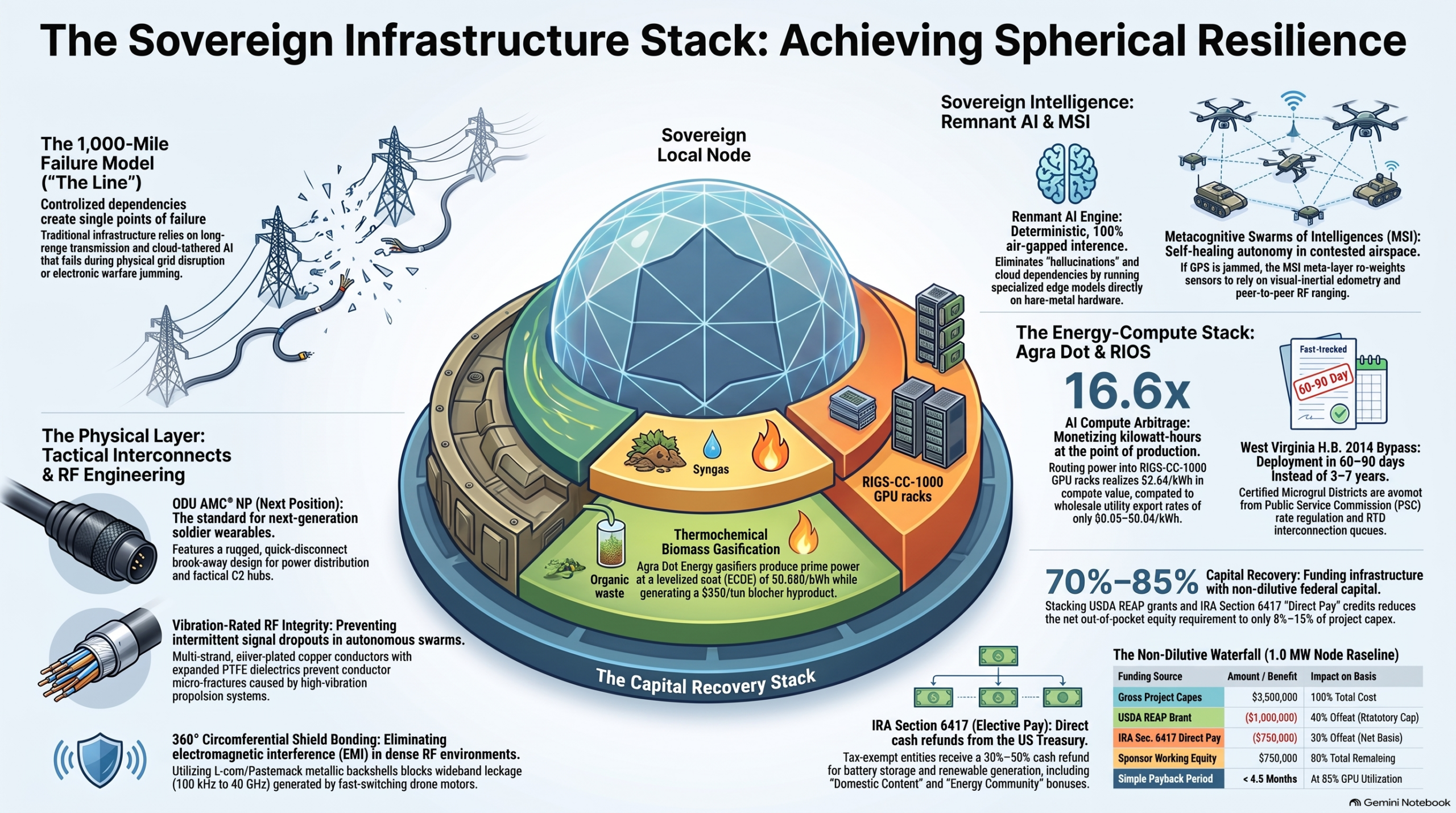
This document synthesizes a comprehensive framework for “Sovereign Infrastructure,” a decentralized model designed to replace fragile, linear dependencies—termed “The Line”—with “Spherical Resilience.” The core of this architecture is the integration of behind-the-meter energy generation, air-gapped deterministic artificial intelligence, and ruggedized tactical hardware.
Critical Takeaways:
- Regulatory & Speed Advantage: By utilizing statutes such as West Virginia H.B. 2014, project developers can bypass 3-7 year utility interconnection queues, achieving deployment in 60-90 days.
- Economic Arbitrage: Generating power via biomass gasification at a levelized cost of $0.038/kWh and converting it into GPU compute realizes a value of approximately $2.64/kWh, a 16.6x economic multiplier.
- Non-Dilutive Financing: A “Sovereign Capital Stack” leveraging USDA REAP grants and Inflation Reduction Act (IRA) tax credits (Section 6417/6418) can offset 70%–85% of total capital expenditures without equity dilution.
- Technological Autonomy: The architecture utilizes the “Remnant AI Engine” and “Metacognitive Swarms of Intelligences” (MSI) to ensure deterministic, air-gapped operations that remain functional in electronic warfare (EW) environments and GPS-denied theaters.
I. Foundational Philosophy: Spherical Resilience vs. The Line
The provided sources contrast two diametrically opposed infrastructure models:
The “Line” (1,000-Mile Failure Model)
Modern infrastructure is characterized by linear, centralized dependencies:
- Power: Bulk grids exposed to physical disruption and cascade blackouts.
- Compute: Probabilistic cloud models requiring uninterrupted fiber links.
- Regulatory: The “Permitting Wall” where regional transmission operators (RTOs) delay interconnections for years.
Spherical Resilience
This model proposes self-contained, omnidirectional enclaves that maintain continuity regardless of external collapses. A sovereign node integrates:
- Baseload Generation: Behind-the-meter syngas and solar thermal.
- Native DC Distribution: 700V DC busbars with sub-16ms islanding capability.
- Edge Intelligence: 100% air-gapped deterministic compute cores.
- Point-of-Need Manufacturing: Containerized additive and CNC capabilities.
II. Energy-Compute Co-Location: The Agra Dot Energy Stack
The architecture centers on the “Silicon Hollow” model, co-locating high-density compute clusters directly at the source of power generation to eliminate grid transmission risks.
Physical and Electrical Topology
The generation chain utilizes a closed-loop thermochemical and solar-thermal cycle:
- Thermochemical Gasification: Converts organic feedstock (forestry slash, timber waste, agricultural effluent) into high-BTU synthesis gas (CO + H2).
- Solar Thermal Augmentation: DOE parabolic troughs concentrate sunlight 80x to produce 350°C steam, preheating gasifiers and eliminating daytime parasitic fuel consumption.
- Direct DC Generation: Pawnee 45 kW Wankel Rotary GenSets run on unrefined syngas, rectifying power directly into a 700V DC busbar. This bypasses AC-inverter losses, achieving 97.7% power-chain efficiency.
AI Compute Arbitrage
Rather than selling power back to the grid at wholesale rates (0.02–0.04/kWh), kilowatt-hours are routed into RIOS-CC-1000 GPU clusters.
Metric Value
Levelized Cost of Energy (LCOE) $0.038 / kWh
Market Rate per GPU-Hour $1.85
Gross Realized Value per kWh $2.64 / kWh
Economic Arbitrage Multiple 16.6x
III. Cognitive Architecture and Swarm Autonomy
Sovereign intelligence is decoupled from cloud dependencies to ensure survival in contested or denied environments.
The Remnant AI Engine
Unlike probabilistic Large Language Models (LLMs) prone to “hallucinations,” the Remnant AI Engine provides deterministic inference. It runs on bare-metal hardware anchored by TPM 2.0 cryptographic roots-of-trust, ensuring security and zero cloud API dependency.
Metacognitive Swarms of Intelligences (MSI)
The MSI framework allows autonomous UAV/UGV swarms to operate without GPS or external telecommunications:
- Object-Level: Agents execute tasks like visual-inertial odometry and sensor fusion.
- Meta-Level: A self-reflective layer monitors internal confidence. If GPS is jammed by electronic warfare, the meta-layer re-weights sensor inputs to rely on peer-relative RF ranging and visual odometry.
IV. Tactical Hardware and Interconnect Standards
The physical layer is engineered for high-vibration, harsh environments where commercial standards typically fail.
ODU AMC® Connector Series
Precision connectors are used to link wearable fabrics, tactical batteries, and C2 hubs.
Series Primary Application Key Feature
Series T Manned/Unmanned Vehicles Exceeds MIL-DTL-38999; heavy mechanical retention.
High-Density Space (Perseverance Rover) Up to 27 contacts; supports complex multi-protocol splitters.
NP (Next Position) Soldier Wearables / PDUs Quick break-away; anti-reflective black carbon finish.
Resilient RF Engineering (L-com / Pasternack)
For UAV and robotic platforms, the documents emphasize:
- 360° Shielded Backshells: Continuous metal-to-metal bonding to prevent RF leakage (100 kHz to 40 GHz) caused by motor PWM switching.
- Vibration-Rated Coax: Multi-strand, silver-plated conductors designed to prevent micro-fractures and “fretting” corrosion induced by propulsion harmonics.
- Impedance Matching: Maintaining a Voltage Standing Wave Ratio (VSWR) below 1.2:1 to prevent transmitter power rollback.
V. Expeditionary Deployment: Project Octagon and Biosecurity
The “Sovereign Stack” is physically manifested in mobile, modular units for rapid field logistics.
Project Octagon and The Sovereign Factory
- Project Octagon: Ruggedized, octagonal-framed container skids integrating biomass generation, battery storage, and liquid-cooled compute.
- The Sovereign Factory (DAOS R US): Containerized 5-axis CNC mills and selective laser metal 3D printers that enable point-of-need fabrication of replacement parts, reducing supply lines from weeks to minutes.
Case Study: Guam Sovereign Eradication Initiative
A joint venture between Pawnee Mobility and DeReticular utilizes autonomous robotic UGVs to protect the Guam electrical grid from invasive brown tree snakes.
- Threat: Snakes scaling utility poles cause frequent short-circuits and blackouts for critical INDOPACOM defense assets.
- Solution: All-terrain robots use multi-spectral thermal tracking and deterministic Remnant AI to identify and neutralize targets at the edge, operating in “Island Mode” without cloud connectivity.
VI. Financial Engineering and Statutory Strategy
The deployment of capital-intensive sovereign infrastructure is enabled by a strategic “Capital Recovery Stack.”
The Non-Dilutive Capital Stack (1.0 MW Node Baseline)
The goal is to achieve maximum capital recovery while maintaining 0% enterprise equity dilution.
- USDA REAP Grant: Covers up to 50% of eligible Capex (capped at $1,000,000 per system).
- IRA Section 6417 (Direct Pay): Provides a cash refund from the IRS (30% base + 10% Energy Community bonus + 10% Domestic Content bonus).
- Bridge Facilities: Short-term debt secured against grant award letters and tax receivables to solve the “Working Capital Timing Deficit.”
Regulatory Bypass: West Virginia H.B. 2014
This statute provides a legal mechanism for Certified Microgrid Districts.
- Exemption: Nodes are exempt from Public Service Commission (PSC) rate regulation and RTO interconnection queues.
- Requirement: Must maintain a high captive consumption ratio. The Agra Dot Energy architecture achieves 84.8% captive load, well above statutory thresholds.
Comparison of IRA Provisions
Provision Metric Section 6417 (Direct Pay) Section 6418 (Transfer)
Eligible Entities Tax-Exempt (Muni, Co-op, Tribal) For-Profit Commercial Entities
Format Cash Refund from US Treasury Cash Sale to Unrelated Taxpayer
Realized Value 100% of Face Value 90%–96% of Face Value
Timing Post-Commissioning 30-60 Days Post-Commissioning