Demystifying Sovereign Mesh Networks & Island Mode Resilience: A Conceptual Primer
- The Vulnerability of Centralized Networks (The “Why”)
1.1 The “1,000-Mile Failure Model” & Traditional Telecom Bottlenecks
Modern digital society depends heavily on centralized telecommunications infrastructure, including commercial cellular towers, centralized hyperscaler cloud providers, and long-haul terrestrial fiber optic lines. While these legacy systems provide high throughput during nominal baseline operations, they suffer from acute systemic fragility. This structural weakness is best understood through the “1,000-Mile Failure Model”—a systemic breakdown scenario where localized communication facilities collapse not because local radio hardware fails, but due to physical disruptions, power outages, or cyber incidents occurring in remote supply chains, upstream cloud datacenters, or regional power grids located hundreds or thousands of miles away.
When localized telecommunications facilities rely entirely on extended external backhaul dependencies, three critical single points of failure emerge across standard telecom networks:
- Commercial Cellular Towers:
- Operational Impact: Commercial cellular towers depend continuously on commercial power grids and localized battery reserves designed for short-duration outages. During severe weather anomalies, widespread blackouts, or extended physical grid failures, backup battery reserves exhaust quickly and upstream microwave backhauls sever, causing immediate network blackouts and severe channel congestion precisely when local Emergency Operations Centers (EOC) and first responders require continuous coordination.
- Centralized Hyperscaler Clouds:
- Operational Impact: Modern enterprise systems and utility automated controls rely on distant cloud server clusters for continuous session authentication, Domain Name System (DNS) resolution, and operational data processing. If a remote cloud datacenter experiences an outage or a primary fiber route severs a thousand miles away, localized systems—including Supervisory Control and Data Acquisition (SCADA) systems and edge telemetry networks—lose operational execution capability despite local equipment remaining undamaged.
- Terrestrial Fiber Optic Lines:
- Operational Impact: Long-haul fiber optic cables deployed along interstate corridors and railway rights-of-way form the physical backbone of commercial internet distribution. Physical severance caused by severe meteorologic events, landslides, or accidental excavation instantly isolates entire municipalities, completely severing connectivity for emergency dispatch services, municipal infrastructure, and local economic activity.
1.2 Noel’s Law of Structural Vulnerability
To evaluate how central dependencies introduce risk into critical infrastructure, systems architects apply Noel’s Law of Structural Vulnerability:
“The survivability of any operational node is inversely proportional to the length and central coordination of its critical supply chains and communication backhauls.”
To understand this law intuitively, consider the operational difference between a local community garden and a globalized food supply chain. If a distant central distribution hub suffers a fuel shortage or cyberattack, the globalized supply chain halts entirely because every distribution link depends on long-distance logistics and central coordination. Conversely, a local community garden yields food continuously and autonomously, completely insulated from remote systemic disruptions.
Applied to telecommunications, Noel’s Law demonstrates why localized “Island Mode” operational capability is essential for resilient municipal and enterprise architecture. Facilities must maintain air-gapped, local execution capability so that when central networks fail, localized emergency, utility, and civic communications remain continuously operational.
To bridge the systemic vulnerabilities inherent in traditional centralized telecom models, modern resilient infrastructure planning relies on a unified, sovereign multi-layer framework.
- The Core Architectural Framework (The 5-Layer Sovereign Stack)
2.1 Deconstructing the 5-Layer Sovereign Architecture
To eliminate remote single points of failure and guarantee localized operational continuity, the Sovereign Infrastructure Consortium (SIC) establishes a multi-organization, 5-layer sovereign architecture. This integrated stack ensures that baseload power, field mobility, radio communications, cognitive intelligence, and administrative governance operate in harmony without external cloud or grid dependencies.
Layer Level & Name Responsible Organization Core Technical Function Key Hardware / Protocol Example
Layer 1: Power Agra Dot Energy Baseload off-grid generation, 700V DC microgrids, and thermochemical biomass pyrolysis 700V DC native busbars; thermochemical gasification bypassing utility interconnect queues
Layer 2: Mobility & Proving Kurb Kars / DAOSRUS Autonomous commercial utility EVs, mobile battery skids, and tactical nomadic nodes Autonomous micro-skids running offline DAOS_A2A_M2M_v3 machine-to-machine protocols
Layer 3: Mesh Communications DeReticular Core / TriFi (Active Prime) Carrier-grade RF mesh networks, sub-16ms channel handoffs, multi-carrier failover, and hardware security Hardware Trusted Platform Module (TPM 2.0) cryptoprocessors; proprietary RIOS telemetry agent; WISP-in-a-Box Lite
Layer 4: SCADA & Cognitive Intelligence DeReticular Energy Air-gapped edge Artificial Intelligence (AI) compute, supervisory telemetry, and zero-cloud operational control Liquid-dielectric immersion-cooled GPU clusters (RIOS-CC-1000)
Layer 5: Governance & Advisory Biz Builder Mike / SIEA Academy Public-Private Partnership (P3) capital stacking, grant procurement, and municipal islanding audits Forensic Municipal Islanding Audits; FEMA BRIC, USDA REAP, and IRA §6417 Direct Pay
2.2 Layer 3 Deep-Dive: Edge Mesh Communications
Operating as the active prime authority within the sovereign architecture, Layer 3 (Mesh Communications) functions as the essential connective tissue of the entire framework. Its primary mission is to establish hardened, high-link-budget Radio Frequency (RF) mesh networks that seamlessly connect physical assets across municipal districts, microgrids, and mobile field operations.
Unlike traditional Customer Premises Equipment (CPE) modems that require active cloud validation and external server routing, Layer 3 hardware executes peer-to-peer data routing directly between local network nodes. During catastrophic power grid collapses or regional backhaul disconnects, Layer 3 networks transition smoothly into an air-gapped “Island Mode.” In this operational state, local hardware nodes maintain continuous zero-trust connectivity, routing local SCADA telemetry, emergency voice communication, and operational data across the mesh without sending queries to remote DNS servers or external cloud gateways.
While the 5-layer stack defines the macro architectural baseline, specialized physical hardware nodes execute Layer 3 radio communications across the physical landscape.
- Mechanics of Resilience: Hardware Ecosystem & Node Collaboration
3.1 Core Enabling Technical Capabilities
Hardware units operating within Layer 3 maintain unbroken communication envelopes across severe environmental conditions through four primary technical capabilities:
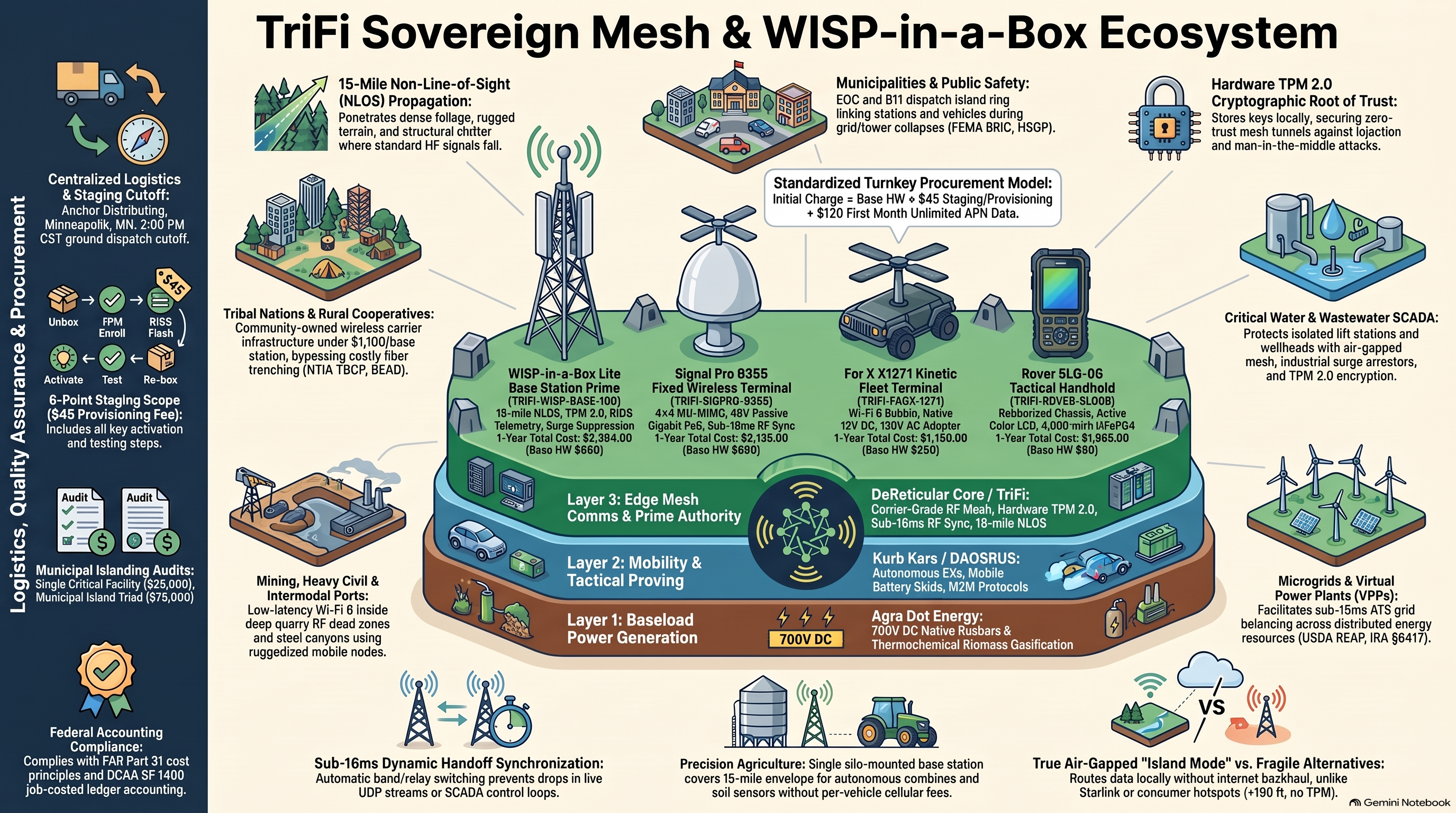
- 15-Mile Non-Line-of-Sight (NLOS) Propagation: Utilizing sub-6 GHz, high link-budget radio propagation profiles, nodes transmit high-throughput data across a 15-mile operational radius. This high link-budget capability penetrates dense foliage, heavy crop canopies, undulating terrain, precipitation, atmospheric smoke, and structural clutter where standard high-frequency or line-of-sight microwave links experience total signal degradation.
- Hardware Cryptoprocessor (TPM 2.0): Security is established directly at the physical silicon layer using an integrated Trusted Platform Module (TPM 2.0) cryptoprocessor chip. The TPM 2.0 chip stores cryptographic master keys, authenticates hardware-rooted device identity, enforces zero-trust mesh tunnels, and validates secure boot integrity—effectively blocking over-the-air firmware injection, signal spoofing, and man-in-the-middle attacks.
- Sub-16ms Dynamic Carrier Synchronization: Integrated radio interfaces continuously monitor signal quality and carrier telemetry. When a primary cellular frequency or tower link degrades, the system executes dynamic channel handoffs in less than 16 milliseconds. Because this sub-16ms switching occurs within a single radio frame window, it prevents dropped voice calls, maintains uninterrupted User Datagram Protocol (UDP) video streams, and completely eliminates packet-loss timeouts in critical SCADA automation. In industrial automation, standard cellular failover latencies (often exceeding 500ms to several seconds) cause SCADA polling loops to time out and Automatic Transfer Switches (ATS) to trigger catastrophic emergency safety lockouts; sub-16ms dynamic synchronization eliminates these operational disruptions.
- Gas-Discharge Lightning Surge Suppression & Hardening: Primary base stations deployed on elevated outdoor infrastructure—such as municipal water towers, agricultural grain silos, and communications masts—incorporate industrial-grade gas-discharge lightning surge arrestors. This physical hardening channels extreme electrical transients safely to ground, protecting sensitive internal RF circuitry from direct atmospheric lightning strikes and electrical surges.
3.2 The Hardware Lineup & Specialized Roles
The TriFi Sovereign Mesh ecosystem comprises four primary hardware platforms designed for distinct operational roles:
┌────────────────────────────────────────────────────────┐
│ TriFi WISP-in-a-Box Lite │
│ (TRIFI-WISP-BASE-100) │
│ 15-Mile NLOS Carrier Base Station │
└───────────────────────────┬────────────────────────────┘
│
┌───────────────────┼───────────────────┐
▼ ▼ ▼
┌──────────────┐ ┌──────────────┐ ┌──────────────┐
│ Signal Pro │ │ Far X X1271 │ │ Rover SLG-06 │
│ (8355 CPE) │ │ (Kinetic AP) │ │ (Tactical) │
└──────────────┘ └──────────────┘ └──────────────┘
TriFi WISP-in-a-Box Lite (TRIFI-WISP-BASE-100)
- Role: District Carrier Anchor / Base Station Prime
- Physical Form Factor & Build: Heavy-duty, high-gain mast/tower-mount base station chassis equipped with heavy-duty gas-discharge lightning surge arrestors.
- Target Environment: High-elevation installations on municipal water towers, central communication masts, grain silos, and enterprise campus structures.
- Operational Function: Functions as the primary central parent node in a Wireless Internet Service Provider (WISP) architecture, coordinating, backhauling, and distributing data across a 15-mile district envelope to fixed client terminals, edge sensors, and kinetic field vehicles.
TriFi Signal Pro 8355 (TRIFI-SIGPRO-8355)
- Role: Fixed Wireless Terminal / Campus Microgrid CPE
- Physical Form Factor & Build: Low-profile, minimalist matte-white circular dome/disc enclosure featuring an IP67 weather-sealed, UV-stabilized cast composite/aluminum chassis engineered for 24/7 exterior exposure.
- Target Environment: Exterior building eaves, utility substations, critical water/wastewater pump facilities, and campus control centers.
- Operational Function: Establishes fixed high-throughput client connections utilizing an internal 4×4 Multi-User Multiple-Input Multiple-Output (MU-MIMO) high-gain directional array powered cleanly via 48V Passive Gigabit Power-over-Ethernet (PoE).
TriFi Far X X1271 (TRIFI-FARX-1271)
- Role: Kinetic Fleet AP / High-Gain Rural Desktop Router
- Physical Form Factor & Build: Upright matte-gray desktop chassis equipped with four prominent vertical 9dBi high-gain directional paddle antennas and a front-facing LED status array.
- Target Environment: Rural residences, remote field offices, utility maintenance trucks, emergency command vehicles, and mobile fleet assets.
- Operational Function: Captures weak, distant cellular signals and converts them into a localized Wi-Fi 6 coverage bubble. Features dual-power flexibility, operating natively on a 12V DC vehicle power input or an included 120V AC desktop wall adapter.
TriFi Rover SLG-06 (TRIFI-ROVER-SLG06)
- Role: Tactical Handheld Hotspot / Personal Field Node
- Physical Form Factor & Build: Pocket-sized vertical handheld terminal featuring a drop-tested rubberized shock-absorbent body and a full-color active LCD screen displaying signal strength, battery percentage, data usage, and a dynamic Wi-Fi pairing QR code.
- Target Environment: First responders, mobile field inspectors, disaster response personnel, and nomadic maintenance crews.
- Operational Function: Provides ultra-portable personal hotspot connectivity. Powered by an internal 4,000 mAh Lithium Iron Phosphate (LiFePO4) battery chemically engineered for extreme thermal stability in environments up to 140°F (60°C), supporting bidirectional USB-C Power Delivery (PD) pass-through charging.
3.3 Hardware Comparison & Total Cost of Ownership (TCO) Analysis
Every hardware platform within the ecosystem follows a standardized financial architecture: \text{Initial Turnkey Charge} = \text{Base Hardware Price} + $45.00\text{ (Staging/Provisioning Fee)} + $120.00\text{ (Month 1 APN Service)}
Ongoing network backhaul access is provided through an uncapped, non-throttled multi-carrier cellular Access Point Name (APN) profile billed at a flat rate of $120.00 per month.
Device Name Form Factor / Visual Design Upfront Hardware Price Staging / Provisioning Fee Initial Turnkey Charge Ongoing Monthly APN 1-Year Total Cost of Ownership (TCO)
TriFi Rover (TRIFI-ROVER-SLG06) Pocket-sized vertical black handheld; color display; rubberized chassis $80.00 $45.00 $245.00 $120.00 / mo $1,565.00
TriFi Far X (TRIFI-FARX-1271) Upright matte-gray desktop router; 4 vertical 9dBi paddle antennas $250.00 $45.00 $415.00 $120.00 / mo $1,735.00
TriFi Signal Pro (TRIFI-SIGPRO-8355) Weather-sealed matte-white circular dome/disc (IP67 composite/aluminum) $650.00 $45.00 $815.00 $120.00 / mo $2,135.00
WISP-in-a-Box Lite (TRIFI-WISP-BASE-100) High-gain mast/tower mount with gas-discharge surge arrestors $899.00 $45.00 $1,064.00 $120.00 / mo $2,384.00
Note on Staging Protocols & Logistics SLA: The mandatory $45.00 staging fee covers a mandatory 5-step Quality Assurance (QA) workflow executed at the central fulfillment hub at Anchor Distributing in Minneapolis, MN:
- Physical unboxing and structural integrity inspection.
- Cryptographic enrollment of the hardware TPM 2.0 chip into the Sovereign Authority root key registry.
- Pre-flashing the proprietary Resilient Infrastructure Operating System (RIOS) telemetry agent.
- Cellular International Mobile Equipment Identity (IMEI) modem activation and Integrated Circuit Card Identifier (ICCID) SIM marrying to private APN backhaul.
- Radio frequency loopback and sub-16ms failover bench-testing prior to re-boxing and dispatch.
All hardware dispatches adhere to a strict 2:00 PM CST ground freight cutoff for same-day routing, tracked internally under cost code 5200-LOGISTICS.
Understanding the technical capabilities and standardized financial metrics of these physical nodes allows system architects to deploy sovereign mesh networks effectively across critical sector verticals.
- Real-World Applications & Public Capital Stacking
4.1 Industry Vertical Deployment Scenarios
WISP-in-a-Box mesh architecture resolves deep structural vulnerabilities across critical public and private sector verticals:
- Municipalities & Public Safety:
- Failure Mode: Commercial cellular towers experience physical damage, backhaul loss, or extreme congestion during major natural disasters (hurricanes, wildfires, tornadoes), cutting off emergency communications.
- Mesh Solution: Deploys an autonomous “Island Mode” communications ring connecting City Hall, 911 dispatch centers, and hospitals. Vehicle-mounted kinetic fleet Access Points (AP) (Far X) and tactical handheld nodes (Rover) roam seamlessly across a 15-mile NLOS perimeter, maintaining inter-agency voice and data routing without commercial tower availability.
- Water / Wastewater SCADA:
- Failure Mode: Remote water lift stations, booster pumps, and chlorination plants exposed to public cellular modems face cyber intrusion risks, while commercial ISP outages disconnect remote telemetry and trigger manual operational shutdowns.
- Mesh Solution: Establishes an air-gapped SCADA mesh network delivering continuous remote telemetry and pump actuation control. Physical TPM 2.0 cryptoprocessors block over-the-air injection attacks, while gas-discharge surge arrestors protect high-mounted outdoor terminals from electrical surge damage during storms.
- Distributed Microgrids & Energy:
- Failure Mode: Cloud backhaul latency delays switchgear control signals during main grid disconnections, causing localized power oscillations or forcing Automatic Transfer Switches (ATS) into safety lockouts.
- Mesh Solution: Provides sub-16ms RF synchronization between Distributed Energy Resource (DER) controllers and ATS switchgear. Sub-16ms switching occurs within a single radio frame window, allowing edge Virtual Power Plant (VPP) balancing and continuous power dispatch without cloud server delays.
- Precision Agriculture:
- Failure Mode: Vast agricultural acreage lacks reliable cellular coverage, and paying individual monthly cellular subscriptions for dozens of autonomous combines and sprayers creates unsustainable operational expenses.
- Mesh Solution: A single silo-mounted WISP-in-a-Box base station radiates a high-gain 15-mile Wi-Fi 6 coverage umbrella across continuous crop acreage, supplying high-bandwidth data to field machinery and moisture sensors while eliminating multi-SIM carrier fees.
4.2 Procurement, Accounting Standards & Grant Capital Stacking
Deploying sovereign communications infrastructure requires specialized engineering preparation and structured financial models, allowing public entities to fund network builds without issuing municipal debt.
Forensic Engineering Audits
To evaluate site requirements and fulfill federal grant prerequisites, DeReticular provides two structured audit Statements of Work (SOW):
- Single Critical Facility Audit ($25,000): A targeted engineering assessment evaluating RF propagation, failover latency, and emergency power integration for an isolated operational asset (e.g., a standalone wastewater treatment plant or fire station).
- Municipal Island Triad Audit ($75,000): A comprehensive regional engineering audit assessing the three fundamental pillars of civic infrastructure:
- City Hall / Administrative Governance Centers
- Water & Wastewater SCADA Infrastructure
- 911 Emergency Dispatch & Emergency Operations Centers (EOC)
Accounting Compliance & Pre-Development Cost Recovery
All hardware procurement, staging logistics managed through Anchor Distributing (cost code 5200-LOGISTICS), and engineering audit SOWs adhere strictly to federal cost-accounting standards. Expenditures comply with FAR Part 31 (Federal Acquisition Regulation: Cost Principles) and utilize DCAA SF 1408 (Defense Contract Audit Agency) job-costed ledger criteria. Because audits and staging protocols are structured under DCAA SF 1408 standards, municipal finance officers can classify these initial audit expenditures as reimbursable pre-development engineering costs under federal grant applications.
Non-Dilutive Grant Capital Stacking
By aligning hardware deployment and forensic audits with federal accounting guidelines, entities can stack non-dilutive capital from multiple federal grant streams:
┌────────────────────────────────────────────────────────┐
│ FEDERAL GRANT CAPITAL STACK │
├──────────────────┬──────────────────┬──────────────────┤
│ FEMA BRIC │ USDA REAP / │ IRA §6417 │
│ (Mitigation) │ ReConnect │ (Direct Pay) │
└──────────────────┴──────────────────┴──────────────────┘
- FEMA BRIC (Building Resilient Infrastructure and Communities): Funds structural hardening, hazard mitigation, and resilient emergency communications infrastructure.
- USDA REAP & ReConnect Programs: Provides non-dilutive grants and loan guarantees for off-grid energy generation, agricultural microgrids, and rural broadband expansion.
- IRA §6417 (Inflation Reduction Act Direct Pay): Enables tax-exempt entities (municipalities, public utilities, Tribal nations) to receive direct cash payments for deploying resilient clean energy and microgrid infrastructure.
- NTIA TBCP & BEAD: The Tribal Broadband Connectivity Program (TBCP) and Broadband Equity, Access, and Deployment (BEAD) program supply direct capital to establish community-owned broadband networks across underserved regions.
Having analyzed sector-specific applications, procurement frameworks, and capital stacking models, decision-makers require a comparative summary to evaluate sovereign mesh networks against alternative technologies.
- Summary & Decision-Maker’s Roadmap
5.1 Paradigm Shift: Consumer Hotspot vs. Satellite vs. Sovereign Mesh
Choosing an enterprise telecommunications strategy requires evaluating standard commercial options against sovereign mesh architectures across key technical and operational metrics:
Metric / Feature Consumer Hotspots Satellite (e.g., Starlink) Sovereign WISP-in-a-Box Mesh
Private Island Mode None (Fails if cell link drops) None (Requires active satellite link) Native / Standard (Operates local air-gapped mesh)
Coverage Radius Short range (<150 feet) Localized terminal footprint Up to 15-Mile NLOS envelope
Hardware Cryptography Rare / Software-based only No (Relies on cloud auth) Integrated Hardware TPM 2.0
Obstruction Vulnerability Poor foliage penetration Severe (Requires unobstructed sky view) Carrier-Grade NLOS Penetration
Handoff Latency Slow / Session drops N/A (Fixed terminal connection) Sub-16ms Dynamic RF Sync
5.2 Key Takeaways & Next Steps
- Eliminate Systemic Single Points of Failure: Traditional commercial cellular towers, centralized cloud platforms, and terrestrial fiber lines remain vulnerable under the 1,000-Mile Failure Model. Organizations must move beyond centralized dependencies to secure operational continuity.
- Deploy True “Island Mode” Autonomy: Combining 15-mile NLOS RF propagation, sub-16ms dynamic carrier handoffs, and hardware TPM 2.0 cryptoprocessors allows municipalities and enterprises to maintain unbroken local data routing and SCADA control even when external public utilities go dark.
- Capitalize on Non-Dilutive Public Funding: By utilizing FAR Part 31 and DCAA SF 1408 compliant forensic audits, organizations can treat pre-development costs as reimbursable expenses and stack non-dilutive federal grants (FEMA BRIC, USDA REAP, IRA §6417 Direct Pay, NTIA BEAD) to fully fund infrastructure deployments without incurring municipal debt.
Transitioning from a passive subscriber of commercial telecommunications into an active operator of sovereign mesh infrastructure serves as an essential operational insurance policy against grid fragility. By deploying hardened, localized mesh networks, communities, emergency services, and critical utilities guarantee that their communication channels remain secure, autonomous, and fully operational under any emergency condition.