Sovereign Ecosystems 101: How Communities Stay Powered and Connected in “Island Mode”
- Introduction: Centralized Vulnerability vs. The Sovereign Solution
1.1 The Blackout Problem
Imagine a massive winter storm knocking down electric poles for hundreds of miles. In an instant, the lights go out, cellular phones lose signal, internet streaming stops working, and grocery store registers freeze completely. Most towns are left helpless, waiting days or weeks for far-away power and telecom corporations to restore critical infrastructure.
When centralized grids fail, the real-world consequences are immediate and catastrophic:
- Loss of Electrical Power: Heating, lighting, water pumps, and refrigeration fail instantly, creating immediate physical hazards.
- Loss of Cellular Signal & Internet: Communication collapses, leaving residents unable to call for emergency help, coordinate emergency response, or receive critical safety updates.
- Loss of Payment Systems: Electronic store registers freeze, completely halting access to food, fuel, medication, and essential supplies.
This systemic fragility stems from total reliance on distant, vulnerable infrastructure managed by remote entities.
1.2 Defining “Island Mode” and “Sovereign Ecosystems”
To eliminate this structural vulnerability, communities can transition to a Sovereign Ecosystem.
- Sovereign means completely independent, self-governing, and locally controlled.
- Island Mode is the engineered operational capacity of a local entity—such as a town, hospital, farm, or emergency operations center—to instantly disconnect from external regional grids during a blackout and continue operating completely on its own.
In Island Mode, local energy generation, autonomous vehicles, local computing clusters, and emergency radios remain fully operational without needing external power lines, commercial gas stations, distant corporate servers, or satellite downlinks.
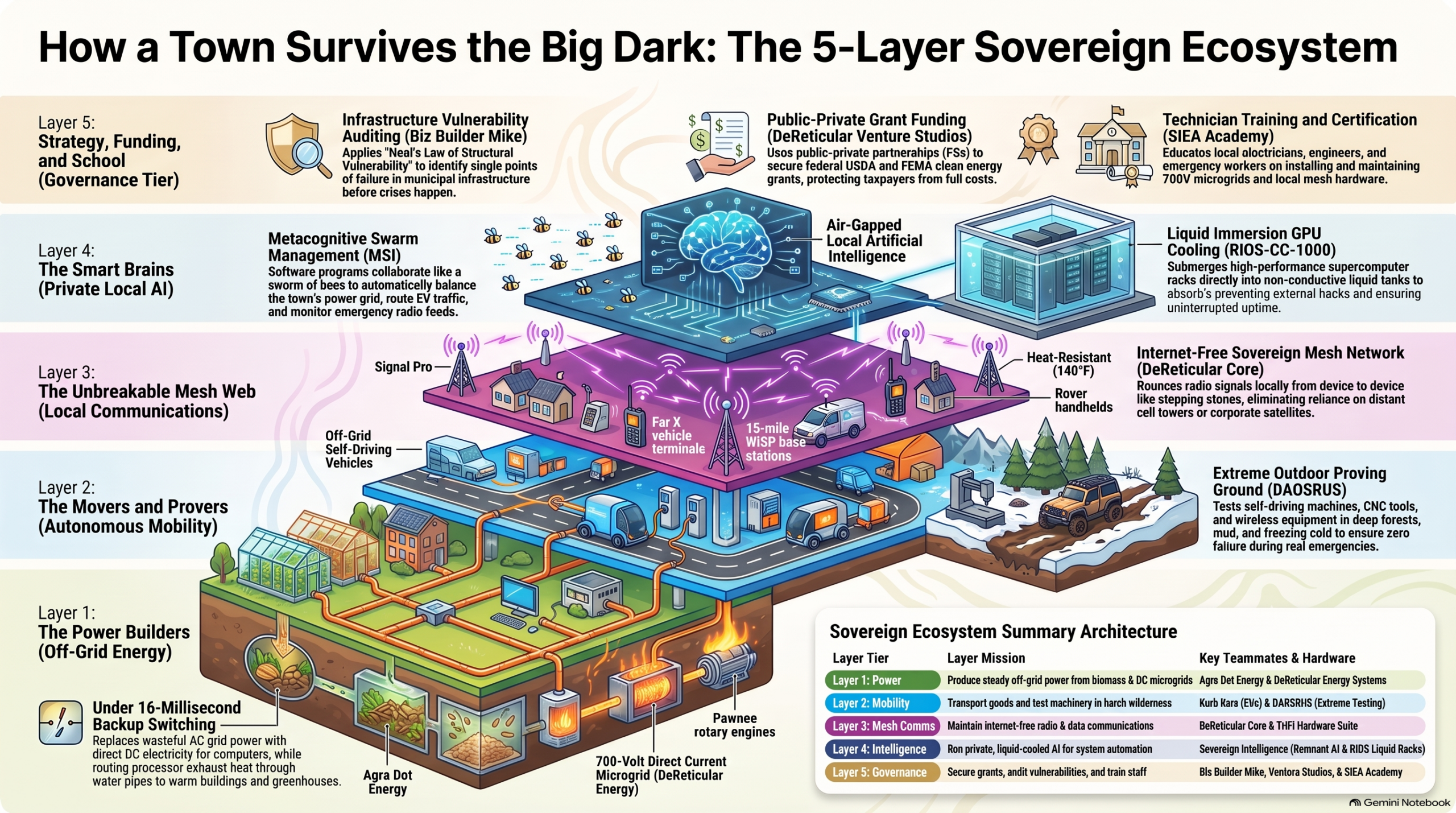
Achieving this level of true independence requires a coordinated, multi-layered hardware and software architecture starting with the most fundamental requirement: continuous local power generation.
- Layer 1: Local Power Generation and High-Efficiency Plumbing
2.1 Generating Power Locally (Agra Dot Energy)
Instead of relying on long-distance high-voltage transmission lines that take years to construct and weeks to repair following storm damage, Agra Dot Energy generates continuous electricity directly at the point of consumption.
The system utilizes locally available organic agricultural waste and wood chips—collectively known as biomass—and processes them through high-temperature pyrolysis and gasification. This thermochemical process heats organic waste in an oxygen-deprived environment, converting solid waste into clean-burning synthesis fuel without producing atmospheric smoke. This fuel powers specialized Pawnee rotary engines to generate continuous 24/7 base-load electricity regardless of weather conditions.
[ Farm Waste & Wood Chips ] ➔ Pyrolysis & Gasification ➔ [ Clean Fuel ] ➔ [ Pawnee Rotary Engines ] ➔ Continuous 24/7 Power
2.2 Efficient Distribution and Instant Backup (DeReticular Energy Systems)
Standard municipal utilities deliver Alternating Current (AC) power. However, modern digital electronics and microchips operate natively on Direct Current (DC). Transforming high-voltage AC from the wall into low-voltage DC at every individual power supply requires multiple conversion steps, generating significant waste heat and dissipating 15–30% of total electrical energy.
DeReticular Energy Systems solves this inefficiency by deploying a high-efficiency 700-Volt Direct Current (DC) electrical microgrid architecture. By delivering native DC power directly to computing hardware and high-efficiency systems, energy conversion losses are minimized.
- The “Magic Switch”: To prevent catastrophic equipment resets or data corruption during an outage, the microgrid incorporates solid-state transfer switches. These switches detect external grid failure and transfer the load to local backup power in under 16 milliseconds—faster than a human eye can blink—ensuring continuous power flow to sensitive hardware.
- Dual-Utility Waste Heat Capture: Rather than venting thermal byproduct into the atmosphere, the system captures intense waste heat from heavy computer processors and circulates high-temperature water through closed-loop piping to heat nearby agricultural greenhouses or community spaces.
Key Comparison: Centralized vs. Sovereign Energy
Traditional Centralized Energy Layer 1 Sovereign Energy
Fuel Source: Distant fossil fuels or remote generation plants transported over long-distance transmission lines. Fuel Source: Local biomass (agricultural scrap, wood chips) processed on-site via pyrolysis and gasification.
Current Type / Distribution: Alternating Current (AC), incurring 15–30% conversion energy loss at digital devices. Current Type / Distribution: High-efficiency 700-Volt Direct Current (DC) tailored for native digital microelectronics.
Blackout Resilience: Highly vulnerable to single-point failures; grid repairs often take days or weeks. Blackout Resilience: Immediate isolation (<16 ms transfer time) operating continuously in Island Mode indefinitely.
Connecting continuous local power to daily operations naturally requires local transportation options and relentless stress-testing under extreme conditions.
- Layer 2: Off-Grid Mobility and Extreme Proving Grounds
3.1 Autonomous Emergency Transport (Kurb Kars)
During a grid collapse, commercial gas stations cannot pump fuel and standard vehicle navigation platforms lose cloud connectivity. Kurb Kars addresses this critical transport vulnerability by deploying autonomous electric utility vehicles and mobile battery pods.
- Grid-Direct Recharging: Vehicles charge directly from the local 700V DC microgrid, eliminating dependency on commercial fueling stations or central internet management.
- Edge-Navigated Autonomy: Unlike consumer self-driving vehicles that rely on real-time internet database queries or cloud-based GPS lookup, Kurb Kars operate off-grid using localized edge sensors, onboard computer vision, pre-mapped micro-routes, and direct wireless telemetry with nearby microgrid nodes.
- Crisis Operations: These self-driving vehicles transport critical medical supplies, move healthcare personnel, deliver rations, and carry patients safely across municipal boundaries during disasters.
3.2 Proving Ground Resilience (DAOSRUS)
Before deploying autonomous electric vehicles, wireless communications nodes, and computer-controlled manufacturing tools (such as CNC machinery) into high-stakes emergency situations, all hardware must be field-tested under punishing environmental conditions.
DAOSRUS (Digital Adventures Outdoors R US) serves as the extreme outdoor testing playground. Equipment is subjected to deep forests, heavy mud, sub-zero cold, and rugged, rocky terrain. This rigorous physical validation ensures that critical machinery will not suffer mechanical, thermal, or electronic failure during a real crisis.
Moving supplies and vehicles safely across a town during a crisis requires a bulletproof, localized communication network.
- Layer 3: The Sovereign Mesh Network (Communication Without Telecom)
4.1 The “Stepping Stone” Mesh Concept (DeReticular Core)
Traditional telecommunications rely on centralized, long-distance routing architectures. A text message or data packet sent to a neighbor often travels hundreds of miles to a centralized corporate server farm before returning. If a regional cellular tower or main fiber trunk line fails, local communication collapses entirely.
DeReticular Core replaces this architecture with a decentralized Sovereign Mesh Network. In this framework, every radio transceiver acts as an independent node—functioning like a stepping stone. Messages hop locally from node to node across the community.
- Self-Healing Network Topology: If a specific stepping stone node is physically damaged, loses power, or is destroyed, the sovereign mesh automatically detects the outage and self-heals by instantly dynamically re-routing data packets through adjacent surviving nodes without human intervention.
4.2 The TriFi Hardware Suite
Device Name Physical Form / Design Primary Operational Role
TriFi Signal Pro 8355 Rugged, weatherproof metal directional antenna Mounted atop key municipal structures (schools, hospitals, water towers) to provide high-bandwidth wireless backbone coverage across an entire campus.
TriFi WISP-in-a-Box Lite High-power commercial base station Transmits a long-range wireless signal bubble up to 15 miles, penetrating dense timber and topographical obstacles.
TriFi Far X – X1271 Vehicle-mounted terminal with dual roof antennas Installed on emergency trucks, maintenance rigs, or ambulances to establish a mobile, rolling Wi-Fi coverage bubble around the vehicle.
TriFi Rover – SLG-06 Rubberized, impact-resistant handheld hotspot Compact personal node featuring specialized battery chemistry engineered for extreme thermal stability that will not melt or overheat in 140°F desert heat.
Once local power and communications are established, a community needs a local brain to manage operations safely.
- Layer 4: Local Artificial Intelligence and Sovereign Intelligence
5.1 Private, Air-Gapped Intelligence
Relying on standard cloud-based artificial intelligence during a critical emergency presents two major flaws: municipal data privacy is compromised, and cloud-dependent tools become completely inaccessible the moment external fiber optics or satellite links break.
Sovereign Intelligence introduces Remnant AI, which runs executable neural networks directly on local hardware chips located inside community facilities. This system operates across a strict air gap—meaning the hardware maintains zero physical or wireless connectivity to the external commercial internet. It remains immune to remote cyberattacks, external data harvesting, or global internet disruptions.
5.2 Advanced Cooling & Swarm Management
- RIOS-CC-1000 Immersion-Cooled GPU Racks: High-density AI computing generates immense heat. Standard air-cooling fans consume excessive electricity, accumulate dust, and fail under harsh conditions. The RIOS-CC-1000 system submerges high-performance GPU hardware directly into tanks filled with a specialized dielectric (non-conductive) fluid. This fluid rapidly absorbs thermal energy directly from electronic components without causing electrical short circuits, maintaining hardware longevity while operating silently.
- Metacognitive Swarms (MSI): Operating on air-gapped processing nodes, automated software agents function like a coordinated bee swarm. Synthesizing real-time telemetry across the entire ecosystem, MSI agents utilize Layer 3 TriFi mesh networks to analyze Layer 1 700V DC microgrid power flows, dynamically re-routing electricity to match Layer 2 autonomous vehicle charging requirements, optimizing emergency transport routes, and scanning local radio channels for distress signals.
Even the most advanced technology is useless without strategy, financial funding, and trained personnel.
- Layer 5: Strategy, Economics, and Education (Generation 5)
6.1 Risk Auditing and Funding (Biz Builder Mike & Venture Studios)
Implementing resilience infrastructure requires rigorous strategic auditing and multi-layered financial structuring:
- Vulnerability Audits: Guided by Noel’s Law of Structural Vulnerability, the strategy team at Biz Builder Mike collaborates with municipal leaders to conduct systematic physical and operational audits. They identify and eliminate hidden single points of failure (such as a single un-redunant electrical transformer that, if damaged, would take down an entire municipal water treatment and pumping facility).
- Financial Architecture: Building sovereign microgrids and localized networks requires capital. DeReticular Venture Studios structures Public-Private Partnerships (P3s) to help municipalities secure competitive federal funding (such as USDA rural clean energy grants and FEMA disaster mitigation grants). Because federal grant awards strictly require documented risk reduction, the vulnerability audits produced under Noel’s Law provide the explicit empirical proof needed to secure these non-dilutive funds, relieving local taxpayers of the primary financial burden.
6.2 Workforce Training (SIEA / DeReticular Academy)
Operated under a non-profit trade association (SIEA), the DeReticular Academy delivers technical workforce training to local electricians, engineers, municipal workers, and emergency responders. Through structured curricula, students master the installation and maintenance of 700V DC microgrids, the deployment of self-healing mesh nodes, and the long-term management of air-gapped compute clusters.
With all components in place, we can now review the complete system architecture as a single, integrated blueprint.
- Conclusion: Synthesis and The “Survival Bubble” Blueprint
7.1 Master Architecture Checklist
Layer Tier Core Mission Key Teammates & Hardware
Layer 1: Power Generate continuous base-load electricity from local biomass and distribute high-efficiency DC power. Agra Dot Energy (Pyrolysis/Gasification, Pawnee Engines) & DeReticular Energy Systems (700V DC Microgrids, <16ms Solid-State Transfer Switches)
Layer 2: Mobility Provide off-grid autonomous transport and stress-test infrastructure in extreme environments. Kurb Kars (Off-grid autonomous EVs & Battery Pods) & DAOSRUS (Harsh environmental outdoor proving ground)
Layer 3: Mesh Comms Maintain localized communications using self-healing peer-to-peer mesh networks without commercial telecom. DeReticular Core & TriFi Hardware Suite (Signal Pro 8355, WISP-in-a-Box Lite, Far X – X1271, Rover – SLG-06)
Layer 4: Intelligence Execute secure, air-gapped local AI processing with high-density liquid cooling and swarm management. Sovereign Intelligence (Air-gapped Remnant AI, RIOS-CC-1000 Immersion Racks, Metacognitive Swarm AI – MSI)
Layer 5: Governance Perform structural risk audits, structure public grant funding, and train local technical workforces. Biz Builder Mike (Noel’s Law Audits), DeReticular Venture Studios (P3 Federal Grant Structuring), & SIEA / DeReticular Academy
7.2 The Big Takeaway
Instead of relying on fragile, long-distance power lines and vulnerable cloud servers, sovereign ecosystems create self-sustaining “survival bubbles.” By integrating local biomass power generation, autonomous off-grid transport, local mesh communications, air-gapped artificial intelligence, and grant-funded community governance, towns can confidently switch to “Island Mode” and keep their critical services fully operational through any crisis.