Understanding Node 2: The Brain of Project Octagon
1. Introduction: The Admiral’s Flagship
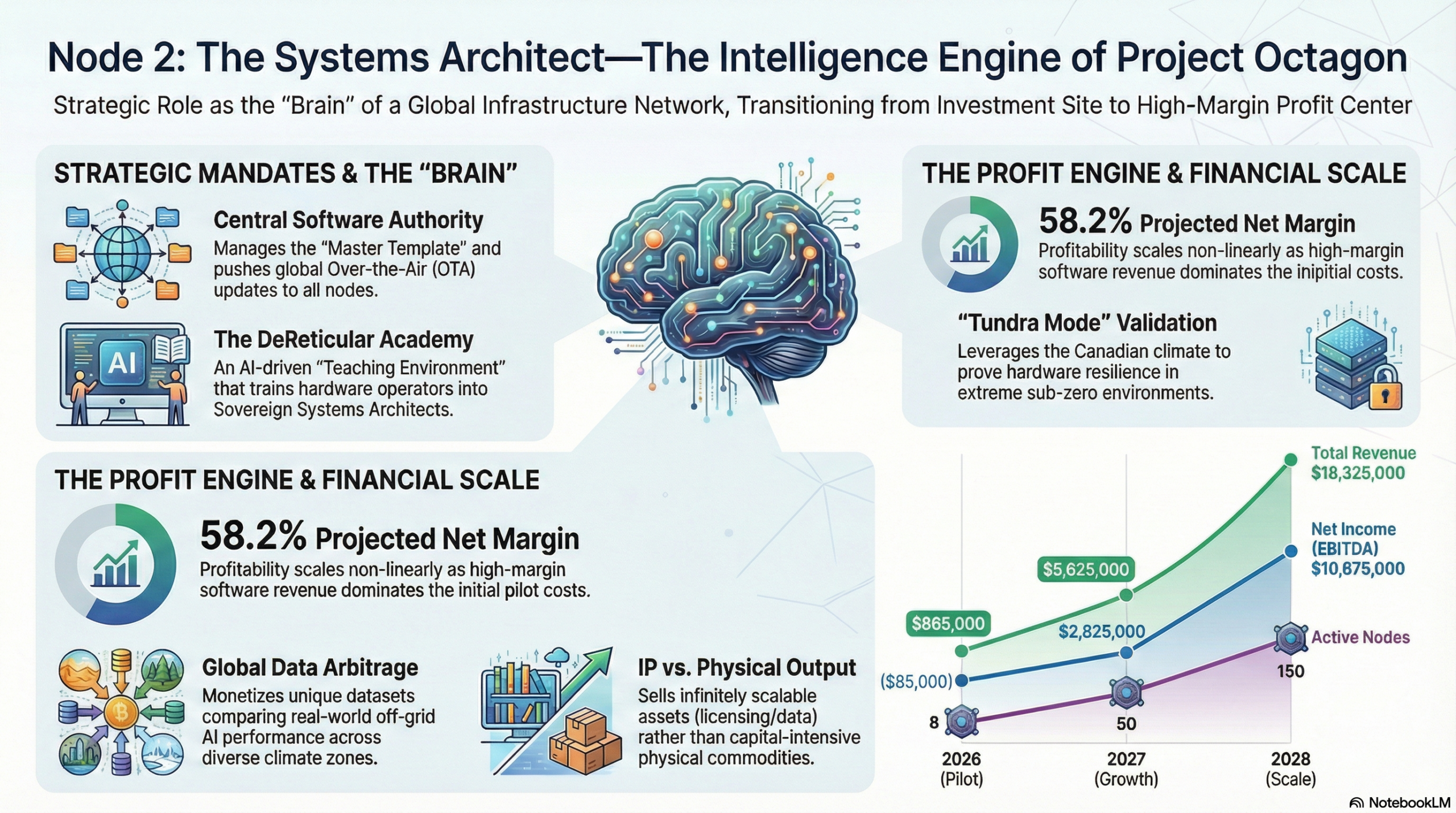
Node 2, also known as “The Systems Architect,” is the central software authority and indispensable “Brain” of the Project Octagon network.
The best way to understand its role is through the “Admiral’s Flagship” analogy.
The Admiral’s Flagship
If Project Octagon were a global fleet, Node 2 would be the Admiral’s flagship. It doesn’t just carry cargo; it carries the maps, codes, and training manuals that tell every other ship in the fleet how to navigate, operate, and survive.
Unlike industrial nodes that focus on physical production, Node 2’s purpose is to manage the network’s logic, security, and evolution. Located in Canada and led by CTO Ash Aly, it is the strategic heart of the entire operation.
To fully grasp Node 2’s importance, we must first examine how its mission fundamentally differs from the other nodes in the network.
2. A Mission of Intelligence, Not Industry
Node 2’s mission is fundamentally different from the field nodes. Where industrial nodes function as the project’s “Revenue Engine,” Node 2 is its “Profit Engine,” designed for high-margin growth by monetizing intellectual property.
This table synthesizes the core difference between Node 2 and the network’s industrial nodes:
| Node 2: The Profit Engine (Canada) | Industrial Nodes: The Revenue Engine (e.g., Uganda) |
| Primary Function: Sells infinitely scalable IP, intelligence, and data. | Primary Function: Sells physical outputs like electricity. |
| Financial Model: High Margin, Low Variable Cost. | Financial Model: High Revenue, High Capital Expenditure (CapEx). |
Node 2’s unique mission is executed through three distinct and critical mandates that define its role as The Systems Architect.
3. The Three Core Mandates of The Systems Architect
Node 2’s function as “The Brain” of Project Octagon can be broken down into three primary roles: Version Control Authority, Intelligence Hub, and Educational Authority.
Version Control Authority: Ensuring a Secure, Uniform Network
Node 2 manages the “Master Template” or “Golden Image,” which is the definitive, secure, and authoritative version of the Rural Infrastructure Operating System (RIOS) software.
Crucially, Node 2 is the sole node authorized to push Over-the-Air (OTA) updates to the global network. This centralized control is a key strategic decision. It guarantees that a node in the Ugandan savanna runs the exact same kernel and security protocols as a node in Texas. This prevents software fragmentation and vulnerabilities, ensuring uniform security across the entire fleet.
Intelligence Hub: Learning from a Global Network
Node 2 serves as the central hub for Federated Learning, a method for training global AI models without compromising local data sovereignty. Here’s how it works:
- Data Aggregation: It ingests performance telemetry from nodes operating in vastly different climates—from the 115°F deserts of Arizona to the sub-zero winters of its home base in Canada.
- Global Optimization: By analyzing this diverse data, Node 2 trains global AI models that improve performance for the entire network. A key example is using heat data from Arizona to enhance battery thermal management for a node in Uganda.
- Data Arbitrage: The monetization of this unique global dataset is known as “Data Arbitrage.” Node 2 possesses the world’s only dataset comparing “Real-World Off-Grid AI Performance” across every climate zone, creating a pure-profit stream. This data is sold to high-value clients, such as agricultural insurers who need it for “advanced climate-based risk modeling,” and hardware manufacturers like NVIDIA and Tesla for “real-world performance validation.”
Educational Authority: Creating the Next Generation of Architects
Node 2 is the official home of the DeReticular Academy. It is not just a control center; it is a school designed to build a self-sustaining ecosystem of expert operators.
- Mission: The Academy’s goal is to transition hardware operators into “Sovereign Systems Architects”—engineers capable of designing and blueprinting complex, off-grid infrastructure.
- Technology: Instruction is delivered via “The Tutor,” an LLM-based AI that provides multi-language technical education. A critical feature is its “Black Start” capability, which allows it to function completely offline, ensuring training can continue even if satellite links are severed.
These three mandates are made possible by a technical foundation that is fundamentally different from any other node in the network.
4. The Foundation: Unique Technical & Strategic Assets
Node 2’s specialized mission requires a unique technical and environmental setup that prioritizes intelligence gathering and resilience over all else.
Prioritizing Compute Power
While field nodes are engineered for power efficiency, Node 2 is built to prioritize raw Compute Power. This is a necessary design choice for several reasons:
- It requires high-density GPU clusters and high-capacity NVMe storage to support the massive AI training simulations needed for the RIOS Master Template. Per an active Request for Quotation (RFQ), these systems are currently being upgraded.
- This advanced hardware also powers the complex LLM-based AI “Tutors” for the DeReticular Academy and supports the development of future high-value modules, such as the “Clinic-in-a-Box” telemedicine platform.
The “Tundra Mode” Differentiator
The strategic location of Node 2 in Canada is a critical asset. It allows for a unique hardware validation process known as “Tundra Mode.”
- Benefit: The team leverages the sub-zero Canadian winters to stress-test RIOS hardware in extreme cold. This process validates critical components like battery thermal management systems and enclosure seals, proving that the hardware can survive and operate in harsh environments where traditional diesel generators often fail.
By combining immense computational power with extreme environmental testing, Node 2 ensures the entire network is both intelligent and physically resilient.
5. Summary: Why Node 2 is the Key to Scalable Success
Node 2 is the indispensable “Brain” and “Profit Engine” of Project Octagon. While industrial nodes provide the physical presence and generate revenue, Node 2 provides the logic, learning, and scalable IP that drives the project’s long-term financial success and technological superiority. As a new team member, these are the most critical takeaways:
- Centralized Logic: Node 2 provides the secure software, updates, and intelligence that all other nodes depend on to function. Its control over the “Master Template” ensures the entire network is secure and uniform.
- Global Learning: It uniquely gathers performance data from all climates to make the entire network smarter and more resilient, turning distributed knowledge into a powerful, centralized asset.
- Scalable Profitability (The Software Flywheel): Because Node 2 sells infinitely scalable IP (software and data), its profitability grows non-linearly with each new physical node deployed. This high-margin, low-cost model is the engine of the project’s financial success.