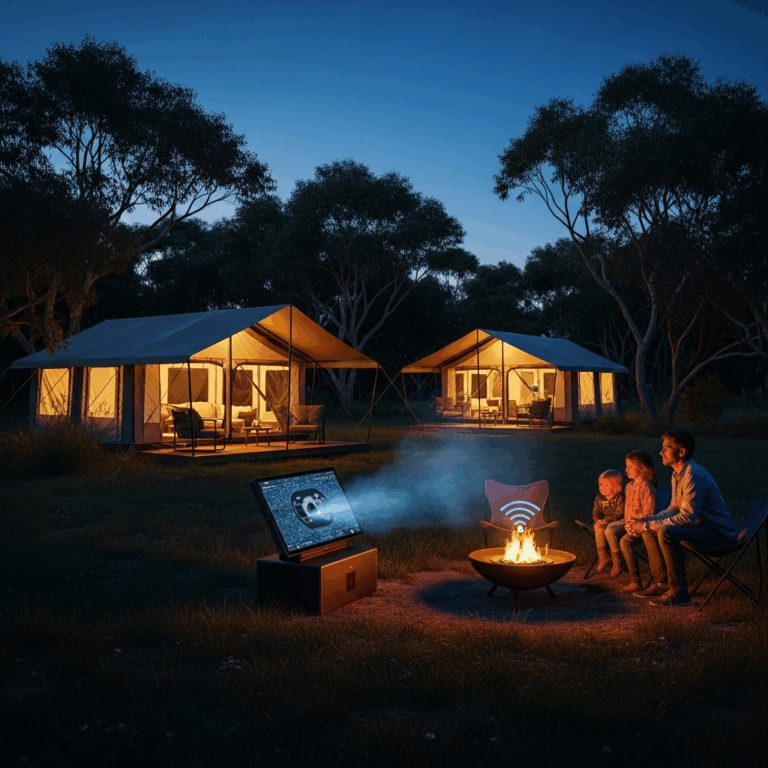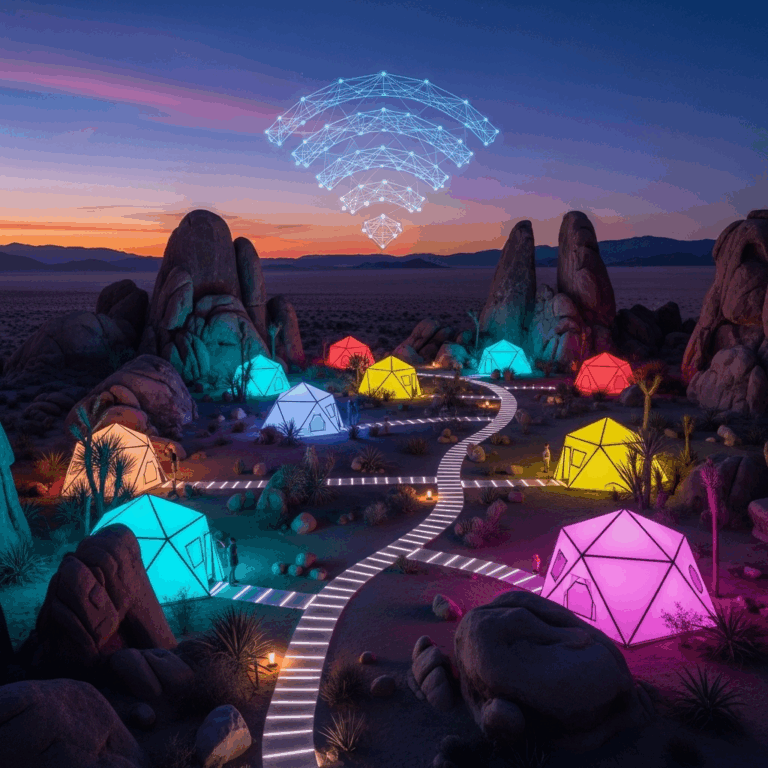
The Sovereign Nodal Network: A Primer for Autonomous Hospitality
1. The Great Inversion: Why the Hospitality Model is Changing
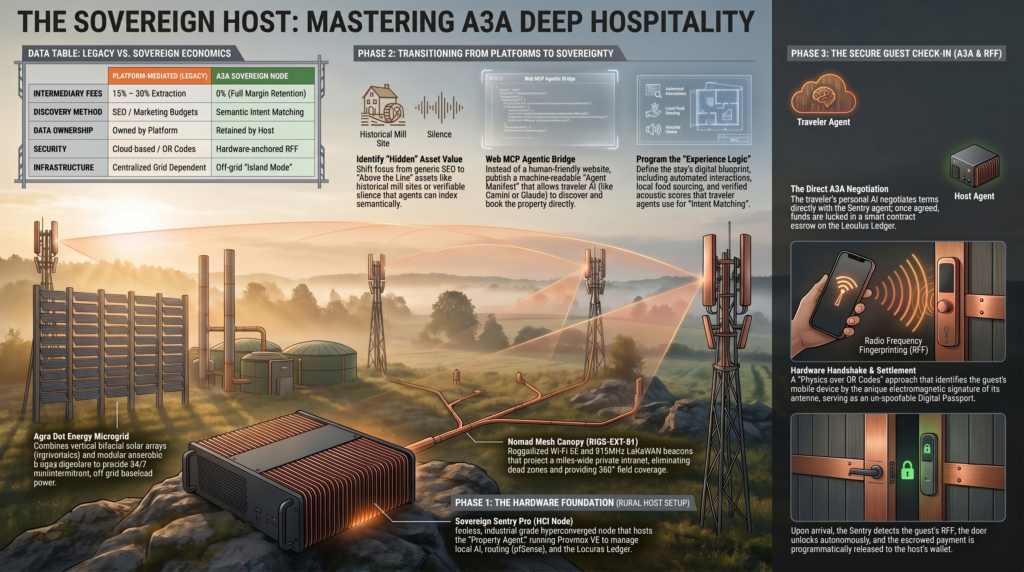
For the last two decades, the travel industry has been shackled to a “Platform-First” model. Aggregators like Airbnb and Expedia function as extractive gatekeepers, demanding a “Platform Tax” of 15% to 30% while commoditizing the host into a generic listing. This system is fragile, linear, and fundamentally centralized.
We are now entering “The Great Inversion.” This is a structural shift toward Agent-Orchestrated hospitality. In this era, value moves “Above the Line”—shifting away from standardized, replaceable rooms toward unique, proprietary contexts like historic mills or off-grid ridges. This transition uses Experience Logic (the machine-verifiable blueprint of a stay) to replace marketing budgets with semantic “Intention Matching.” For the Sovereign Host, this means reclaiming data ownership and total profit margin retention.
podcast
Comparing the Eras of Travel
| Dimension | The Platform Era (Legacy) | The Sovereign Era (Nodal) |
| Discovery | Centralized search algorithms & paid SEO | Semantic “Intention Matching” via A2A |
| Fees | 15–30% “Platform Tax” per booking | 0% intermediary fees; 100% margin retention |
| Data Ownership | Platforms own the guest/host relationship | Hosts retain direct, sovereign data control |
| Infrastructure | Brittle, linear, dependent on national grids | Spherical Resilience & Death of the Line |
To understand this inversion, one must first look at the physical hardware that makes independence a tangible reality.
——————————————————————————–
2. The Physical Backbone: Decentralized Physical Infrastructure (DePIN)
A Sovereign Node is an off-grid destination operating on Decentralized Physical Infrastructure (DePIN). Built for “Spherical Resilience,” these nodes eliminate single points of failure and are capable of “Island Mode”—maintaining full compute, energy, and network operations even when disconnected from the macro-internet or national power grid.
The hardware stack consists of three core components:
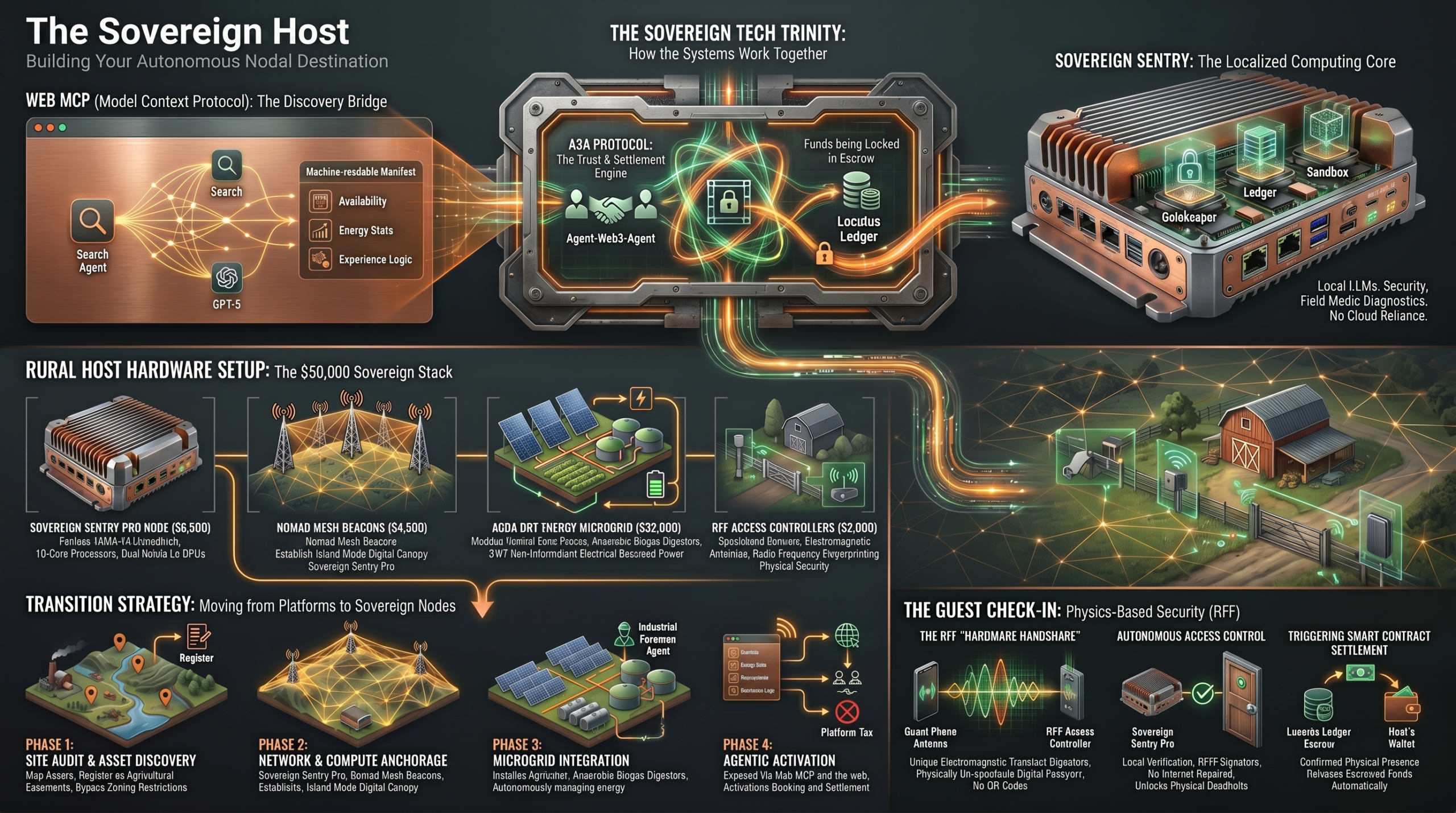
- The Sovereign Sentry Pro (HCI): This is the node’s “brain,” housed in a NEMA 4X weather-sealed, fanless aluminum monoblock. It features an AMD EPYC Embedded Processor and Dual Nvidia L4 GPUs (48GB VRAM) for local model inference. It runs Proxmox VE to host three isolated environments:
- The Gatekeeper: Runs pfSense/OPNsense for deep packet inspection and automated WAN failover.
- The Ledger: Runs the Locutus/Freenet daemon to manage the P2P ledger and encrypted data shards.
- The Sandbox: An air-gapped environment for local LLMs and automation agents.
- Nomad Mesh Beacons (RIOS-EXT-01): These weather-sealed routers project a “private intranet canopy” using Wi-Fi 6E and 915MHz LoRaWAN. They eliminate “dead zones” across the property, creating a high-bandwidth localized internet miles wide.
- Agra Dot Energy Microgrid: This system provides non-intermittent baseload power. It combines vertical bifacial solar panels—maintaining a Land Equivalent Ratio (LER) above 1.2 to bypass utility zoning bans—with modular biogas digesters and a Combined Heat and Power (CHP) generator.
While the hardware provides the body, the Agent-to-Agent protocols provide the language for the network.
——————————————————————————–
3. The Language of Autonomy: Agent-to-Agent (A2A) & Web MCP
The network communicates through two layers: Model Context Protocol (MCP), which allows Agents to talk to Tools (like local sensor databases), and Agent-to-Agent (A2A) protocols, which allow machines to negotiate directly.
The A2A Communication Lifecycle follows three distinct stages:
- Discovery (The Agent Card): The guest’s agent fetches the host’s Agent Card, a JSON-LD machine-readable manifest.
- Authentication: Secure verification is established using x402 protocols and ERC-7715 session keys for gasless, non-custodial transaction signing.
- Communication: Agents negotiate terms via JSON-RPC 2.0 over HTTPS, matching guest intent to the node’s specific manifest.
Teacher’s Note: The Agent Card The Agent Card shifts marketing from emotional branding to structured information. It is a JSON-LD manifest that tells visiting AI agents exactly what the property offers in machine-readable tags (e.g., #acoustic-silence-90dB, #off-grid-biogas, #starlink-integrated). If the agent can “understand” the context of the property, the guest will show up.
Once agents can talk, they need a way to verify who is interacting with the physical property.
——————————————————————————–
4. Physics Over Barcodes: Understanding Radio Frequency Fingerprinting (RFF)
For the Sovereign Traveler, security relies on “Physics over QR Codes.” Instead of easily cloned barcodes or cloud-dependent keycards, the network utilizes the DAOSRUS Digital Passport powered by Radio Frequency Fingerprinting (RFF).
RFF analyzes the unique electromagnetic signature of a mobile device’s antenna created during manufacturing. This signature is an un-spoofable hardware “Digital Passport” used for military-grade access control.
Benefits of RFF for the Sovereign Host:
- [x] Un-spoofable Identity: Cannot be copied via software or MAC-address spoofing.
- [x] No Personal Metadata Transmission: Identity is verified by hardware physics, not by sharing private data with a central server.
- [x] Offline Access Control: The Sentry Pro unlocks deadbolts via local RFF signature matching, even during a total network partition.
——————————————————————————–
5. Trustless Commerce: The A3A Settlement Engine
The Agent-Web3-Agent (A3A) protocol moves beyond messaging into financial settlement, replacing traditional banks and processors with a decentralized trust layer.
The A3A Execution Flow:
- Direct Negotiation: The traveler’s personal agent and the host’s Sentry agent agree on terms via JSON-RPC 2.0.
- Smart Contract Escrow: The payment is locked in a smart contract on the Locutus Ledger.
- RFF-Verified Check-in: Upon arrival, the guest’s unique RFF signature is detected by the Sentry Pro, proving physical presence.
- Automated Payment Release: The release of funds is programmatically triggered by the hardware handshake (the RFF signature), settling the transaction instantly.
——————————————————————————–
6. The “Sovereign Host” Advantage: Economic & Strategic Impact
Rural entrepreneurs gain a massive strategic advantage by moving “Above the Line.” This is the realm of proprietary context—historical silence and biological authenticity—that AI cannot reproduce or commoditize. By cutting out platforms, the host creates a Circular Economic Flywheel, where tourism revenue directly funds the expansion of local Sentry nodes and energy microgrids.
Unit Economics per Node (Projected Annual Contribution)
| Revenue Channel | Description | Annual Contribution |
| A3A Lodging | Direct bookings at $250/night (65% occupancy) | $59,250 |
| Local Compute | Leasing Sentry Pro GPU cycles for AI inference | $6,000 |
| Mesh Access | Subscriptions for high-speed local intranet | $12,000 |
| Energy Arbitrage | Surplus power/fuel sold to neighbors/grid | $7,250 |
| Total Gross | Revenue per Node | $84,500 |
Key Insight: Algorithmic Immunity Because discovery is handled by agents matching structured manifests to guest intent, the host is immune to platform algorithms. Value is discovered mathematically, not bought through SEO.
——————————————————————————–
7. Conclusion: The Autonomous Journey
A day in the life of a Sovereign Traveler begins with an intent: “I need 48 hours of verifiable silence for deep work.” Your agent discovers a historic mill stay via its Web MCP manifest and settles a deposit into escrow via A3A.
As you enter the rural valley, your phone loses cellular signal but seamlessly transitions into “Offline Intranet Mode” via the Nomad Mesh. Your phone displays AR Trail Maps served directly from the local Sentry. When you approach the cabin, the Sentry Pro recognizes your phone’s unique RFF signature and unlocks the door. The Locutus Ledger programmatically settles the payment. You are now off-grid, powered by an Agra Dot microgrid, secured by physics.
“The transition from ‘Consumer’ to ‘Sovereign’ is a shift from being a user of a platform to becoming a developer of the sovereign frontier. In the Nodal Network, the destination is a self-sustaining anchor of economic and digital independence.”