The Rural Renaissance: From Field and Mine to Fiber and Mind
- The Great Economic Shift: From “The Funnel” to “The Node”
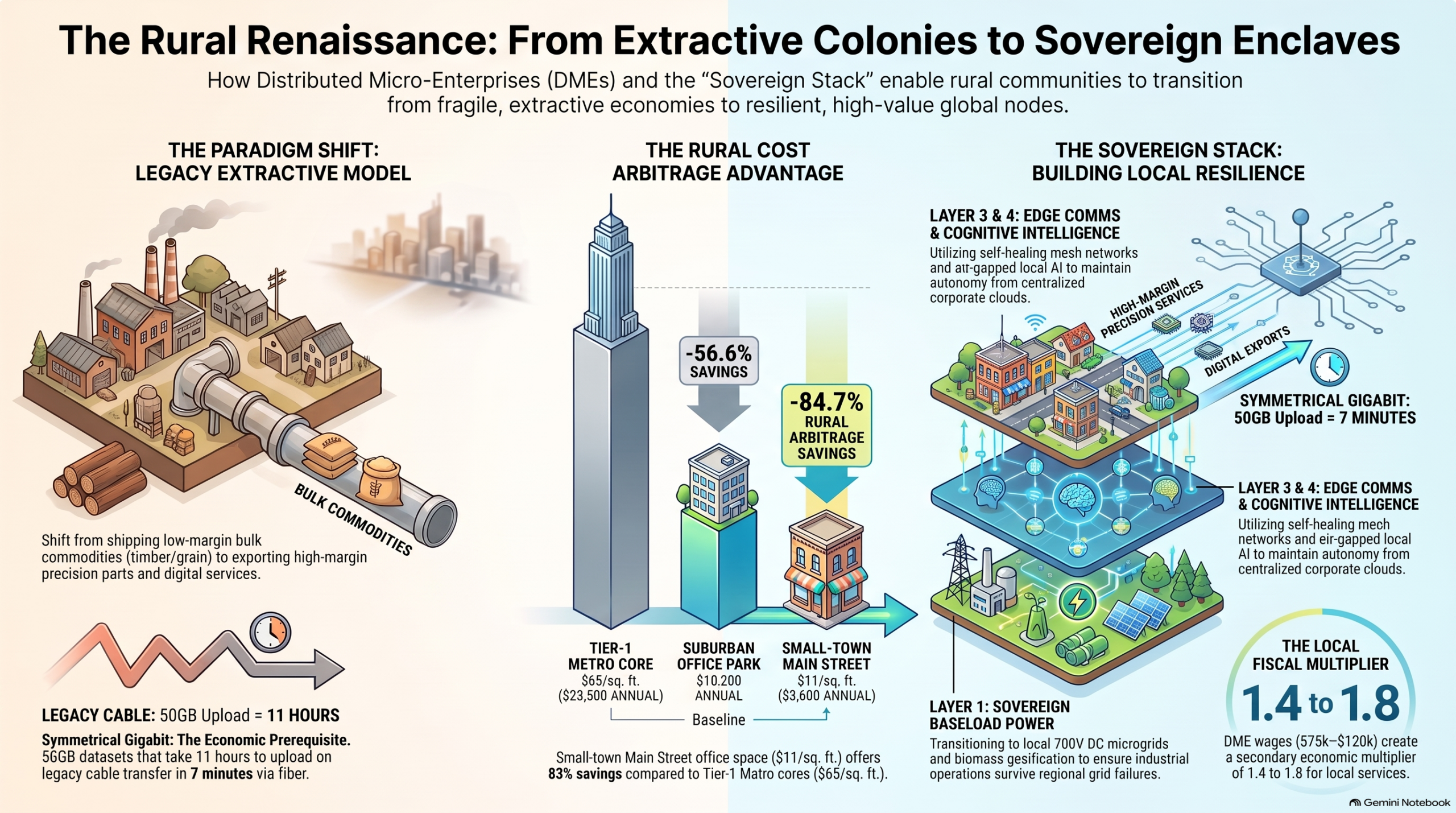
For over a century, the rural economy was defined by the “Commodity-Extractive Model.” Think of this as a giant funnel: rural communities worked the land to harvest timber, mine ore, and grow grain, only to ship those raw, low-margin materials away to metropolitan hubs for processing. In this model, the high-value profits, specialized jobs, and intellectual property stayed in the cities, leaving small towns vulnerable to the volatile “boom and bust” cycles of global commodity prices.
Today, we are re-architecting this foundation into the “Modern Distributed Node Model.” In this new era, a rural town is no longer a mere starting point for raw goods; it is a high-tech command center—a “node”—connected to the global economy via fiber optics. As a node, a town does more than receive data; it processes, adds value, and re-broadcasts it. This shift isn’t limited to office work; it has transformed the fields. Precision Agriculture now utilizes autonomous tractor fleets, subsoil sensor meshes, and multispectral drones to turn a farm into a data-driven engine that exports high-margin agronomic insights alongside its crops.
The Rural Evolution
Category Historic Extractive Model Modern Distributed Node Model
Primary Export Raw Commodities (Timber, Grains, Ore) High-Margin Services, Data, & Precision Products
Economic Goal Industrial Recruitment (Chasing Factories) Fostering Distributed Micro-Enterprises (DMEs)
Key Infrastructure Rail Lines and Highways Symmetrical Fiber & Sovereign Baseload Power
Synthesis Insight: Transitioning into a “node” grants a town structural stability. By diversifying into digital industries like software, forensic accounting, and specialized manufacturing, a community is no longer at the mercy of a single crop’s price. This digital engine provides the resilience necessary to thrive regardless of global market shifts.
- Why “Upload Speed” is Your Secret Weapon
The historic “digital divide” was about how fast you could download a movie. But for the modern rural professional, upload speed is the operational bottleneck. Most residential internet is “asymmetric,” meaning it downloads fast but uploads at a crawl. To run a global business, you need “symmetrical” gigabit fiber, where data moves at the same lightning speed in both directions.
This is best illustrated by the massive 3D “point cloud” datasets used in modern engineering and geospatial LiDAR mapping. Without symmetrical speed, collaborating with partners in New York or London becomes a multi-day ordeal.
The 11-Hour Bottleneck
Dataset: 50GB Geospatial LiDAR Point Cloud
- Legacy Cable (10 Mbps Upload): Takes 11.1 hours to upload. This connection is prone to packet loss and “time-outs,” making real-time global collaboration impossible.
- Symmetrical Fiber (1,000 Mbps Upload): Takes only 6.7 minutes. This allows a rural firm to co-author blueprints and sync multi-terabyte files with remote servers in real-time.
Critical Warning: Middle-Mile Redundancy A “Node” is only as resilient as its connection. To avoid total digital loss from a single backhoe cut along a highway, sovereign towns must invest in “Diverse-Path Rings”—physically separate fiber routes that ensure the town remains online even if one line is severed. This infrastructure is what allows high-value businesses to anchor themselves permanently on Main Street.
- The Four Pillars of the Modern Rural Business
The new rural economy is built on Distributed Micro-Enterprises (DMEs)—lean teams of 3 to 25 people who use technology to serve global clients from an affordable physical footprint.
- Specialized Financial & Forensic Compliance
- The Work: Performing forensic blockchain auditing or complex multi-state tax defense for national retail brands.
- Environmental & Geospatial Engineering
- The Work: Using drones and 2D hydrodynamic modeling to create high-density flood maps for national infrastructure projects.
- Distributed Software & Digital Media
- The Work: Building cloud-native API integrations or cinema VFX asset pipelines that sync to remote production servers.
- Precision Light Manufacturing
- The Work: Utilizing 5-axis CNC machines and SLS/DMLS 3D printing to manufacture titanium surgical tools or aerospace housings with tolerances of ±0.0001 inches.
Synthesis Insight: Precision Light Manufacturing allows a town to bypass fragile overseas supply chains. If a heavy piece of agricultural or mining equipment breaks, a local micro-fab can download the blueprints and manufacture the replacement part locally within 24 hours.
- Winning the “Math of Business”: The Rural Advantage
A company chooses a small town because of “Real Estate and Operating Cost Arbitrage.” It is simply more profitable to run a 12-person firm in a renovated historic bank than in a “Tier-1 Metro” core. Because the business saves hundreds of thousands in overhead, it can pay higher competitive wages to local workers while keeping more profit.
Yearly Costs per Workstation (12-Person Firm)
Expense Category Tier-1 Metro Core (e.g., Seattle) Small-Town Main Street
Commercial Rent $227,500 $38,500
Parking & Facility Fees $36,000 $1,200 (Nominal)
Local Property Tax High (12–18/sq. ft.) Low (1.50–3.00/sq. ft.)
Total Cost per Worker $23,500/year $3,600/year
So what? This math turns “Brain Drain” (young people forced to leave) into “Brain Circulation.” You can earn an urban-level salary while enjoying a rural cost of living. This financial advantage allows talented people to return to their hometowns and bring their expertise with them.
- Your Future in the “Sovereign Enclave”
The most resilient communities are becoming “Sovereign Enclaves.” These are places that have moved from “Linear Fragility” to “Spherical Resilience.” They don’t just wait for the grid to work; they generate Sovereign Baseload Power by utilizing Section 6417 Direct Pay tax credits to build local microgrids powered by agricultural waste gasification.
In a Sovereign Enclave, geographic isolation is no longer a weakness—it is a protective barrier that allows a community to generate its own power, export its own ideas, and control its own destiny.
Resilient Town Takeaway Checklist
- Symmetrical Fiber: Does the town have gigabit upload speeds and redundant middle-mile rings?
- Sovereign Baseload Power: Is the town utilizing thermochemical gasification or local microgrids to stay online during regional blackouts?
- Form-Based Codes: Has the town replaced restrictive zoning with codes that allow clean “live-work” precision labs on Main Street?
- Adaptive Reuse: Are historic banks and warehouses being converted into tech hubs with Three-Phase 480V Power?
- Shared Maker/Incubator Spaces: Is there a physical hub where young developers can apprentice alongside master machinists?
You are the future leader of this digital rural landscape. Geographic isolation no longer means being left out; it means having the space to build a sovereign future. Stop begging for jobs to come to you; start building the node.