
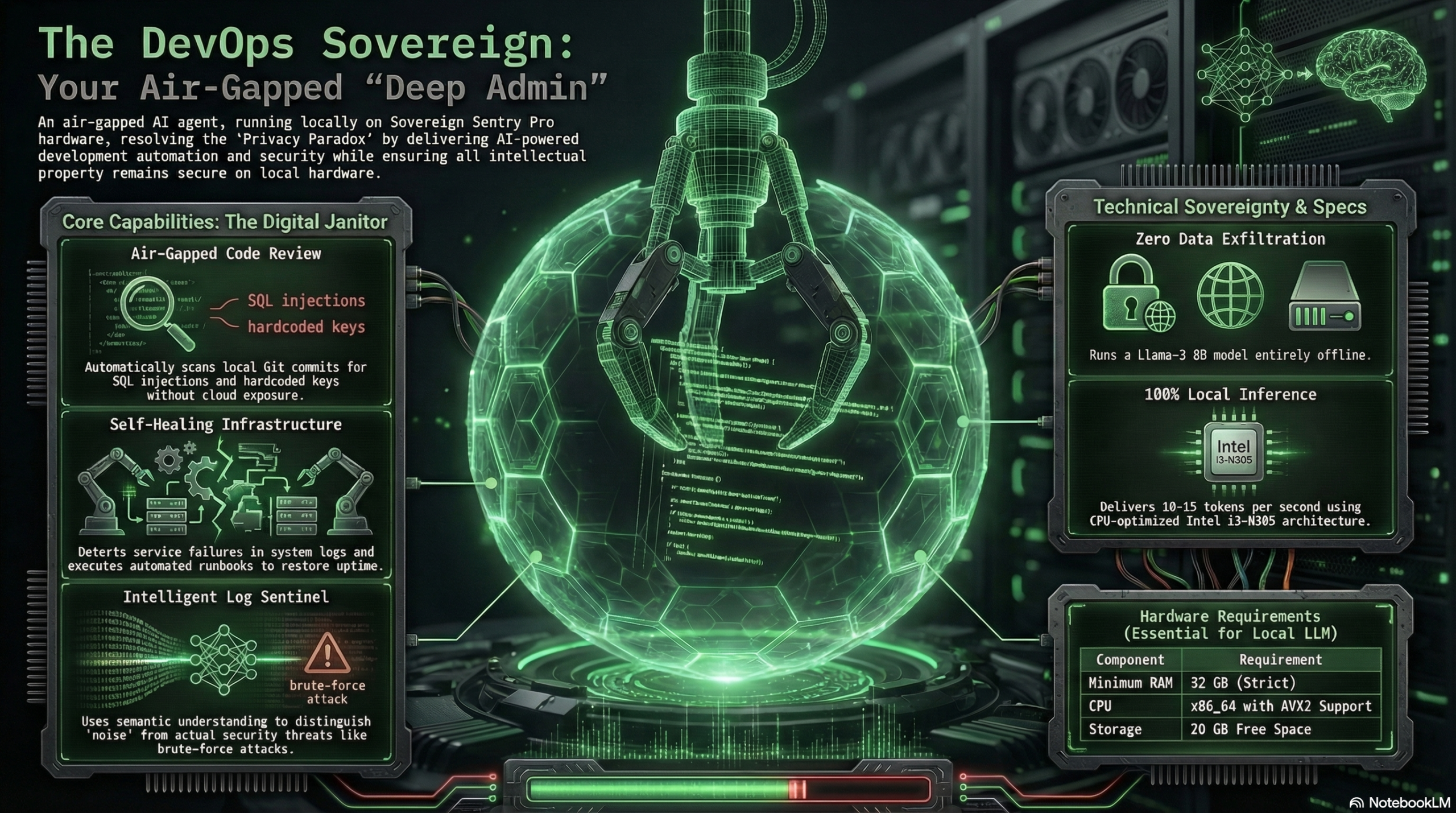
The Ghost in the Metal: Ending the Privacy Paradox with the Sovereign Sentry Pro
We are living through a quiet crisis of custody: the desperate need for AI-driven velocity versus the slow, systematic bleed of our intellectual property into the cloud’s black box. Every time a developer pastes a proprietary algorithm into a centralized chat box, another brick is removed from the fortress of their trade secrets. This is the Privacy Paradox—the paralyzing tension between wanting the transformative speed of AI coding assistants and the unacceptable security risk of feeding your most valuable IP to the centralized beast.
The solution isn’t to retreat from AI; it’s to seize the means of intelligence. Enter The DevOps Sovereign (OpenClaw: Deep Admin). By bringing the “brain” directly to the server rack, we move from a model of dependency to one of absolute technical autonomy.
Takeaway 1: “Island Mode” – Your Code Never Leaves the Metal
The foundation of the Sovereign philosophy is “Island Mode.” While the rest of the world streams their vulnerabilities to third-party servers, the Sovereign Sentry Pro runs a fully air-gapped Llama-3-8B-Instruct-v2.gguf (Quantized 4-bit) model. This isn’t a “lite” experience; it is a senior-level auditor living entirely offline in your matte-black aluminum chassis.
For “Stealth Mode” startups or labs handling sensitive cryptographic keys, this is the only viable path forward. When you push a commit to your local Gitea or GitLab instance, the agent triggers a hook, spins up the local LLM, and performs a deep audit for SQL injection or logic loops.
“Your Code is Your Castle. Don’t Leak It.”
By hosting the model weights and the repository on the same local hardware, the risk of data exfiltration is mathematically zero. The intelligence stays where the data lives: on your metal.
Takeaway 2: The 3:00 AM Self-Healing Fix
In the “Industrial Core” world of the Deep Admin, downtime is a failure of architecture, not just an inconvenience. The DevOps Sovereign acts as a “Digital Janitor” that never sleeps. Using the OpenClaw framework, the agent monitors your service stack with a level of vigilance no human can match.
Imagine it’s 3:00 AM. Your Freenet daemon or Apache server hangs due to a memory leak. In the old world, a pager screams and a human is dragged into the cold light of a monitor. In the Sovereign world, the agent detects the service failure in the systemd logs. We visualize this as the “Claw”—a digital robotic arm made of glowing wireframe geometry that reaches into the scrolling waterfall of your server logs, grabs the bright red “ERROR: SERVICE FAILED” line, and replaces it with a neon green “AUTO-RESTART: SUCCESS.”
The agent consults its localized Runbook, executes the systemctl restart, and verifies uptime. You simply wake up to a Signal notification that the incident was resolved while you were in REM sleep.
Takeaway 3: The Log Sentinel is “Smarter” than Fail2Ban
Traditional security tools are “dumb” instruments; Fail2Ban blocks IPs based on rigid, brittle rules. The DevOps Sovereign’s Log Sentinel uses semantic understanding to differentiate between routine “noise” and genuine contextual anomalies. It doesn’t just see a failed login; it understands the intent behind the pattern.
By parsing Nginx or syslog data, the agent can recognize a coordinated botnet probe across different subnets. It then interacts directly with your pfSense firewall API to drop the entire range before the probe can escalate. For the “Paranoid SysAdmin,” this sovereignty extends to the physical layer: if a rogue USB device is inserted into the Sentry Pro, the agent detects the udev event, snaps a photo via a connected webcam, and locks the terminal instantly. All alerts are routed through encrypted Signal or Telegram channels, providing a high-fidelity “Deep Admin” experience from any device.
Takeaway 4: The Hardware Hurdle (32GB of Sovereignty)
Sovereignty is not free; it is paid for in raw silicon and thermal overhead. To run local inference at acceptable speeds (10-15 tokens/sec) without starving the host OS, the hardware requirements are non-negotiable. The installer is built with a “rigorous error message” protocol: if it detects less than 30GB of available RAM via free -m, the installation aborts immediately to prevent a system-wide Out-Of-Memory (OOM) crash.
To maintain the “Sovereign” standard, the system requires:
- RAM: 32GB Strict (The Llama-3 model consumes 12GB-24GB; the rest is reserved for the OS and localized VMs).
- CPU: x86_64 8-Core (Optimized specifically for the Intel i3-N305 and AVX2 instructions for efficient CPU inference).
- Storage: 20GB Free (A dedicated buffer for high-speed model weights and the vector database used for log context).
Takeaway 5: Zero Data Exfiltration as a Feature, Not a Goal
The aesthetic of the Sovereign Sentry Pro is “Industrial-core”—cold metal and glowing neural networks. This is best visualized by the “Air-Gap Forcefield”: a translucent, glowing digital hexagon surrounding your Ethernet port. Inside, your green data particles (Intellectual Property) circulate safely; outside, red cloud particles (Data Exfiltration) are repelled by a digital barrier.
This architecture is a lifeline for remote node operators. Consider a solar-powered node in Uganda operating via Starlink. In a cloud-dependent setup, streaming 50GB of raw logs to a provider like Datadog would bankrupt the operation in bandwidth costs alone. The DevOps Sovereign processes those 50GB of logs locally, on the metal, and only transmits a tiny 5kb encrypted summary when an actionable event occurs. This isn’t just a feature; it is bandwidth sovereignty.
Conclusion: The Future of the Sovereign SysAdmin
The rise of local AI fundamentally shifts the role of the CTO and the Lead Developer. The server rack is no longer just a passive cabinet of spinning disks; it is an active, intelligent participant in your infrastructure’s survival. By moving the “brain” back to the local metal, you reclaim the dignity of ownership and the security of the air-gap.
We have reached the end of the era of blind trust in the cloud. The tools for total autonomy are here, wrapped in black anodized aluminum and powered by local weights. The only remaining question is: Are you ready to stop feeding the centralized beast and move your intelligence back to the server rack?