The Cloud is Losing Its Grip: Why the Future of Robotics is Local
1. Introduction: The Ghost in the Machine
We have all experienced the specialized frustration of modern “smart” hardware: a device that sits idle and useless because a remote server in a different time zone has gone offline. This “ghost in the machine”—the invisible tether to a corporate cloud—has turned our most expensive tools into temporary rentals. When the connection drops, or when a company decides to “end-of-life” a product, your hardware becomes a paperweight.
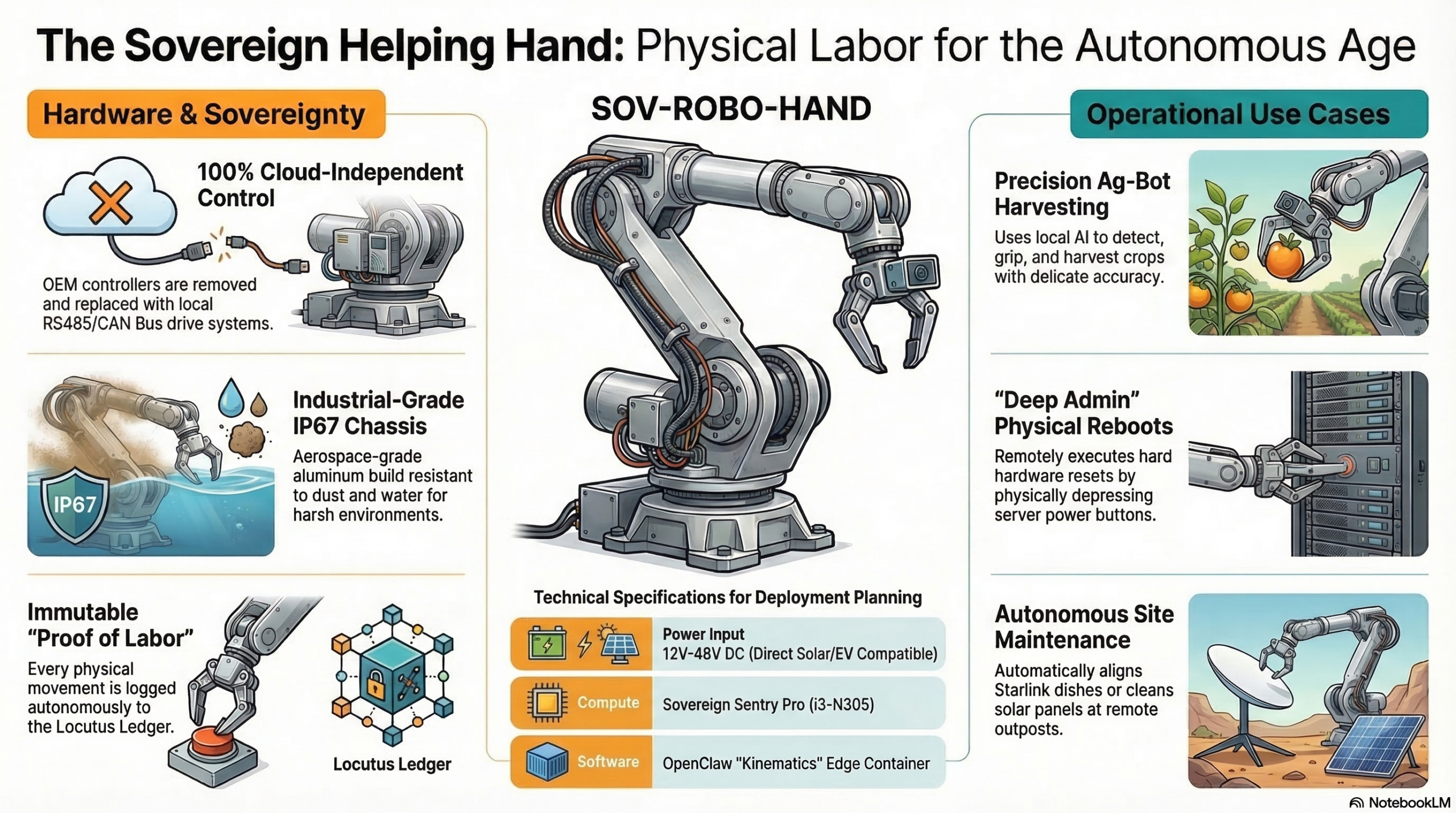
The Sovereign Helping Hand (SKU: SOV-ROBO-HAND) is designed to sever that tether forever. It is a rugged, 6-axis industrial manipulator that bridges the gap between digital logic and physical labor without sacrificing privacy or autonomy. It is important to understand that this arm isn’t just a peripheral; it is a physical extension of the DeReticular ecosystem. While the arm provides the “muscle,” its “brain” resides locally on a Sovereign Sentry (Pro) or Nomad Fleet Kit, utilizing the i3-N305 processor to handle complex inverse kinematics. This is the end of digital ghosting and the beginning of sovereign labor.
2. Takeaway 1: The “Great Brainwashing” of Industrial Hardware
The path to true sovereignty begins with a process that might seem counter-intuitive: the intentional “brainwashing” of high-end hardware. Most industrial-grade robotic arms arrive from the manufacturer pre-loaded with proprietary firmware designed to “phone home” to a central cloud, creating a permanent security backdoor into your operation.
At our Node 3 Workshop, we perform a mandatory “Teardown.” Our technicians physically gut the OEM Wi-Fi and cloud controller boards. In their place, a custom RS485 adapter is soldered directly to the motor driver bus, utilizing CAN Bus for zero-latency communication. This process renders the machine “deaf and blind to the cloud.” In the DeReticular philosophy, being unable to talk to the internet is a premium feature. By stripping away external dependencies, the arm is forced to listen only to its paired local node, ending the era of corporate bricking and ensuring that no remote actor can ever hijack your physical workspace.
3. Takeaway 2: A Hand That Remembers Even When the Power Fails
Operating in off-grid environments—whether mounted to a Kurb Kar or a remote solar outpost—requires a level of resilience that consumer electronics cannot match. The Sovereign Helping Hand is housed in an aerospace-grade aluminum chassis and is IP67-rated for dust and water resistance. This isn’t a lab toy; it’s built for the grit of a real-world homestead or a hazardous industrial site.
The arm utilizes high-torque brushless DC motors equipped with absolute magnetic encoders. In standard robotics, a power failure often causes the arm to “forget” its position, requiring a dangerous and tedious recalibration. Because of these absolute encoders, the Helping Hand retains its exact positional awareness even if power is completely severed. Furthermore, for maximum safety and longevity, the unit contains no internal lithium-ion batteries that could swell or catch fire in extreme heat.
“We replace the OEM controller with a ruggedized DeReticular DC-drive system, allowing the arm to be operated 100% locally.”
4. Takeaway 3: The “Deep Admin” – When Robots Press the Reset Button
There is a profound, almost humorous irony in using a high-tech robotic arm to perform the simplest of tasks: pressing a button. Yet, in the world of remote server management and microgrid maintenance, this represents the ultimate “mechanical failover.”
This is the “Deep Admin Physical Reboot” use case. When a remote server rack or a Nomad Link experiences a catastrophic software freeze that renders SSH access impossible, the SysAdmin doesn’t need to drive hours to the site. Instead, they interact with the OpenClaw Deep Admin bot via an encrypted Telegram or Signal message. The bot instructs the arm to literally reach out and depress the physical power button on the frozen hardware. This mechanical intervention solves a digital crisis, proving that reclaiming the means of physical production sometimes requires nothing more than a well-placed robotic finger.
5. Takeaway 4: Proof of Labor – Putting Physical Movement on the Ledger
The Sovereign Helping Hand does not just work; it accounts for its labor. Through the OpenClaw “Foreman” agent, the arm integrates directly with the Locutus Ledger, creating a “Vision-to-Grip” pipeline. Using data from a Vault Warden’s LiDAR or the HempGrade AI stack, the system identifies a target—such as a mature fruit—and executes a precise movement.
Once the task is complete, a “Proof of Harvest” block is instantly minted on the ledger, providing an immutable record of productivity. This is how we move from “trusting” an autonomous system to “verifying” its output. The data points captured for each block include:
- Timestamp: The precise millisecond the action occurred.
- Geographic Location: The GPS coordinates of the task, verified by the Nomad Fleet Kit.
- Spectral Quality: Real-time data regarding the health and maturity of the handled item.
6. Takeaway 5: The “Sovereign Key” – Preventing the Rogue Robot Scenario
The primary concern with autonomous physical manipulators is “rogue actuation”—the fear that a software glitch or a remote exploit could cause the arm to move dangerously. To mitigate this, we have implemented a hardware-level “human-in-the-loop” requirement.
Any action categorized as “High-Risk” or “High-Torque” requires authorization via a physical Sovereign Key (NFC). A human operator must physically tap their key against the Sentry Node to unlock these movements. This creates a physical security layer that no remote hacker, no matter how skilled, can bypass. It ensures that while the robot can be autonomous, it remains a tool under the absolute control of its local master.
7. Conclusion: The End of Digital Ghosting
The Sovereign Helping Hand represents a fundamental shift in our relationship with technology. It moves us away from being “users” of cloud-serviced gadgets and toward being “masters” of local, resilient tools. At an MSRP of $2,899.00, it provides an industrial-grade solution for those who refuse to let their physical labor be managed by a third party.
As we integrate more robotics into our homes, farms, and businesses, we must choose our allegiance. Would you rather trust a robot that is constantly whispering to a distant corporate server, or one that has been “brainwashed” to listen only to you? The future of robotics isn’t in the cloud—it’s right in your hands.