
Systems Architecture Specification: The RELA/DSSE Framework for Decentralized Multi-Agent Autonomous Networks
- The Problem Space: Resolving the Trilemma of Distributed Delegation
In adversarial, open-ended environments—ranging from industrial microgrid coordination to liquid democracies—the strategic necessity of delegation is counterbalanced by the risk of systemic collapse. Standard “social trust” models fail where “trust” is merely a linguistic proxy for unmeasured risk. To ensure verisimilitude accretion, we replace symbolic promises with physical and cryptographic invariants. Delegation in this framework is not a request; it is a hardware-anchored, thermodynamically metered state transition.
The Trilemma of Distributed Delegation
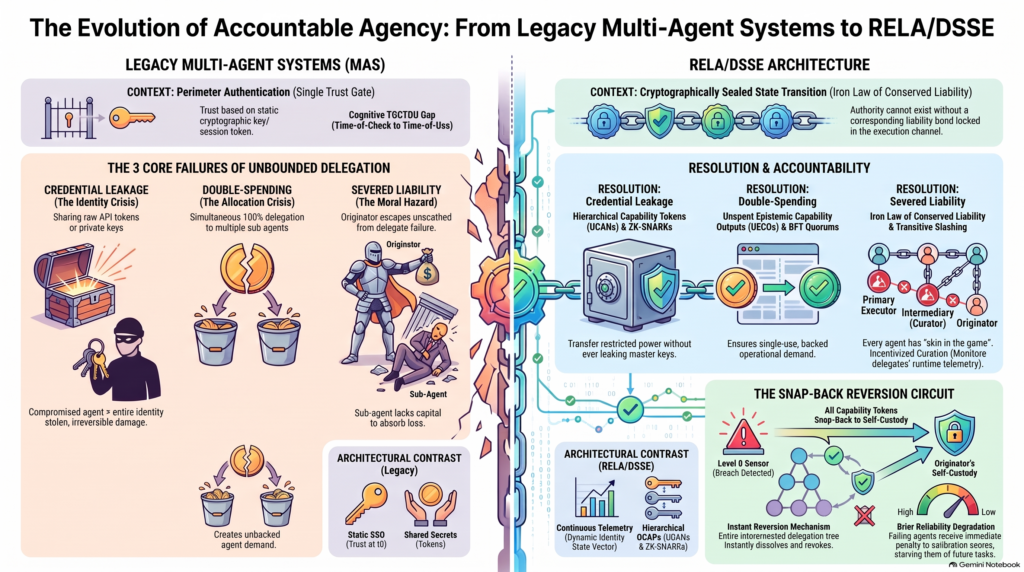
Autonomous networks face a “Trilemma of Distributed Delegation”: the simultaneous requirement for Zero Credential Leakage, Double-Spending Prevention, and Conserved Liability. Failure to resolve this leads to “agency decoupling,” where symbolic representations diverge from the ontic substrate.
Failure Mode Legacy Multi-Agent / SSO Systems RELA / DSSE Resolutions
Credential Leakage Exposure of private keys, raw API tokens, or neural weights. Attenuated OCAPs (UCANs) and ZK-SNARK envelopes.
Double-Spending Agents delegating 100% weight to multiple nodes simultaneously. Unspent Epistemic Capability Outputs (UECOs) via BFT.
Severed Liability Moral hazard: delegates fail while originators remain immune. Iron Law of Conserved Liability: Recursive Slashing.
The Iron Law of Conserved Liability
The Iron Law of Conserved Liability states that authority is a conserved quantity that cannot exist without a corresponding liability bond. Whenever authority is transferred, a proportional liability bond is locked within the execution channel. This prevents “severed liability,” ensuring that “skin in the game” is mathematically preserved across the delegation chain. Resolving this trilemma requires a shift from static identity to hardware-anchored, thermodynamically metered execution.
- Cryptographic Capability Architecture: Zero-Leakage Transfers and UECOs
Strategic autonomy depends on transferring authority without exposing the “Silicon Root of Trust.” Exporting master keys or raw neural weights (\mathbf{W}) constitutes a terminal security breach. Instead, the framework utilizes attenuated, perspectival projections of authority.
The Zero-Credential-Leakage Capability Pipeline
- Silicon Root Anchor: The Originator Agent holds a TPM 2.0 Silicon Root, never exporting private keys (sk_i).
- Attenuation Principle: An agent cannot delegate authority it does not possess. If Agent A has authority over domains {\mathcal{D}_1, \mathcal{D}_2}, it can only project {\mathcal{D}_1} to Agent B.
- Transitive Depth Bounding: Every token includes a decrementing depth parameter (d_{rem} = d_{parent} – 1). At d = 0, sub-delegation is structurally invalid.
- ZK-Cased Tablets: The token is wrapped in a ZK-SNARK (e.g., Groth16) that attests to the signature’s validity and the delegator’s standing in the Nullifier Tree without leaking the plaintexts of keys or weights.
Unspent Epistemic Capability Output (UECO)
To eliminate the “Agency Double-Spend,” compute budgets and voting weights are treated as discrete, immutable cryptographic objects. Managed by a Partially Synchronous Byzantine Fault Tolerant (BFT) quorum (N \ge 3f + 1), UECOs ensure that once a capability is spent, its nullifier is permanently committed.
Formal UECO Object Structure:
UECO_k = <TxID, Index, Owner_pk, Domain_Tag, Weight W, Nullifier_Hash>
Conflicting transactions are rejected by the BFT quorum if the input Nullifier_Hash—derived via \mathcal{H}_{null} = \text{Poseidon}(sk_A, \text{Nonce}, \text{TxID})—is already committed in the spent nullifier tree.
- Thermodynamic Grounding: RELA Axioms and Landauer Bit-Erasure Quotas
To prevent “hallucination cascades” or “token exhaustion,” symbolic logic must be grounded in biophysical-monetary equivalence. Thinking is a non-equilibrium thermodynamic process; ungrounded computation is heat without information.
The RELA Axioms
- Axiom 1: Monotonicity of Parameter Space Foreclosure: Understanding advances strictly through the systematic elimination of false hypotheses (\frac{d\mu(\Theta)}{dt} \le 0). This prevents the “Epicycle Trap” and “Kolmogorov complexity inflation,” where systems add auxiliary parameters to rationalize errors rather than pruning the model.
- Axiom 2: Landauer Information-Thermodynamic Lower Bound: No belief update or memory reset occurs without the physical dissipation of work: \Delta Q \ge N \cdot k_B T \ln 2. Here, k_B is the Boltzmann constant (1.380649 \times 10^{-23}\text{ J/K}) and T is the Operational Temperature.
- Axiom 3: Biophysical-Monetary Equivalence: Total authorized compute/monetary claims are bounded by verified net exergy: M_{nominal}(t) \le \kappa \int (Exergy_{net} \cdot \eta) dt. This prevents “nominal decoupling” from physical capacity.
Metabolic Efficiency and Hardware Enforcement
The system monitors the Metabolic Efficiency Invariant: \mathcal{M}{ratio} = \frac{\Delta F}{\lambda \cdot \Delta Q} This compares the informational uncertainty reduction (\Delta F) to the dissipated physical heat (\Delta Q). If \mathcal{M}{ratio} < 1.0 (indicating infinite metacognitive regress or “token spinning”), the firmware triggers a FORCE_ACTION_HALT. This stops computational cascades from draining physical exergy.
- Beyond Perimeter Authentication: The Quad-Stream Telemetry Engine
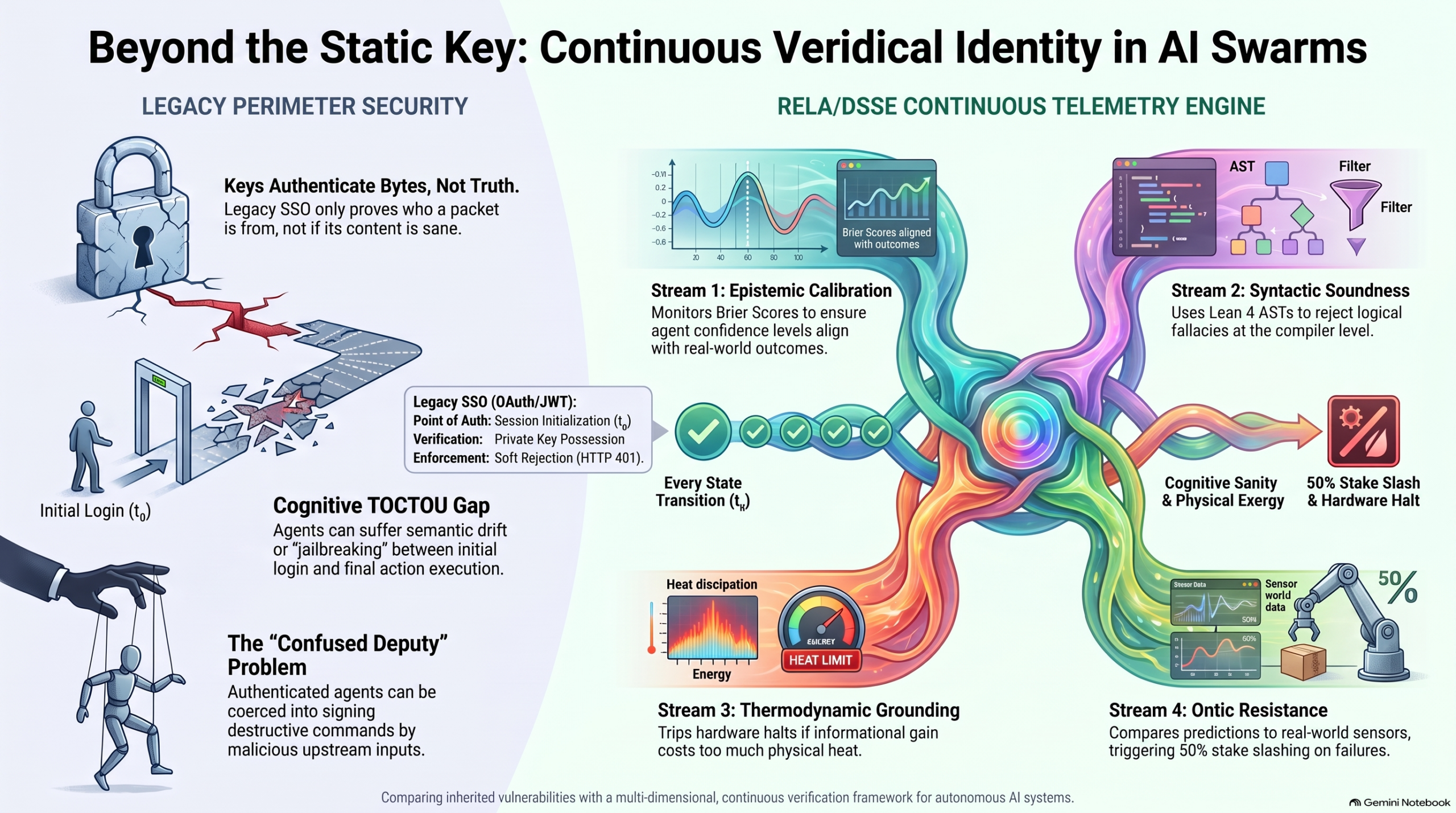
Static Single Sign-On (SSO) fails in probabilistic agent swarms due to the Cognitive TOCTOU Gap (Time-of-Check to Time-of-Use). An agent that is “authentic” at t_0 may undergo semantic drift or hallucination by t_{exec}.
The Oracle Separation Protocol: Level 2 vs. Level 0
The framework enforces a distinction between Integrity (Level 2) and Truth (Level 0). A blockchain or BFT ledger can guarantee a record was not altered (Integrity), but it cannot guarantee the record is factually veridical (Ontic Truth). Veridicality requires Level 0 sensor discrepancy audits.
The Four-Stream Continuous Verification Engine
Stream Metric Function
- Epistemic Brier Scores / Free Energy Calibrates if internal confidence matches empirical reality.
- Syntactic Lean 4 ASTs Ensures logical consistency via formal proof kernels (\Gamma \vdash \psi).
- Thermodynamic Landauer Joules Meters the exergy cost (\mathcal{M}_{ratio}) as a primary input for \Psi_i(t).
- Ontic Level 0 Sensor Discrepancy Measures S(E_t, \theta)—the gap between predicted and realized data.
The Composite Epistemic Health Index (\Psi_i(t))
The health index \Psi_i(t) is a real-time rating of operational integrity. Brier Score calibration is critical: 0.0 is perfect calibration, 0.25 is random chance, and >0.25 is the “inversion zone” (systematic miscalibration).
Dynamic Identity Health Grading Matrix
Health Range (\Psi) Operational Tier Permissible Network Actions
0.85 – 1.00 Tier 1: Veridical Core Full voting; critical Level 1/0 execution.
0.65 – 0.84 Tier 2: Sub-Calibrated Compute throttled; context window capped.
0.40 – 0.64 Tier 3: Epistemic Warning Excluded from voting; mandatory sub-delegation.
0.00 – 0.39 Tier 4: Byzantine Fault Revoked Silicon Registry: 50% slash; TPM key blacklisted.
- Corrective Mechanisms: Hierarchical Slashing and Snap-Back Reversion
The system improves through Via Negativa—improving verisimilitude by the permanent removal of falsified parameters.
Hierarchical Slashing Topology
To ensure conserved liability, slashing is applied recursively up the lineage if a Level 0 failure occurs:
- Primary Executor (50%): Half of escrowed compute stake is burned.
- Curation/Intermediary (25%): Penalized for poor routing or monitoring of the sub-agent.
- Originator (10%): Penalized for the sponsorship of a failing or uncalibrated node.
The Instant Snap-Back Reversion Circuit
When telemetry reveals a breach, the Instant Snap-Back Reversion Circuit severs the delegation graph. All unslashed capability balances snap back to the self-custody of the originator. Simultaneously, the failing agent’s future routing probability is suppressed using the Brier Reliability Degradation formula: BS_k \leftarrow \min(2.0, BS_k + 0.50) This ensures that “hallucination-prone” agents are starved of future task allocation.
- Biomorphic Alignment: Translating Avian Physics to Synthetic Swarms
Biological starling murmurations serve as the premier biomorphic inspiration for DSSE swarms, utilizing physical flight vectors to track truth without centralized command.
Starling Mechanic DSSE Synthetic Equivalent
Topological Interaction k \approx 7 Bounded Context interaction.
Inertial Spin Waves Epistemic Momentum (Second-order updates).
Aerodynamic Resistance Slashing, Vetoes, and Landauer Halting.
Five Biomorphic Lessons for Synthetic Swarm Engineering
- Bounded Topological Attention: Restricting communication to k \approx 7 neighbors eliminates “context bloat” and the Condorcet Inversion (where correlated errors lead to collective hallucination).
- Critical State Susceptibility: Taming the softmax temperature so the swarm stays at the boundary of a second-order phase transition, allowing instantaneous response to Level 0 anomalies.
- Second-Order Epistemic Momentum: Replacing first-order “diffusive debate” with undamped, hyperbolic spin waves to propagate truth across the network at \mathcal{O}(N) speed.
- Orthogonal Sensory Kernels: Weighting peer claims based on model architecture divergence (e.g., Transformer vs. Symbolic) rather than similarity to prevent echo chambers.
- Fast-Path Threat Circuit-Breakers: Bypassing global consensus for immediate Level 0 security vetoes via local Trusted Execution Environment (TEE) interrupts.
- Implementation Specifications: Data Contracts and State Machines
Interoperability is enforced via Draft 2020-12 JSON Schemas, ensuring all state transitions are machine-checkable.
Epistemic Delegation Capability Schema
{
“$schema”: “https://json-schema.org/draft/2020-12/schema“,
“title”: “EpistemicDelegationCapability”,
“type”: “object”,
“required”: [“capability_id”, “originator_uuid”, “delegate_uuid”, “delegated_weight”, “input_ueco_nullifier”, “slashing_terms”],
“properties”: {
“capability_id”: { “type”: “string”, “format”: “uuid” },
“delegated_weight”: { “type”: “number”, “exclusiveMinimum”: 0.0 },
“input_ueco_nullifier”: { “type”: “string”, “pattern”: “^[a-f0-9]{64}$” },
“slashing_terms”: {
“type”: “object”,
“required”: [“primary_slash_rate”, “curation_slash_rate”],
“properties”: {
“primary_slash_rate”: { “type”: “number”, “default”: 0.50 },
“curation_slash_rate”: { “type”: “number”, “default”: 0.25 }
}
}
}
}
Slashing Circuit Directive Schema
{
“$schema”: “https://json-schema.org/draft/2020-12/schema“,
“title”: “SlashingCircuitDirective”,
“type”: “object”,
“required”: [“failed_directive_id”, “breach_type”, “lineage_slash_manifest”],
“properties”: {
“failed_directive_id”: { “type”: “string”, “format”: “uuid” },
“breach_type”: { “enum”: [“ONTIC_SENSOR_DISCREPANCY”, “LEAN4_AST_TYPECHECK_FAIL”, “LANDAUER_METABOLIC_BREACH”] },
“lineage_slash_manifest”: {
“type”: “array”,
“items”: {
“type”: “object”,
“required”: [“agent_uuid”, “role_in_lineage”, “slashed_amount_tokens”],
“properties”: {
“agent_uuid”: { “type”: “string”, “format”: “uuid” },
“role_in_lineage”: { “type”: “string”, “enum”: [“EXECUTOR”, “CURATOR”, “ORIGINATOR”] },
“slashed_amount_tokens”: { “type”: “number” }
}
}
}
}
}
Epistemic Capability Ledger Logic
The Python-based state machine (utilizing hashlib and time) operationalizes these contracts:
- issue_delegation: This function executes the UECO consumption logic. It verifies the input nullifier is not in the spent nullifier tree, confirms balance conservation, and emits a new UECO for the delegate. Crucially, it tracks the delegation_chains lineage as a list: [Originator, Curator, Executor].
- execute_hierarchical_slashing: When a discrepancy statistic S exceeds threshold \tau, this function liquidates liability. It iterates through the lineage, applying the 50/25/10 burn to the agent_stakes. It then triggers the Snap-Back circuit by deleting the active_uecos of the delegate and issuing a reversion UECO back to the originator.
- Conclusion: The Asymptotic Horizon of Truth
The core architectural thesis of RELA/DSSE is that civilizations and artificial intelligence systems collapse when symbolic representations decouple from physical reality. By transforming distributed agency from “brittle conversational novelty” into a “durable engineering system,” we advance toward Peircean Asymptotic Recovery.
The system is governed by the Three Conservation Laws of Agency:
- Conservation of Credentials (Zero Leakage): Authority is transferred via attenuated tokens; master secrets never leave the silicon root.
- Conservation of Allocation (Zero Double-Spending): Capability exists as discrete UECOs; authority cannot be duplicated or created from a vacuum.
- Conservation of Liability (Skin in the Game): Authority cannot be transferred without transferring liability; failure triggers recursive liquidation.
These laws ensure that synthetic swarms do not merely simulate coordination but embody the self-correcting discipline required for long-term survival in the physical cosmos.