Sovereign Stack Regulatory Compliance and 2026 Legislative Alignment
1. Strategic Context: The Pivot to Spherical Resilience
The global infrastructure landscape of 2026 has been permanently altered by a set of unavoidable “Kinetic Threats”: Extreme Heat, Dust and Ash Intrusion, High-Frequency Vibration, and the increasing frequency of EMPs and Solar Flares. Traditional, centralized infrastructure—characterized by “Linear Fragility”—is now a liability. Legacy grids rely on thousand-mile fiber-optic chains and vulnerable high-tension lines; a single break 1,000 miles away results in total system paralysis. This model is obsolete.
The Sovereign Stack provides a strategic mandate for community autonomy through “Spherical Resilience.” By transitioning from passive consumption to active custody, municipalities achieve “Island Mode” capability. This is facilitated by the RIOS-CC-1000, a field-deployable asset protected by an IP67-rated aluminum “Exo-Shell” that functions as a high-grade Faraday cage. Longevity in harsh conditions is ensured by the “Positive Pressure Cycle,” where the unit “exhales” high-velocity air to physically repel contaminants, replacing the failure-prone intake fans of the Old World.
Systems Comparative Analysis: Linear Grid vs. Sovereign Mesh
| Feature | Old World (Traditional Cloud/Grid) | New World (Sovereign Stack) |
| Topology | Linear: Reliance on single, 1,000-mile lines of fiber and power. | Hex-Mesh: A redundant, spherical web of interconnected nodes. |
| Connectivity | Centralized: Total dependency on distant, harvested data centers. | Redundant: Local-first mesh with Starlink/Satellite backhaul. |
| Failure Impact | Cascading Collapse: One break leads to total darkness. | Self-Healing: Continuity maintained; traffic automatically reroutes. |
| Core Logic | Centralized Cognition: Intelligence resides in the “Cloud.” | Distributed Cognition: Intelligence resides at the Edge (Local). |
| Perimeter Security | Software-defined: Firewalls vulnerable to IP/MAC spoofing. | Hardware-Aware: Security via RF Fingerprinting and Physical Disassociation. |
| Maintenance Cycles | High-Maintenance: Constant filter cleaning; vulnerable to dust. | 30-Day Checks: Enabled by Positive Pressure Cycle and Exo-Shell. |
This transition transforms the municipal risk profile from victimhood to vertical integration, setting the stage for full alignment with 2026’s rigorous legal frameworks.
——————————————————————————–
2. Financial Compliance: The GENIUS and CLARITY Acts of 2026
The 2026 legislative landscape has codified the intersection of Decentralized Physical Infrastructure (DePIN) and digital assets. Sovereign Stack operations are engineered to meet the highest standards of U.S. and International financial law.
The GENIUS Act (2025/2026)
The GENIUS Act mandates that all payment stablecoins used for Machine-to-Machine (M2M) Settlements within the RIOS ecosystem must be 1:1 backed by high-quality liquid assets (Cash/U.S. Treasuries). Our treasury management protocols strictly prohibit the rehypothecation of reserve assets, ensuring 100% solvency for internal liquidity.
The CLARITY Act (2026)
Under the CLARITY Act, Sovereign Stack utility tokens (e.g., energy credits) are categorized as Digital Commodities under CFTC jurisdiction. Industrial nodes satisfy the “liquidity and credit-quality” standards of the CFTC Digital Assets Pilot Program, enabling nodes to engage in industrial derivatives—such as hedging energy prices—using tokenized collateral.
Mandatory Differentiators Against “Security” Classification
To ensure assets are never classified as “Securities” under the revised 2026 SEC guidelines, the following are enforced by default:
- Thermodynamic Linking: Tokens are tied to tangible industrial output (e.g., 10MW of power or synthetic diesel volume).
- Operational Utility: Assets function as settlement rails for automated machine-to-machine resource logging.
- Decentralized Governance: Infrastructure is governed via DAOs to prevent corporate capture and ensure community-first resource allocation.
- Immutable Logging: Real-time Proof of Energy and Proof of Compute are logged to the RIOS ledger for instant federal auditability.
——————————————————————————–
3. The ‘Safety Gate’ Mechanism: Industrial Certification and Hardware Logic
Decentralized power and compute management require workforce verifiability that matches the stakes of the environment. The DeReticular Academy addresses this through the ‘Safety Gate’ mechanism, a non-negotiable prerequisite for hardware interaction.
Workforce Verifiability and Hardware Integration
Operational permissions for the RIOS-CC-1000 and Agra Power systems are locked by default. Permissions are only unlocked when a technician achieves a 100% score on safety and compliance simulations. All credentials (CRA, SPT, SSA) are issued as W3C-compliant Verifiable Credentials (VCs) on the RIOS ledger, providing trustless verification of competence for insurance adjusters and federal evaluators.
The Human Operating System: Specialization Tracks
- Certified RIOS Administrator (CRA) – “The Nerves”: Masters trustless node deployment and Starlink hybridization. Responsible for the “Zero-Trust Bubble” and executing “Project Phoenix” recoveries.
- Sovereign Power Technician (SPT) – “The Heart”: Manages the 1,500°C plasma dissociation process and Micro-GTL (Gas-to-Liquids) refinery operations for total energy independence.
- Sovereign Systems Architect (SSA) – “The Vision”: Orchestrates circular economic models and “Digital Constitutions.” SSAs manage DAOs to prevent corporate capture, ensuring the “Spark Spread” serves the community wealth.
——————————————————————————–
4. Data Sovereignty and AI Safety Protocols
In accordance with the 2026 Digital Privacy & Sovereignty Executive Order, the Sovereign Stack implements a “Local-First” privacy paradigm at the edge.
Hardware-Aware Privacy (RIOS-CC-1000)
All data is encrypted via Customer-Managed Keys (CMK). The hardware features a “Scorched Earth” policy linked to the Seal Integrity Light. If the IP67 seal is breached without authorized “Maintenance Mode” activation, the system instantly deletes all encryption keys, rendering the NVMe-native compute blades unreadable.
Sovereign Intelligence Framework
Edge deployment of OpenAI GPT-5.2 and RIOS-AI agents ensures that data remains localized on-node. Data is never used to train external “frontier” models, satisfying the strict privacy requirements for healthcare (Node 4/Uganda) and industrial situational awareness.
Watchtower Protocol and RFF
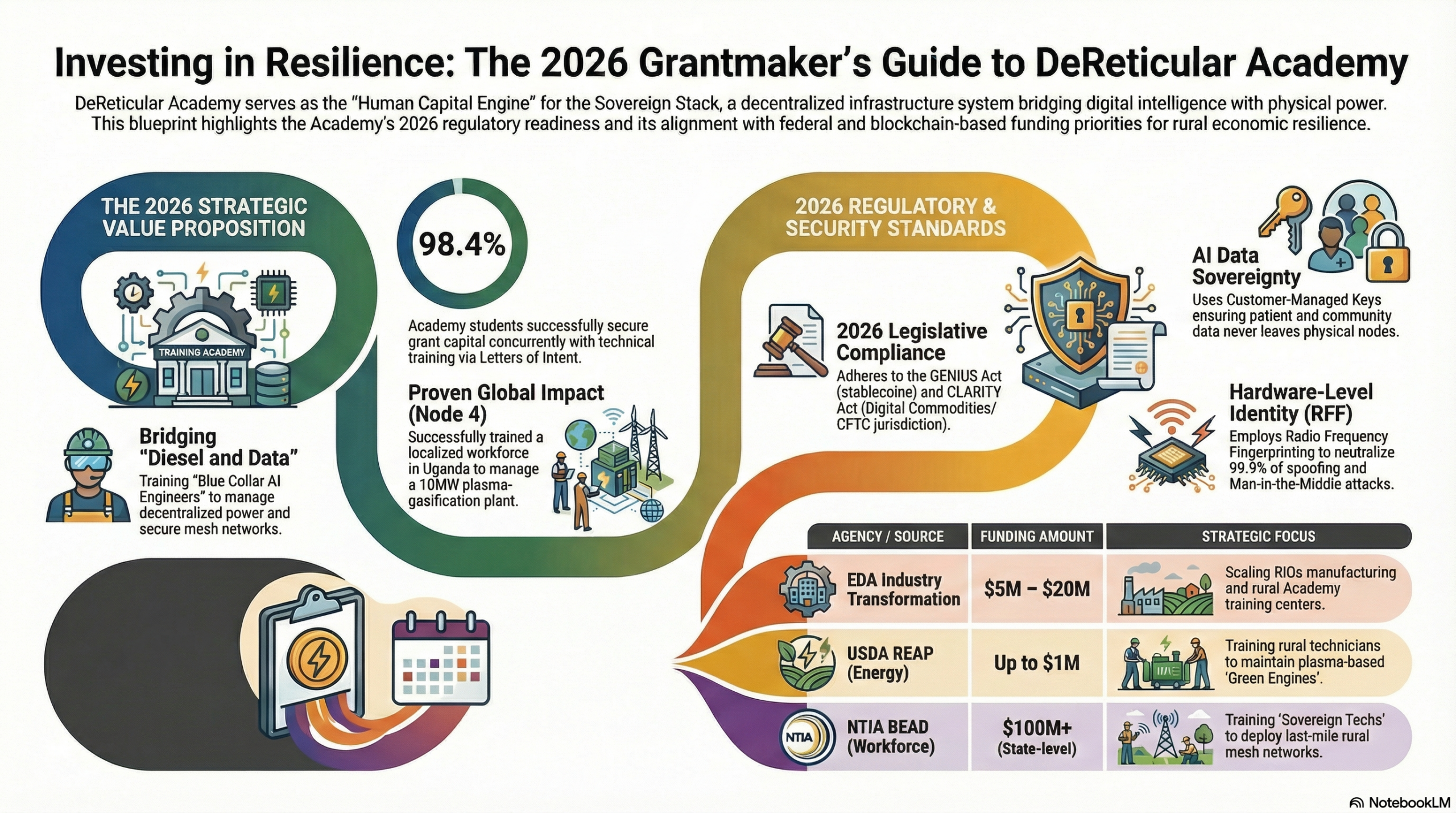
To satisfy the NIST Zero Trust Framework, the system utilizes Radio Frequency Fingerprinting (RFF). By identifying the unique radio signatures of hardware imperfections, the system neutralizes 99.9% of spoofing attacks. Hostile devices are mitigated via Physical Disassociation: the administrator utilizes Software Defined Radio (SDR) to triangulate the device and executes a permanent hardware-level ban.
——————————————————————————–
5. Environmental and Industrial Standards (Agra Energy Compliance)
The Sovereign Stack utilizes the “Velcro Principle”—the strategic coupling of digital logic (compute) and physical thermodynamics (power) to turn waste into wealth.
The Molecular Scissor Protocol
The Agra Power Core (SPS) utilizes 1,500°C plasma gasification to execute the “Molecular Scissor” protocol. This process dissociates molecular bonds in waste feedstock (tires, plastics, biomass), resulting in two primary outputs:
- Output A: Baseload Electricity: 10MW of constant 60Hz power to run the RIOS cluster and localized grid.
- Output B: Synthetic Diesel: Excess syngas is condensed via a Micro-GTL refinery into liquid fuel.
- Vitrification: All byproduct is converted into inert, non-leaching slag, eliminating the community waste stream.
Carbon-Negative ESG Reporting
This process meets or exceeds 2026 “Green Industrial Engine” standards (EPA/USDA). The RIOS blockchain provides automated, real-time ESG reporting, providing immutable verification for carbon credits. This feeds the “Spark Spread” economic model, an algorithmic decision node that calculates the most profitable use of syngas between electricity, synthetic diesel, or battery storage.
——————————————————————————–
6. Audit-Ready Status for Federal Grant Submissions
As 2026 federal funding pivots toward “Economic Nationalism,” the Sovereign Stack is positioned as an “Audit-Ready” domestic manufacturing and energy solution.
Roadmap for Grant Applicants
Project leads utilize the “Dean’s Letter of Intent” as Proof of Technical Intent, a legal mechanism that allows candidates to unlock capital from bodies like the USDA and NSF during their training.
- NTIA BEAD (Workforce): Leveraging CRA certification to manage “last-mile” mesh networks where fiber has failed.
- USDA REAP (Energy): Funding the deployment of Agra SPS units for rural energy independence.
Private RFP Board: 2026 Strategic Targets
The Academy provides direct access to high-probability targets for graduates:
- DOI (Mineral Exploration): Utilizing the Nightingale IoT Fabric for 3D geophysical mapping.
- DHS (Cyber-Workforce): Training in hardware-level security via RFF and the Watchtower Protocol.
- DOD (Black Start Microgrids): Deploying RIOS-CC-1000 units for independent, resilient base power.
The 15-Minute Promise (SLA)
The ultimate benchmark for civilizational resilience is the 15-Minute Promise, a survival Service Level Agreement broken into three 5-minute phases:
- 0–5 Minutes (Power Stabilization): Agra SPS stable at 60Hz; WAN isolated.
- 5–10 Minutes (Boot & Integrity): Master Key USB insertion; Heartbeat Beep Code verified.
- 10–15 Minutes (Mesh & App Availability): “SOS_BEACON” broadcast; Matrix/Village Ledger apps live.
Don’t just survive the future. Blueprint it.
Sovereign Stack Regulatory Compliance and 2026 Legislative Alignment
1. Strategic Context: The Pivot to Spherical Resilience
The global infrastructure landscape of 2026 has been permanently altered by a set of unavoidable “Kinetic Threats”: Extreme Heat, Dust and Ash Intrusion, High-Frequency Vibration, and the increasing frequency of EMPs and Solar Flares. Traditional, centralized infrastructure—characterized by “Linear Fragility”—is now a liability. Legacy grids rely on thousand-mile fiber-optic chains and vulnerable high-tension lines; a single break 1,000 miles away results in total system paralysis. This model is obsolete.
The Sovereign Stack provides a strategic mandate for community autonomy through “Spherical Resilience.” By transitioning from passive consumption to active custody, municipalities achieve “Island Mode” capability. This is facilitated by the RIOS-CC-1000, a field-deployable asset protected by an IP67-rated aluminum “Exo-Shell” that functions as a high-grade Faraday cage. Longevity in harsh conditions is ensured by the “Positive Pressure Cycle,” where the unit “exhales” high-velocity air to physically repel contaminants, replacing the failure-prone intake fans of the Old World.
Systems Comparative Analysis: Linear Grid vs. Sovereign Mesh
| Feature | Old World (Traditional Cloud/Grid) | New World (Sovereign Stack) |
| Topology | Linear: Reliance on single, 1,000-mile lines of fiber and power. | Hex-Mesh: A redundant, spherical web of interconnected nodes. |
| Connectivity | Centralized: Total dependency on distant, harvested data centers. | Redundant: Local-first mesh with Starlink/Satellite backhaul. |
| Failure Impact | Cascading Collapse: One break leads to total darkness. | Self-Healing: Continuity maintained; traffic automatically reroutes. |
| Core Logic | Centralized Cognition: Intelligence resides in the “Cloud.” | Distributed Cognition: Intelligence resides at the Edge (Local). |
| Perimeter Security | Software-defined: Firewalls vulnerable to IP/MAC spoofing. | Hardware-Aware: Security via RF Fingerprinting and Physical Disassociation. |
| Maintenance Cycles | High-Maintenance: Constant filter cleaning; vulnerable to dust. | 30-Day Checks: Enabled by Positive Pressure Cycle and Exo-Shell. |
This transition transforms the municipal risk profile from victimhood to vertical integration, setting the stage for full alignment with 2026’s rigorous legal frameworks.
——————————————————————————–
2. Financial Compliance: The GENIUS and CLARITY Acts of 2026
The 2026 legislative landscape has codified the intersection of Decentralized Physical Infrastructure (DePIN) and digital assets. Sovereign Stack operations are engineered to meet the highest standards of U.S. and International financial law.
The GENIUS Act (2025/2026)
The GENIUS Act mandates that all payment stablecoins used for Machine-to-Machine (M2M) Settlements within the RIOS ecosystem must be 1:1 backed by high-quality liquid assets (Cash/U.S. Treasuries). Our treasury management protocols strictly prohibit the rehypothecation of reserve assets, ensuring 100% solvency for internal liquidity.
The CLARITY Act (2026)
Under the CLARITY Act, Sovereign Stack utility tokens (e.g., energy credits) are categorized as Digital Commodities under CFTC jurisdiction. Industrial nodes satisfy the “liquidity and credit-quality” standards of the CFTC Digital Assets Pilot Program, enabling nodes to engage in industrial derivatives—such as hedging energy prices—using tokenized collateral.
Mandatory Differentiators Against “Security” Classification
To ensure assets are never classified as “Securities” under the revised 2026 SEC guidelines, the following are enforced by default:
- Thermodynamic Linking: Tokens are tied to tangible industrial output (e.g., 10MW of power or synthetic diesel volume).
- Operational Utility: Assets function as settlement rails for automated machine-to-machine resource logging.
- Decentralized Governance: Infrastructure is governed via DAOs to prevent corporate capture and ensure community-first resource allocation.
- Immutable Logging: Real-time Proof of Energy and Proof of Compute are logged to the RIOS ledger for instant federal auditability.
——————————————————————————–
3. The ‘Safety Gate’ Mechanism: Industrial Certification and Hardware Logic
Decentralized power and compute management require workforce verifiability that matches the stakes of the environment. The DeReticular Academy addresses this through the ‘Safety Gate’ mechanism, a non-negotiable prerequisite for hardware interaction.
Workforce Verifiability and Hardware Integration
Operational permissions for the RIOS-CC-1000 and Agra Power systems are locked by default. Permissions are only unlocked when a technician achieves a 100% score on safety and compliance simulations. All credentials (CRA, SPT, SSA) are issued as W3C-compliant Verifiable Credentials (VCs) on the RIOS ledger, providing trustless verification of competence for insurance adjusters and federal evaluators.
The Human Operating System: Specialization Tracks
- Certified RIOS Administrator (CRA) – “The Nerves”: Masters trustless node deployment and Starlink hybridization. Responsible for the “Zero-Trust Bubble” and executing “Project Phoenix” recoveries.
- Sovereign Power Technician (SPT) – “The Heart”: Manages the 1,500°C plasma dissociation process and Micro-GTL (Gas-to-Liquids) refinery operations for total energy independence.
- Sovereign Systems Architect (SSA) – “The Vision”: Orchestrates circular economic models and “Digital Constitutions.” SSAs manage DAOs to prevent corporate capture, ensuring the “Spark Spread” serves the community wealth.
——————————————————————————–
4. Data Sovereignty and AI Safety Protocols
In accordance with the 2026 Digital Privacy & Sovereignty Executive Order, the Sovereign Stack implements a “Local-First” privacy paradigm at the edge.
Hardware-Aware Privacy (RIOS-CC-1000)
All data is encrypted via Customer-Managed Keys (CMK). The hardware features a “Scorched Earth” policy linked to the Seal Integrity Light. If the IP67 seal is breached without authorized “Maintenance Mode” activation, the system instantly deletes all encryption keys, rendering the NVMe-native compute blades unreadable.
Sovereign Intelligence Framework
Edge deployment of OpenAI GPT-5.2 and RIOS-AI agents ensures that data remains localized on-node. Data is never used to train external “frontier” models, satisfying the strict privacy requirements for healthcare (Node 4/Uganda) and industrial situational awareness.
Watchtower Protocol and RFF
To satisfy the NIST Zero Trust Framework, the system utilizes Radio Frequency Fingerprinting (RFF). By identifying the unique radio signatures of hardware imperfections, the system neutralizes 99.9% of spoofing attacks. Hostile devices are mitigated via Physical Disassociation: the administrator utilizes Software Defined Radio (SDR) to triangulate the device and executes a permanent hardware-level ban.
——————————————————————————–
5. Environmental and Industrial Standards (Agra Energy Compliance)
The Sovereign Stack utilizes the “Velcro Principle”—the strategic coupling of digital logic (compute) and physical thermodynamics (power) to turn waste into wealth.
The Molecular Scissor Protocol
The Agra Power Core (SPS) utilizes 1,500°C plasma gasification to execute the “Molecular Scissor” protocol. This process dissociates molecular bonds in waste feedstock (tires, plastics, biomass), resulting in two primary outputs:
- Output A: Baseload Electricity: 10MW of constant 60Hz power to run the RIOS cluster and localized grid.
- Output B: Synthetic Diesel: Excess syngas is condensed via a Micro-GTL refinery into liquid fuel.
- Vitrification: All byproduct is converted into inert, non-leaching slag, eliminating the community waste stream.
Carbon-Negative ESG Reporting
This process meets or exceeds 2026 “Green Industrial Engine” standards (EPA/USDA). The RIOS blockchain provides automated, real-time ESG reporting, providing immutable verification for carbon credits. This feeds the “Spark Spread” economic model, an algorithmic decision node that calculates the most profitable use of syngas between electricity, synthetic diesel, or battery storage.
——————————————————————————–
6. Audit-Ready Status for Federal Grant Submissions
As 2026 federal funding pivots toward “Economic Nationalism,” the Sovereign Stack is positioned as an “Audit-Ready” domestic manufacturing and energy solution.
Roadmap for Grant Applicants
Project leads utilize the “Dean’s Letter of Intent” as Proof of Technical Intent, a legal mechanism that allows candidates to unlock capital from bodies like the USDA and NSF during their training.
- NTIA BEAD (Workforce): Leveraging CRA certification to manage “last-mile” mesh networks where fiber has failed.
- USDA REAP (Energy): Funding the deployment of Agra SPS units for rural energy independence.
Private RFP Board: 2026 Strategic Targets
The Academy provides direct access to high-probability targets for graduates:
- DOI (Mineral Exploration): Utilizing the Nightingale IoT Fabric for 3D geophysical mapping.
- DHS (Cyber-Workforce): Training in hardware-level security via RFF and the Watchtower Protocol.
- DOD (Black Start Microgrids): Deploying RIOS-CC-1000 units for independent, resilient base power.
The 15-Minute Promise (SLA)
The ultimate benchmark for civilizational resilience is the 15-Minute Promise, a survival Service Level Agreement broken into three 5-minute phases:
- 0–5 Minutes (Power Stabilization): Agra SPS stable at 60Hz; WAN isolated.
- 5–10 Minutes (Boot & Integrity): Master Key USB insertion; Heartbeat Beep Code verified.
- 10–15 Minutes (Mesh & App Availability): “SOS_BEACON” broadcast; Matrix/Village Ledger apps live.
Don’t just survive the future. Blueprint it.